18 Horizontal Fence Ideas That Actually Look Good (and Last)
Last weekend I watched my neighbor finally tear down the chain-link fence that came with his house in 1994. What went up in its place wasn’t another row of vertical pickets — it was a clean run of horizontal cedar boards that made his whole backyard look ten years newer overnight. That’s the quiet shift happening in yards everywhere right now, and these 18 amazing horizontal fence ideas pull from what’s actually working: real materials, honest budgets, and styles that won’t feel dated by 2030.
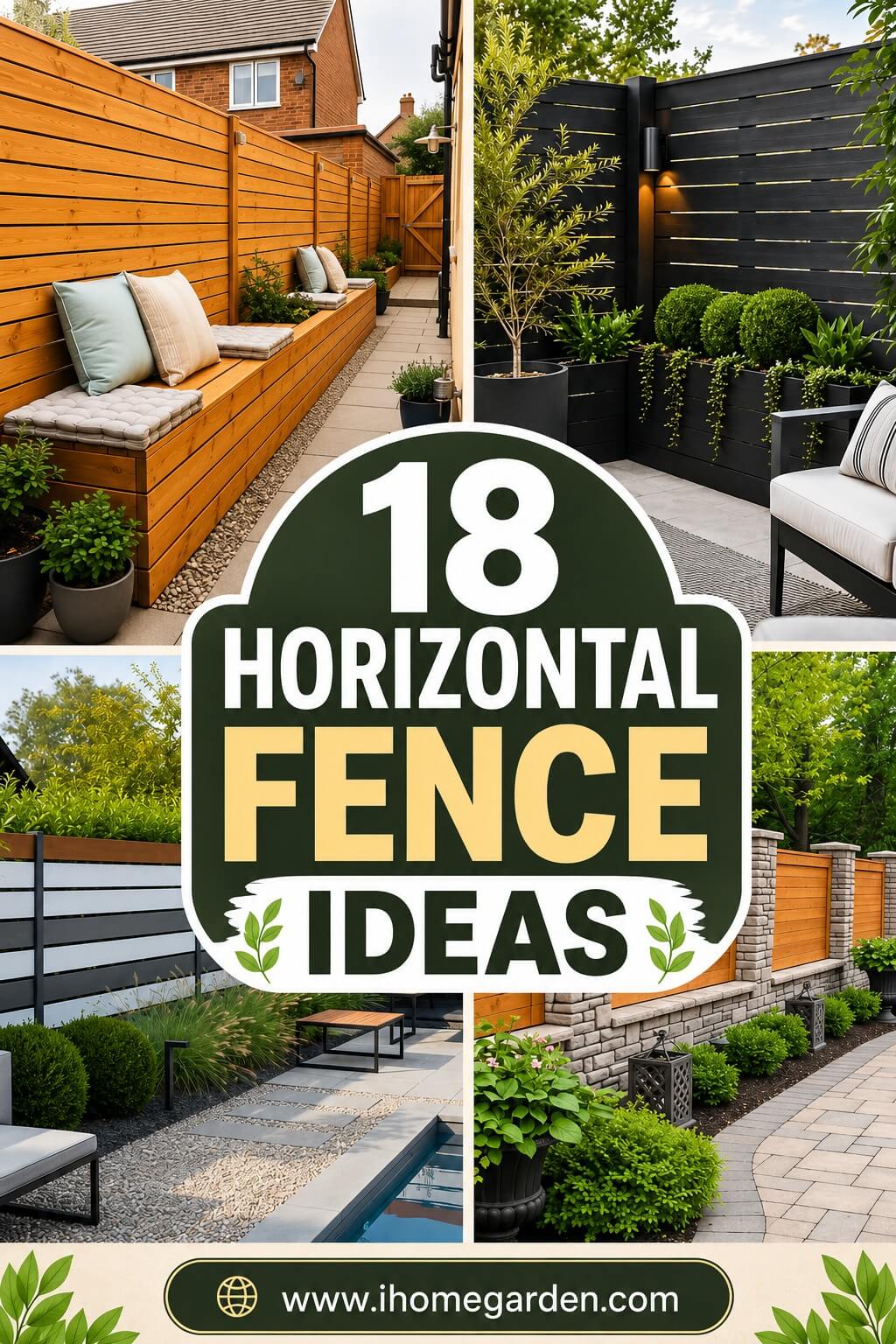
Horizontal boards behave differently than vertical ones. They need stronger posts, tighter spacing, and smarter wood choices, or they sag within three summers. Get those basics right and you’re looking at a fence that frames your yard like a piece of architecture instead of just blocking the view. Whether you’re working with $2,000 or $15,000, there’s something below worth stealing.
1. Classic Wood Slats
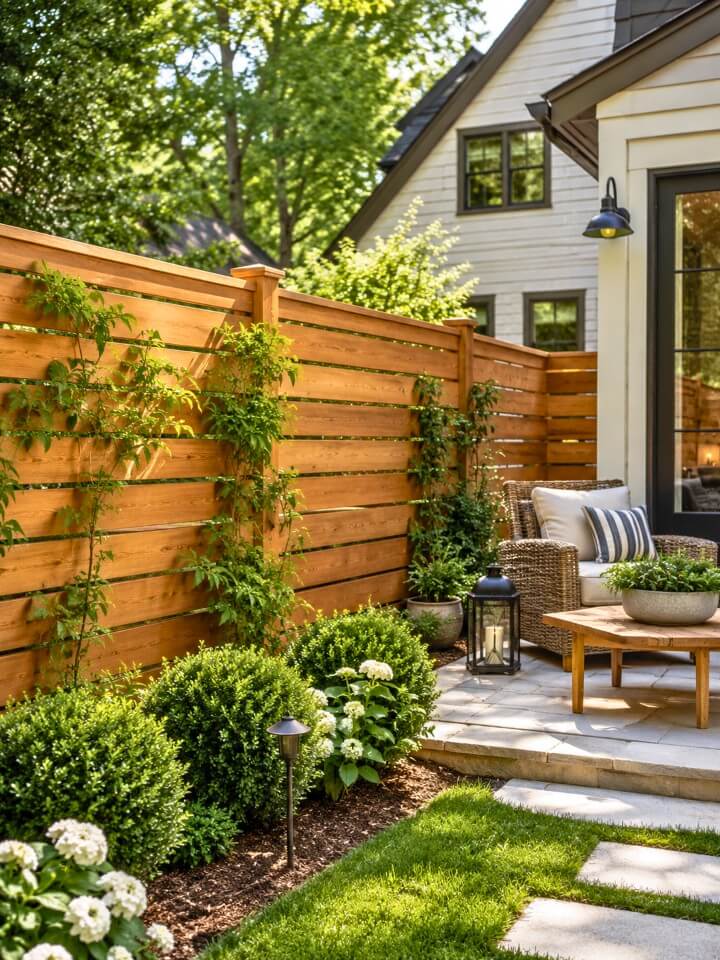
Walk through any neighborhood built in the last decade, and you’ll spot this fence everywhere — for good reason. It’s the horizontal equivalent of a white t-shirt: hard to mess up, harder to get tired of.
The build is straightforward. 1×6 cedar or pressure-treated pine boards, 1/4 inch gaps between them, mounted on 6×6 posts set 6 feet apart. That gap matters more than people realize — skip it and your boards will buckle the first humid summer.
Cedar runs about $20 per linear foot installed and lasts 15-20 years with a UV-blocking sealer every 2-3 years. Avoid “clear natural” sealants; they fail fast under direct sun and your fence goes gray within a season.
2. Mixed Material Panels
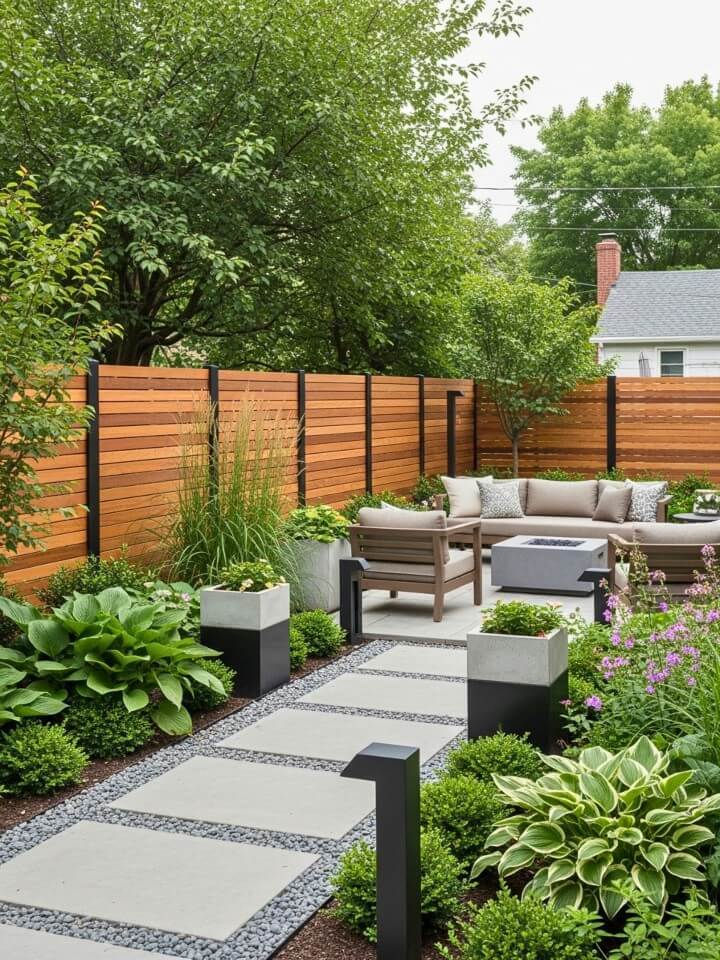
Ever notice how a long stretch of plain wood fence starts disappearing from your eye after a week? Your brain stops registering it. Mixing materials fixes that.
Cedar boards interrupted every third panel by black powder-coated steel — solid sheet, perforated, or welded rebar grid — keeps the fence visually active because each material catches afternoon light differently. By 6pm the steel sections glow warm while the wood holds shadow.
| Material combo | Cost/linear ft | Best for |
|---|---|---|
| Cedar + steel sheet | $40-50 | Modern homes |
| Cedar + perforated metal | $45-55 | Privacy with airflow |
| Pine + rebar grid | $35-45 | Industrial loft style |
Warning worth knowing: where steel touches pressure-treated lumber, galvanic corrosion eats both. Use a rubber barrier strip between them or you’ll be replacing sections in five years.
3. Sleek Metal Lines
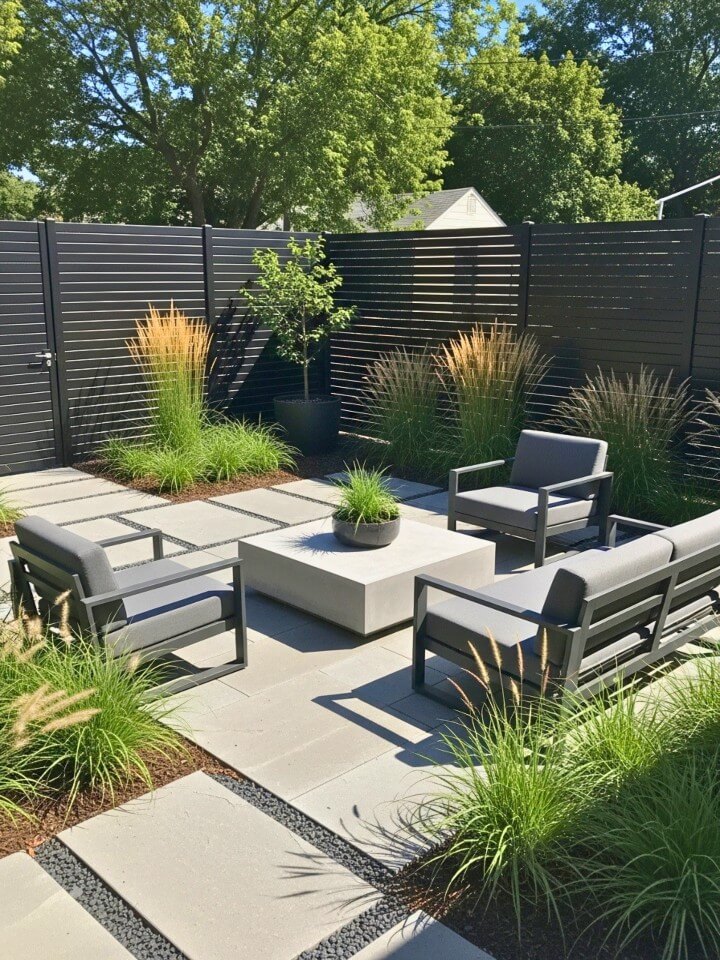
Explore horizontal fence ideas that add clean lines, bold curb appeal, and stylish backyard privacy. Three things kill wood fences: warping, rotting, repainting. Aluminum eliminates all three.
Pre-finished horizontal slat systems from companies like Trex Horizons and Ameristar ship ready to install in matte black, bronze, or charcoal gray. Warranties run 20-25 years. Upfront cost is $45-65 per linear foot installed — painful compared to cedar’s $20 — but cedar needs sealing every two years and replacement around year 18. Over a 20-year window, aluminum wins on total cost.
The thing nobody puts in product brochures: south or west-facing metal hits 140°F in July. If kids or pets brush along that fence, plant boxwoods or feather reed grass at the base as a buffer. The planting softens the harsh edge anyway.
4. Painted Color Blocks
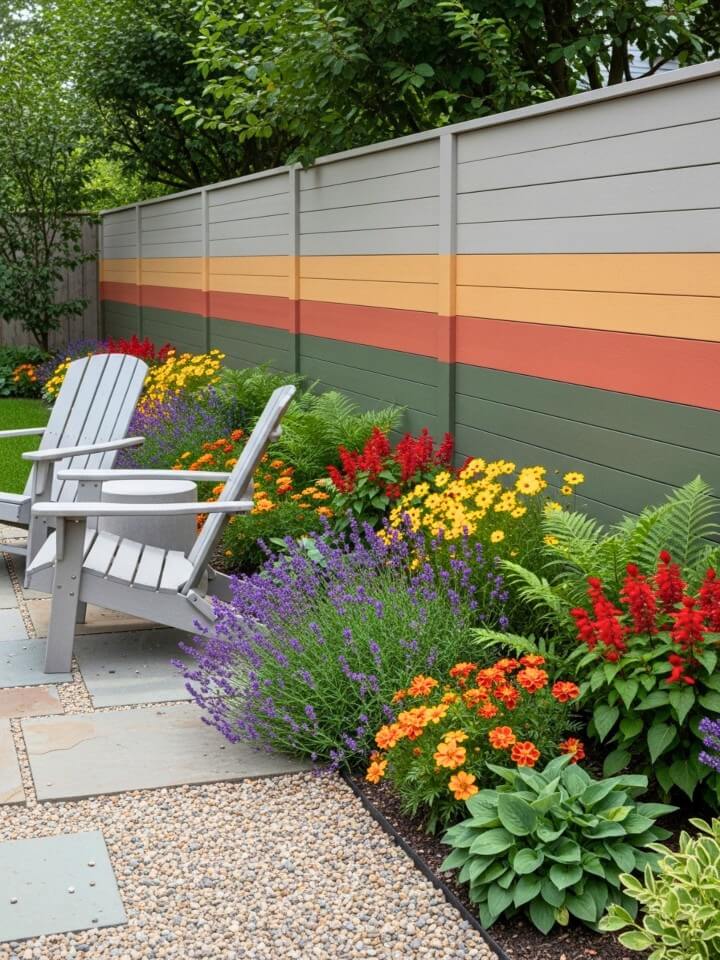
Paint is cheap. Bad paint choices are expensive — you’ll either repaint every three years or stare at a regret for ten.
Two rules keep this from going wrong:
Rule one — restraint. Two colors maximum, three if one is just natural wood. Let one dominate around 70% of the surface and let the other show up in deliberate stretches, not random panels.
Rule two — buy real exterior paint. Benjamin Moore Aura Exterior or Sherwin-Williams Emerald. Both hold color through UV for 7-10 years. Cheap exterior paint chalks and fades in two.
Combinations that consistently work: sage green with warm white. Charcoal with mustard accent. Deep navy with raw cedar showing through. What doesn’t work: pastels (they look dirty within a year), pure white (shows every speck of dirt and mildew), and anything trendy you saw on Instagram last month.
Prime first. Always. Even on new wood.
5. Open and Spaced Boards
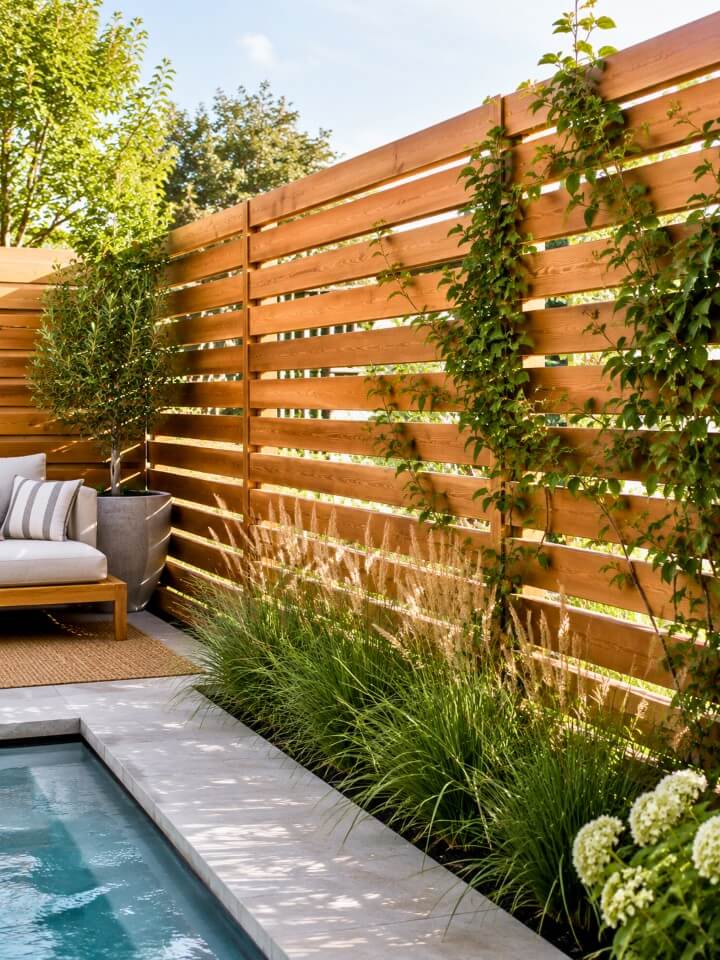
Full privacy isn’t always the goal. Sometimes you just need a line that says this is the edge of my yard without building a wall, and that same thinking shows up in many magnificent fence line landscaping ideas where plants and spacing do part of the work.
Space your 1×4 or 1×6 boards 1.5 to 2 inches apart and you get exactly that — a visual boundary with breeze, light, and a view of whatever’s planted on the other side. Pool enclosures benefit especially, since solid fences trap chlorine smell and humidity against the water.
Plant tall ornamental grasses 18 inches in front — miscanthus, feather reed, or switchgrass all work — and you get privacy when you’re sitting on the patio but openness when you’re standing. Best of both, basically.
6. Warm Cedar Horizontal Fence
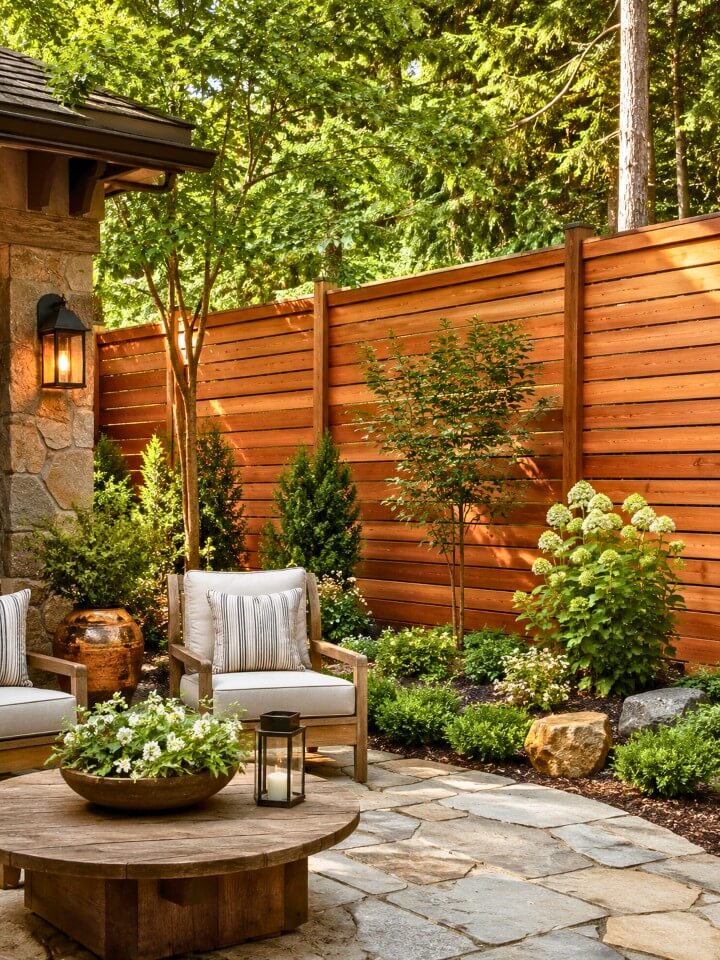
Cedar earns its reputation honestly. The wood contains natural oils (thujaplicins, if you want the chemistry) that repel insects and resist rot without any chemical treatment, which is why you’ll find 40-year-old cedar fences still standing in the Pacific Northwest with nothing but weathering to show for it.
Western Red Cedar is the premium choice at roughly $22-28 per linear foot installed. Northern White Cedar costs less ($18-22) but the boards are narrower and knottier. Both work; the difference is mostly aesthetic.
Here’s where most people go wrong: they let the cedar weather to gray, thinking it’s the “natural” look. Gray cedar is dying cedar. The silver patina you see is UV damage breaking down the lignin in the wood fibers. Apply a penetrating oil finish like Penofin or TWP within the first six months, then refresh every 2-3 years. Your fence will hold that warm honey-red tone for two decades instead of fading out in three years.
7. Black Horizontal Privacy Fence
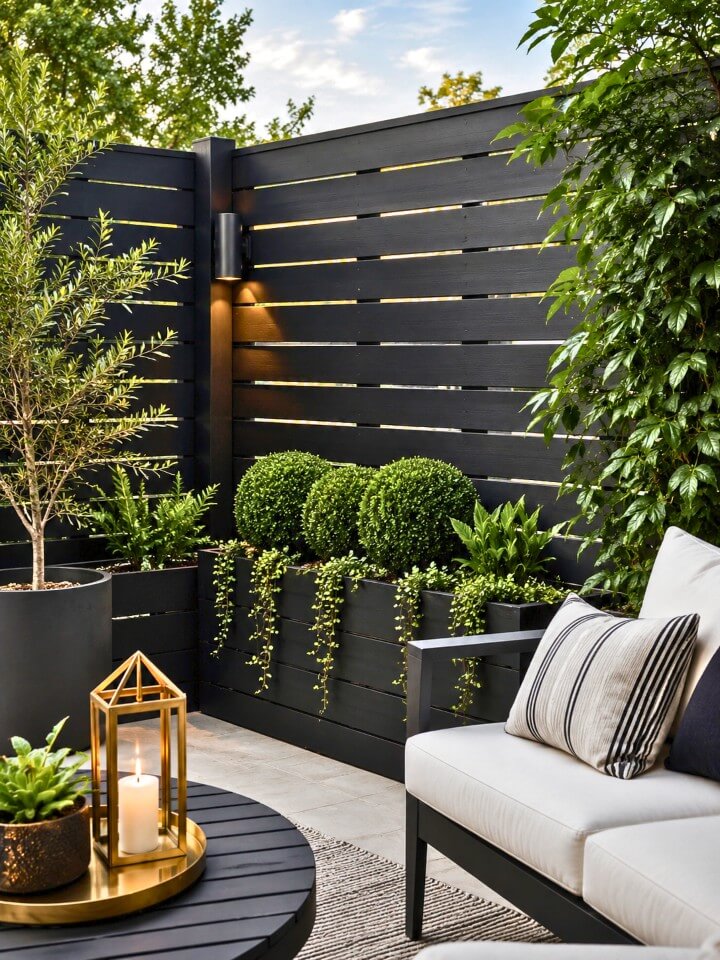
Choose a modern horizontal fence for sleek outdoor style, crisp structure, and a polished home look. Black fences photograph beautifully and make plants pop like nothing else. They also absorb heat, fade unevenly if you use the wrong product, and show every speck of pollen and dust.
Worth it? Usually yes — if you do it right.
The right way: composite boards (TimberTech, Trex) in a factory-finished black, or smooth cedar coated with Sherwin-Williams Emerald Urethane Trim Enamel in Tricorn Black. Both hold color for 8-10 years minimum.
The wrong way: standard exterior latex on pine. You’ll be repainting in three years and the fade pattern will be blotchy.
One design note worth stealing — black recedes visually, which makes small yards feel larger, not smaller. Counterintuitive but true. The fence becomes a backdrop instead of a boundary, and your eye reads the plants and furniture as the foreground.
8. Horizontal Fence With Planter Boxes
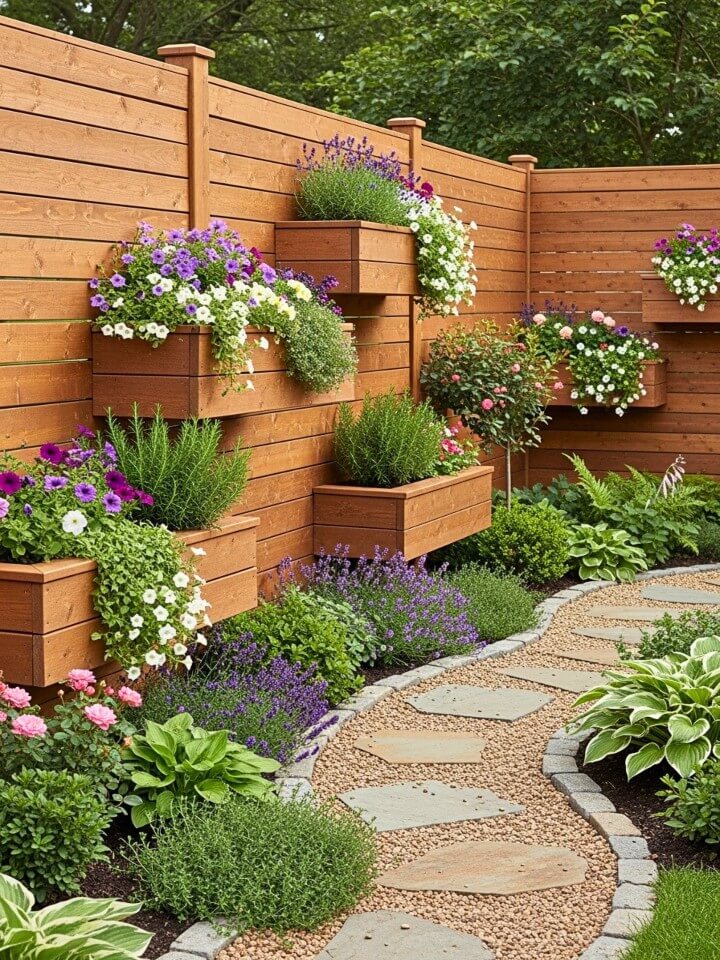
This is one of those ideas that looks effortless and is actually a small engineering project. Wet soil weighs around 100 pounds per cubic foot. A modest 4-foot planter box holds 200+ pounds of saturated dirt. Your fence framing has to carry that load without leaning.
What You Need:
- Posts: 6×6, set minimum 36 inches deep in concrete
- Box brackets: lag-bolted directly into posts, never into fence boards
- Drainage: holes every 6 inches along the bottom, plus a gravel layer
- Liner: pond liner or heavy-duty landscape fabric (skip the plastic — it rots the wood from behind)
Best plants for these boxes are things with shallow roots that tolerate heat reflection from the fence: herbs (rosemary, thyme, oregano), succulents, trailing petunias, sweet potato vine. Avoid tomatoes and anything with aggressive roots — they’ll crack the box within two seasons.
Built right, these last 10-15 years and turn a fence into a vertical garden.
9. Rustic Reclaimed Wood Fence
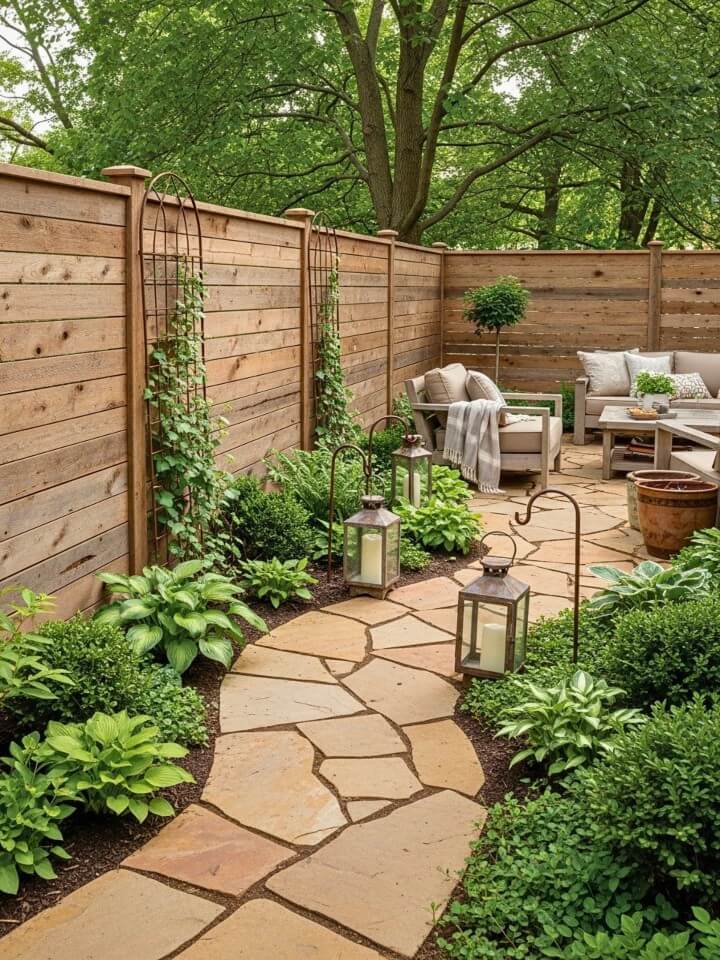
There’s something a fresh-milled board cannot fake: the look of wood that’s already lived 80 years. Nail holes, saw marks, sun-bleached patches, the occasional faint paint trace. You either love it or you don’t, but if you do, nothing else scratches the itch.
Sourcing matters more than the design itself. Good places to find usable reclaimed lumber:
- Architectural salvage yards (search “[your city] architectural salvage”)
- Habitat for Humanity ReStores
- Local Craigslist farm/barn listings
- Demolition contractors — call directly, ask if they have wood coming down
Expect $4-8 per board foot, which sounds cheap until you realize you’ll spend a weekend pulling nails, scrubbing off old finish, and sorting boards by thickness. Budget 2-3x more labor hours than a standard fence.
Two warnings: have any pre-1978 painted wood tested for lead before you sand it. And check for powder post beetle holes — tiny pinpricks in clusters mean active infestation, and that wood will eat your good lumber.
10. Horizontal Fence With Stone Posts
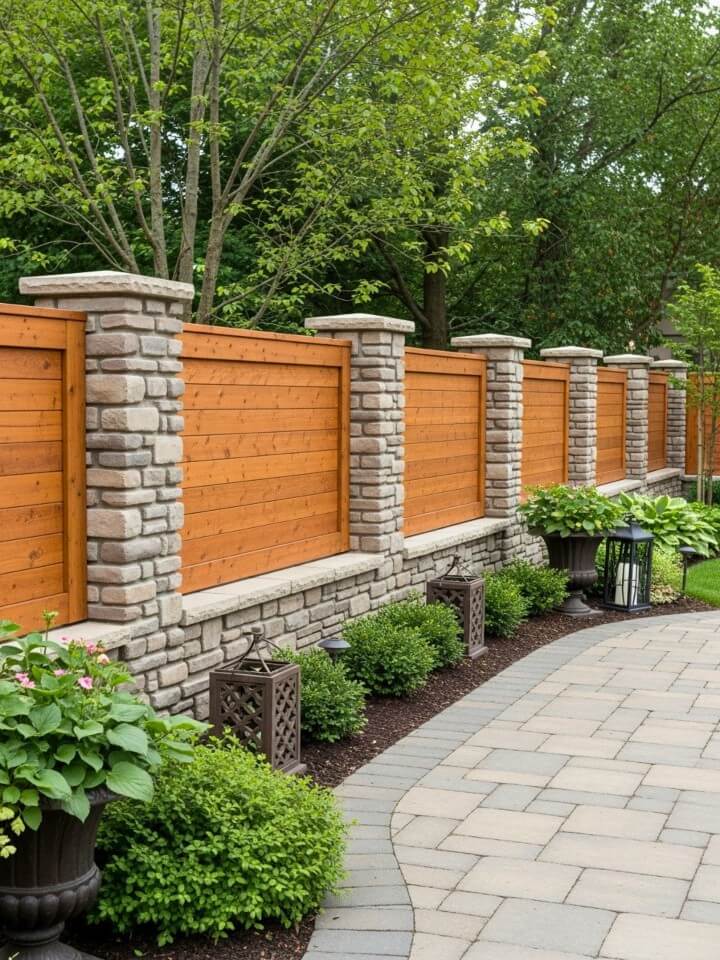
Stone posts between wood panels solve a problem most homeowners don’t know they have until it’s too late: wood posts fail at the ground line. Always. Moisture wicks up from the soil, sits against the lumber, and rots the post from inside out — usually around year 12-15 even with treated wood.
Stone columns sidestep the whole issue. Properly built with a concrete core and stone veneer, they outlast the wood panels they support by decades.
Two Construction Approaches:
Full masonry columns — $400-700 per column, built by a mason on a concrete footing below frost line. This is the permanent version. Forty-year lifespan, maybe longer.
Manufactured stone veneer over concrete block — $200-350 per column, DIY-able with patience. Looks identical to full masonry from six feet away. Lifespan around 25-30 years before the veneer needs attention.
Space columns every 8-10 feet and let cedar or ipe panels span between them. The mixed texture reads as expensive even when most of the cost is in just a few feature columns.
11. Horizontal Fence With Lattice Top
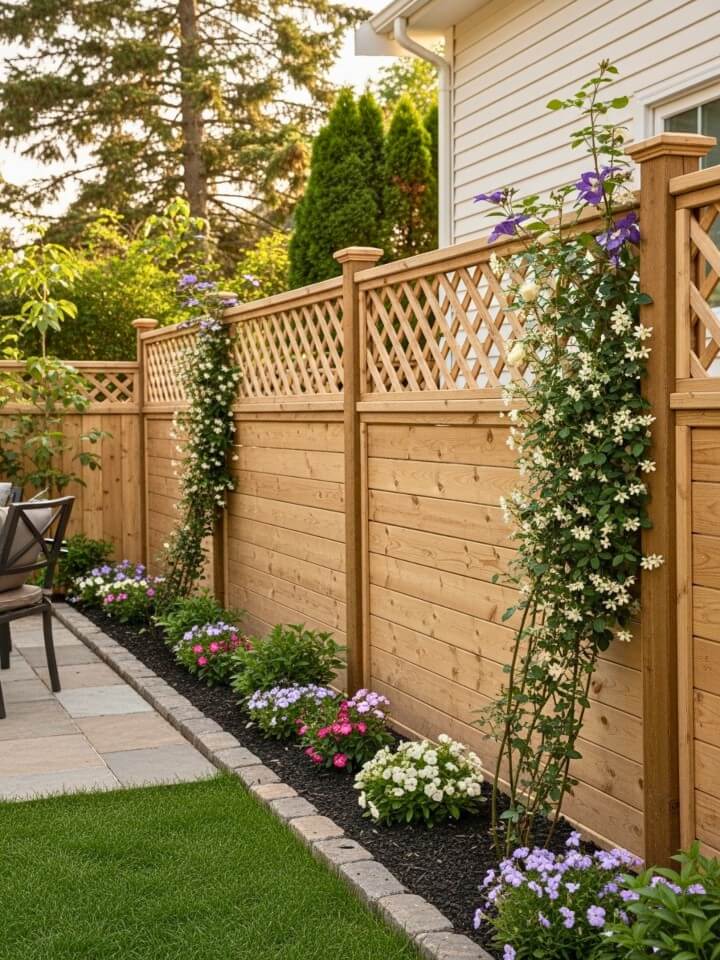
Old-school lattice tops used to look like something your grandmother nailed up in 1985. Modern lattice has caught up — and when you pair it with horizontal boards below, you get something that solves a specific problem: privacy at sitting height, openness above.
Why that combination matters: a solid 6-foot fence around a patio can feel like sitting in a box. Drop the solid section to 4 feet and add 2 feet of lattice above, and the same patio suddenly breathes. You still can’t see the neighbors when you’re on the couch, but the sky stays in view.
Skip the flimsy 1/4 inch lattice from big box stores — it warps within two summers. Look for 3/4 inch cedar or vinyl lattice from a real lumber yard. Costs more ($8-12 per square foot vs $3) but holds shape for 15+ years.
Plant climbing jasmine, clematis, or climbing hydrangea at the base. Within two seasons the lattice disappears under bloom and the fence reads as half garden, half boundary.
12. Modern Minimalist Horizontal Panels
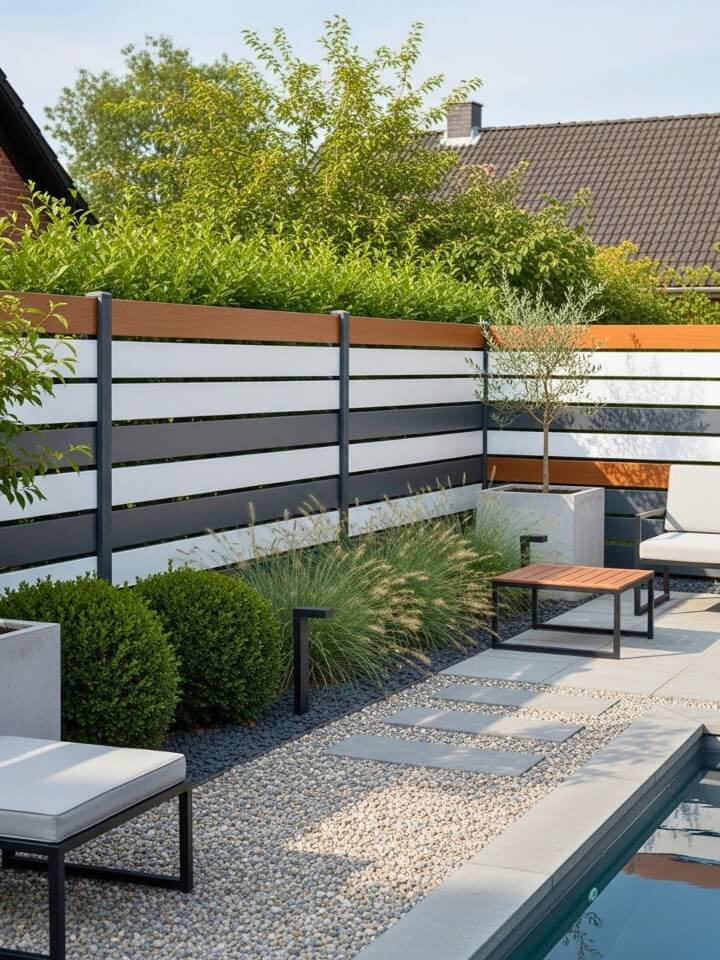
Build a horizontal privacy fence that feels elegant, secure, and perfect for relaxing outdoors. Minimalism is harder than it looks. Take away the detail and every imperfection shows — uneven gaps, mismatched board widths, sloppy miter joints at corners. There’s nowhere to hide.
What Separates a Good Minimalist Fence from A Cheap-Looking One:
- Board consistency. Every board the same width, same thickness, same color. Hand-pick lumber at the yard if you have to.
- Hidden fasteners. Visible screw heads ruin the look. Use clip systems like Camo Edge or face-screw with color-matched plugs.
- Sharp corners. Mitered 45° corners where panels meet, not butt joints with exposed end grain.
- Perfectly level top line. A wavy top line is the first thing the eye catches.
Stick to a tight palette — black, charcoal, white, or a single warm wood tone. No accents. No contrast. The whole point is that nothing competes for attention.
Pair with concrete pavers, gravel beds, and one or two architectural plants like a Japanese maple or a row of boxwood spheres. That’s it. Resist adding anything else.
13. Horizontal Fence With Lighting Accents
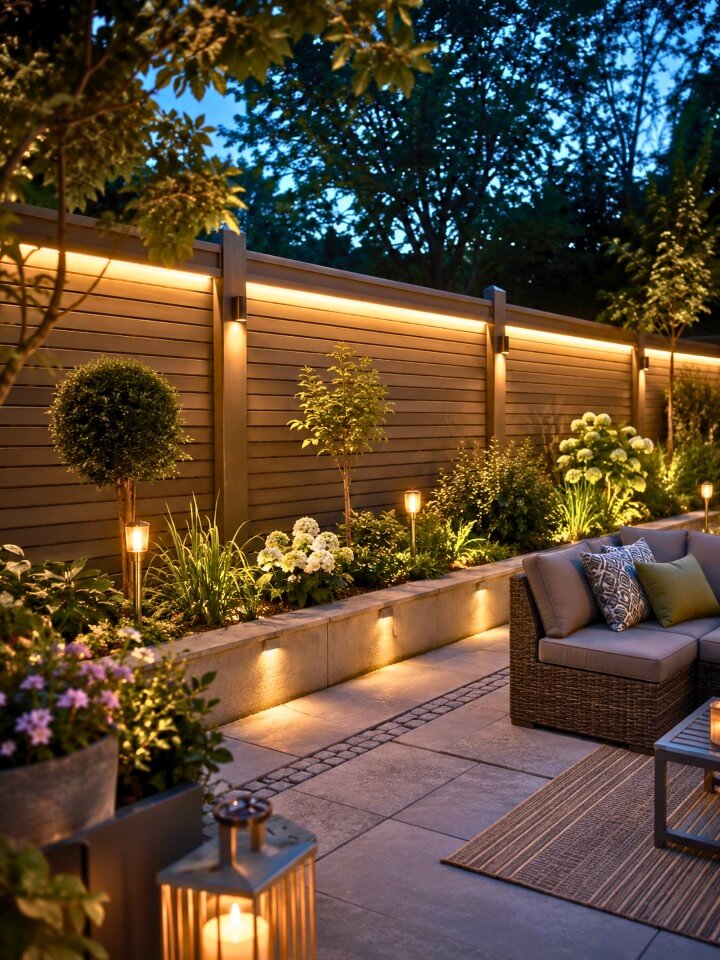
Most fence lighting looks like an afterthought because it is an afterthought. Run the wiring before you build, and the result feels intentional instead of like solar lights bought in a panic.
Three Lighting Approaches Worth Considering:
- Linear LED strips under the cap rail. Casts a soft wash down the fence face. Choose 2700K (warm white) — anything cooler reads as harsh. Around $15-25 per foot for outdoor-rated strips, plus a transformer.
- Post-mounted downlights. Small fixtures on top of each post throwing light downward in cones. Good for walkways alongside the fence. Hinkley and Kichler make weatherproof versions in the $80-150 range each.
- Integrated horizontal slot lights. A linear fixture built into a gap between two boards, glowing outward. The most expensive option ($30-50 per linear foot) and the best looking by far.
Whatever you pick, get it on a photocell or smart timer. Lights that come on at dusk and shut off at midnight feel curated. Lights that stay on until 4am feel like a parking lot.
14. Horizontal Fence With Bamboo Accents
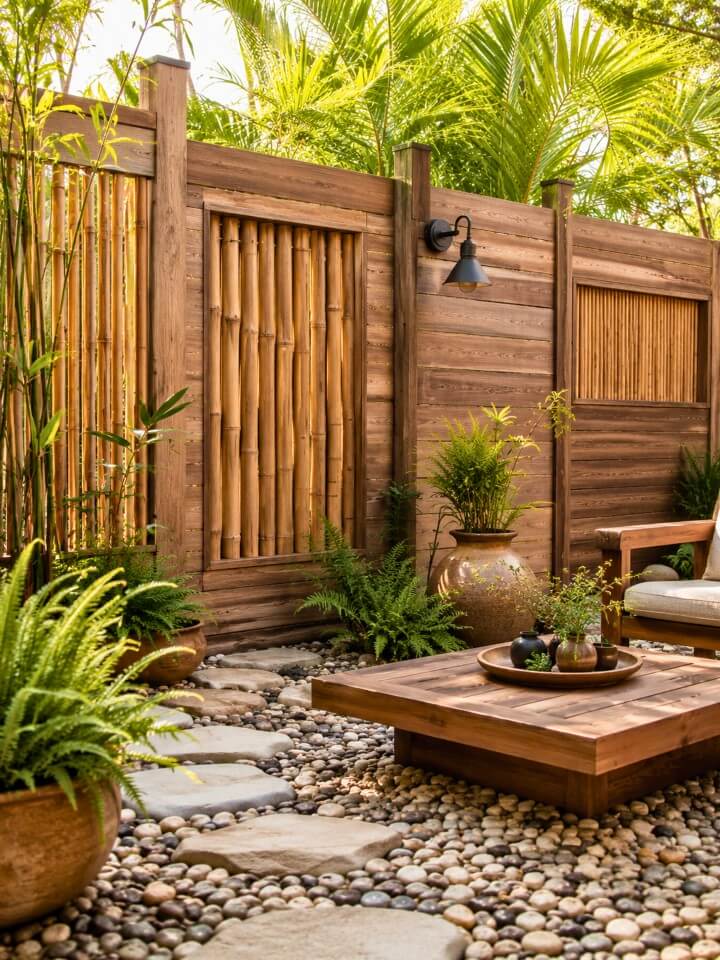
Bamboo brings a texture nothing else replicates — vertical lines, hollow knock when tapped, that pale gold color that deepens to honey over a year outdoors. Mixed into a horizontal fence as accent panels, it reads as relaxed and intentional at the same time.
The catch nobody warns you about: not all bamboo is created equal.
| Type | Durability outdoors | Cost |
|---|---|---|
| Imported rolled bamboo | 2-4 years | Cheap ($3-5/sq ft) |
| Moso bamboo panels | 5-8 years | Mid ($10-15/sq ft) |
| Carbonized/treated bamboo | 15-20 years | Premium ($20-30/sq ft) |
The cheap stuff from import stores will look great for one summer and split during the first hard freeze. Spend the money on carbonized or thermally-treated bamboo if you want this to last.
Frame the bamboo sections inside cedar or steel rectangles for support — bamboo on its own sags. And seal the cut ends; that’s where moisture gets in and starts the splitting.
Works best with pebble paths, ferns, Japanese forest grass, and simple teak furniture. Avoid anything fussy — bamboo’s whole point is calm.
15. Horizontal Fence With Mixed Heights
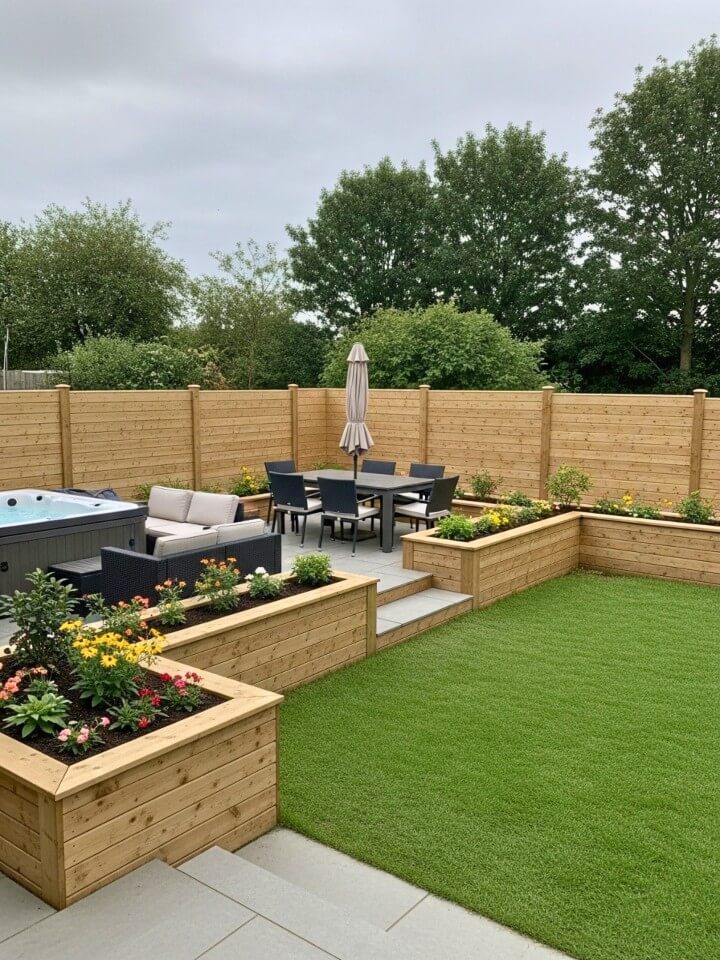
A fence at one continuous height treats every part of the yard the same. Most yards don’t actually need that. The patio needs privacy. The vegetable garden needs four feet so deer think twice. The lawn edge needs a knee-high marker. Why build six feet of fence everywhere?
Mixed-height fencing follows function instead of fighting it.
A Practical Layout for A Typical Suburban Backyard:
- 6 feet behind the patio or hot tub (full screening)
- 5 feet along the side property line (privacy without canyon effect)
- 4 feet around garden beds (visual division, easy to step over for maintenance)
- 3 feet at the front lawn transition (boundary marker)
The key to making this look planned rather than random: use the same board style, same wood, same finish throughout. Only the height changes. The transitions between heights should happen at logical points — at a post, at a corner, where two zones meet — never mid-panel.
Build the tallest sections first. It’s easier to step heights down than try to match heights up.
16. Horizontal Fence With Metal Frame
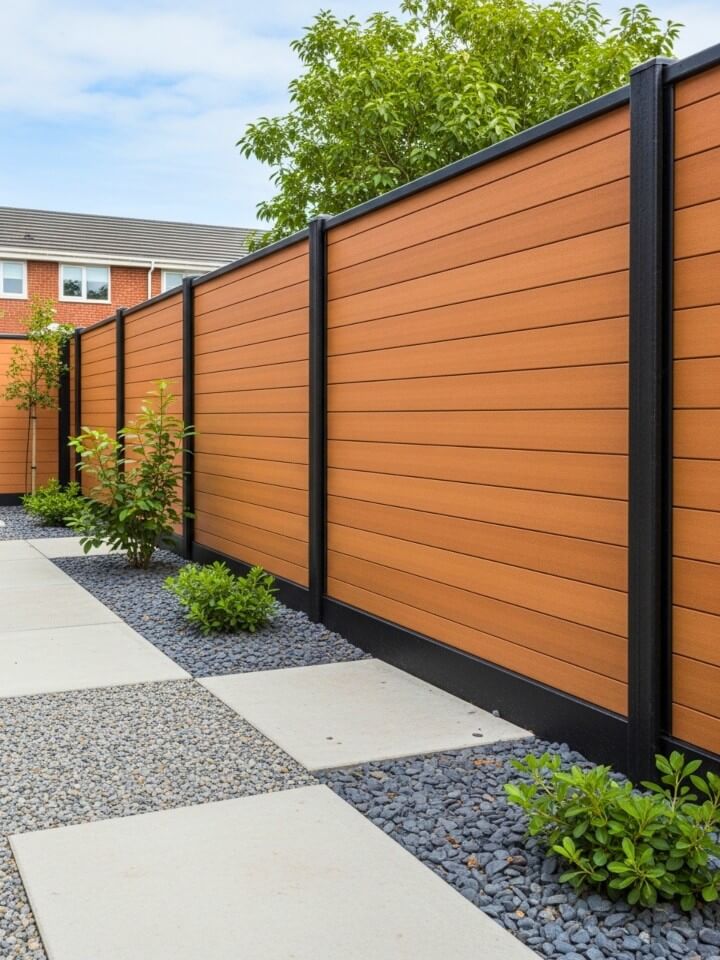
If you’ve ever pulled an old wood fence out of the ground, you know exactly where it failed: the posts. Wood-in-soil contact is the weak link in every fence system, and no amount of pressure treatment fully fixes it.
Steel post frames eliminate the problem entirely.
The system works like this: galvanized or powder-coated steel posts get concreted into the ground, with horizontal steel rails connecting them. Wood or composite boards then mount to the steel frame instead of touching soil at any point. The wood lasts twice as long because it stays dry, and if a board ever needs replacing, you swap it out without disturbing the structure.
The aesthetic is a bonus. Black steel posts with warm cedar boards inside read as deliberately modern — like the wood was chosen, not just nailed up. It pairs particularly well with concrete pavers, gravel, and tightly clipped landscaping.
Dark groundcover can sharpen the contrast too, which is why awesome black mulch landscaping ideas are worth studying before you choose the planting bed finish.
17. Whitewashed Horizontal Wood Fence
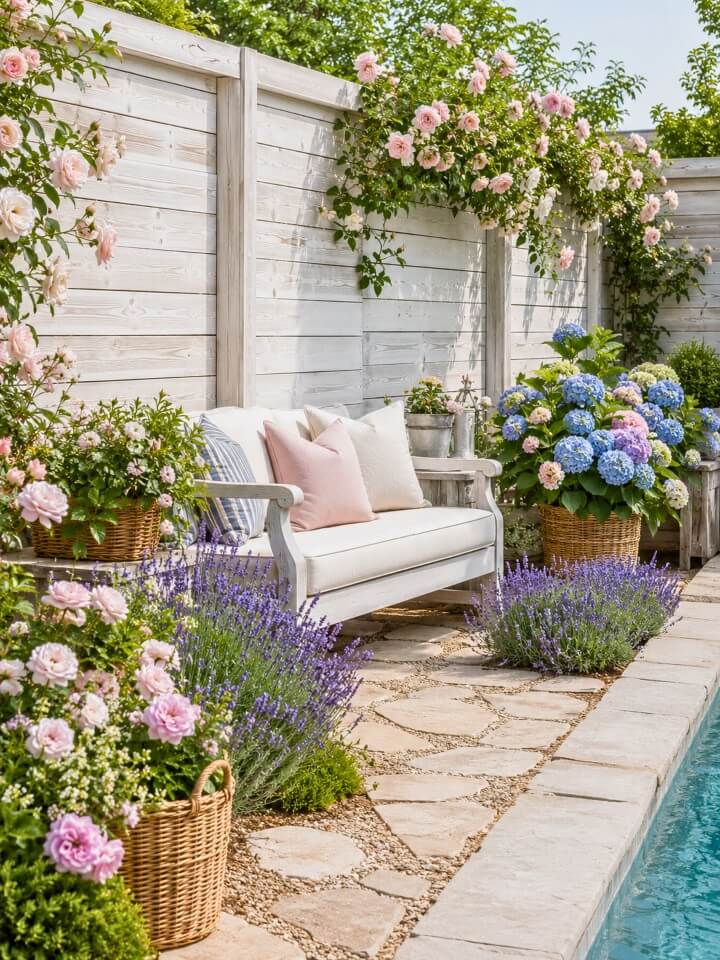
Upgrade your yard with privacy fence ideas that blend beauty, comfort, and everyday outdoor peace. Whitewash is paint’s quieter cousin. Solid paint covers wood. Whitewash colors it while letting the grain breathe through. The effect is bright without feeling clinical, which is exactly what you want around a small patio or a coastal-style yard.
Two Ways to Get the Look:
The traditional way — thin exterior latex with water at a 1:3 ratio (one part paint, three parts water). Brush it on, wait 60 seconds, wipe back with a rag. Cheap, fast, and somewhat unpredictable. Each board comes out slightly different, which is part of the charm if you like that, and a problem if you don’t.
The modern way — pre-mixed solid-color stains in white from Cabot or Olympic. More consistent, longer-lasting (8-10 years vs 3-5 for thinned paint), about $50 per gallon. Apply with a brush, not a sprayer; sprayers go on too even and kill the wash effect.
Either way, prime knots first with shellac-based primer like Zinsser BIN. Knots bleed tannins through white finishes faster than anything else and you’ll see brown spots within a month if you skip this step.
Looks particularly good with lavender, hydrangea, climbing roses, or anything silver-leaved like Russian sage.
18. Horizontal Fence With Built-In Bench
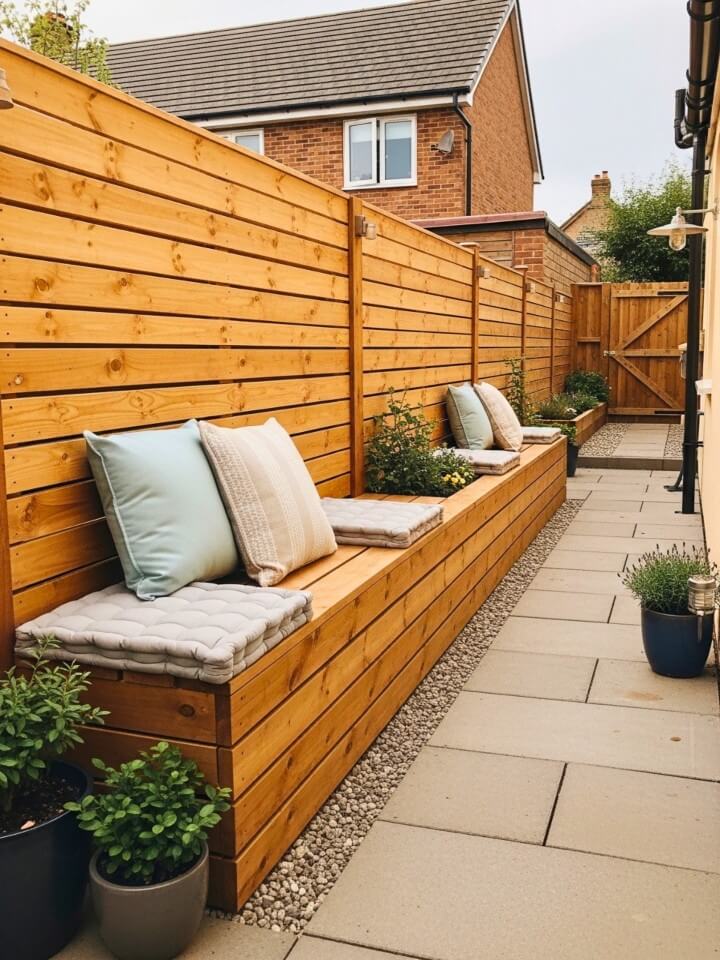
A fence and a bench are two structures fighting for the same wall space. Combine them and you reclaim the yard.
The construction is more involved than it looks. The bench can’t just bolt to the fence — fence boards aren’t structural and will tear off under weight. The bench needs its own frame, anchored to the same posts that hold the fence, with the seat sitting independently of the fence boards.
Standard Dimensions Worth Knowing:
- Seat height: 17-18 inches off the ground
- Seat depth: 16-18 inches (deeper if you want to add cushions)
- Backrest angle: 100-105 degrees from the seat (straight 90° is uncomfortable after ten minutes)
- Length: size to the post spacing — usually 6 or 8 feet between posts
Leave a 1-inch gap between the seat back and the fence boards. Water needs somewhere to go, and that gap also makes seasonal expansion possible without splitting either structure.
Storage under the seat is a question to answer up front. Hinged lids look great in magazines but trap moisture and rust the hinges within two years. Open underneath, with a gravel pad below for drainage, lasts longer and lets you slide cushion storage bins in and out.
Add weatherproof cushions in muted colors and you have seating that costs less than buying outdoor furniture and never gets blown over in a storm.
Frequently Asked Questions About Horizontal Fences
Before you start digging post holes, these are the practical questions homeowners actually ask once the planning gets real — answered honestly without the sales pitch.
Do Horizontal Fences Need a Permit?
Most municipalities require a permit for any fence over 6 feet tall, and some require one for any fence at all. Call your local building department before buying lumber — fines run $200-500 for unpermitted work.
How Long Does It Take to Install a Horizontal Fence?
A 100-foot horizontal fence takes a two-person crew about 3-4 days: one day for post holes and concrete, one day for the concrete to cure, and 1-2 days for board installation and finishing.
Will a Horizontal Fence Lower or Raise My Property Value?
Appraisers generally add $3,000-7,000 in value for a well-built privacy fence on a typical suburban lot. Horizontal styles in cedar or composite tend to appraise higher than basic pressure-treated pine fences.
Can I Install a Horizontal Fence on A Sloped Yard?
Yes, but use the stepped method instead of racking the boards to follow the slope. Each fence section stays level, dropping down at each post — this prevents board warping and keeps lines visually clean.
How Do I Keep Horizontal Fence Boards from Sagging Over Time?
Use 6×6 posts spaced no more than 6 feet apart, choose boards no longer than 8 feet, and add a mid-rail behind longer panels. Skipping any of these three creates the sag everyone complains about.
Conclusion:
The best horizontal fence isn’t the most expensive one or the one with the most Pinterest saves — it’s the one that matches how you actually live in your yard. Some of these ideas cost less than a weekend grocery run for a family of four. Others are projects you’ll plan for months. Both are valid. Walk your property line tomorrow morning with coffee in hand and ask yourself one question: what do I want this fence to do for me? Privacy, beauty, structure, seating, garden support — pick your two priorities and the right idea above will find you.