21 Hydrangea Landscaping Ideas for Every Corner of Your Yard
Walk into any garden center in June, and you’ll see the same scene — people standing in front of the hydrangea section, phone in hand, completely overwhelmed. Mophead or panicle? Pink or blue? Sun or shade? It’s a plant with serious opinions, and that’s exactly why these 21 fascinating hydrangea landscaping ideas exist — to take the guesswork out of where each variety actually belongs.
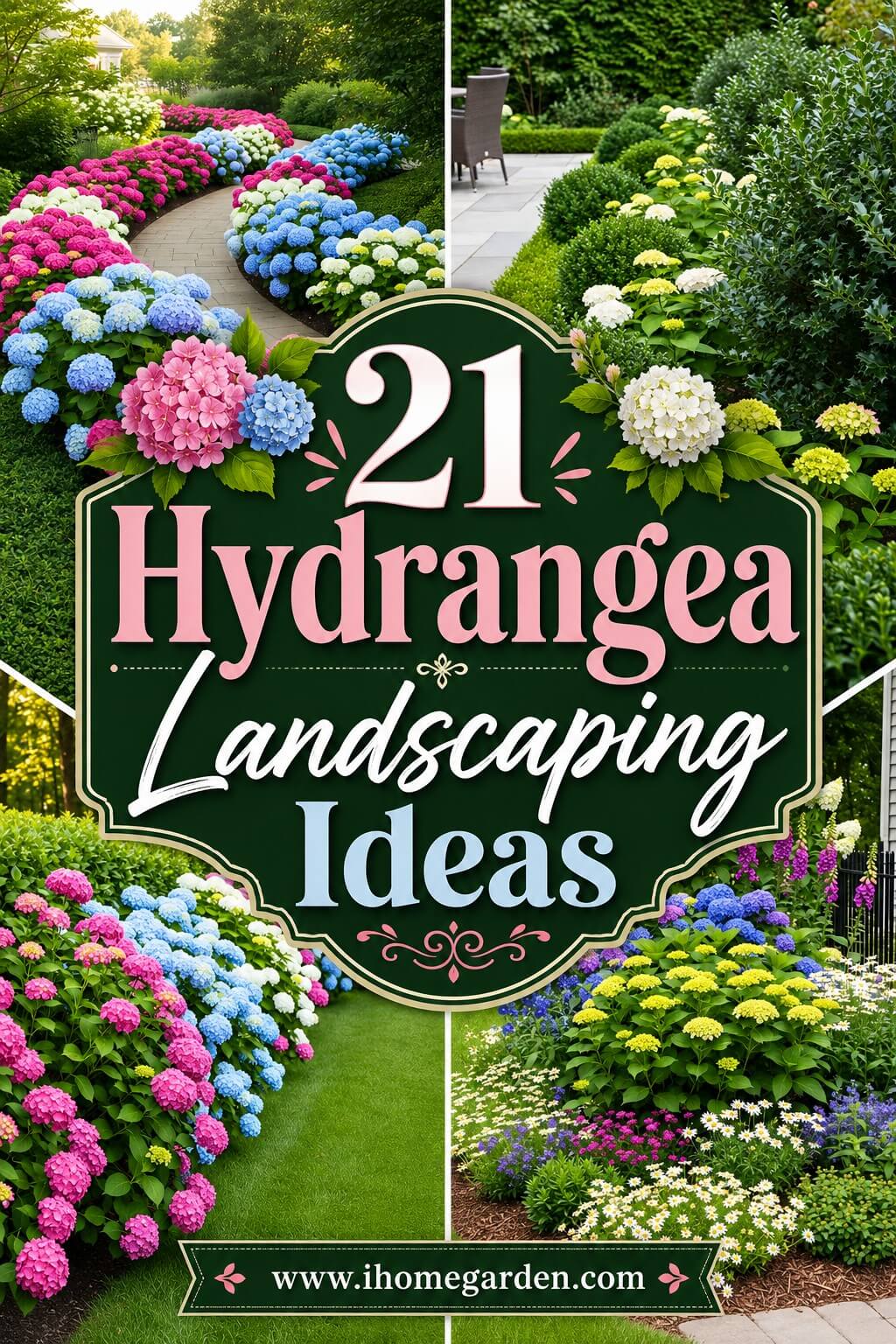
Hydrangeas aren’t a fill-in-the-blank shrub you drop wherever there’s an empty patch. Put a sun-loving panicle in deep shade and it sulks. Tuck a delicate bigleaf next to a hot driveway and it wilts by noon. Place the right one in the right spot, though, and the same plant can soften a sharp fence line, frame a quiet bench, or turn a forgotten corner into the part of the garden you actually walk people over to see. Below, every idea pairs a real spot with a real solution.
1. Build a Hydrangea Hedge for Privacy
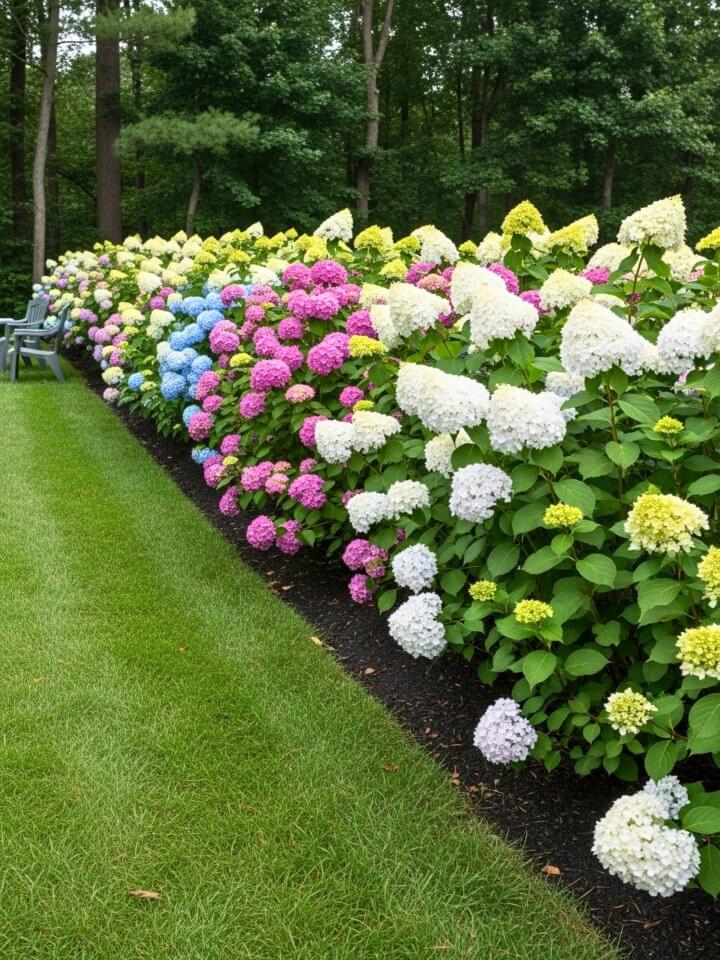
A useable privacy hedge takes about three growing seasons to fill in — that’s the realistic timeline most landscaping articles skip past. The spacing decisions you make on day one determine whether you end up with a continuous wall or a row of disconnected shrubs three years later.
How Tight to Plant
For a solid screen, ‘Limelight’ or ‘Quick Fire’ should sit 4 to 5 feet apart, measured center to center. Tighter than that and they compete for water; looser and you’ll see gaps even at maturity. Dig all the holes the same day so root collars sit at consistent height across the run — a hedge that bumps up and down looks unfinished forever. Water deeply twice a week the first summer. Pruning starts year two: light shaping in late winter, never a hard cut, or you lose next year’s blooms.
2. Border Your Walkway with Blooming Hydrangeas
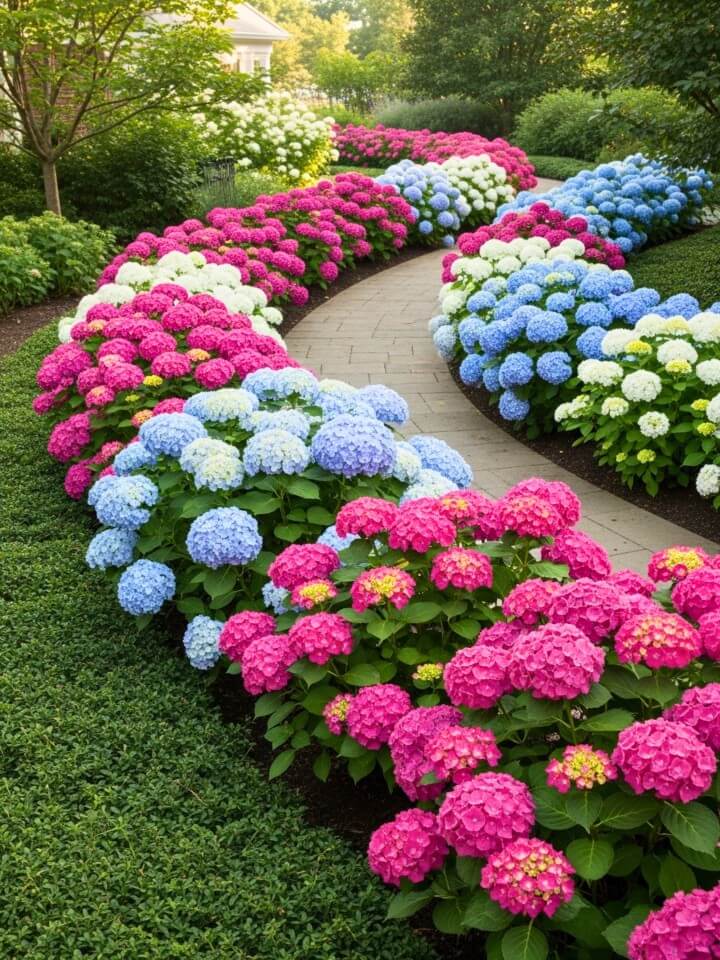
A visitor’s first impression of your garden usually happens in the few seconds they spend walking to your front door. Lining that path with hydrangeas turns those few seconds into something they actually remember.
Pick Varieties that Stay in Their Lane
Compact panicle types are the safest bet because they don’t sprawl. ‘Bobo’ tops out under 3 feet, and ‘Little Lime’ lands around 3 to 5. Plant them 30 to 36 inches apart, set back roughly a foot from the pavers so wet blooms don’t drape over the path after rain. Tuck creeping thyme or mondo grass right along the edge to hide the bare lower stems. In zones 5–9 these tolerate full sun, but morning light with afternoon shade keeps the flower heads from crisping by August.
3. Build a Relaxing Garden Retreat Surrounded by Hydrangeas
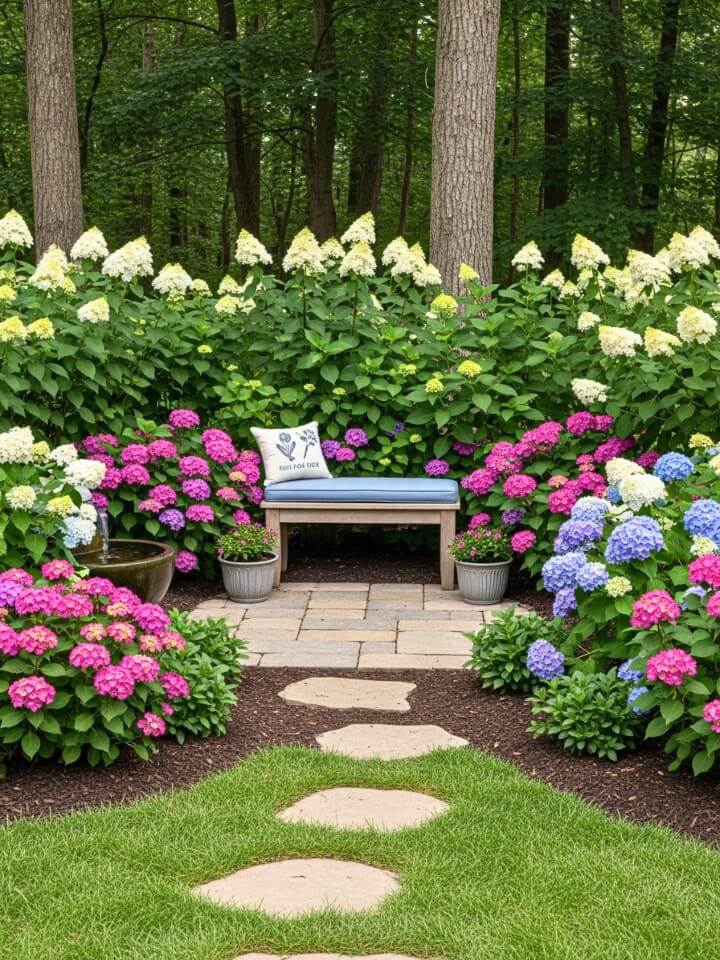
The whole point of a garden retreat is psychological — a place that feels separated from the rest of the yard, where the noise of the house drops away. Hydrangeas excel at creating that sense of enclosure because they’re full enough to screen sightlines without feeling oppressive the way solid hedges can.
Build the Enclosure on Three Sides
Set a bench, hammock, or pair of chairs against one wall, fence, or large shrub — that’s your anchor. Plant taller ‘Limelight’ or ‘Pinky Winky’ along the two open sides, about 3 to 4 feet behind the seating. Fill the gaps with mid-height ‘Endless Summer’ or ‘Bobo’ to soften the floor level. Leave the fourth side open as your entry view. Lay flagstone or pea gravel underfoot — lawn turns into a mud patch fast in a heavily-used spot like this.
4. Create a Colorful Corner in Your Backyard
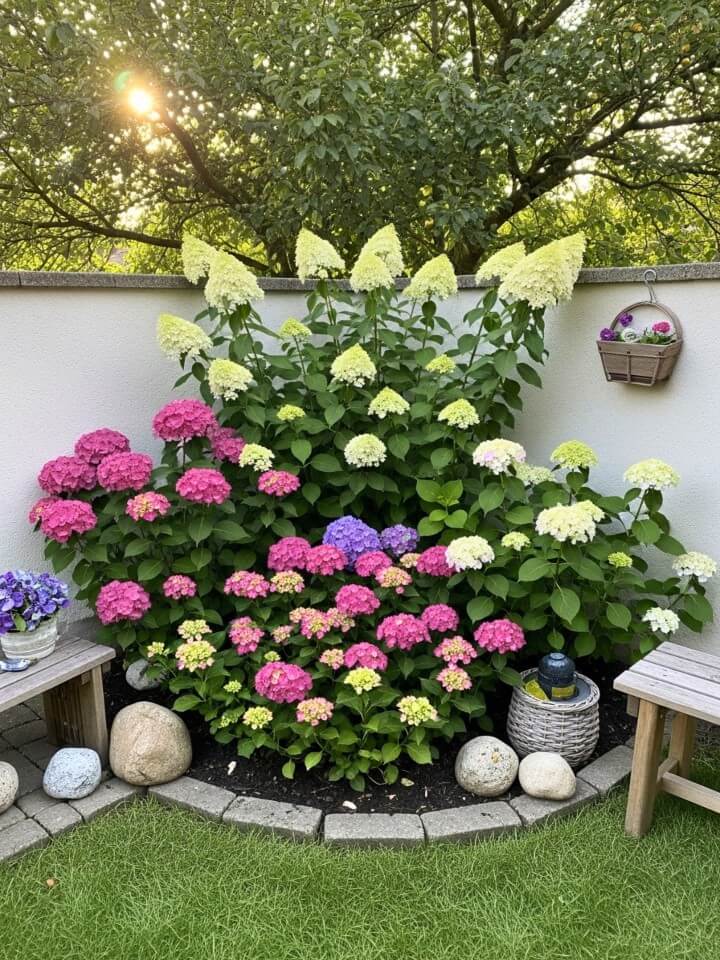
Every yard has at least one corner that feels forgotten — a tuck behind the shed, a spot where two fences meet and the lawn just gives up. That dead zone is actually the easiest place to build something striking, because anything intentional there reads as a design choice.
The Three-Layer Formula
Anchor the back with a tall ‘Limelight’ (6–8 feet, cone-shaped blooms that fade from white to dusty pink by September). In front of it, plant two ‘Endless Summer’ mopheads — these rebloom and shift color based on soil pH (acidic pushes blue, alkaline pushes pink). Edge the front with low ‘Invincibelle Wee White’. Drop in a weathered bench or a single large stone, and the corner becomes a destination instead of a leftover.
5. Mix Hydrangeas with Evergreens for Year-Round Appeal
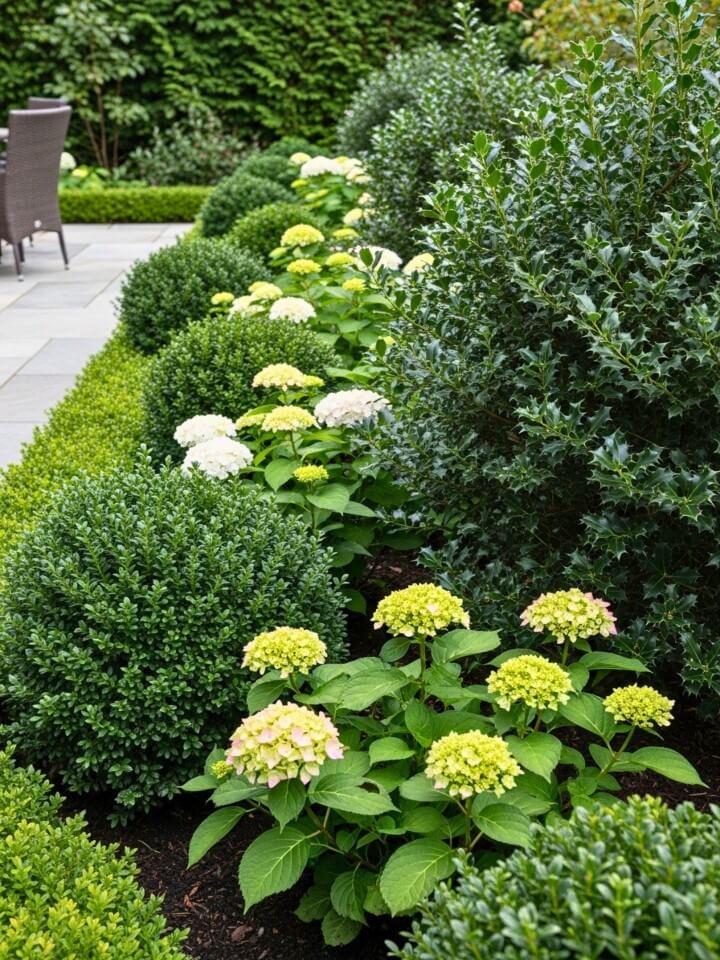
Bold hydrangea landscaping ideas that turn any dull corner into your yard’s photographed showpiece. Here’s the honest tradeoff with hydrangeas: roughly four months of flowers, eight months of bare stems. Evergreens close that gap. Pair them thoughtfully and the bed still looks pulled-together in February when nothing else is happening.
A Layout that Actually Works
Run a low boxwood hedge — kept around 12 to 18 inches tall — along the back. Plant ‘Annabelle’ hydrangeas about 3 feet in front of it. The white snowball blooms read like clouds floating against the dark green wall. For shadier spots, swap in oakleaf hydrangea; ‘Ruby Slippers’ stays near 3 feet and turns deep burgundy in fall, which pairs beautifully with dwarf English yew. One thing to skip: shearing the evergreens into sharp boxes. Soft rounded shapes flatter the flowers far more.
6. Frame Your Patio with Potted Hydrangeas
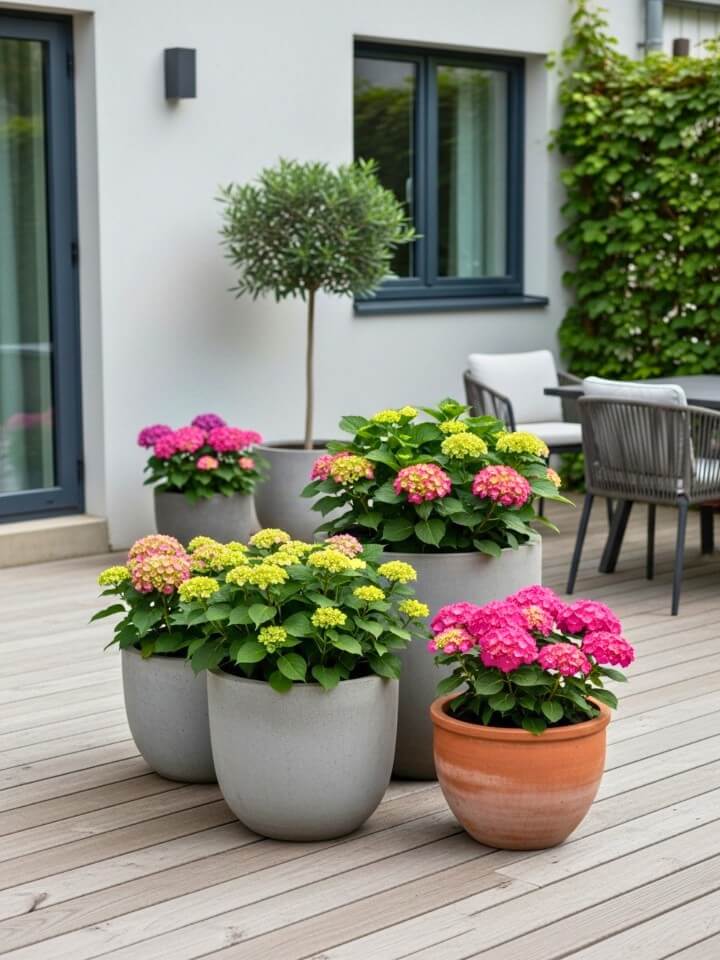
No garden bed? Not a problem. Containers let you keep hydrangeas on a deck, a paved patio, even a second-floor balcony — and you can shuffle them around when the light shifts through the season.
How Big Does the Pot Need to Be?
Bigger than you think. Aim for at least 18 inches across and 16 inches deep. Anything smaller will dry out by lunchtime in July, no matter how often you water. ‘Cityline Mars’ and ‘Let’s Dance Can Do!’ were bred specifically for container life and rarely cross 3 feet. Glazed ceramic holds moisture noticeably better than terracotta, which wicks water out through its walls. Group three pots at varying heights rather than lining them up — odd numbers and uneven heights always look more natural to the eye.
7. Soften a Fence Line with Layered Hydrangea Plantings
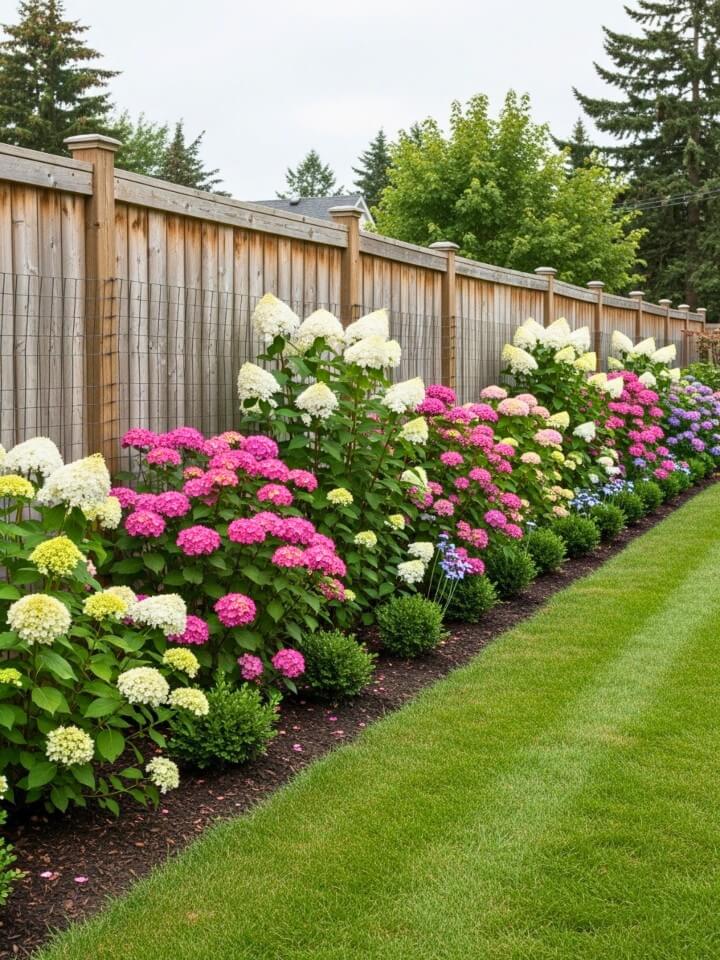
A long fence is a blank canvas, but it’s also a heat trap. Plants pushed right up against the boards bake in summer and rot in winter, so the first rule of fence-line planting is simple: give them room to breathe.
Layer It in Three Tiers
Set hydrangeas 2 to 3 feet out from the boards, never tight against them. Plant a tall ‘Pinky Winky’ (6–7 feet) every 8 feet along the run as your back layer. Fill the gaps in front with ‘Bobo’ or ‘Little Lime’ for a mid-height tier. Then drift low catmint or hardy geranium along the soil line to cover the bare ankles of the shrubs. Mulch 2 inches deep with shredded bark every spring — it holds moisture in and keeps weeds from creeping up from the lawn.
Sections 6–10 below. Har section ka shape phir alag rakha hai — sensory opening, comparison opening, aesthetic-philosophy opening, reframe opening, aur counterintuitive opening. H3 phrasing bhi five different styles mein hai (instruction, label, “why”, list-promise, warning).
8. Plant Hydrangeas Around a Garden Bench
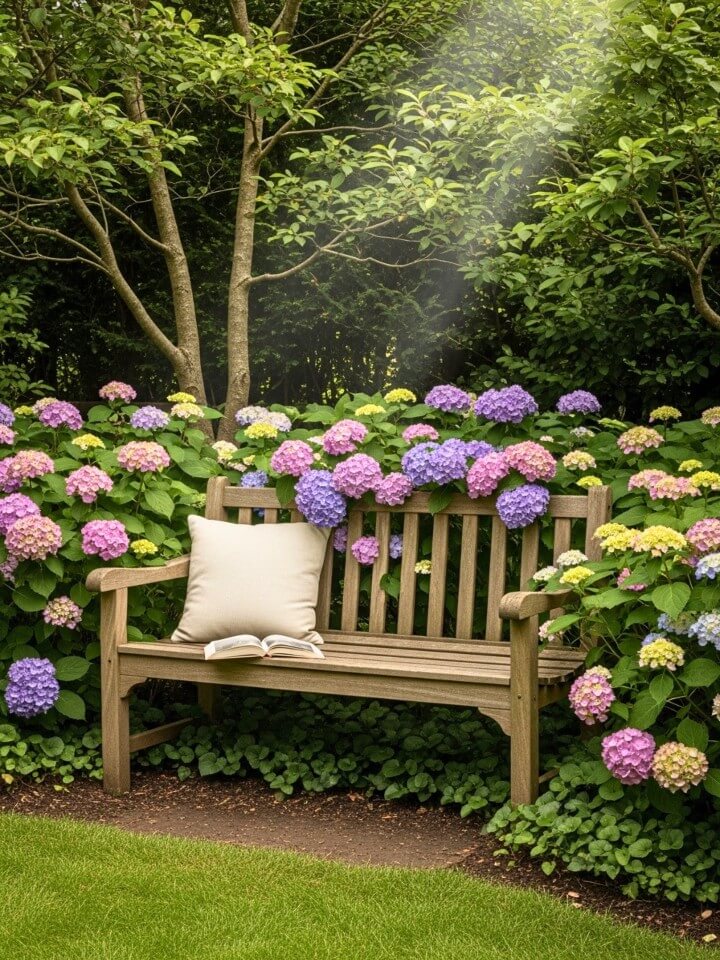
A bench tucked into the right planting almost dares you to sit down. The trick to making a garden bench feel like an actual retreat — instead of just furniture parked on a lawn — is surrounding it with plants that have presence without crowding the seat.
Choose Blooms You’ll See from A Seated Angle
Hydrangea heads land anywhere from waist-high to chest-high on a seated adult, which is exactly where you want them. Plant ‘Nikko Blue’ or ‘Penny Mac’ about 3 feet behind the bench so the flower heads peek over the backrest at eye level. Flank the sides with shorter ‘Bobo’ or ‘Little Quick Fire’. Keep a 4-foot clear zone in front so your feet aren’t fighting roots. Shredded bark underneath keeps the spot from turning muddy after rain.
9. Use Hydrangeas to Highlight a Water Feature
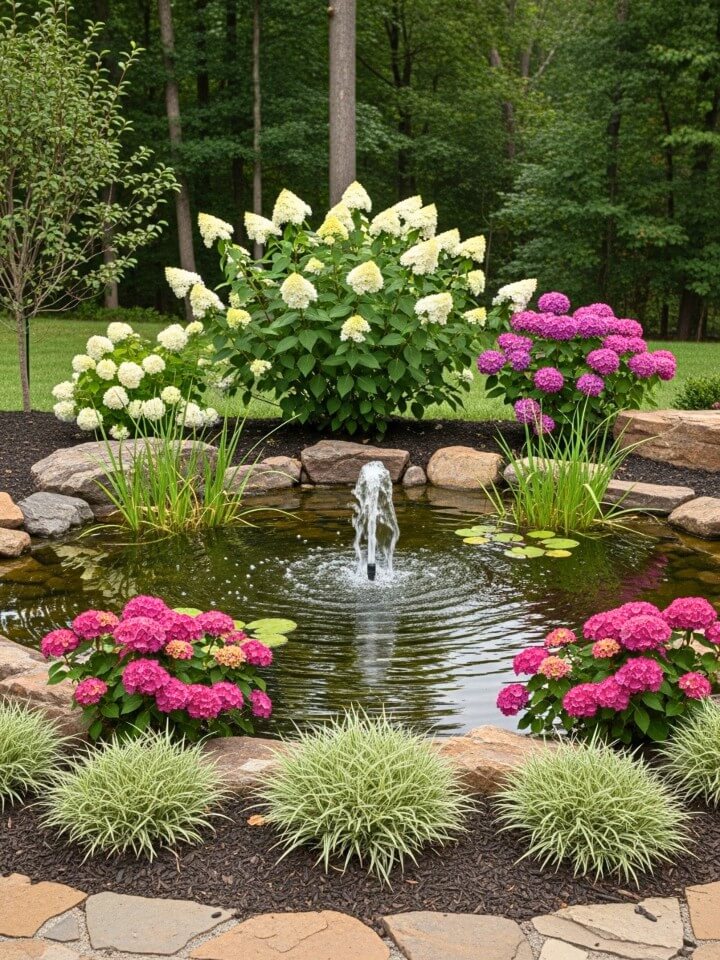
Water features earn their keep through reflection and sound, but most of them sit alone in a sea of lawn or rock — visually isolated and easy to walk right past. Hydrangeas around the edge fix that by bouncing color into the water itself.
Placement Matters More than Variety Here
Set taller types like ‘Limelight’ or ‘Pinky Winky’ on the far side of the feature so they show up in the reflection from your usual seating spot. Lower ‘Bobo’ or ‘Wee White’ go closer to the water’s edge but at least 18 inches back — hydrangeas like damp soil, not soggy soil, and standing water rots the crown fast. A border of smooth river stones between the plants and water hides drip lines and keeps soil from washing in during heavy rain.
10. Create a Cottage-Style Flower Bed with Hydrangeas
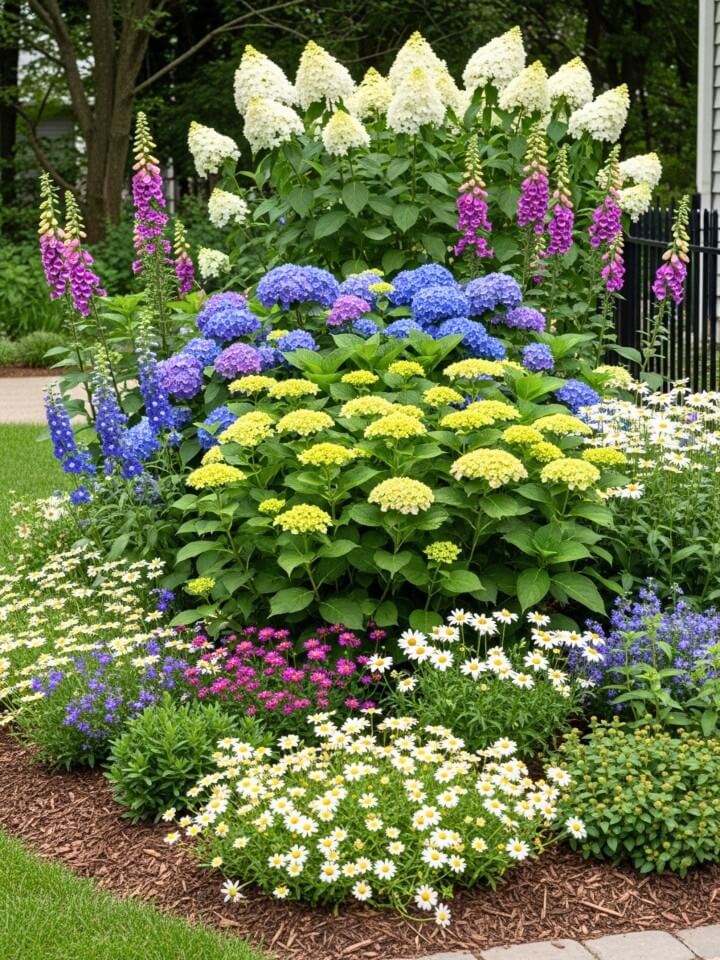
Bloom-packed hydrangea garden ideas that stretch color from late spring deep into autumn every year. Cottage style sounds casual, but the best versions of it are actually carefully orchestrated — controlled chaos, layered to feel like the plants just decided to land there on their own. Hydrangeas anchor that look beautifully because their round, full blooms balance out the wispier cottage staples.
The Companion List that Always Works
Pair ‘Annabelle’ or ‘Incrediball’ hydrangeas with spires of foxglove and delphinium at the back, Shasta daisies and rudbeckia in the middle, and creeping phlox or lady’s mantle along the front edge. Vary heights from 4 feet down to ground level so the eye travels through the bed instead of scanning it flat. Tuck a few alliums in for early-summer punctuation. Bark mulch keeps roots cool through July and August, when this style tends to look ragged without it.
11. Combine Hydrangeas with Hostas for Shady Spots
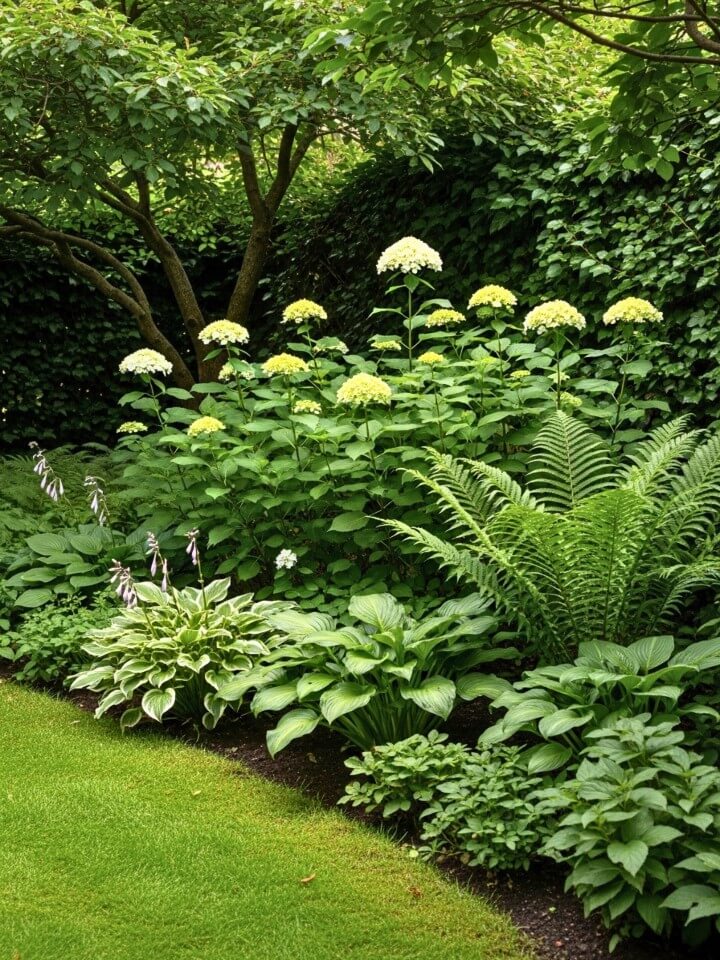
Shady spots get an unfair reputation. Most homeowners treat them as the corner where nothing will grow — but several of the best hydrangeas actually prefer that softer light, and hostas were practically built for it.
Why the Pairing Works so Well
Hydrangea foliage is broad and bold; hosta foliage comes in everything from blue-green to lime to white-edged. Place taller bigleaf or oakleaf hydrangeas at the back of a shade bed and ring them with hostas in graduated leaf sizes — ‘Sum and Substance’ for drama, ‘Patriot’ for variegation, ‘Mouse Ears’ along the front. Leave 24 inches between hosta clumps so they fill out without competing. Tuck ferns and Japanese forest grass into the small gaps. The bed reads cool and lush, not dim or neglected.
12. Line Your Driveway with Hydrangea Shrubs
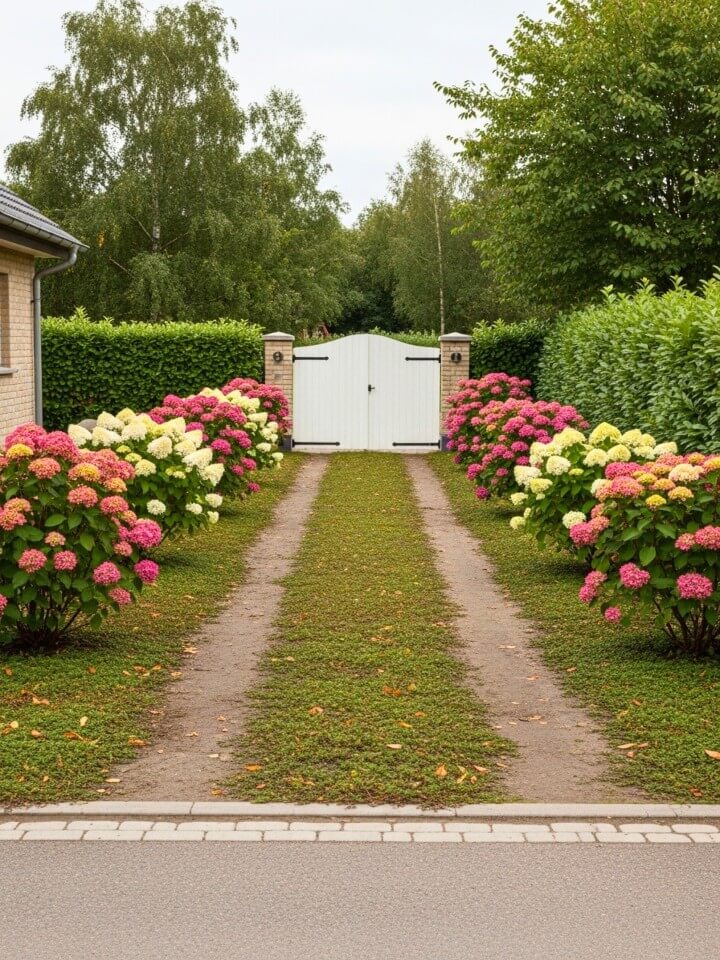
Driveways usually get treated as utility space, but they’re often the longest sight line on the entire property — and lining one with hydrangeas can quietly change the whole feel of the approach to your home.
Mistakes to Avoid Before You Plant
Don’t plant too close. Mature hydrangeas spread 4 to 6 feet wide, so keep them at least 3 feet back from the pavement to avoid scraped car doors and winter salt damage. Skip mophead types if the driveway gets all-day sun; they wilt visibly by midafternoon. Reach for panicle varieties instead — ‘Quick Fire’ and ‘Fire Light’ both handle heat and reflected pavement glare. Stagger plantings every 4 to 5 feet rather than lining them up rigidly; a looser rhythm reads more inviting than military precision.
13. Add Hydrangeas to a Rock Garden
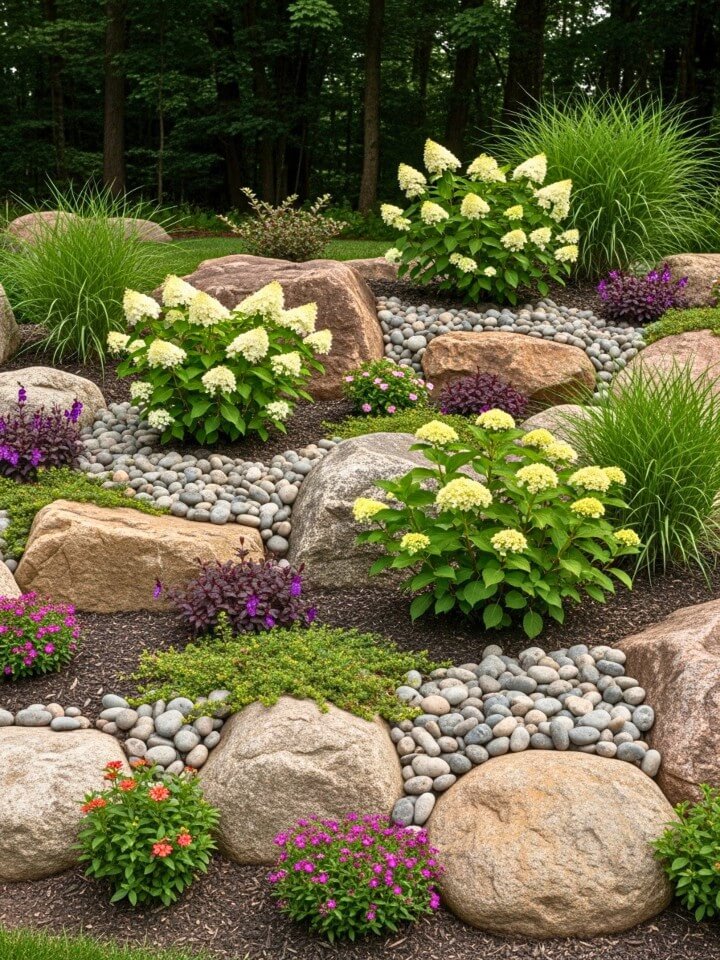
Most gardening guides will tell you hydrangeas and rock gardens don’t mix — too much water, wrong drainage, scale problems. That’s only true if you treat the whole space as one zone. Tuck the right variety into the right pocket and the contrast actually works in your favor.
Pick the Dry-Tolerant Varieties
Skip bigleaf mopheads here; they’ll wilt within a day. Reach for oakleaf hydrangea (‘Pee Wee’ stays around 3 feet) or ‘Bombshell’ — both tolerate the sharper drainage rock gardens demand. Plant them in soil pockets between larger boulders where roots can run deep, not in shallow scree. Amend the planting hole with compost, but leave the surrounding gravel alone. Pair them with sedum, dwarf conifers, and creeping thyme so the textures contrast: lush hydrangea foliage against tight, low alpines.
14. Plant Hydrangeas Around Trees for Layered Interest
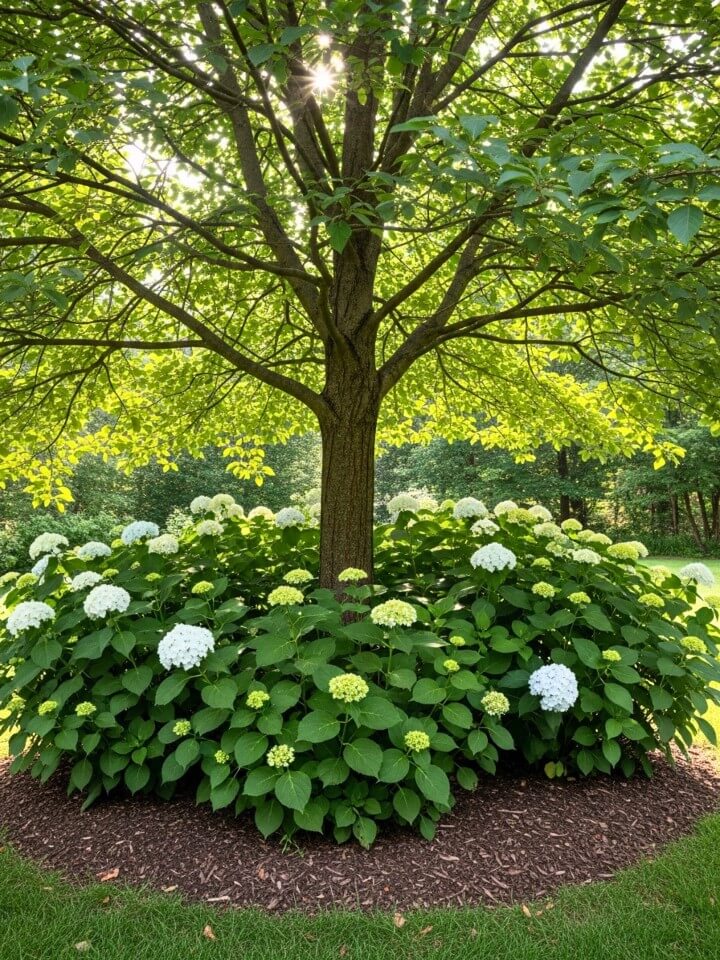
If you have a mature tree with bare ground underneath and grass that refuses to thrive, the area is telling you something — roots and shade are winning. Hydrangeas can fill that zone where lawn can’t, but only if you respect the tree you’re planting under.
Read the Canopy Before You Dig
Look up. A dense, low canopy means deep shade; oakleaf hydrangea handles that well. A high, open canopy means dappled light, and bigleaf types or ‘Annabelle’ will bloom fine. Plant outside the inner third of the root zone — roughly halfway between the trunk and the drip line — so you’re not slicing through major feeder roots. Dig wide, shallow holes; you’ll hit roots, so work around them, never through. Mulch the whole bed evenly with 2 to 3 inches of shredded bark.
15. Incorporate Hydrangeas into a Formal Garden Layout
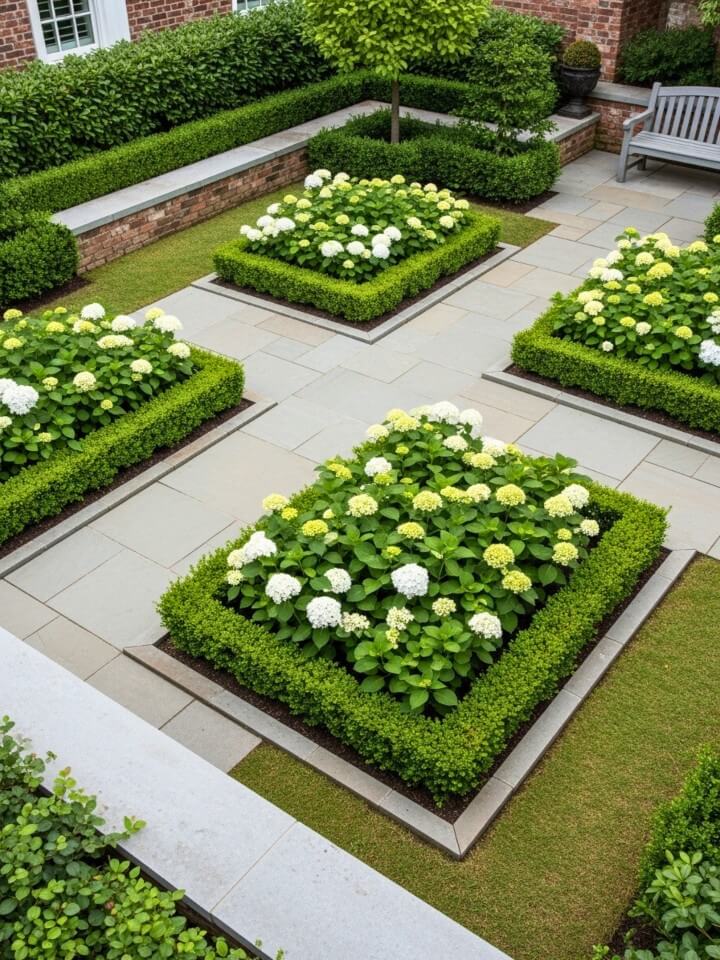
Formal gardens get associated with rigidity, but the actual defining feature is symmetry, not stiffness. That distinction matters because hydrangeas — soft, billowy, irregular — can absolutely live inside a formal layout. They just need to be placed where the geometry can hold them.
Use Them as The Soft Counterweight
Plant matched pairs flanking entrances, gates, or the corners of a parterre. ‘Incrediball’ or ‘Limelight’ standards (trained into tree form) work especially well here because the lollipop shape echoes formal topiary. Keep bed lines crisp with boxwood edging or cut stone, then let the blooms tumble over those clean lines. Repetition is what reads as formal: same variety, same size, same spacing on both sides. One asymmetrical hydrangea breaks the entire effect, so resist mixing types within a single axis.
16. Mix Different Hydrangea Varieties for Seasonal Blooms
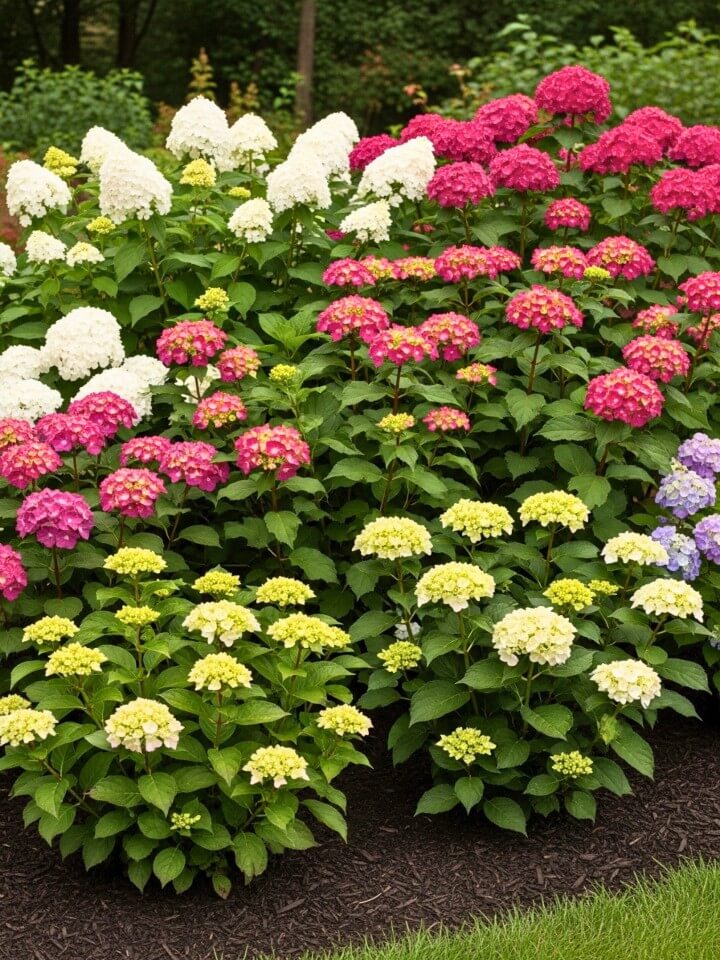
Effortless landscaping ideas with hydrangeas, from soft walkways to bold privacy-creating screens. Most homeowners plant one type of hydrangea and end up with six weeks of bloom followed by four months of plain green foliage. The fix isn’t planting more — it’s planting smarter. Different hydrangea families bloom on different timelines, and stacking them stretches the show from late spring well into fall.
A Four-Variety Lineup that Covers the Season
Bigleaf types (‘Endless Summer’, ‘Nikko Blue’) open first, late May into June. Smooth hydrangea (‘Annabelle’, ‘Incrediball’) follows from June through July. Panicle types (‘Limelight’, ‘Quick Fire’) take over in mid-July and hold their color through September, often fading to a dusty rose. Oakleaf overlaps from June and then carries the bed with burgundy fall foliage into October. Plant one of each family in the same bed and you’ll have something in bloom for nearly five months straight.
Sections 16–21 below. Naye 6 structural shapes: viewpoint-driven, functional-job, indoor-view-first, contrast-logic, two-problems-one-solution, and psychology-of-space opening. H3 phrasings bhi sab different.
17. Create a Hydrangea-Filled Island Bed in the Lawn
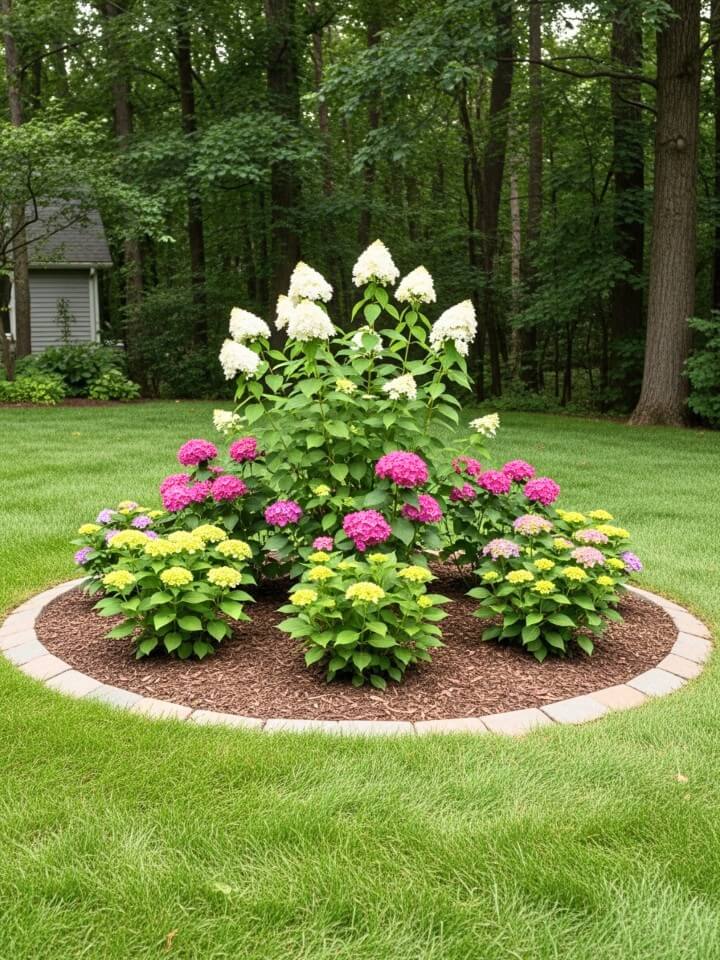
The best island beds are designed for one specific viewpoint — usually the kitchen window or the back deck — and every other decision flows from that one choice. Pick the angle you’ll see the bed from most, then build the planting outward from there.
Shape and Plant Placement
Round or kidney-shaped beds read more natural than perfect circles. Aim for 8 to 12 feet across in a mid-sized lawn; anything smaller looks like a polka dot, anything larger fights the lawn for attention. Anchor the center with a tall panicle like ‘Phantom’ or ‘Limelight’ (it’ll hit 6 to 8 feet). Ring it with mid-height ‘Bobo’ or ‘Little Lime’, then drift low-growing perennials — sedum, hardy geranium, or coreopsis — along the edge. Cut a clean steel or stone border into the lawn so the mower doesn’t fight you every weekend.
18. Use Hydrangeas as a Foundation Planting Around Your Home
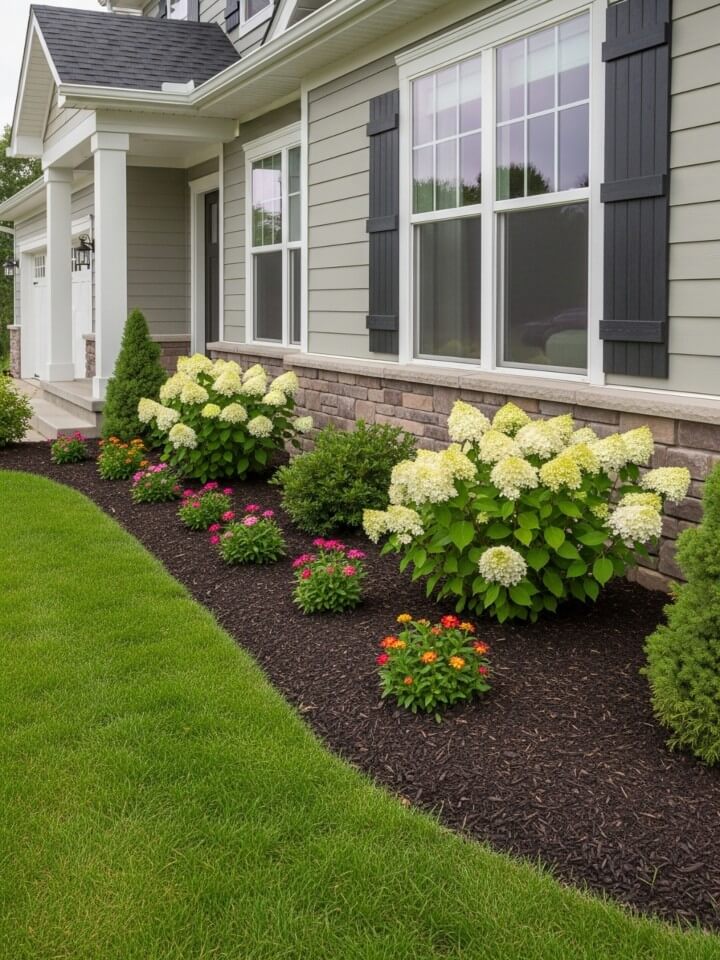
Foundation plantings have a specific job: soften the abrupt line where a building meets the ground. Done well, they pull the house into the landscape. Done poorly, they end up as evergreen meatballs that swallow the windows by year five.
Sizing the Plants to The House
Match plant height to architectural features. Under standard ground-floor windows (typically 30 inches off the ground), use ‘Bobo’ or ‘Little Quick Fire’ — both stay below the sill at maturity. For corners, where some vertical weight helps anchor the elevation, drop in ‘Limelight’ or ‘Quick Fire’. Keep all hydrangeas at least 3 feet out from the foundation itself; closer than that, they get blasted by heat reflecting off the siding and rarely thrive. Mix dwarf evergreens between them for winter structure when the hydrangeas are bare.
19. Design a Hydrangea Garden Along a Backyard Fence
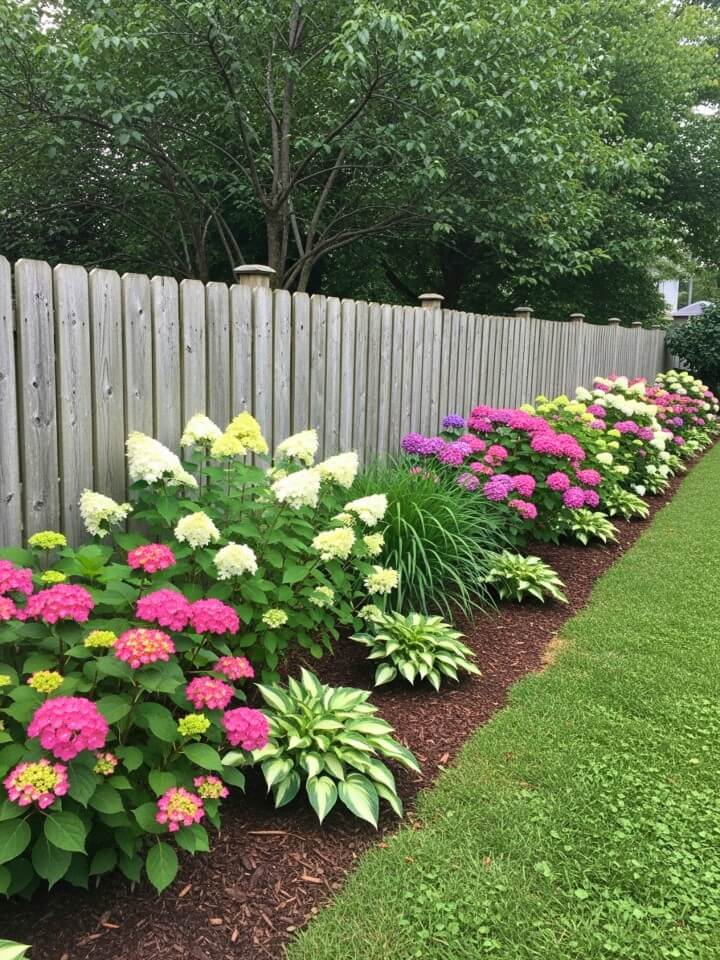
Backyard fences come with a built-in challenge: you see them every single day from inside the house, so the planting has to work as a view — not just as decoration from the property line. The bed should reward you when you’re looking out the window in February as much as in July.
Build for The Indoor View First
Stand inside, look out, and pick the spot your eye lands on most — that’s your focal point. Plant a showstopper there. Oakleaf hydrangea works year-round thanks to its fall color and peeling cinnamon bark in winter. Stretch ‘Limelight’ or ‘Quick Fire’ along the rest of the fence in groups of three. Skip the single-row look; layer hostas, ferns, or astilbe in front to give the bed depth. Keep 3 feet of clearance from the fence for airflow.
20. Pair Hydrangeas with Ornamental Grasses for Texture
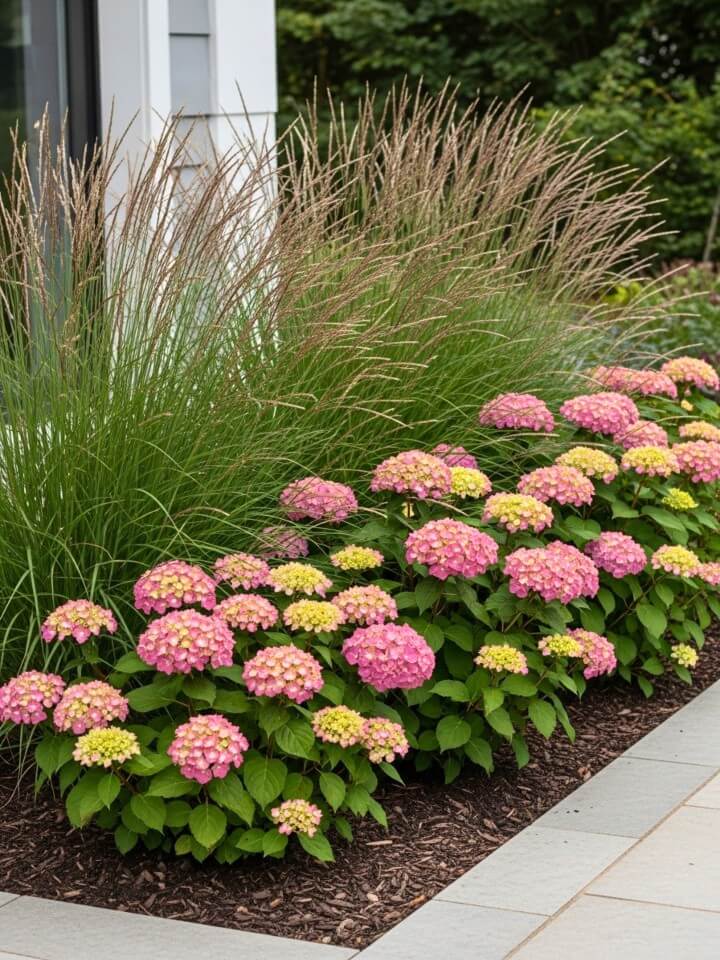
Hydrangea blooms are dense and static. Ornamental grasses are airy and constantly moving. That contrast — solid against feathery, still against shifting — is what makes the pairing work. One without the other looks fine; together, they elevate each other.
Match Grass Scale to Hydrangea Size
Big hydrangeas need big grasses. Behind a 6-foot ‘Limelight’, plant tall maiden grass (Miscanthus ‘Morning Light’) or switchgrass (‘Northwind’) — both hit 5 to 6 feet and sway in any breeze. With mid-size ‘Bobo’ or ‘Little Lime’, step down to fountain grass (‘Hameln’) at 2 to 3 feet. Plant the grass behind or to one side, never directly in front. Leave the grasses standing through winter — the bleached plumes look stunning against bare hydrangea stems and a dusting of snow.
21. Brighten a Sloped Yard with Mass Hydrangea Plantings
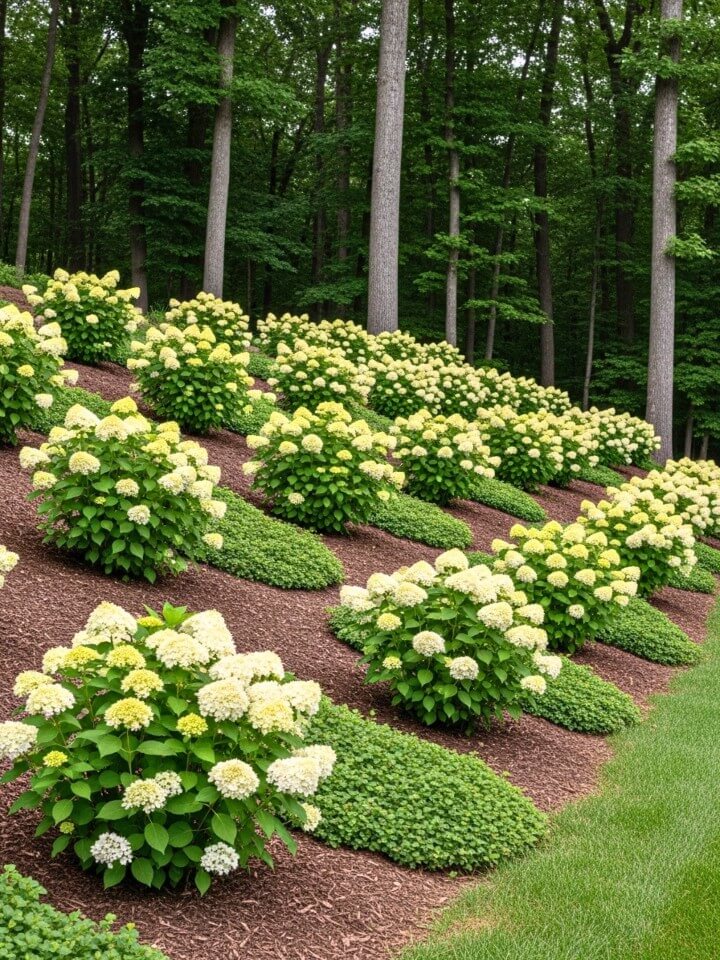
Practical hydrangea landscape ideas built on smart variety choice, spacing, and seasonal layering. A sloped yard comes with two problems at once: it’s hard to mow, and harder to keep soil in place during heavy rain. Mass hydrangea plantings solve both — roots grip the soil, foliage breaks rainfall before it hits the ground, and the blooms turn an awkward grade into the most photographed part of the property.
Plant in Staggered Drifts, Not Rows
Skip straight lines. Set hydrangeas in offset clusters of three to five, with each cluster slightly downslope from the next. That zigzag pattern slows water runoff far better than rows ever do. Use tough panicle varieties — ‘Quick Fire’ and ‘Pinky Winky’ tolerate the drier conditions higher up the slope — and pair with ‘Annabelle’ near the bottom where moisture collects. Lay 3 inches of shredded hardwood mulch right after planting to hold the soil during the first season.
Conclusion:
Hydrangeas reward planning more than they reward enthusiasm. The homeowners whose yards stop you mid-walk aren’t the ones who planted the most shrubs — they’re the ones who picked the right variety for the right corner and gave each plant the breathing room to do its job. Treat your yard like a series of small rooms, each with a purpose: a soft entry, a quiet retreat, a long view from the kitchen window. Then let hydrangeas furnish those rooms the way you’d furnish indoor ones — with intention, scale, and a little restraint. The shrub will repay you for decades.
FAQs About Hydrangea Landscaping
Quick answers to the questions that come up after the planting is done — covering bloom problems, soil chemistry, wildlife, winter care, and the timing decisions that determine whether your hydrangeas thrive or just survive each season.
When Is the Best Time to Plant Hydrangeas?
Early spring and fall are both ideal — soil is workable, temperatures are mild, and roots establish before summer stress sets in. Avoid planting during peak heat in July or August unless you can water deeply every single day for six weeks.
Why Aren’t My Hydrangeas Blooming?
The three most common reasons are pruning at the wrong time, too much shade, and late spring frost damage to flower buds. Bigleaf and oakleaf types bloom on old wood, so cutting them back in spring eliminates that year’s entire flower show.
How Do I Change My Hydrangea’s Bloom Color?
Only bigleaf and mountain hydrangeas shift color through soil chemistry. Add aluminum sulfate to push blooms blue in acidic soil (pH below 6); add garden lime to shift them pink in alkaline soil above pH 7. White varieties stay white regardless.
Are Hydrangeas Deer-Resistant?
Not really — deer browse hydrangeas, especially tender new growth in spring. Oakleaf hydrangea tends to be less appealing thanks to its fuzzy leaves, but no variety is truly safe. Liquid deer repellents or fencing offer the most reliable long-term protection.
How Do I Protect Hydrangeas Through Winter?
Mound 4 to 6 inches of shredded leaves or bark mulch over the crown right after the first hard frost. For bigleaf types in zones 5 and colder, wrap the entire shrub in burlap to protect dormant flower buds from drying winter winds.