34 Gravel Driveway Ideas For A Welcoming Home Entrance
Your driveway is the first thing anyone sees when they pull up to your home. It sets the tone before the front door even comes into view. That’s why these 34 incredible gravel driveway ideas matter — they offer a low-cost way to transform curb appeal without the heavy price tag of concrete or asphalt.
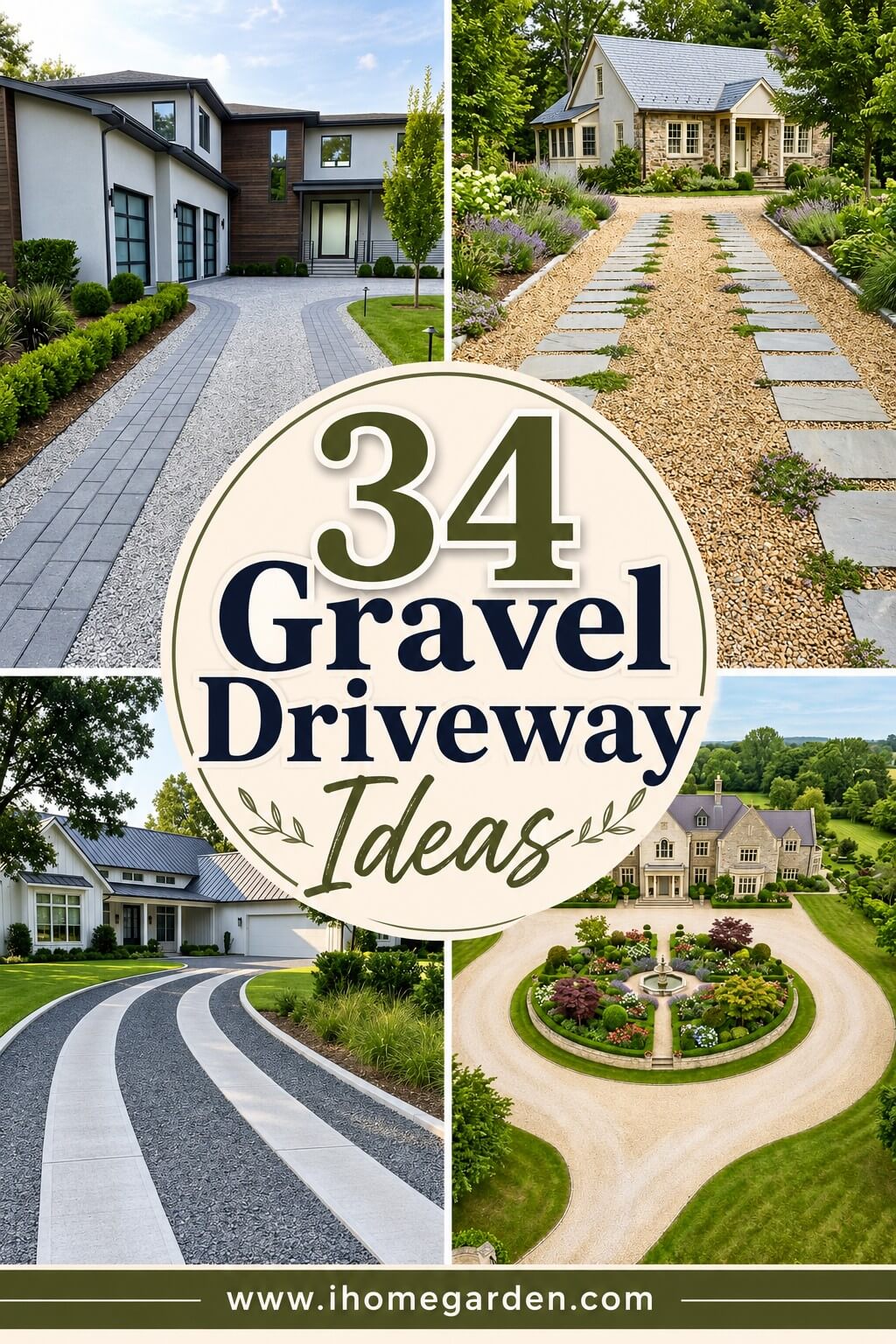
Gravel works because it’s flexible. You can refresh it in a weekend. It drains better than paved surfaces. And it suits almost any home style, from farmhouse to modern minimalist.
But not every gravel works for every yard. The right choice depends on your climate, your slope, how often you drive on it, and the look you want.
Below you’ll find driveway ideas with real notes on cost, upkeep, and where each style actually performs best. Pick the one that fits your home, not just the one that photographs well.
1. Classic Pea Gravel Driveway
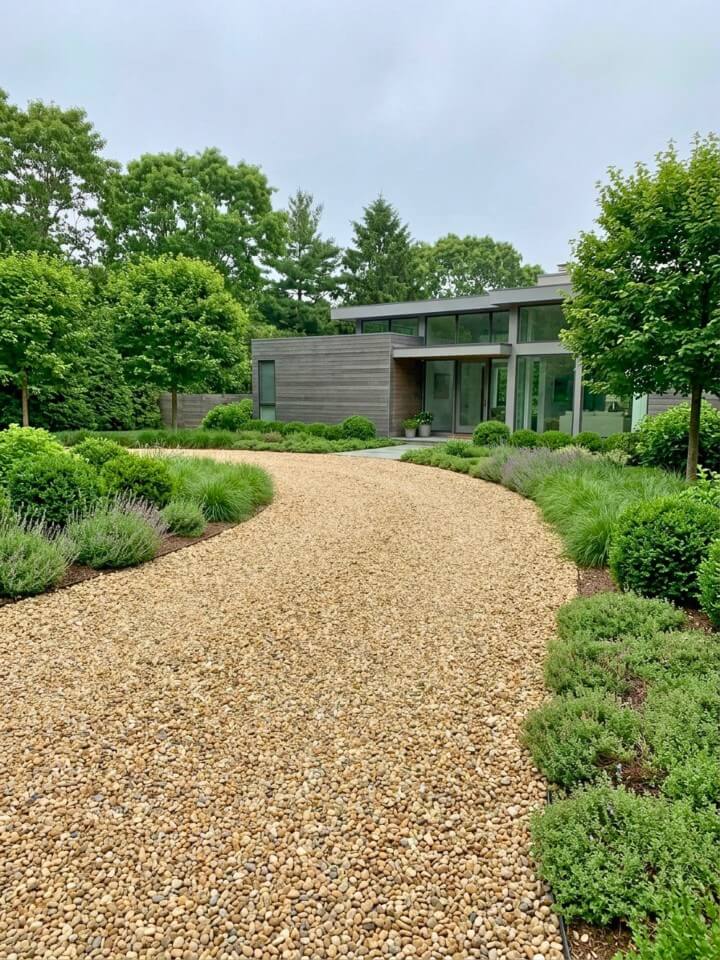
Pea gravel is where most homeowners start, and there’s a reason for that. The stones are small, smooth, and roughly the size of a green pea, which gives the driveway that soft crunch underfoot that everyone associates with countryside homes.
- Best for: Cottage, farmhouse, and casual modern homes with flat or gently sloped yards.
- Estimated cost: $1.50–$3 per square foot installed.
- Maintenance: Moderate. You’ll need to rake it back into shape every few months and top it up once a year.
- Heads-up: Pea gravel shifts under heavy tires, so if you park trucks or trailers daily, pair it with a stabilizer grid underneath. Avoid it on steep slopes — it migrates downhill fast.
2. Herringbone Brick-Bordered Gravel
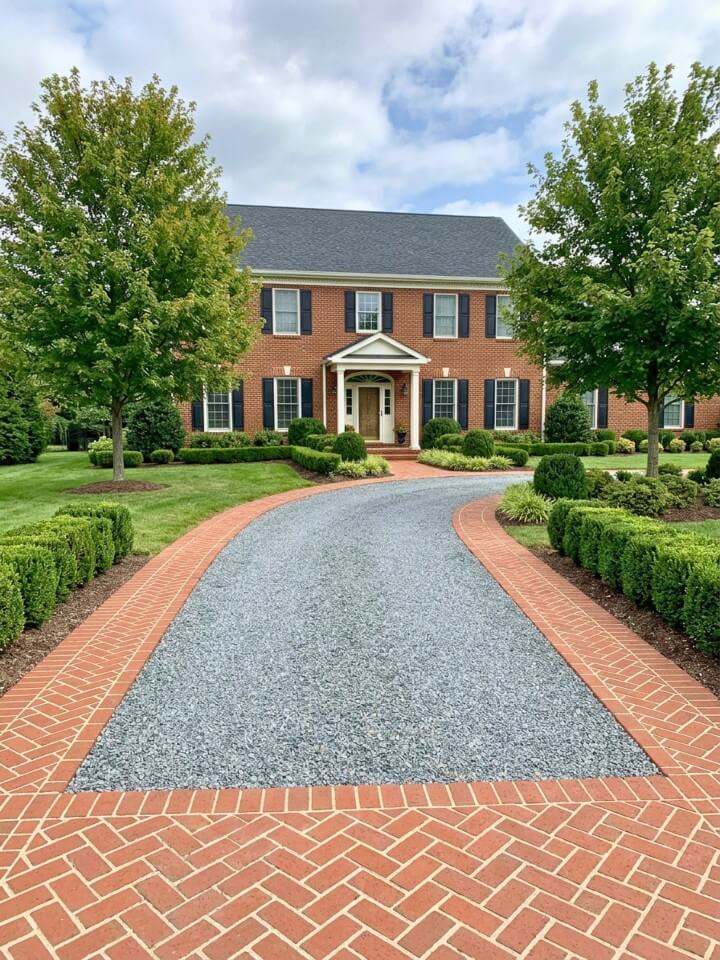
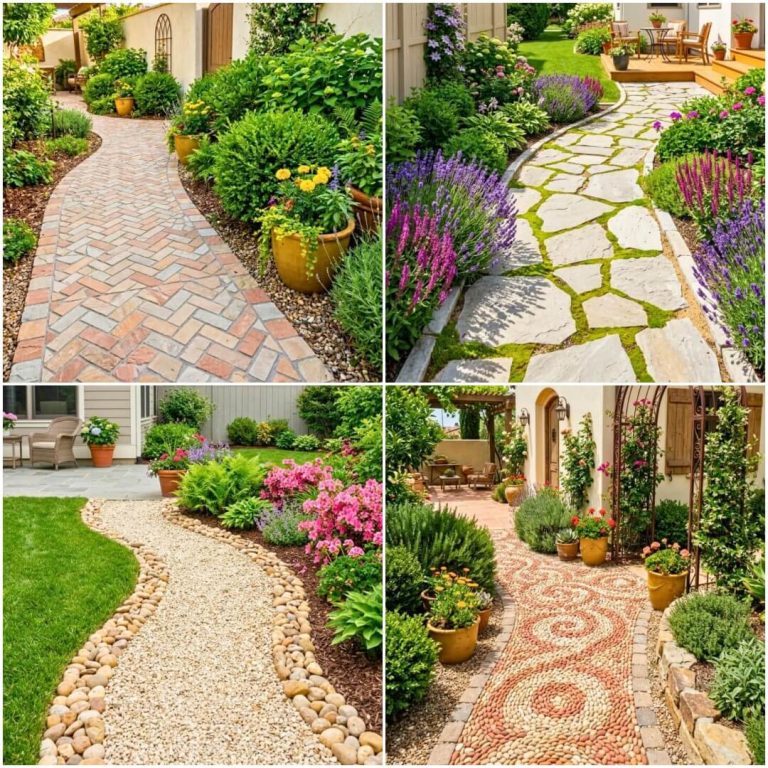
This one takes a plain gravel drive and dresses it up with a brick border laid in a herringbone pattern. The visual rhythm of the bricks does most of the work, so even a simple gravel center looks intentional and refined.
A Few Things to Know Before You Commit:
- The brick border holds gravel in place better than wood or steel, so spreading is minimal
- Installation is more involved — expect $4–$7 per square foot total
- It pairs beautifully with brick homes, colonial facades, and symmetrical front yards
- Reclaimed bricks give a warmer, weathered feel; new bricks look crisp and formal
Upkeep is low once installed. Re-level the gravel center once a year and check the brick edges for any that have shifted after freeze-thaw cycles.
3. Crushed Stone with Stone Border
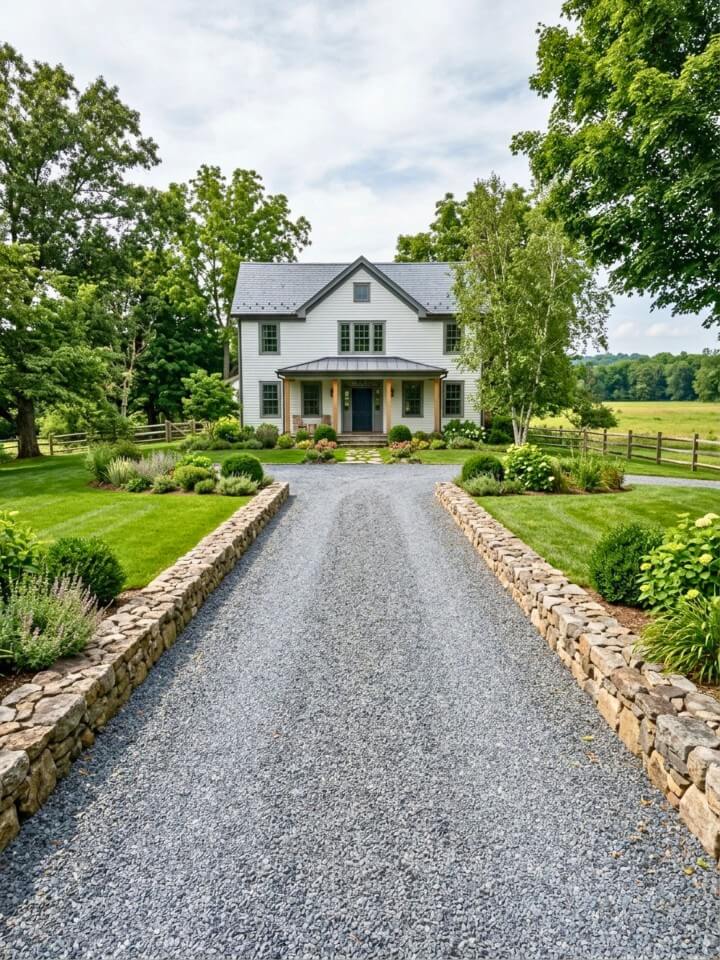
Explore stunning gravel driveway ideas to boost curb appeal without breaking your budget today. Crushed stone has sharper edges than pea gravel, which means the pieces lock together and create a firmer driving surface. Frame it with a natural stone border and you get a driveway that handles regular truck and SUV traffic without rutting.
This style suits larger properties, rural homes, and modern farmhouses where a defined entrance matters. The stone border isn’t just decorative — it physically stops gravel from spilling into your lawn, which cuts down on raking and refilling.
- Cost: $2–$4 per square foot, more if you use premium stone for the border.
- Lifespan: 8–10 years before a full top-up is needed.
- Climate note: Crushed stone performs well in snowy regions because plows can scrape it without flinging stones the way pea gravel does.
4. White Marble Chip Driveway
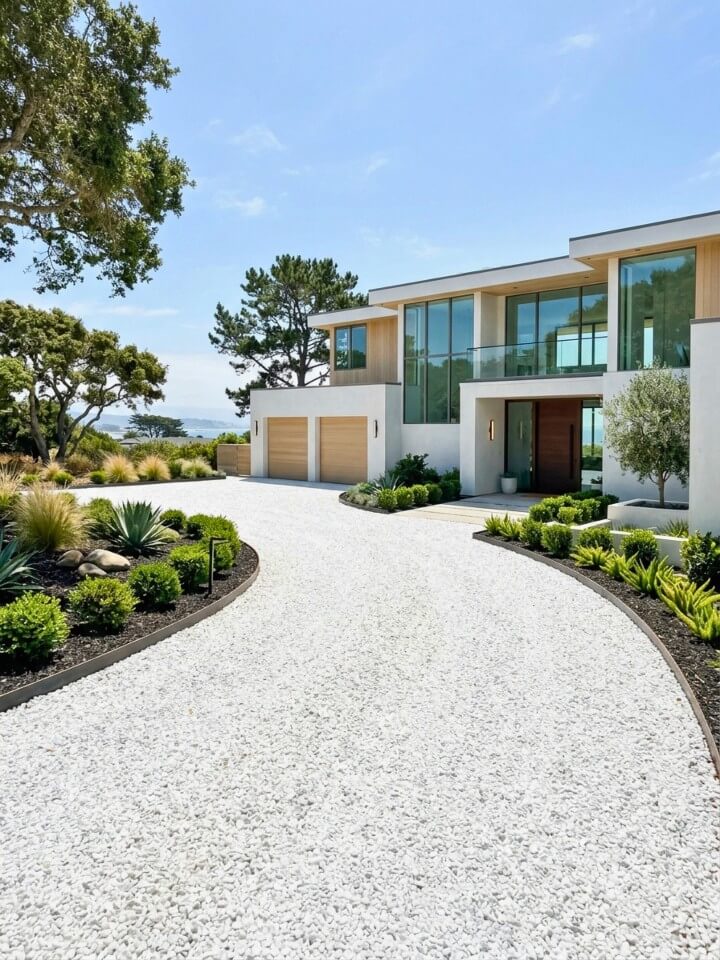
White marble chips are the showpiece option. They reflect light, brighten shaded entrances, and look stunning against dark siding or deep green landscaping. But they’re not for everyone — here’s the honest breakdown.
What works in their favor: the bright surface keeps the driveway cooler in summer, the chips have a clean angular shape that locks together well, and they instantly elevate a modern or coastal-style home.
What to think about: marble chips cost more, usually $3–$6 per square foot. They also stain. Rust from a leaking car, oil drips, or even tannins from fallen leaves can leave marks that don’t easily wash out. If your driveway sits under heavy tree cover, pick a different color.
Best paired with white or light-colored exteriors, glass railings, and minimalist plant beds.
5. Gravel and Paver Strip Combo
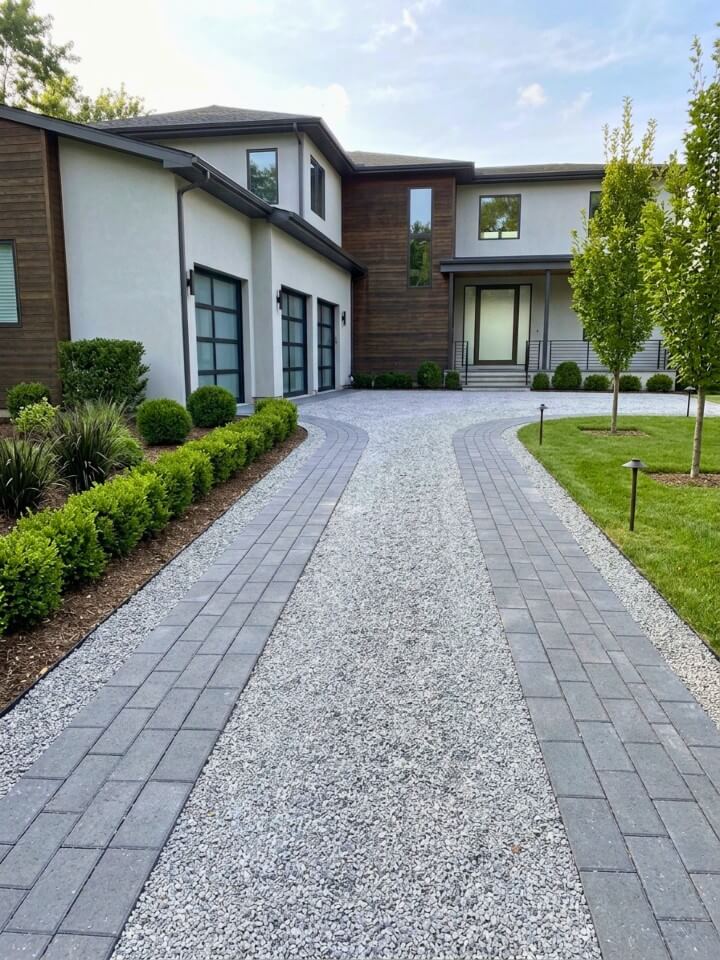
Two narrow paver strips run down the center where your tires roll, with gravel filling the rest of the driveway. It’s a smart hybrid — you get the stability of pavers exactly where you need it, without paying to pave the entire surface.
This setup solves a common gravel problem: ruts. Over time, tires carve grooves into loose stone, and you end up refilling those tracks constantly. Paver strips eliminate that entirely.
Where It Shines:
- Medium to long driveways with daily car use
- Modern, minimalist, and transitional home styles
- Properties where you want clean lines without losing the gravel texture
Cost: $5–$9 per square foot since you’re combining two materials.
Tip: Measure your vehicle’s wheelbase before laying the strips. Standard width is about 24 inches per strip with 36–40 inches between centers, but adjust based on what you actually drive.
6. Decomposed Granite Driveway
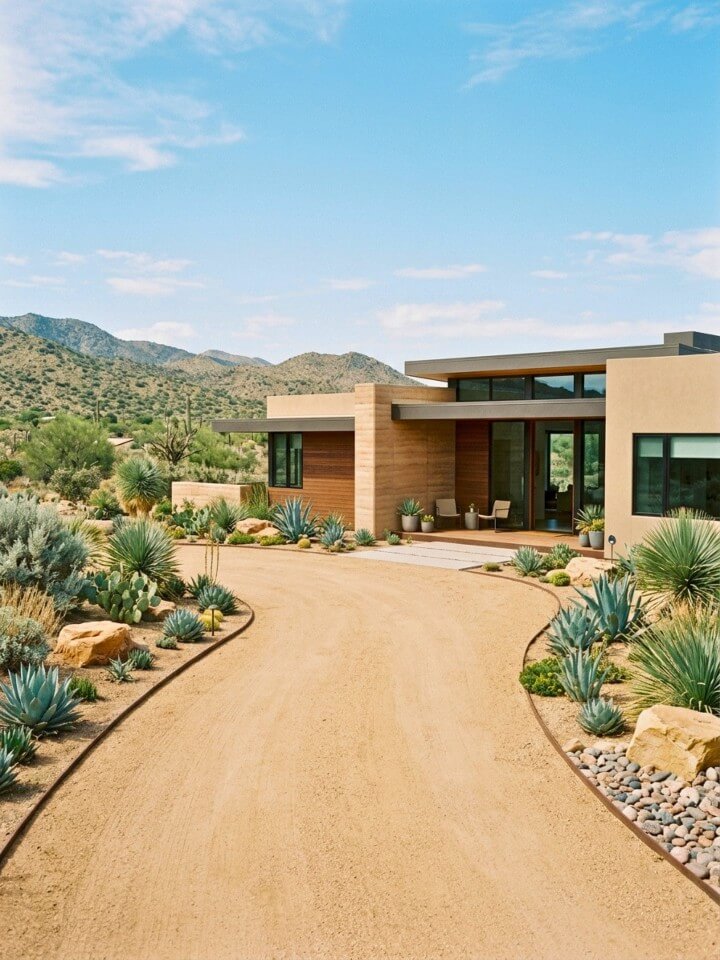
Walk on a properly installed DG driveway and you’d swear it was packed earth — that’s how tight the surface gets once it’s compacted. Decomposed granite is crushed so fine that the smallest particles fill the gaps between the larger ones, creating a dense, almost solid driving surface that still drains.
It’s the gravel of choice for dry climates and modern desert landscapes. Homes in Arizona, Nevada, and inland California use it constantly because it handles heat without softening and pairs naturally with succulents and warm-toned stucco.
The catch is water. In regions with heavy rainfall, DG erodes — you’ll see rusty tan streaks running down your driveway and onto your sidewalk after every storm. The fix is a stabilizer binder mixed into the top layer, which costs more upfront ($4–$6 per square foot installed versus $1–$3 loose) but eliminates the washout problem entirely.
If you live somewhere wet, either commit to the binder or pick a different material.
7. Gravel with Concrete Ribbon Tracks
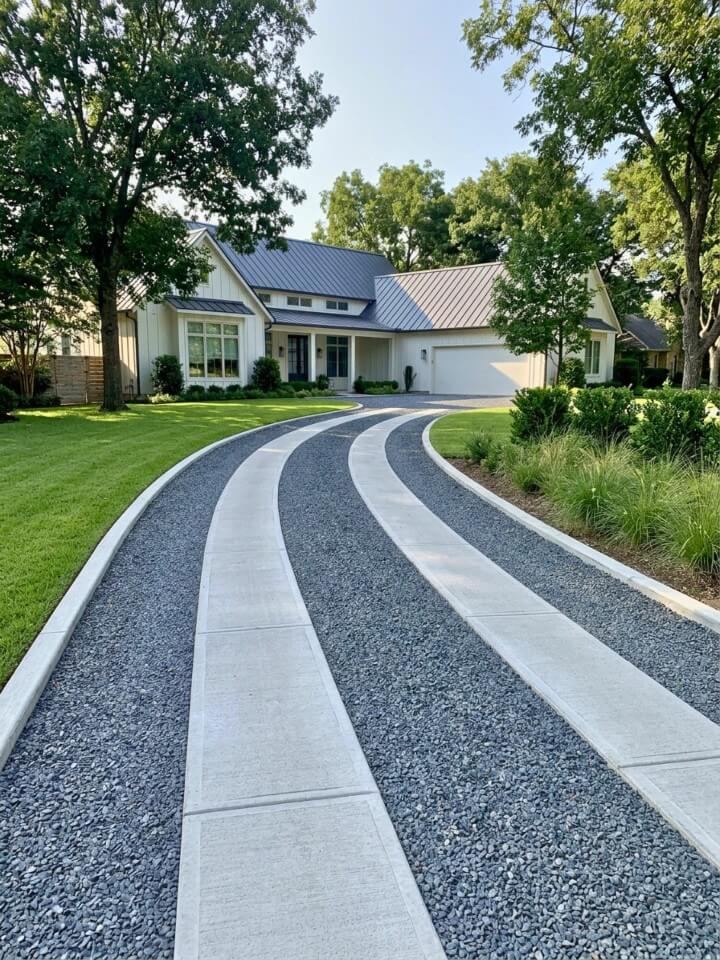
Long gravel driveways develop washboard ripples and tire ruts. You spend weekends raking and refilling, and the surface still looks beat up.
Two concrete strips, each 18–24 inches wide, running the full length of the driveway exactly where tires track. Gravel fills everywhere else.
Why It Works:
- Tires never touch loose stone, so no rutting
- Gravel between the tracks still drains properly
- The look stays visually soft because most of the surface is still gravel
- Snow plows have a hard edge to scrape against
What it costs: $6–$10 per square foot for the combined system. Concrete tracks alone run about $8 per linear foot.
Sizing note: Measure your widest vehicle’s track width (the distance between the centers of the left and right tires) before pouring. Standard American pickups need centers about 68 inches apart. Get this wrong and you’ll be straddling the strips for years.
8. Gravel with Stepping Stone Path
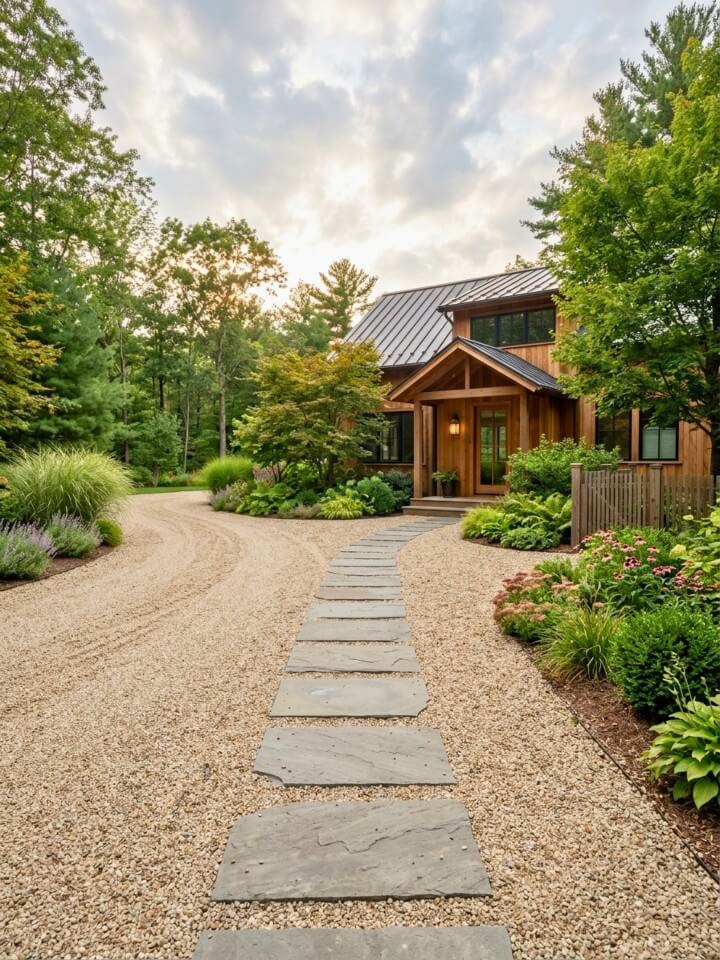
Discover cheap gravel driveway ideas that save money while creating a stylish rustic yard look. Anyone who’s hosted a dinner party on a gravel driveway has watched at least one guest pick their way across in heels, looking miserable. Stepping stones fix that.
The idea is simple — set flat stones into the gravel along the walking route from the parking area to the front door, spaced for a comfortable stride (roughly 24 inches center-to-center for most adults). Guests now have a stable path. Gravel still does its job everywhere else.
A few details that separate a good install from a sloppy one:
The stones must sit flush with the gravel surface, not above it. Raised stones become trip hazards the moment fall leaves cover them. Each stone needs a compacted gravel base underneath, at least 2 inches deep, or it’ll wobble within a season. Stone choice matters — bluestone, slate, and limestone handle freeze-thaw cycles. Sandstone flakes apart and looks terrible by year three.
Budget $200–$600 in stones for a typical front walkway, plus a few hours of labor if you’re doing it yourself.
9. Two-Tone Gravel Driveway
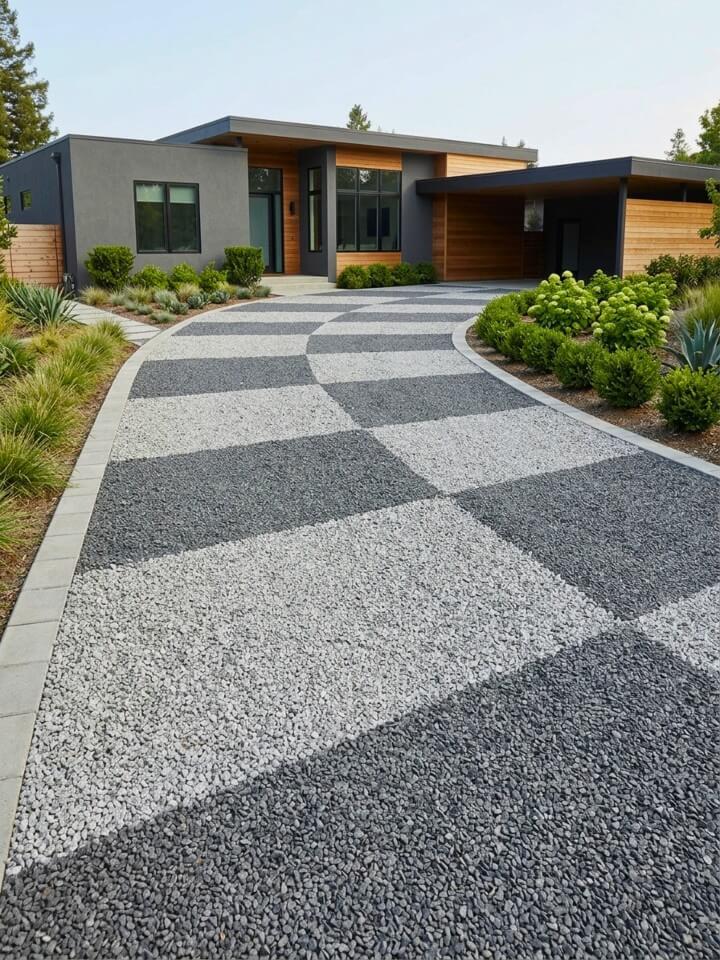
“How do I make a gravel driveway look like it was actually designed and not just dumped?”
This is one answer. Two-tone driveways use contrasting stones — usually a darker border with a lighter center, or wide bands of alternating color — to make the surface read as intentional.
Some combinations that consistently work:
| Center stone | Border stone | Style match |
|---|---|---|
| Pea gravel (tan) | Black basalt | Modern, contemporary |
| White marble chips | Dark river rock | Coastal, transitional |
| Beige crushed stone | Charcoal slate | Minimalist, urban |
| Light granite | Red lava rock | Southwestern, desert |
The single most important detail: install a steel or aluminum edging strip between the two stones. Without that physical barrier, the colors blend together within a year as stones migrate across the line. With it, the pattern stays crisp for a decade.
Cost runs $3–$5 per square foot, which is barely more than a single-tone driveway. The visual upgrade is significant.
10. Cobblestone-Edged Gravel Driveway
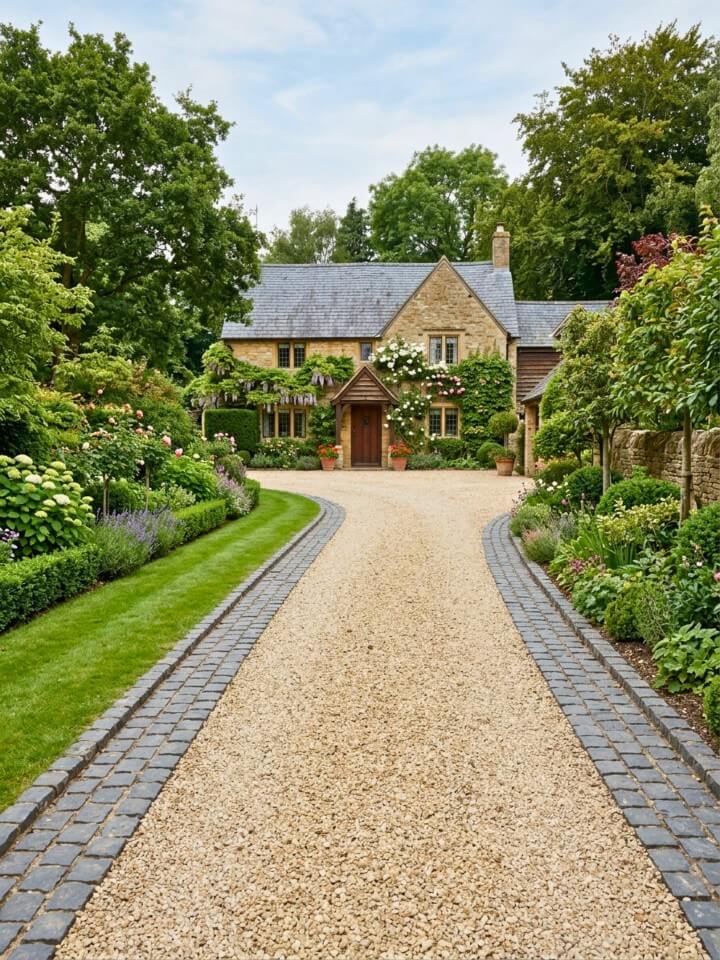
There’s a reason European courtyards have looked the same for 400 years — cobblestone holds up. When you border a gravel drive with real cobblestone, you’re not just adding decoration. You’re adding a feature that will likely outlast the house itself.
This is the right pick for homeowners who want their driveway to feel established the day the contractor leaves. Cobblestones bring instant age and weight, which is why they sit so naturally next to brick facades, stone walls, and traditional landscaping.
A few things worth knowing before you commit:
Real granite cobblestone runs $8–$15 per linear foot. The concrete reproductions are about half that price and look fine for the first few years, but they spall and crack in freeze-thaw climates. If you’re in the Northeast or Midwest, spring for the real material.
Installation is not a DIY project for most people. Cobblestones need to be set in a mortar bed over a compacted base — skip that step and they’ll shift within one winter. Plan to hire a mason, which roughly doubles the material cost in labor.
What you get for the investment: 30+ years of border life, a driveway that genuinely improves home resale value, and a finish that looks better as it weathers.
11. Crushed Granite with Timber Borders
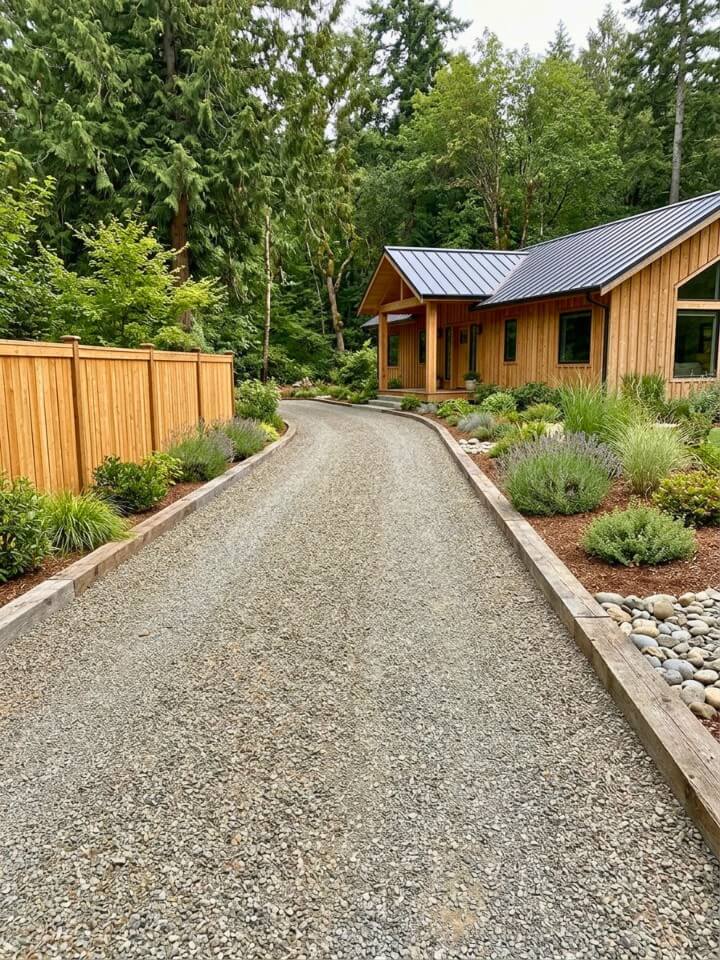
There’s something about crushed granite framed in timber that just looks like it belongs on a property — not installed on one. The warm grain of the wood softens the sharp edges of the granite, and the whole thing ages into the landscape rather than fighting it.
I’d recommend this style if your home leans rustic: log cabins, farmhouses, anything with cedar siding or board-and-batten walls. The timber borders are usually pressure-treated 4×6 or 6×6 beams, laid flat and pinned with rebar so they don’t shift. Reclaimed railroad ties work too, but they’re heavier and harder to source clean.
Budget around $3–$5 per square foot total. Timber lasts 10–15 years before the bottom edges start rotting, so factor in eventual replacement.
12. Gravel with Belgian Block Edging
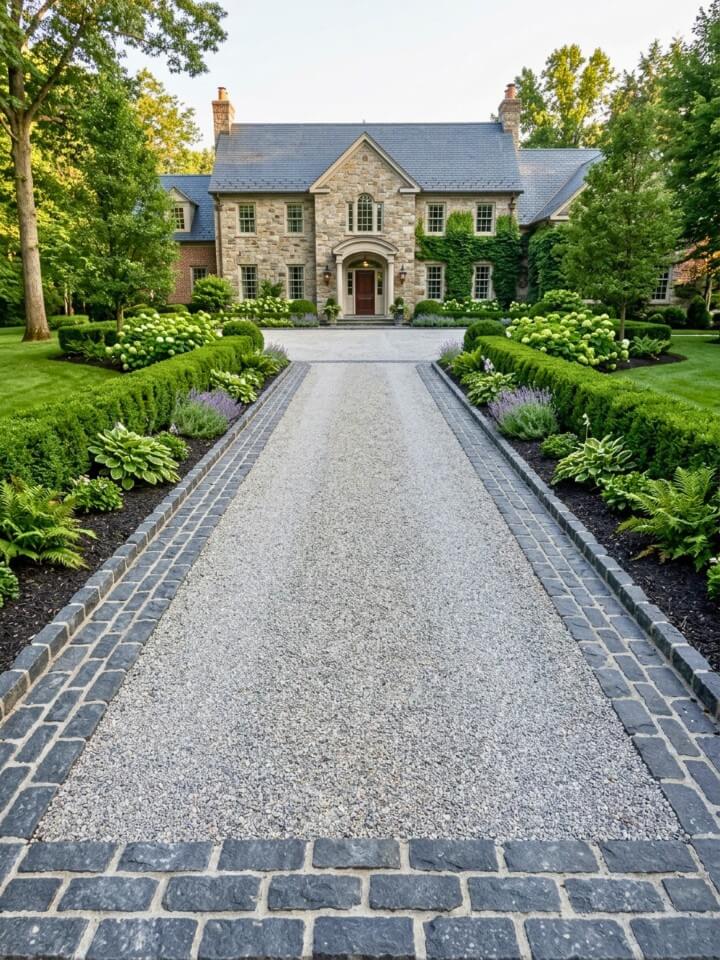
A gravel driveway bordered by Belgian blocks — granite cubes about 4 to 6 inches on each side, originally used to pave European streets.
The blocks are heavy enough that they don’t move, sharp-edged enough to look formal, and durable enough to outlast the house.
- Cost range: $10–$18 per linear foot for the blocks, plus standard gravel pricing for the center.
- Where it fits best: Formal homes, urban properties, anywhere a clean rectangular driveway shape matters. It looks especially right with Georgian, Federal, and traditional brick architecture.
- Common mistake: Setting Belgian blocks directly in sand. They need a concrete footing, or they’ll tilt within two winters of freeze-thaw cycles.
13. Gravel Driveway with Lighting Borders
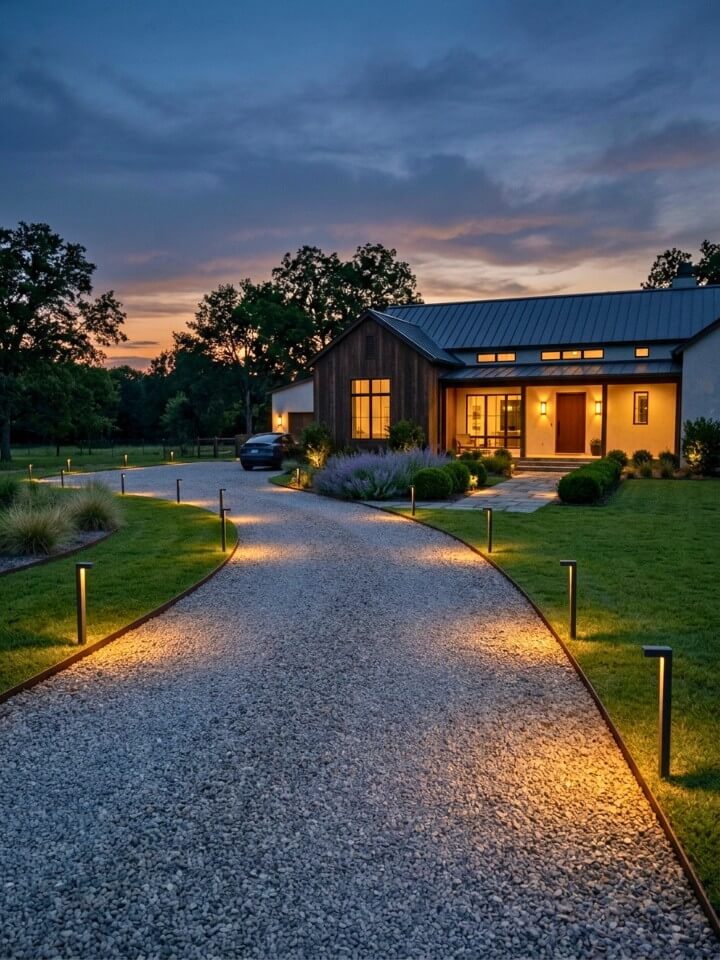
Upgrade your home with a modern gravel driveway design that blends sleek style and function. Lighting isn’t usually the first thing people consider for a driveway, but once you’ve come home in the rain at 11 PM and missed the edge of your gravel drive, you understand why it matters.
There are three lighting approaches that work well here:
- Low-voltage path lights — the most common. Stake-mounted, 12V, easy to install yourself. Expect $30–$80 per fixture and plan one every 6–8 feet.
- Recessed in-ground lights — sleeker and won’t get knocked over by snowplows. Pricier at $80–$200 each and need proper drainage cups underneath, or they fill with water.
- Solar bollards — cheapest option but unreliable in shaded driveways or northern winters with short daylight hours.
Whichever you choose, warm white (2700K–3000K) bulbs look right with gravel. Cool white reads as institutional.
14. River Rock Driveway
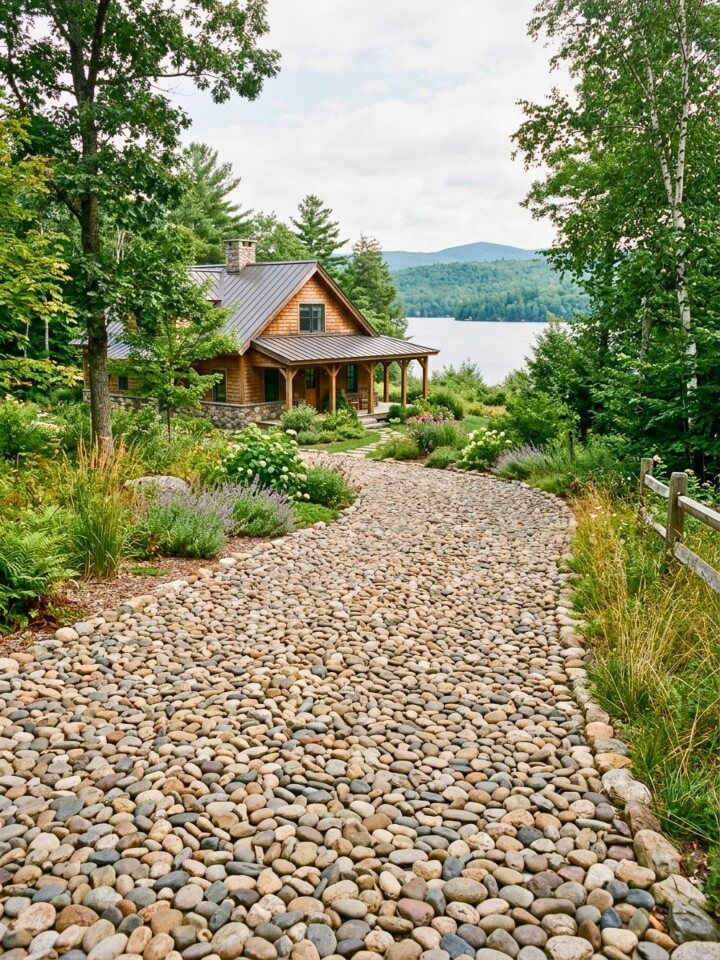
River rocks are the smooth, rounded stones you’d find in a streambed — and that smoothness is both their charm and their problem.
The look is unbeatable for rural homes, lakeside properties, and earthy landscapes. Rocks in the 1–3 inch range give a chunky, naturalistic surface that feels grounded in nature.
But here’s the honest tradeoff: those round shapes don’t lock together the way crushed stone does. Drive on a pure river rock surface and your tires will displace stones with every pass. The fix is to install a gravel stabilizer grid underneath — plastic honeycomb panels that hold each stone in place — or to use river rock only as a decorative top layer over a compacted crushed base.
Expect $3–$6 per square foot done properly. Skip the shortcuts on the base, or you’ll be raking weekly.
15. Gravel with Grass Strip Center
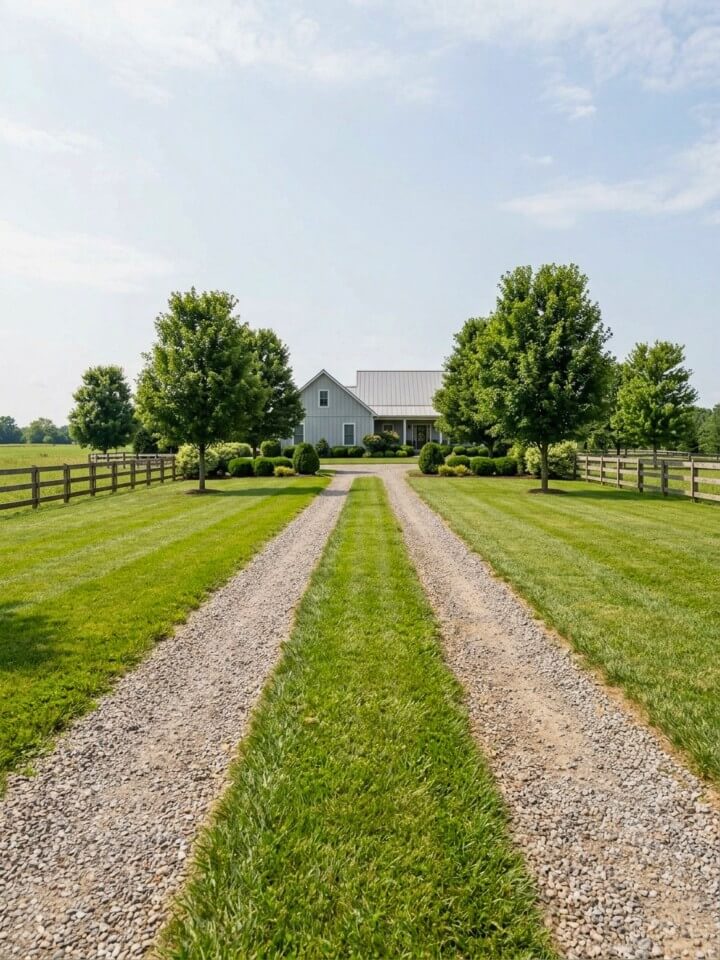
Two gravel tracks for your tires, a strip of living grass running down the middle. It’s an old design — you’ll see it on farmsteads dating back a century — and it still works because it solves a real problem: how to have a driveway that doesn’t feel like a driveway.
The grass center keeps the surface soft, helps with rainwater absorption, and visually shrinks the driveway so your front yard doesn’t feel cut in half by gray stone.
That said, this only works under specific conditions:
- You have a longer driveway with room for the design to breathe (short ones look awkward)
- Your traffic is light to moderate — daily commuters, not constant deliveries
- You’re willing to mow that center strip, which means a push mower or string trimmer
Tough grasses like fescue, zoysia, and buffalo grass handle occasional tire crossings best. Avoid Kentucky bluegrass — it won’t survive even gentle compaction.
Budget roughly $3–$5 per square foot. The look is worth it if your property suits it.
16. Tar and Chip Driveway
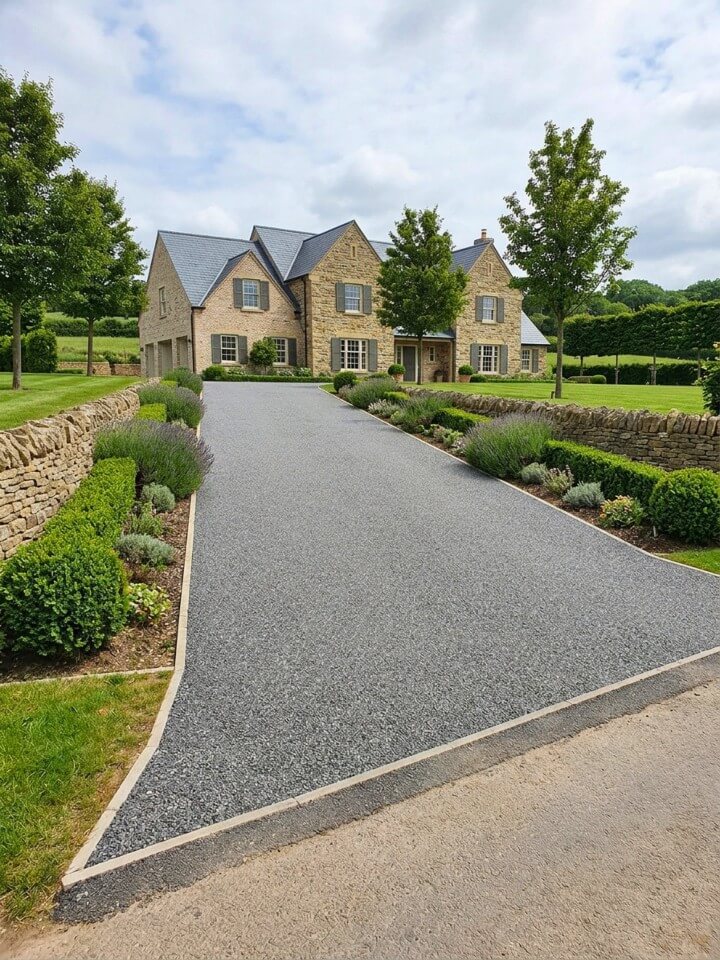
Tar and chip is one of the most underrated driveway finishes available. Hot liquid asphalt is sprayed over a prepared base, then crushed stone is rolled into the surface while the asphalt is still tacky — the stones lock in permanently. What you get drives like asphalt but looks like gravel.
It costs roughly 40% less than full asphalt ($2–$5 per square foot) and handles sloped driveways far better than loose stone, which tends to migrate downhill. Traction in rain is excellent.
The honest tradeoff: you can’t shovel snow off it cleanly without dislodging chips, and the surface needs a fresh chip layer every 7–10 years to stay looking sharp. Worth it for rural and traditional homes.
17. Resin-Bound Gravel Driveway
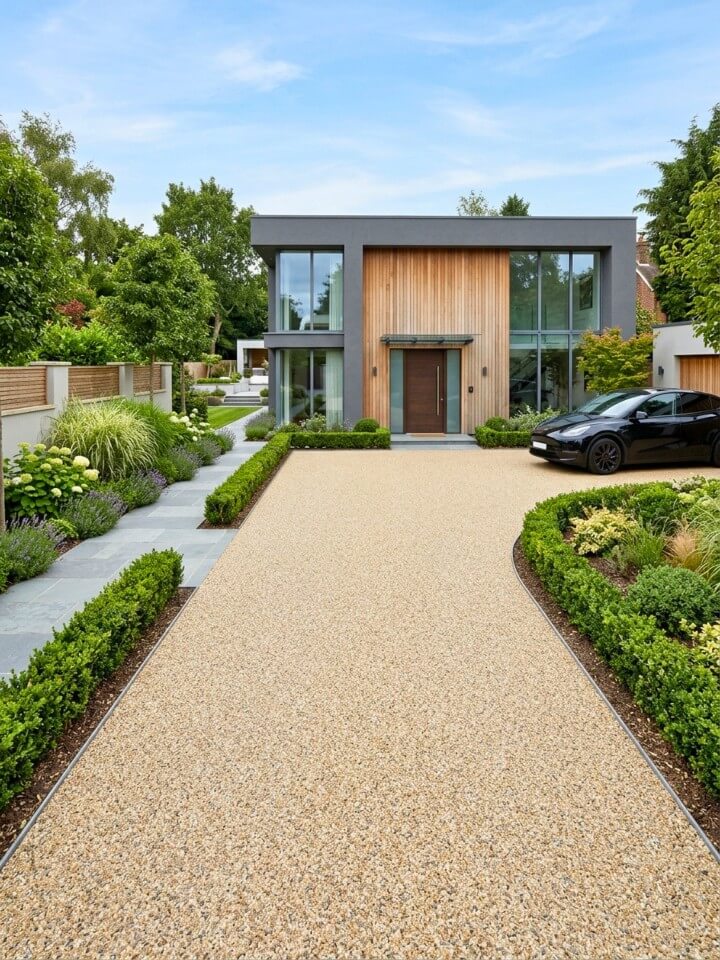
Small stones mixed with clear resin and troweled onto a base, creating a smooth, solid surface with a gravel appearance but no loose pieces.
Why Homeowners Are Switching to It:
- Zero migration — stones never spread onto lawns or walkways
- Fully permeable, so rainwater drains straight through
- Wheelchair and stroller friendly, unlike loose gravel
- No raking, no top-ups, no weeds growing through
- Realistic cost: $12–$20 per square foot. That’s the premium price point in this entire list.
- Where it makes sense: Modern homes, urban properties, and accessibility-focused designs. The investment pays off if you’d otherwise be replacing pavers every decade.
- Lifespan: 15–25 years if installed by a certified contractor. DIY kits exist but rarely cure evenly.
18. Crushed Seashell Driveway
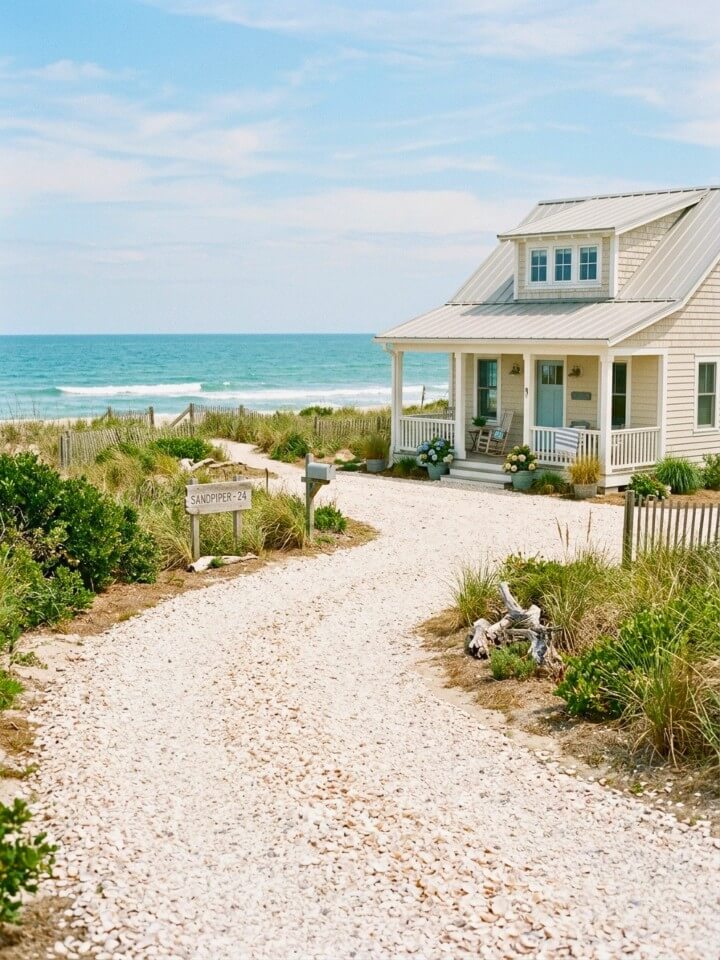
Crushed seashells make for one of the most distinctive driveway surfaces you can install. The pale, sun-bleached tones reflect light beautifully and give coastal homes a finish that feels rooted in place rather than imported.
There’s also a practical side that surprises people. The calcium carbonate in shells slowly leaches into the soil and discourages weeds along the driveway edges — a small but real benefit.
This material performs best in dry, warm regions. In wet climates, shells break down faster and develop a faint mineral smell after heavy rain. Budget $2–$4 per square foot. Plan to top up every 2–3 years as shells crush under tire weight, which is part of the natural aging process.
19. Slate Chip Driveway
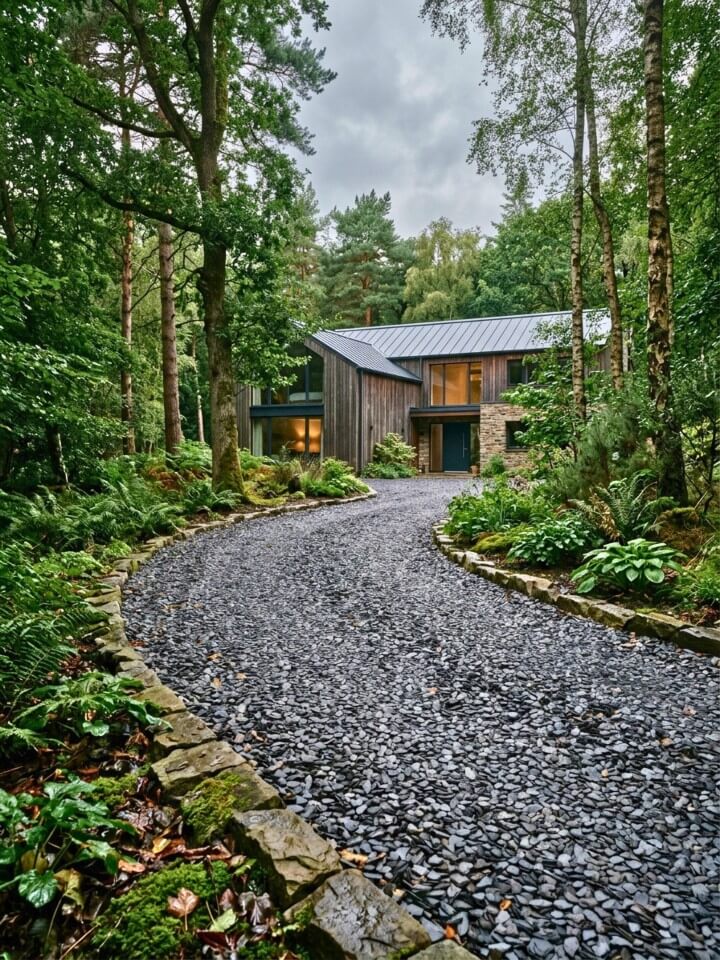
Most gravel reads light and bright. Slate chips do the opposite — deep blue-grays, charcoals, and muted greens that absorb light instead of bouncing it back.
That darker tone matters more than people expect. It grounds the entrance of a home, makes greenery look more saturated by contrast, and pairs especially well with modern architecture or wooded lots where a pale driveway would feel out of place.
The flat, angular shape of slate chips locks together better than rounded stones, giving a more stable driving surface. Heat absorption is the tradeoff — in summer, the surface gets noticeably hot underfoot.
Cost falls between $3–$6 per square foot. Stable, handsome, low-maintenance once installed properly.
20. Gravel Grid System Driveway
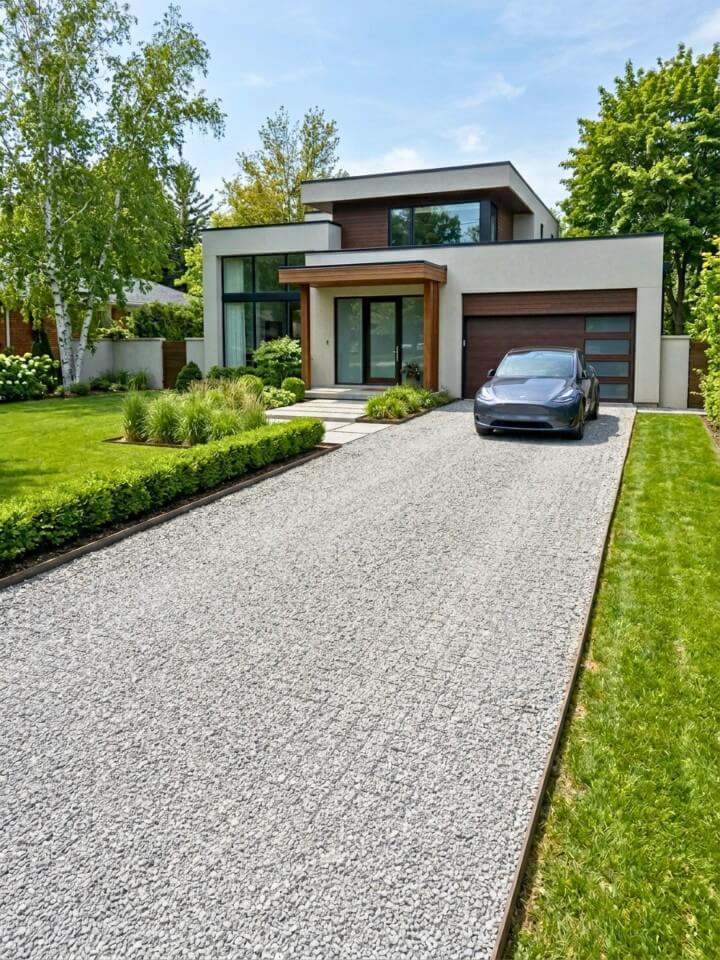
Transform your yard with creative gravel driveway landscaping ideas for lasting curb appeal
Can a gravel driveway handle daily SUV traffic, sloped terrain, and snowplowing without turning into a rutted mess?
With a grid system underneath, yes.
Gravel grids are honeycomb-shaped plastic panels installed below the surface. Each cell holds gravel in place individually, so stones can’t migrate, rut, or wash out. The grid stays invisible — you only see gravel on top — but it does all the structural work.
This is the right choice for sloped driveways, shared driveways with heavy use, and any property where loose gravel keeps failing. Installation runs $4–$8 per square foot including the grid and gravel fill. Lifespan exceeds 25 years. It’s the single biggest upgrade you can make to a problem driveway.
21. Mixed Gravel and Flagstone Driveway
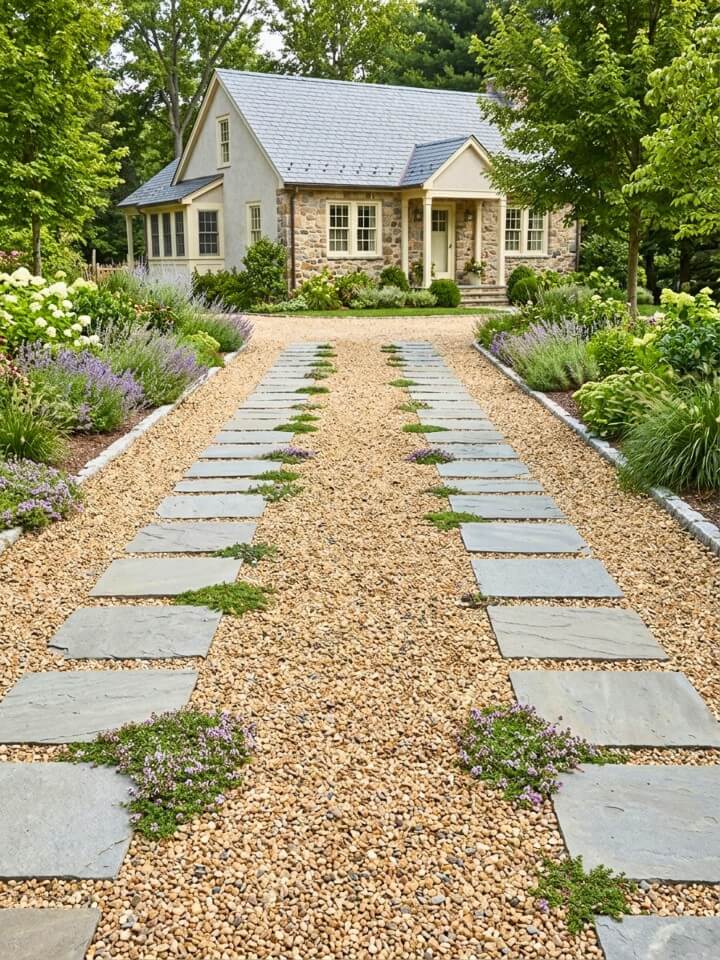
Picture flat flagstones set into a gravel surface like islands — large enough to walk on comfortably, spaced so gravel fills the gaps between them. The flagstones handle foot traffic and act as visual anchors. The gravel handles drainage and softens everything.
This combination works particularly well for garden-heavy front yards where the driveway needs to feel like part of the landscape rather than a separate hardscape feature. Cottage homes, Mediterranean villas, and relaxed traditional properties suit it best.
Flagstone choice matters: bluestone and limestone hold up to vehicles, sandstone doesn’t. Set each stone on a compacted base at least 3 inches deep. Budget $4–$8 per square foot depending on flagstone quality and size.
22. Lava Rock Driveway
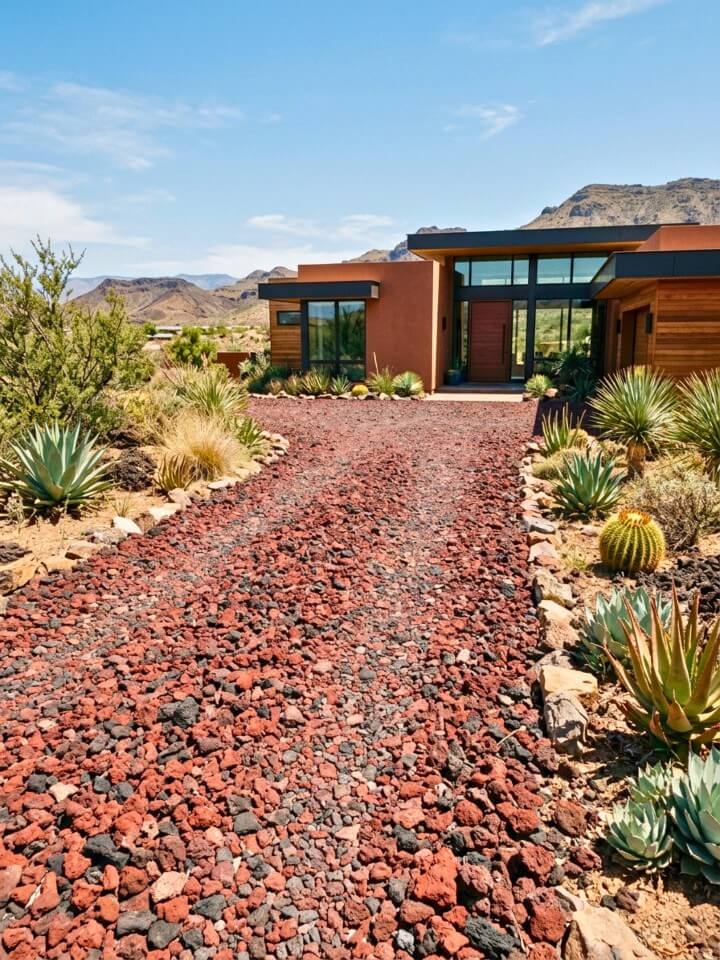
Deep red, rust, and black tones with a porous, almost volcanic texture. Bold and unmistakable.
Southwestern homes, desert landscapes, and tropical settings. Anywhere a soft beige gravel would look generic.
Cost: $2–$4 per square foot for the rock itself.
Lava rock is lightweight. Drive over it daily and the pieces scatter quickly because they don’t have the mass to stay put. It needs strong edging and works best as a decorative surface for low-traffic driveways or accent areas.
The porous structure absorbs and slowly releases water, which helps surrounding plants during dry spells.
Pair it with succulents, concrete pavers, and minimal planting to let the dramatic color do the work.
23. Gravel with Railroad Tie Borders
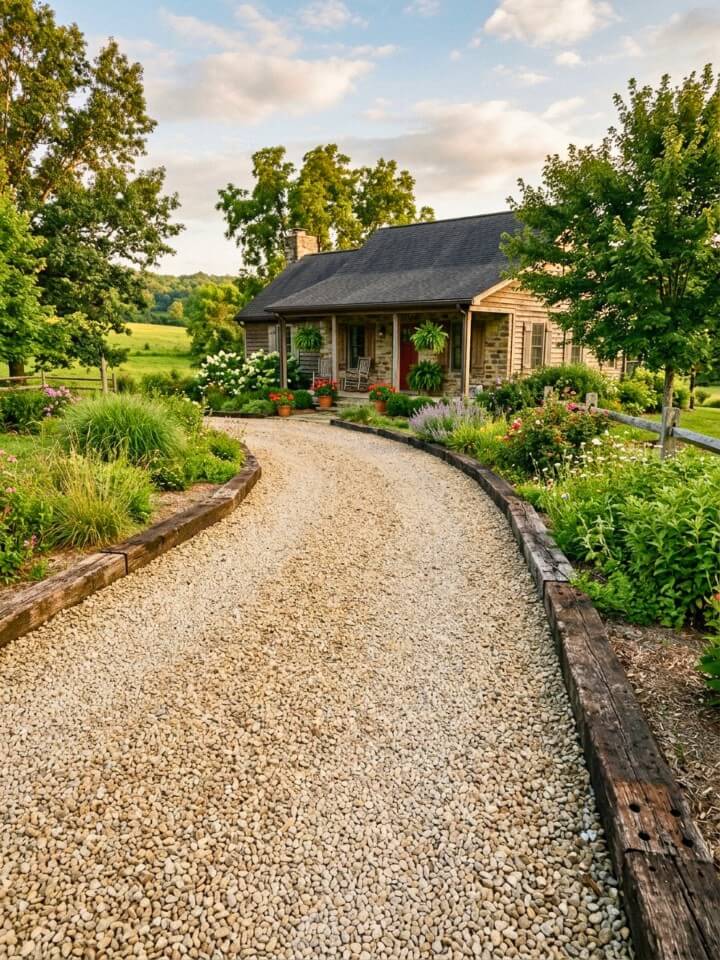
Railroad ties bring a weathered, reclaimed character to a driveway that newer materials can’t replicate. The dark creosote-treated wood contrasts beautifully against light gravel and gives the entrance a grounded, handcrafted feel that suits cabins, farmhouses, and country properties.
A couple of things worth knowing before you commit. Authentic salvaged ties contain creosote, which is a wood preservative now restricted for residential use in many areas — check local regulations before installing. Creosote-free reclaimed ties or new untreated hardwood beams give the same look without the chemical concerns.
Installation involves laying ties flat along the driveway edges, pinning them with 18-inch rebar driven through pre-drilled holes. Expect $2–$4 per linear foot for materials. Lifespan runs 15–20 years before replacement.
24. Black Basalt Gravel Driveway
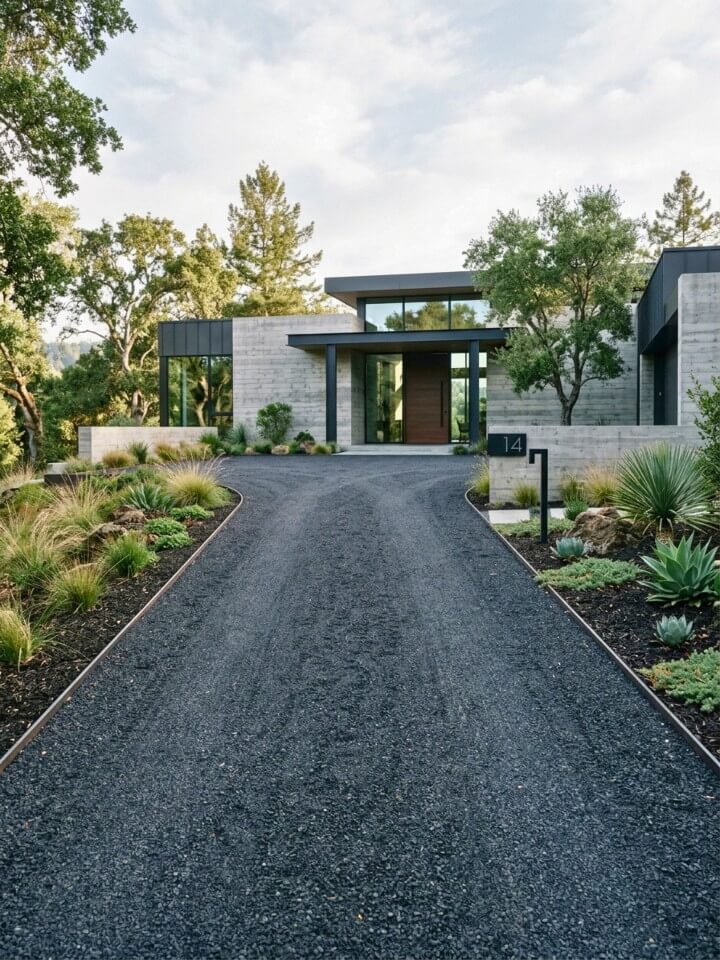
There’s a particular kind of homeowner who looks at beige and tan gravel options and knows immediately that none of them are right. Black basalt is for that person.
The stone is volcanic in origin, dense, and a deep matte black that holds its color through years of sun exposure — unlike dyed gravels that fade. It pairs naturally with modern architecture: white stucco, black-framed windows, exposed steel, raw concrete. Anything where sharp lines and high contrast matter.
The angular shape locks together well, creating a stable surface that resists shifting. Heat absorption is the main consideration in hot climates — the surface gets warm in direct sun. Cost lands at $3–$6 per square foot.
25. Curved Gravel Driveway with Landscaping
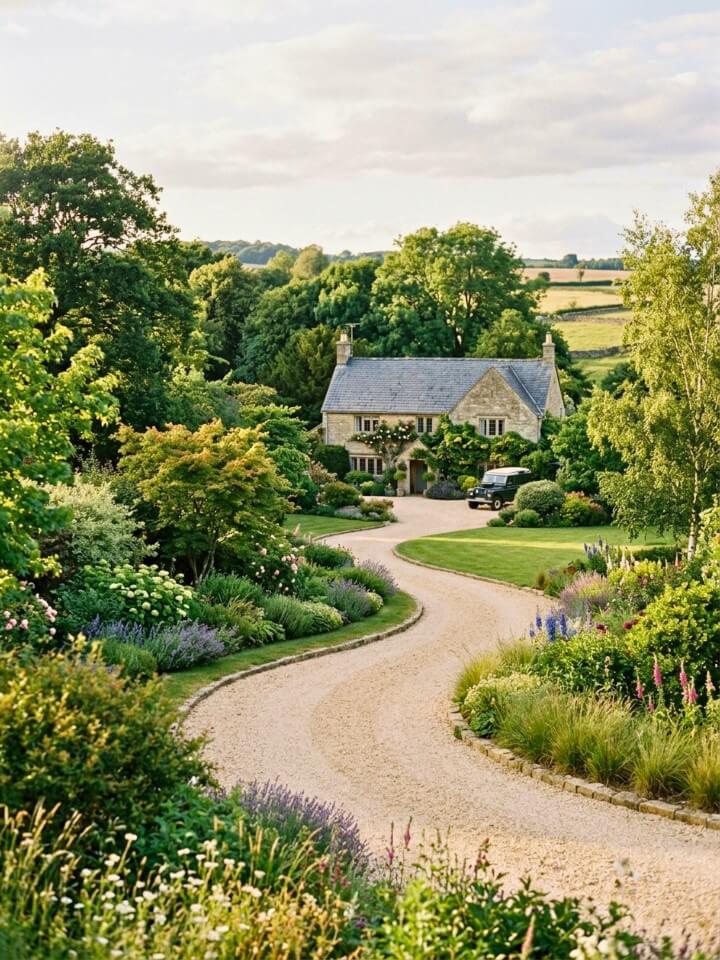
A straight driveway gets you from point A to point B. A curved one creates an experience.
Why the Curve Matters:
- It slows arriving vehicles naturally, making the approach feel more deliberate
- It opens up planting opportunities along the inside and outside of the bend
- It hides the parking area from the street, which improves the home’s curb view
- It makes a small property feel larger by breaking the sightline
Planning Considerations:
Curves need space. A gentle bend requires at least 60 feet of length to look natural rather than forced. The radius should accommodate your largest vehicle’s turning circle — typically 25–30 feet for residential use.
Landscaping that Works Alongside:
Layered plantings with low groundcover near the gravel, mid-height shrubs behind, and small ornamental trees at the back. Avoid anything that drops sticky fruit or heavy debris onto the driving surface.
Total project cost varies widely depending on length and landscaping ambition.
26. Gravel with Cobblestone Apron
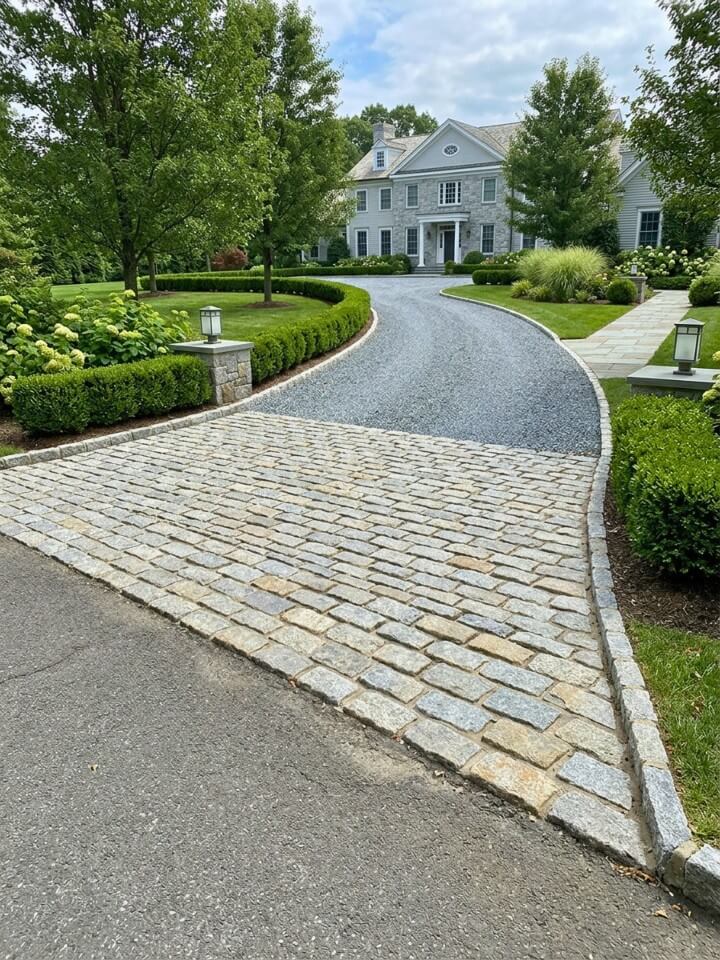
Browse elegant stone driveway ideas to create a timeless and durable entrance for your home. The apron is where the driveway meets the street — the section that takes the most abuse from turning vehicles, delivery trucks, and snowplows. Cobblestone solves that problem permanently.
The approach is straightforward: pave the first 6–10 feet of the driveway in cobblestone, then transition to gravel for the rest. Heavy vehicles never touch the loose stone, which means no gravel gets dragged onto the road and no ruts form at the entrance.
Beyond the practical side, a cobblestone apron signals quality the moment someone arrives. It pairs especially well with colonial, traditional, and formal landscapes.
Budget $15–$25 per square foot for the apron section.
27. Pea Gravel with Steel Edging
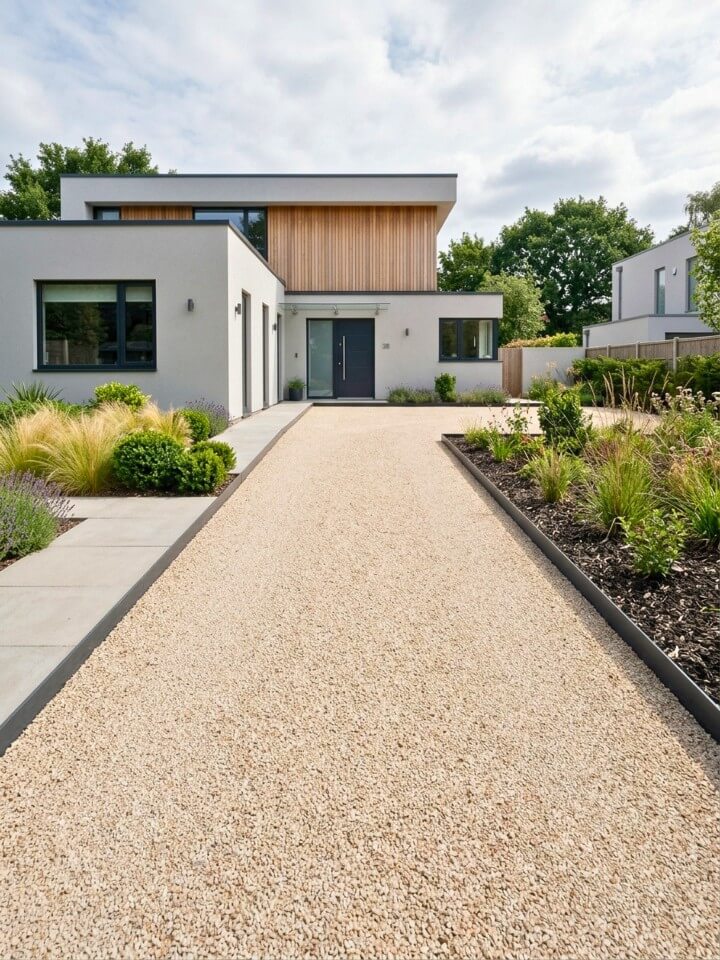
Soft, rounded pea gravel held in by sharp, minimal steel strips. The contrast is the entire point.
Why Steel Beats Other Edging:
- Stays put through freeze-thaw cycles (wood rots, plastic warps)
- Bends into smooth curves that brick or stone can’t match
- Disappears visually, letting gravel be the focus
- Lasts 30+ years without maintenance
Cor-Ten develops a rust-orange patina suited to modern homes. Galvanized stays silver-gray. Powder-coated black gives the cleanest minimalist line.
Cost: $4–$8 per linear foot for edging.
Best fit: Narrow urban driveways and contemporary architecture where clean lines matter.
28. Quartz Gravel Driveway
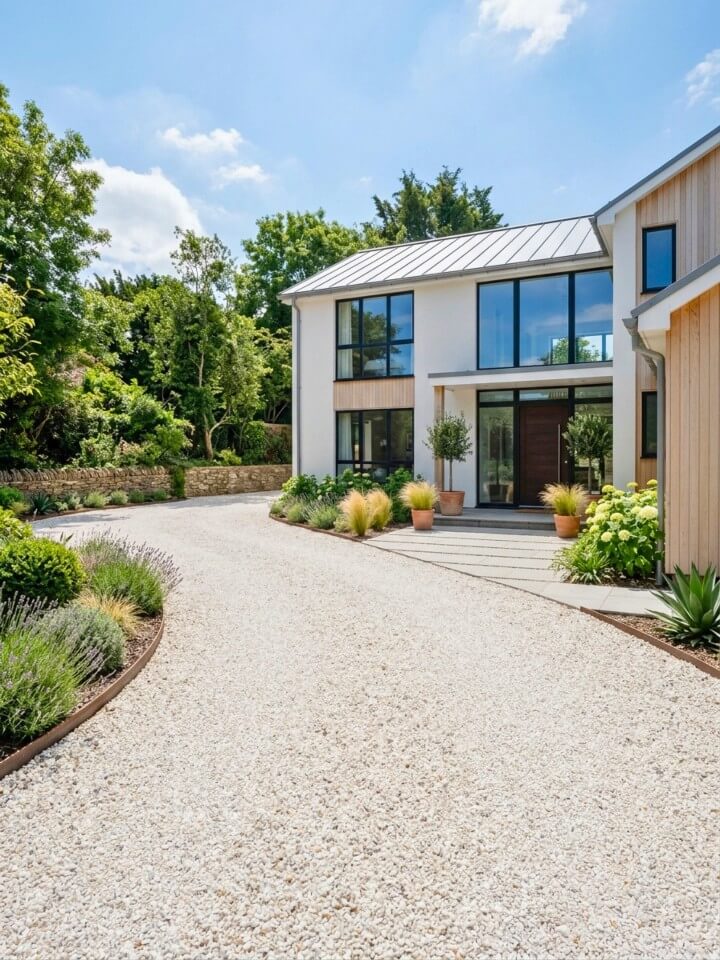
Quartz catches light differently than other stones. The crystalline structure inside each piece reflects sunlight from multiple angles, giving the surface a subtle shimmer most noticeable in morning and late afternoon light.
The stones come in white, pink, gold, and gray depending on the source quarry. White quartz is the popular choice because it brightens shaded entrances and contrasts well with darker home exteriors.
There’s a practical side too. Quartz is one of the hardest minerals sold as gravel — harder than granite, much harder than limestone — so it resists crushing under vehicle weight better than softer stones.
Expect $4–$7 per square foot.
29. Gravel with Mosaic Stone Inlays
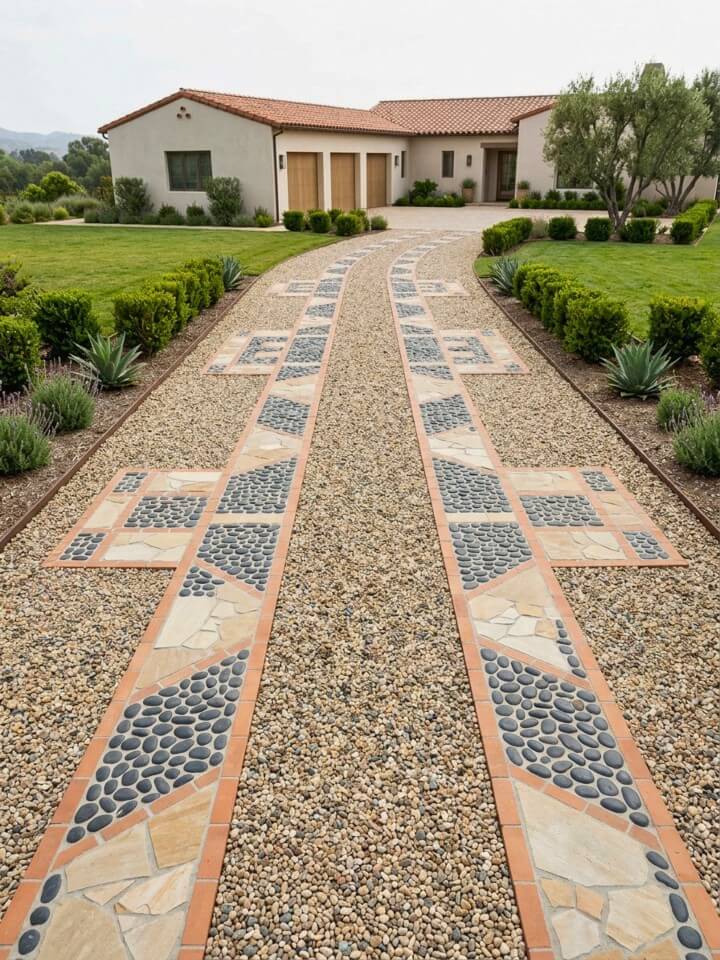
This is the artistic option in the driveway world. Sections of patterned stone — geometric designs, circular medallions, custom motifs — get inlaid into specific spots within a gravel surface, usually at the entrance or near the front door.
The technique comes from Mediterranean courtyard design, where craftsmen set small pebbles into mortar for elaborate floor patterns. Modern installations simplify the approach but keep the visual impact.
Placement matters more than complexity. A single well-placed mosaic at the main entry reads as elegant. Multiple inlays scattered throughout look busy.
Costs vary enormously — anywhere from $500 to $5,000+ per inlay section.
30. Circular Gravel Driveway with Center Garden
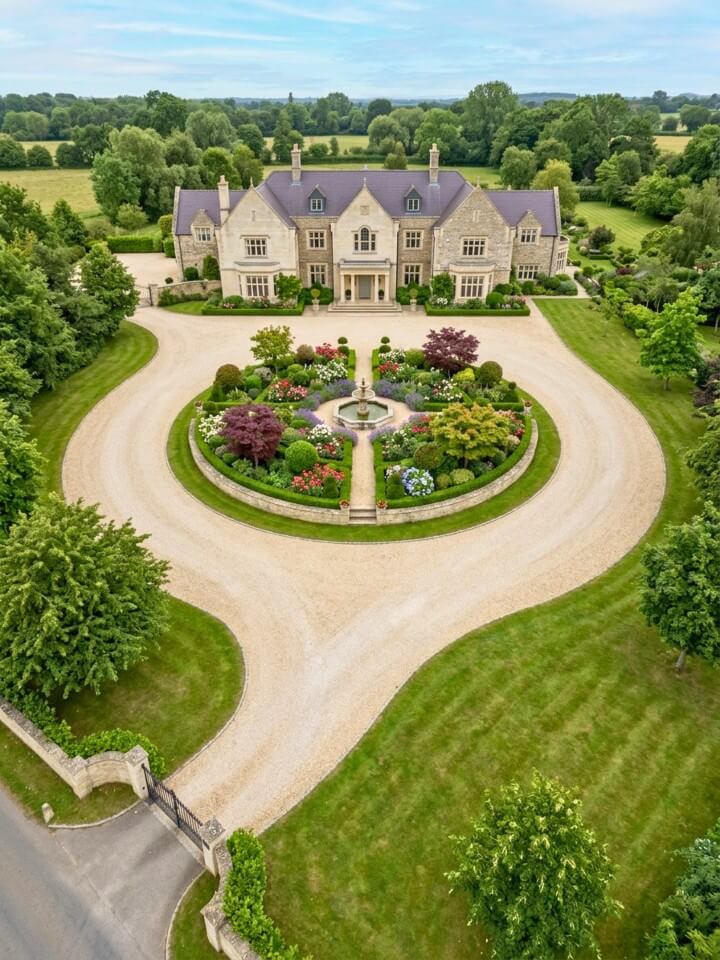
Find inspiring rock driveway ideas that add texture and natural charm to your home’s front yard
Does my property have enough room for a circular driveway?
The minimum workable diameter is 60 feet edge to edge. Anything smaller forces tight turns that feel awkward.
If you have the space, the payoff is real. Circular driveways eliminate the need to back onto the street, handle multiple guest vehicles during gatherings, and the center garden becomes the architectural focal point of the front yard.
What goes in the center matters. A single specimen tree — Japanese maple, dogwood, magnolia — anchors the design year-round. Around that anchor, flowering shrubs from dazzling hydrangea landscaping ideas can soften the gravel and give the center island seasonal color. Avoid annual flower beds that look empty for half the year.
Total installation typically runs $8,000–$25,000.
31. Gravel with Wooden Plank Borders
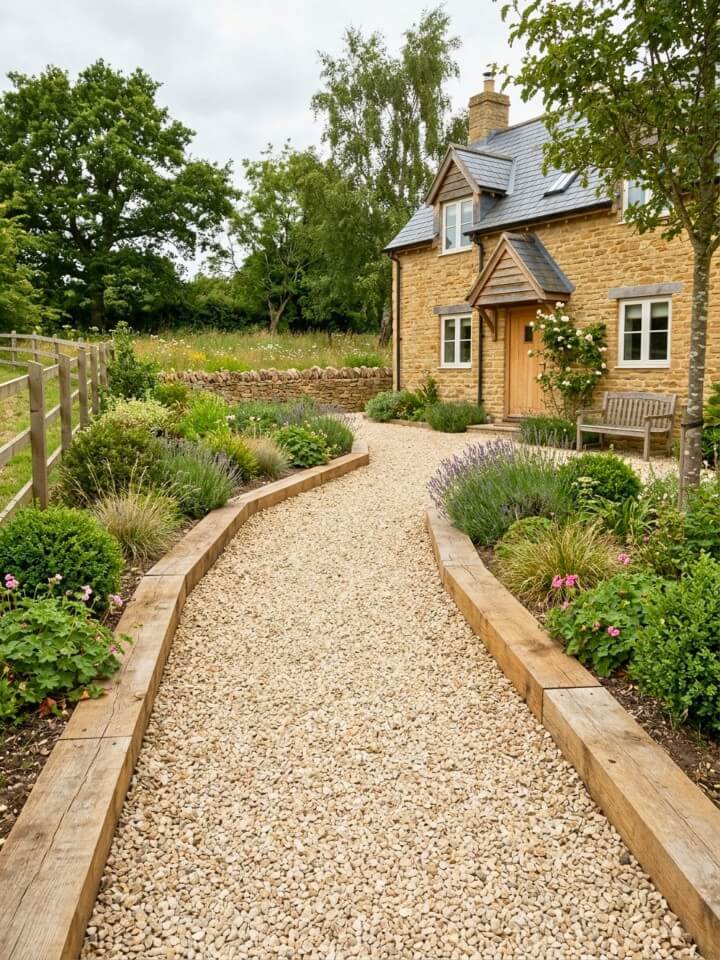
Wooden planks bring a warmth that stone and steel edging can’t match. The grain, the slight color variation between boards, the way the wood softens over time — it makes a driveway feel handmade rather than installed.
This style suits rustic homes, garden cottages, and countryside properties where natural materials are part of the overall design language. Cedar and redwood are the top choices because they resist rot naturally without chemical treatment. Pressure-treated pine works too but doesn’t age as gracefully.
Standard installation uses 2×6 or 2×8 boards staked with rebar every 3 feet to prevent shifting. Budget $3–$6 per linear foot. Expect 10–15 years before boards need replacement.
32. Recycled Glass Gravel Driveway
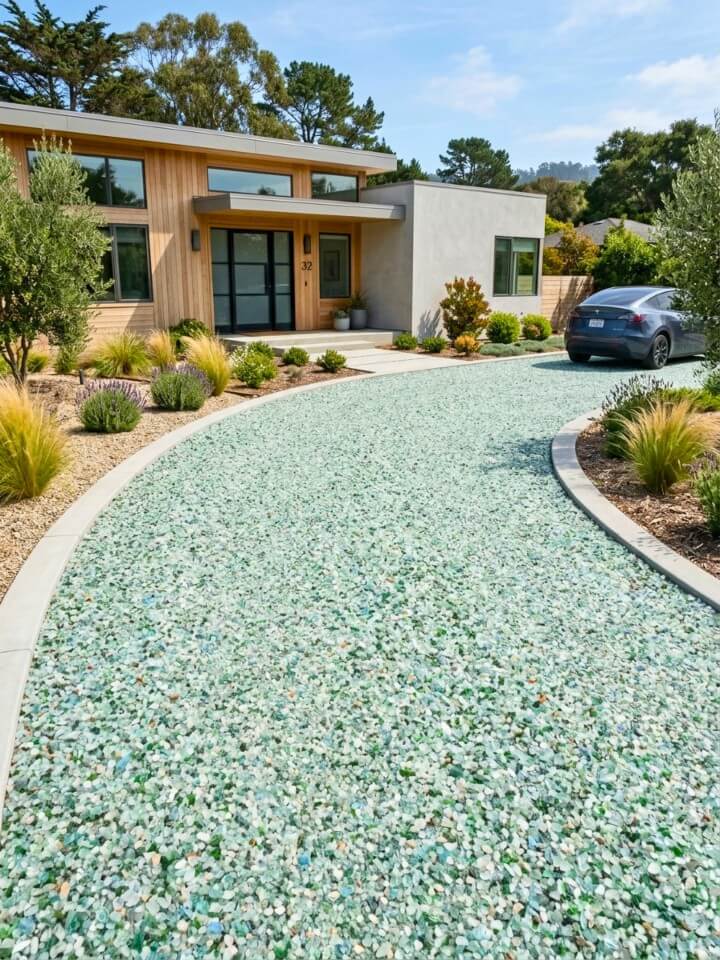
Tumbled glass pieces — usually from recycled bottles — used in place of natural stone gravel.
Surface shimmer that changes throughout the day. Cobalt blues, sea greens, and amber tones are most common.
Why Homeowners Pick It:
- Diverts glass from landfills (each ton replaces about 2,000 wine bottles)
- Doesn’t fade in sunlight the way dyed gravels do
- Smooth tumbled edges are safe to walk on barefoot
- Pairs beautifully with modern and eco-conscious architecture
Cost: $5–$10 per square foot, comparable to premium natural stone.
Best installation: Over a stable crushed-stone base with strong edging. Glass shifts more than angular gravel, so containment matters.
33. Gravel with Boxwood Hedge Borders
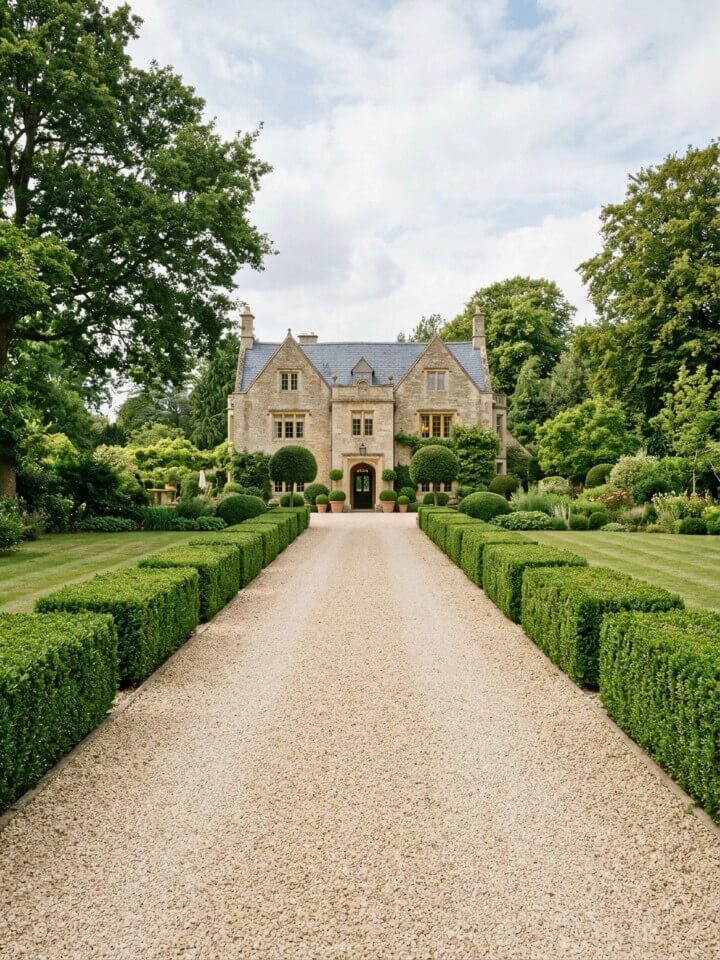
Boxwood hedges give a driveway architectural structure that no inert material can replicate. The dense green walls define the edges precisely, frame the approach to the home, and bring a formality that suits traditional and classical properties.
This is a long-term commitment more than an installation. Boxwoods grow slowly — typically 3–6 inches per year — so it takes 4–7 years before young plants form a continuous hedge. Choose mature plants from a nursery if you want immediate impact, though the cost climbs significantly.
Trim twice a year to maintain crisp lines. Watch for boxwood blight, which has spread widely in recent years. Plan $15–$40 per linear foot for the hedge planting.
34. Gravel Driveway with Gabion Wall Edging
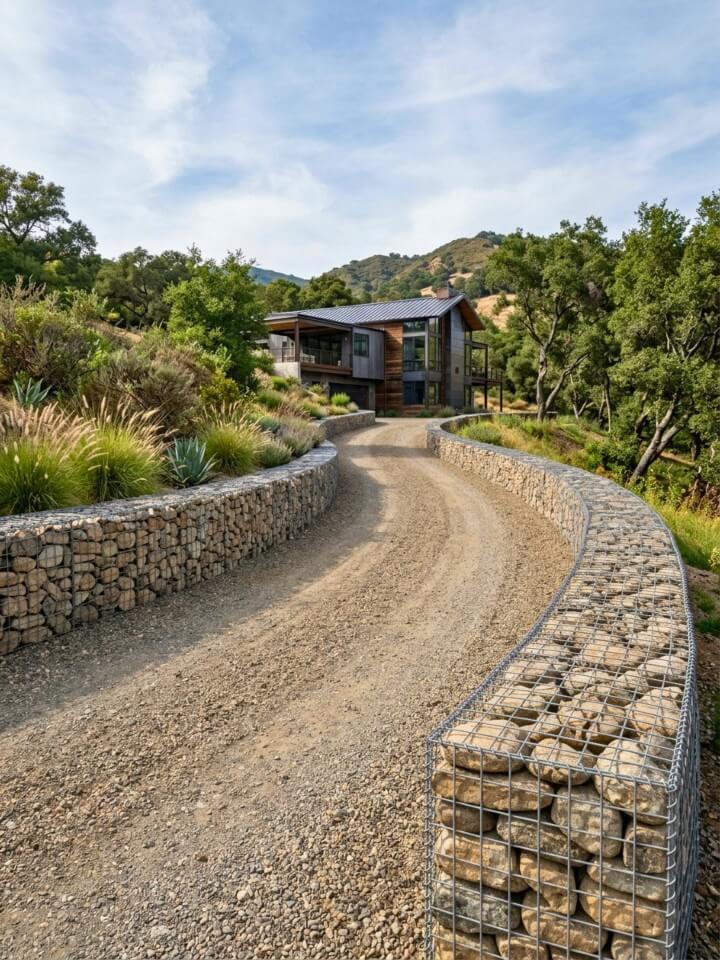
Gabion walls are wire cages filled with loose stone, originally engineered for erosion control and retaining walls on construction sites. Modern landscape design has adopted them as bold, industrial-looking edging for driveways.
The aesthetic is unmistakable — chunky, textural, architectural. Gabion walls work especially well on hillside properties because they double as retaining structures, holding back soil while defining the driveway edge.
Stone fill options change the look completely. River rock reads natural and soft. Crushed granite looks sharp and modern. Mixed colors create visual depth.
Cost runs $20–$40 per linear foot installed. Lifespan exceeds 50 years since both the wire cages and stone are essentially permanent.
How to Choose the Right Gravel Driveway
With 34 options on the table, narrowing down comes down to four practical questions:
What’s Your Climate?
Snowy regions need angular, locking stones (crushed granite, basalt, slate) that plows won’t scatter. Hot, dry areas suit decomposed granite and lava rock. Wet climates need permeable systems with strong drainage.
How Much Traffic?
Daily multi-vehicle households need stabilization — grids, paver tracks, or resin-bound surfaces. Light-use driveways can run on simple pea gravel without trouble.
What’s The Slope?
Anything over a 10% grade needs locked stones, tar and chip, or grid reinforcement. Loose pea gravel and river rock will migrate downhill within months on steep grades.
What’s Your Budget?
Basic pea gravel runs $1.50–$3 per square foot. Premium resin-bound systems hit $20+. Most homeowners land in the $3–$8 range with bordered, mid-grade installations.
Match the material to your actual conditions, not just the photo that caught your eye. A driveway that suits your climate, traffic, and slope will outlast and outperform one chosen on looks alone.
FAQs About Gravel Driveways
Practical answers covering cost, durability, climate suitability, and upkeep – everything you need to know before starting your driveway project.
How Much Does a Gravel Driveway Cost on Average?
For a standard two-car driveway (around 600 square feet), expect $1,200–$5,000 for basic installations and $6,000–$15,000 for premium options with borders, grids, or specialty stone.
How Long Does a Gravel Driveway Last?
A properly installed gravel driveway lasts 10–25 years before major rework. Annual top-ups of fresh gravel keep the surface looking new throughout that lifespan.
Is Gravel Cheaper than Concrete or Asphalt?
Yes — significantly. Concrete runs $8–$15 per square foot installed. Asphalt costs $7–$13. Gravel averages $2–$5 for standard installations, making it the most affordable durable driveway option.
Do Gravel Driveways Work in Snowy Regions?
They work well if you choose angular crushed stone over rounded pea gravel or river rock. Use a plastic-edged shovel or set your snowblower slightly higher than the gravel surface to avoid scooping stones.
How Often Does Gravel Need to Be Replaced?
Full replacement is rare. Most driveways need a top-up layer every 1–3 years to replace stones lost to traffic, weather, and migration. Total refresh happens once every 8–10 years.
Can I Install a Gravel Driveway Myself?
Simple pea gravel or crushed stone installations are realistic DIY projects for handy homeowners. Anything involving cobblestone borders, concrete tracks, resin-bound surfaces, or gabion walls requires professional installation.
Do Gravel Driveways Increase Home Value?
A well-designed gravel driveway with proper edging and landscaping can add 3–7% to perceived home value. A poorly maintained or unbordered gravel patch can actually hurt curb appeal.
Conclusion:
A gravel driveway is one of those rare home upgrades where practical and beautiful actually meet. You’re not just choosing a surface — you’re shaping how your home greets the world every single day.
The best driveway isn’t the most expensive one or the trendiest. It’s the one that fits your climate, handles your daily traffic, and still makes you smile when you turn into it after a long day.
Pick the gravel driveway idea that matches your real life, not just a saved photo. Years from now, you’ll still hear that satisfying crunch under the tires — and know you chose right.