23 Ranch Gate Entrance Ideas for Modern and Rustic Properties
Pull up to a ranch, and the gate tells you everything before you even reach the front door. It hints at the people who live there, the care they take with their land, and sometimes even the stories the property holds. The right entrance does more than mark where your land begins — it shapes the whole first impression and can even bump resale value by 3–8% according to real estate appraisers. Whether you’re working with a 2-acre hobby farm or a cattle ranch stretching across hundreds, your gate has to balance looks with real, everyday function. These 23 stunning ranch gate entrance ideas cover every style and budget you can think of.
Before you fall for a design, run through the basics: driveway width (most need 12–16 feet of clearance), how often trucks or livestock will move through, and the weather your gate has to handle. A wooden gate might last 15–20 years in dry country but only 8–10 along a humid coast without treatment. Budget plays in too – simple wooden builds start near $400 installed, while custom iron-and-stone entrances can push past $10,000.
Below, you’ll find ideas covering every style, budget, and property size, with practical notes on materials, placement, costs, and upkeep – so you pick something that actually fits your land, not just your Pinterest board.
1. Classic Wooden Split-Rail Gate
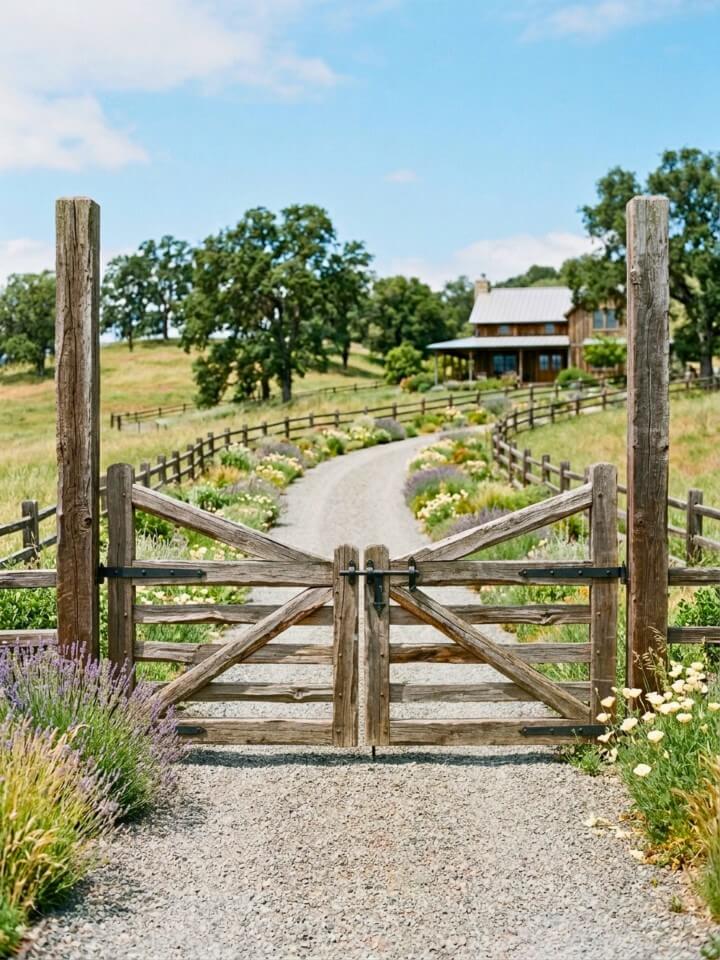
Split-rail gates carry the kind of honest, lived-in charm you cannot fake with newer materials. Built typically from cedar, locust, or pressure-treated pine, these gates run roughly $300–$700 for an 8-foot section and last anywhere from 12 to 25 years depending on wood choice. They suit wide pasture entries, farm driveways, and country lanes where you want openness rather than privacy. Skip them if you need to keep small animals contained, since the wide rails leave gaps.
A simple latch and galvanized hinges keep things working without fuss. Plant native bunchgrasses or wild bergamot along the base to soften the line where wood meets land, and the whole entrance settles into the landscape within a season or two.
2. Wrought Iron Gate with Rustic Details
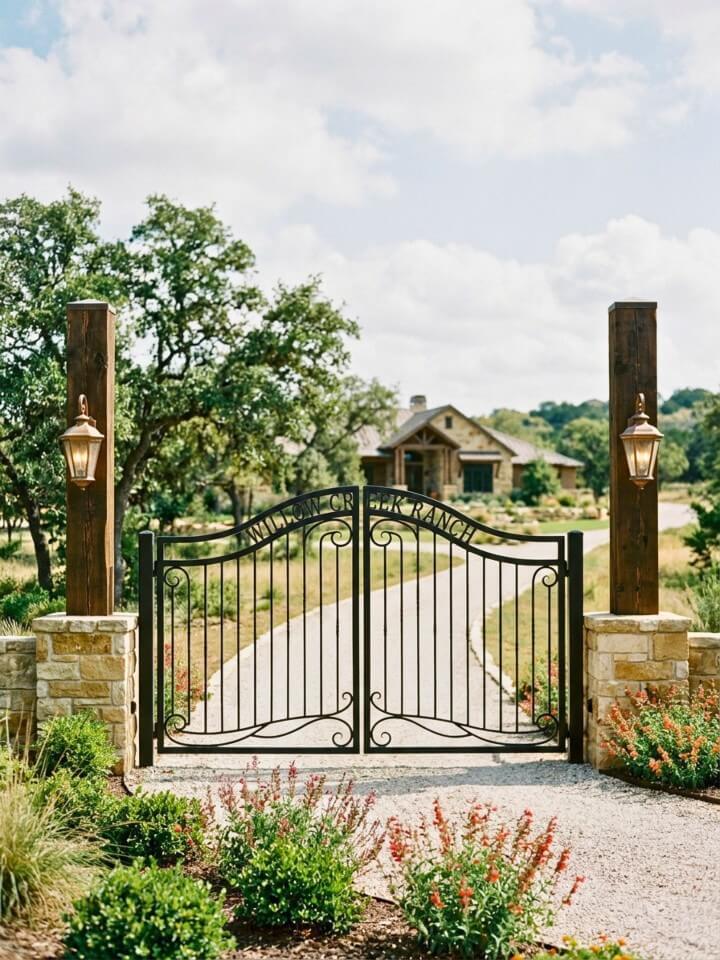
Wrought iron has been used at ranch entries for over 150 years for one reason: it survives weather, kicks from livestock, and decades of daily use. Pairing iron panels with rough-cut timber posts or hammered copper accents softens the formality so the gate reads as country rather than estate.
Expect to spend $1,500–$4,500 for a quality custom piece, with installation adding another $500–$1,200. The catch is rust – humid or coastal climates require a fresh coat of rust-inhibiting paint every 3–4 years. Use it where you want clear sightlines through the metalwork while still controlling who enters. Climbing roses or trumpet vine on the posts add seasonal color without hiding the craftsmanship.
3. Sliding Barn-Style Gate
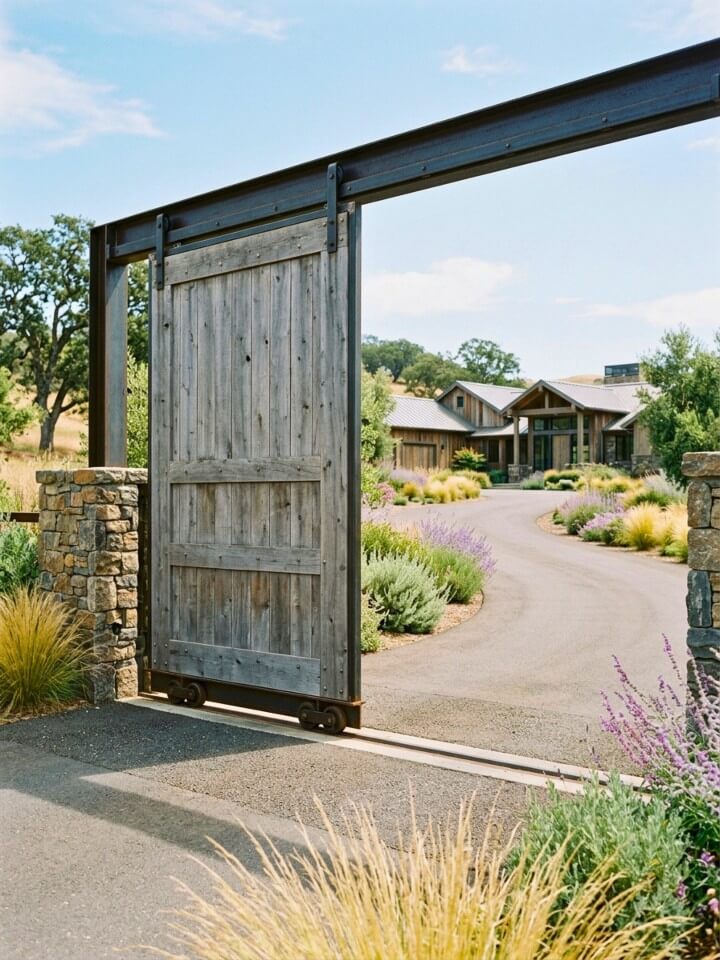
A sliding gate moves sideways along an overhead or ground track, which makes it the practical pick for narrow driveways, tight property corners, or anywhere a swinging gate would block traffic. Counter to common assumption, these work best on level ground – slopes greater than 5 degrees usually need a cantilever design, which costs noticeably more.
A standard 14-foot sliding barn gate runs $1,200–$3,500 installed, with automation adding $800–$2,000. The look pairs naturally with weathered barn wood, black iron pull handles, and steel V-track hardware. Lubricate the rollers twice a year and clear debris from the track after storms; that simple maintenance keeps the gate sliding smoothly for 20-plus years.
4. Stone Pillars with Timber Gate
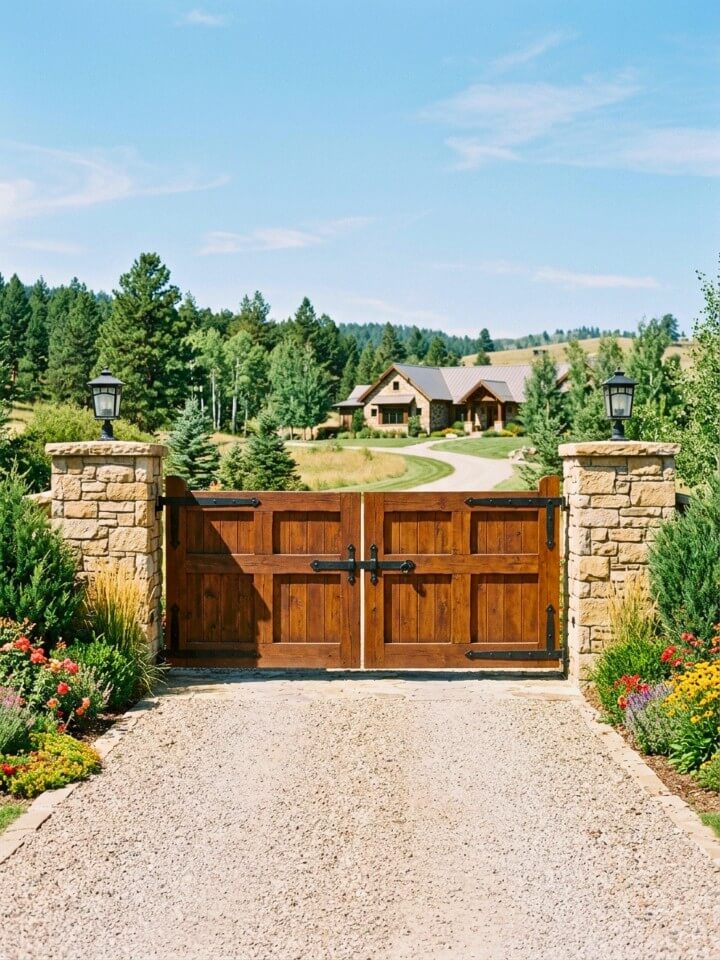
Few entrances feel as permanent and rooted as natural stone pillars flanking a heavy timber gate. This is a focal-point choice for properties of 10 acres or more where the entry is meant to be seen and remembered. Stone pillars typically run 5–7 feet tall and use fieldstone, limestone, or local quarried rock; expect $2,000–$6,000 per pillar depending on stone type and labor rates. The timber gate itself, usually cedar or Douglas fir, adds $800–$2,500. Beyond looks, stone pillars give you a solid mounting point for address numbers, mailboxes, or low-voltage lighting. Mortar joints should be inspected every 5–7 years and repointed as needed to prevent water damage.
5. Combination Metal and Wood Gate
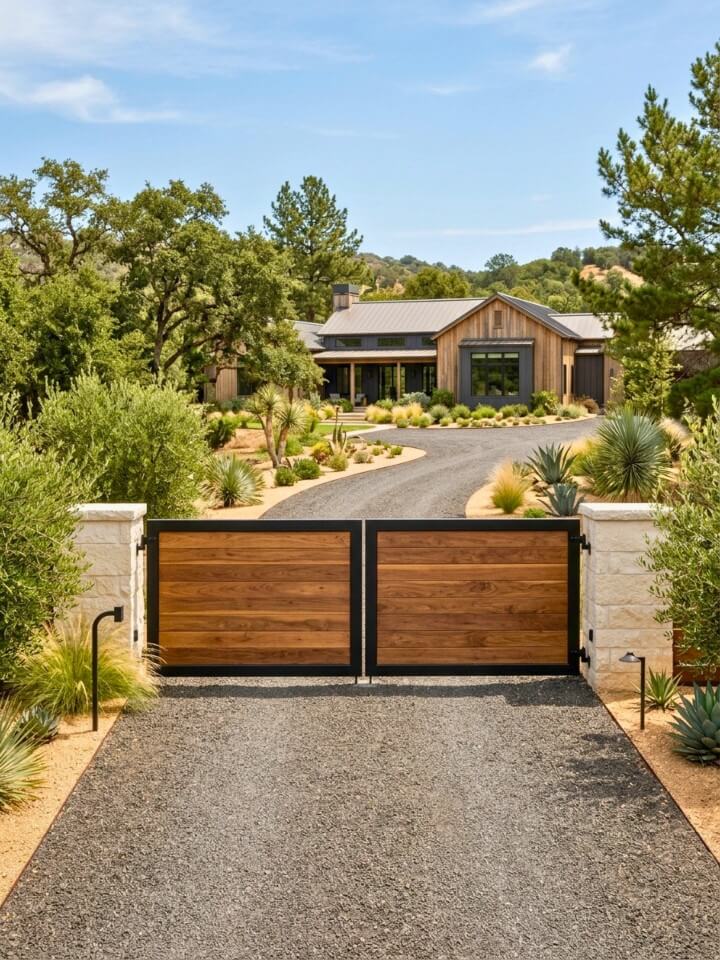
Mixing materials lets you get the structural strength of steel with the warmth of wood, which is why this hybrid has become one of the most-installed ranch gate styles of the last decade. A welded steel frame, typically powder-coated black or bronze, holds wooden infill panels of cedar, redwood, or thermally modified ash.
Total cost lands around $1,000–$3,000 for a 12-foot gate. The steel takes the weight and abuse while the wood absorbs the visual heaviness, so the gate never feels industrial. Match your hardware finish to nearby fixtures – porch lights, mailbox, house numbers – for a cohesive look. Re-stain wood panels every 2–3 years to prevent graying, unless gray patina is the goal.
6. Modern Horizontal Slat Gate
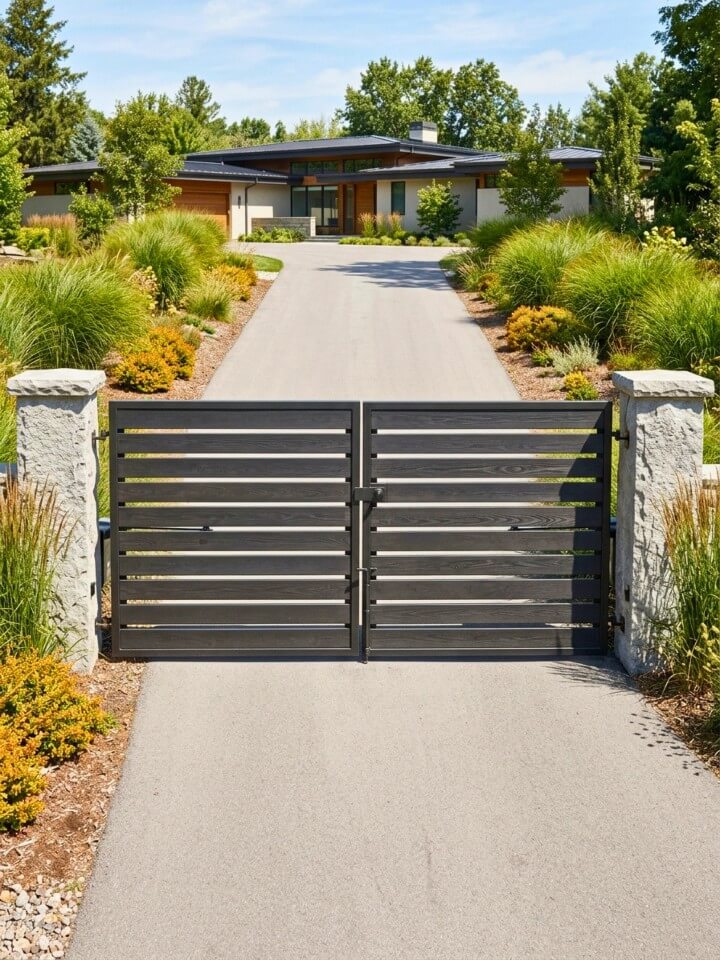
If your home leans contemporary – clean rooflines, large windows, neutral palette – a traditional ranch gate can look mismatched at the entrance. Horizontal slat gates solve this. Built from steel-framed cedar, ipe, or composite slats spaced 1–2 inches apart, they read modern without feeling cold on a rural property.
A 12-foot slat gate runs $1,400–$3,800 and works best on straight, level driveways. The spacing matters: tighter gaps add privacy and wind resistance, wider gaps keep airflow and let snow pass through in winter climates. Pair with matte black hardware, minimalist square posts, and dark ground cover inspired by fabulous black mulch landscaping ideas to keep the look intentional rather than accidental.
7. Arched Gate with Vine Trellis
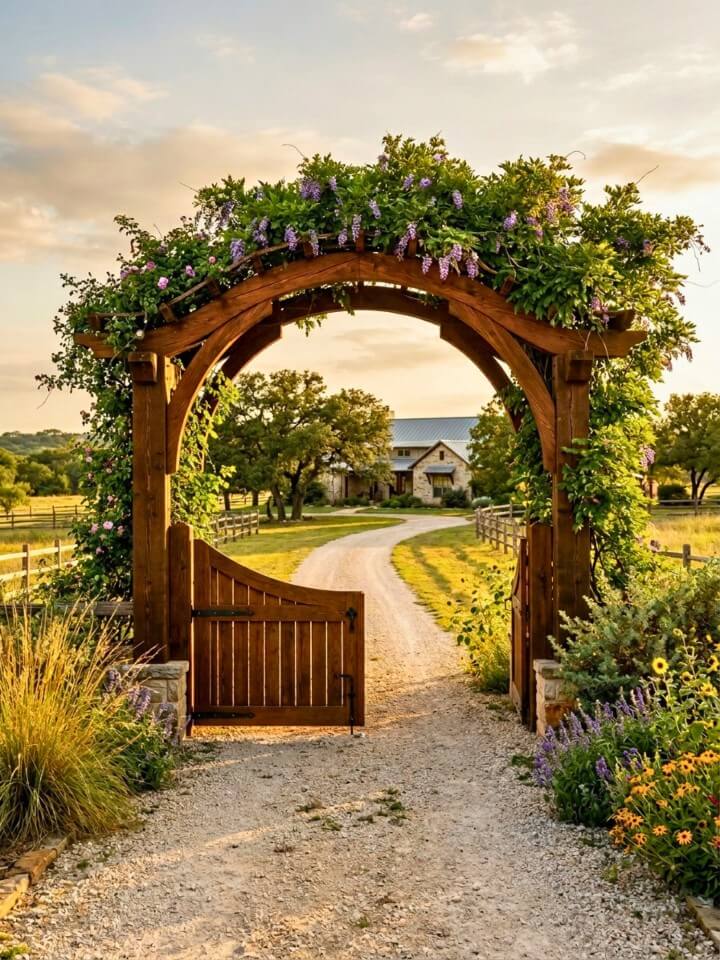
An arched gate with an integrated trellis turns an ordinary entrance into something that changes with the seasons. The arch itself, built from bent steel tubing or laminated timber, typically spans 8–12 feet and stands 8–10 feet at the peak. Budget $800–$2,500 for the structure depending on materials.
The real charm comes from the climbers: trumpet honeysuckle, climbing hydrangea, native clematis, or for warmer zones, climbing roses like ‘New Dawn.’ Plant on both sides for fuller coverage within 2–3 growing seasons. This style fits cottage gardens, smaller hobby farms, and any entry where you want softness rather than statement. Prune annually to keep growth off the hinges and latch mechanisms.
8. Rustic Log Gate with Carved Accents
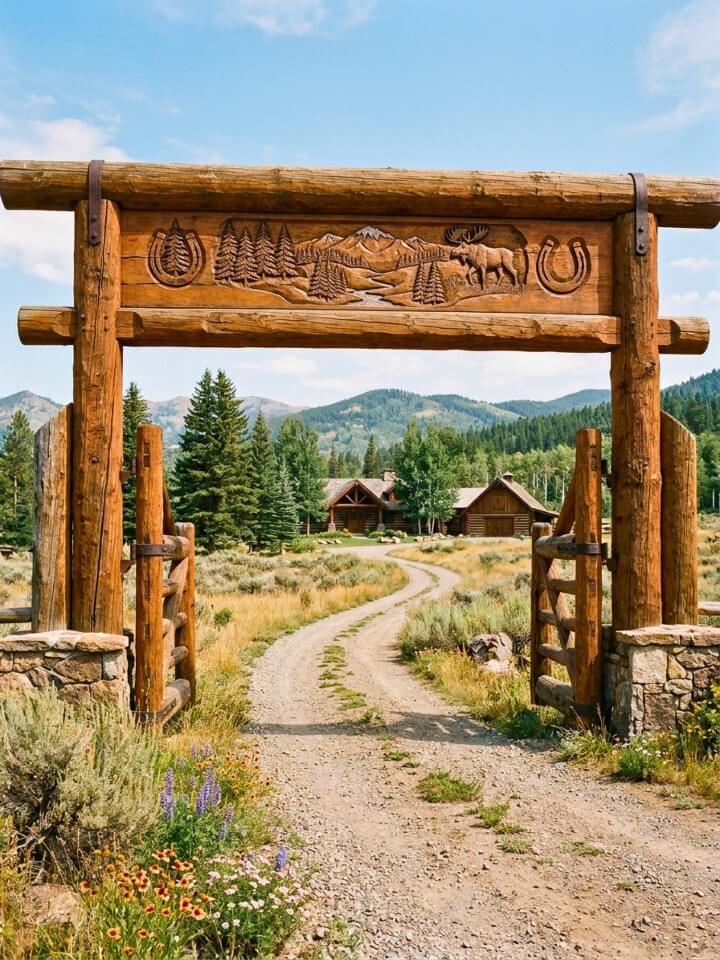
A log gate makes a statement that smaller, refined designs cannot match. Built from peeled cedar, pine, or even reclaimed barn beams, these gates typically use logs 6–10 inches in diameter for the frame and feature carved details like the ranch name, brand, or wildlife silhouettes.
Custom log gates run $2,500–$8,000 depending on size and detail work, and they fit best on western, mountain, or heavily wooded properties. The honest weight of the materials demands matching anchors – log posts set in concrete, or a stone base. Apply UV-blocking sealant every 3–5 years to slow checking and graying. Carved accents stay sharper longer when treated with penetrating oil rather than surface varnish.
9. Farmhouse-Style Crossbuck Gate
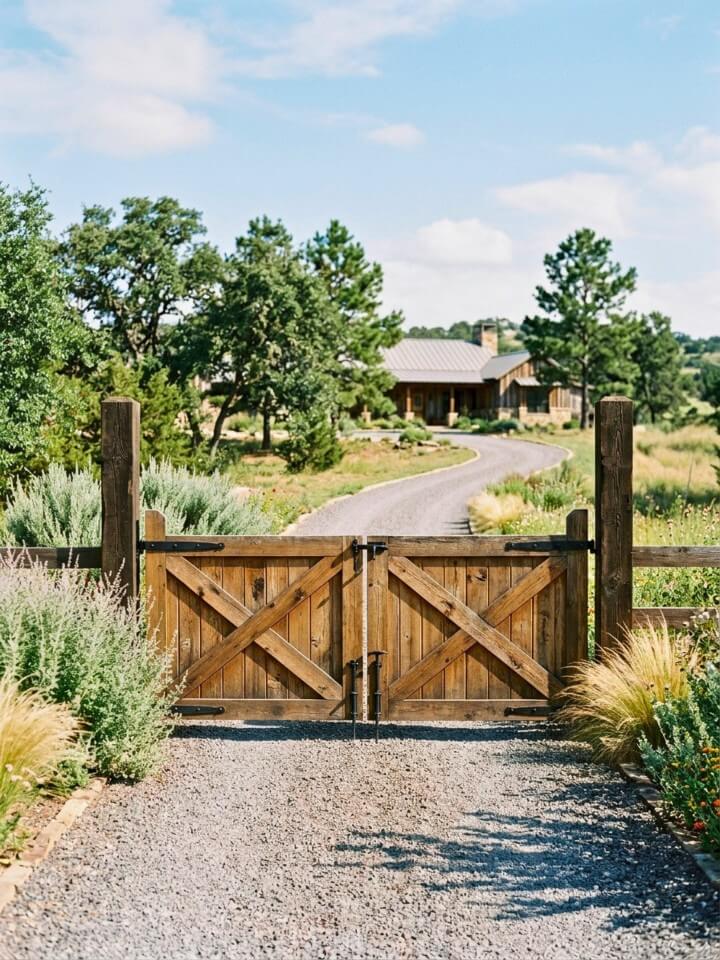
The crossbuck – that classic X-pattern brace across the gate frame – is one of the oldest farm gate designs still in active use, dating back to early American homesteads. The design isn’t decorative; the diagonal braces prevent the gate from sagging under its own weight, which matters on spans over 8 feet.
Build it from cedar or pressure-treated pine for $200–$600 in materials, plus a day of work if you’re handy. Paint white for that traditional farmhouse contrast, leave natural for rustic, or stain dark for modern farmhouse looks. Pair with simple black T-hinges and a thumb latch. This style fits pasture entrances, garden gates, and side access points where charm matters more than security.
10. Gate with Lantern Posts and Lighting
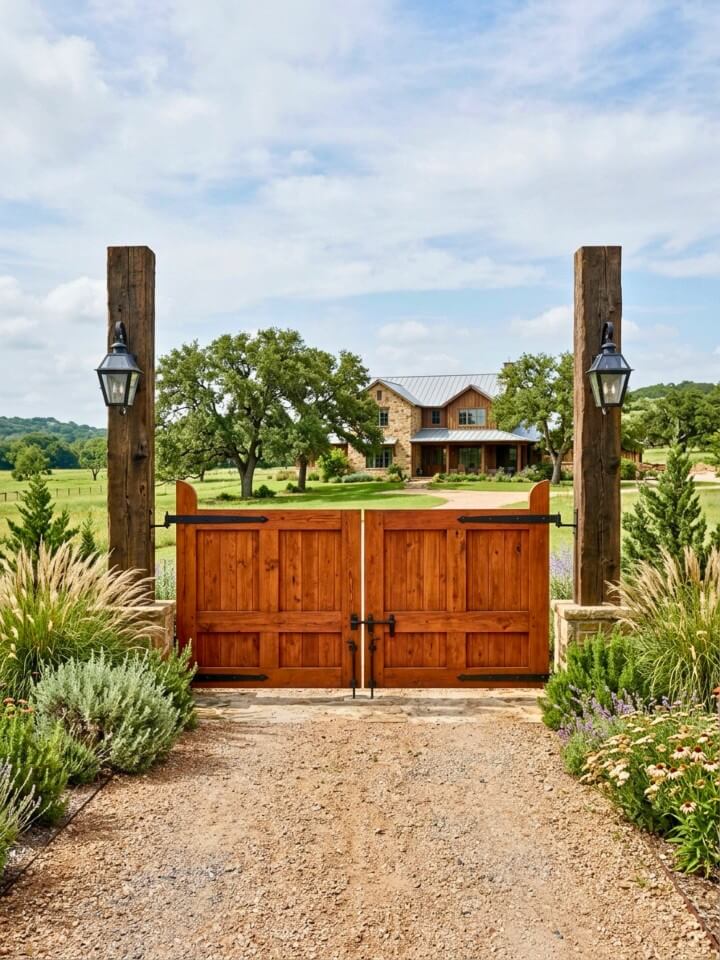
Lighting transforms a gate from a daytime feature into a 24-hour landmark, and it solves the practical problem of finding your turnoff on a dark rural road. Two main approaches work: traditional gas-style lanterns mounted on post tops, or low-voltage LED uplighting recessed into the post base. Lantern fixtures run $150–$600 each, while a basic solar setup costs under $100 per post.
Choose warm white bulbs (2700K–3000K) for an inviting glow; cool white reads commercial. For wired systems, run conduit during construction — retrofitting later is messy and expensive. Pair lights with reflective house numbers visible from 50 feet away so emergency services and deliveries can find you reliably.
11. Steel Frame Gate with Wood Infill
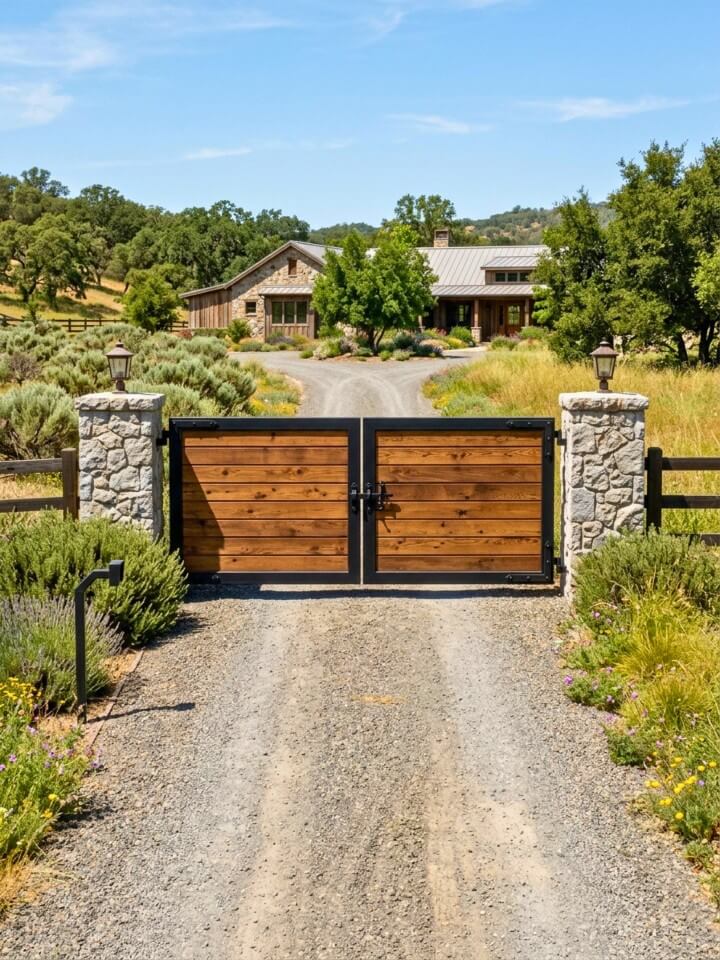
This is the workhorse of the modern ranch gate world. A welded square or rectangular steel tube frame, usually 2×2 or 2×3 inch stock, holds tongue-and-groove or shiplap wood panels in place. Expect $1,200–$3,500 for a 14-foot version.
What sets it apart from option 5 is the structural priority — the steel does all the load-bearing work, so wood panels can be replaced individually as they age without rebuilding the gate. That makes long-term maintenance cheap and easy. Powder-coat the steel rather than paint; powder coatings last 15–20 years versus 5–7 for paint. Use this design on driveways with heavy daily use, automation, or anywhere wind load is a concern.
12. Double Swing Gate with Decorative Hardware
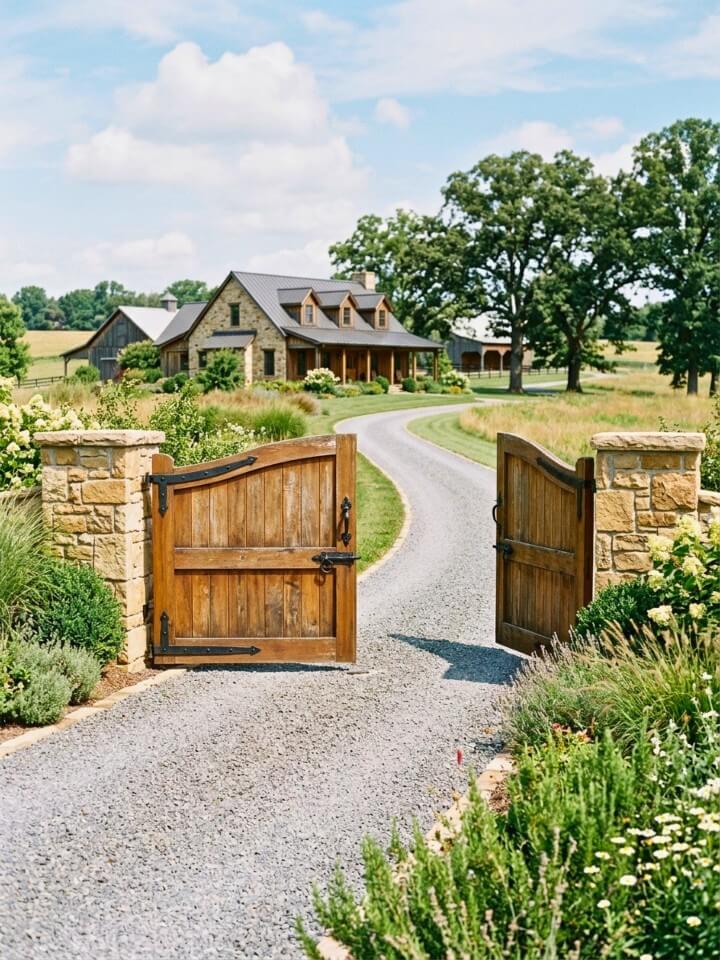
When your driveway clears 14 feet and you want presence at the entry, a double swing gate delivers. Each leaf swings independently, which means lighter individual panels, easier hardware, and the option to open just one side for foot traffic. Double swing gates typically cost $1,800–$5,500 installed, plus $1,500–$3,000 for automation if you want it.
Hardware deserves attention here — strap hinges, ring latches, or decorative drop rods can run $100–$400 per piece but transform the look. Stone or large timber posts anchor the design and handle the lateral loads. Build in a 1–2 inch ground clearance to handle frost heave and prevent dragging during heavy snow or mud seasons.
13. Live Hedge Gate Entrance
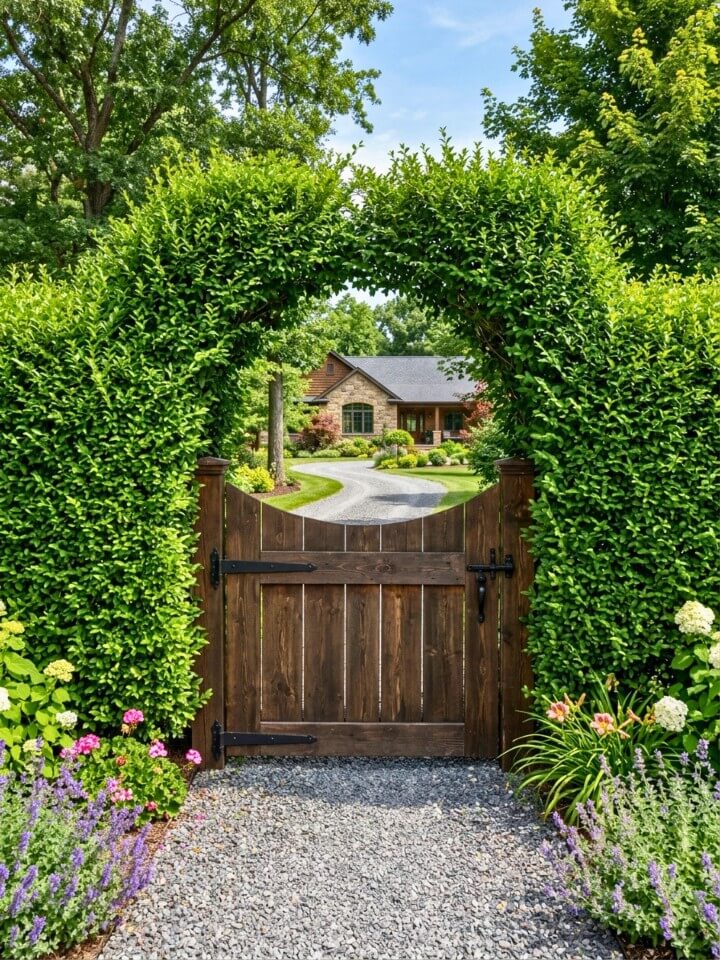
A gate flanked by mature hedging gives privacy that no fence can match while supporting pollinators and providing year-round structure. The hedge does most of the visual work, so the gate itself can stay simple — a basic wood or metal pedestrian gate often suffices.
For evergreen coverage, choose American holly, arborvitae ‘Green Giant’ (which actually grows 3–5 feet per year, unlike slower options like boxwood), or wax myrtle in southern zones. In hot, humid regions, unique low-maintenance Florida landscaping ideas can help you choose plants that stay attractive without constant watering or trimming. Expect 3–5 years from planting to full screen height. Plan for a 4–6 foot hedge width at maturity, so set the gate back from the property line to allow for growth. Annual shaping in late winter keeps the hedge dense rather than leggy.
14. Gate with Stone and Metal Combination
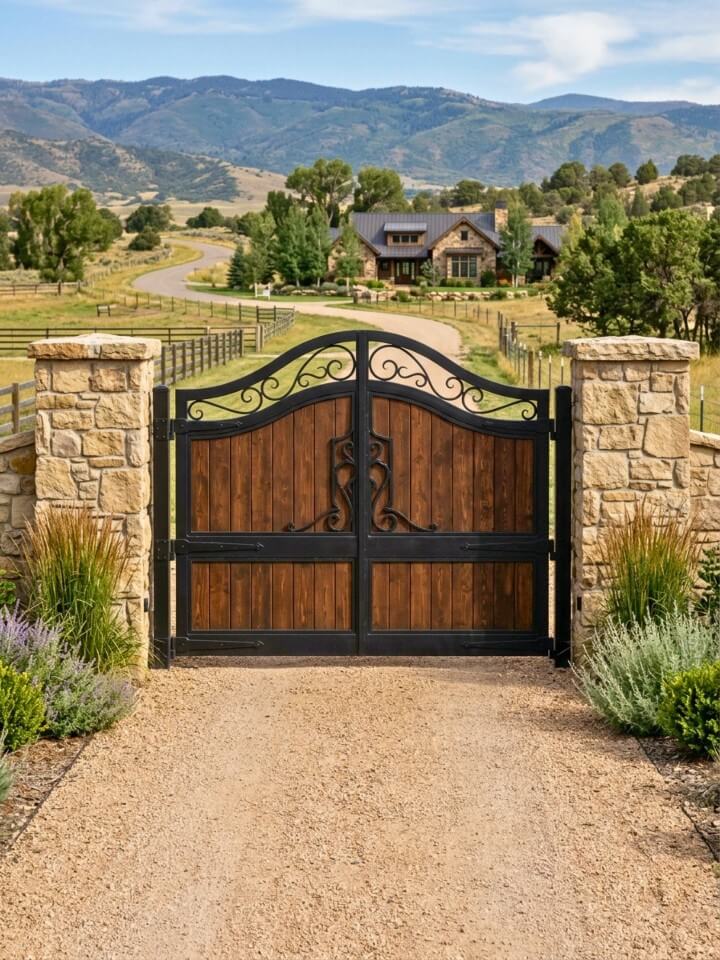
Pairing stone pillars with a metal gate gives you the permanence of masonry with the see-through quality of ironwork — useful when you want a substantial entrance that doesn’t feel like a wall. Local fieldstone keeps costs reasonable at $80–$150 per square foot of pillar face; imported or cut stone can double that.
The metal gate, typically wrought iron or powder-coated steel, runs $1,200–$4,000 for a single swing or $2,500–$7,000 for a double. The contrast between heavy stone and lighter metal works visually because the eye reads it as old-meets-new without either material competing. Add a stone or steel ranch nameplate centered above the gate to anchor the composition.
15. Reclaimed Wood Gate with Natural Finish
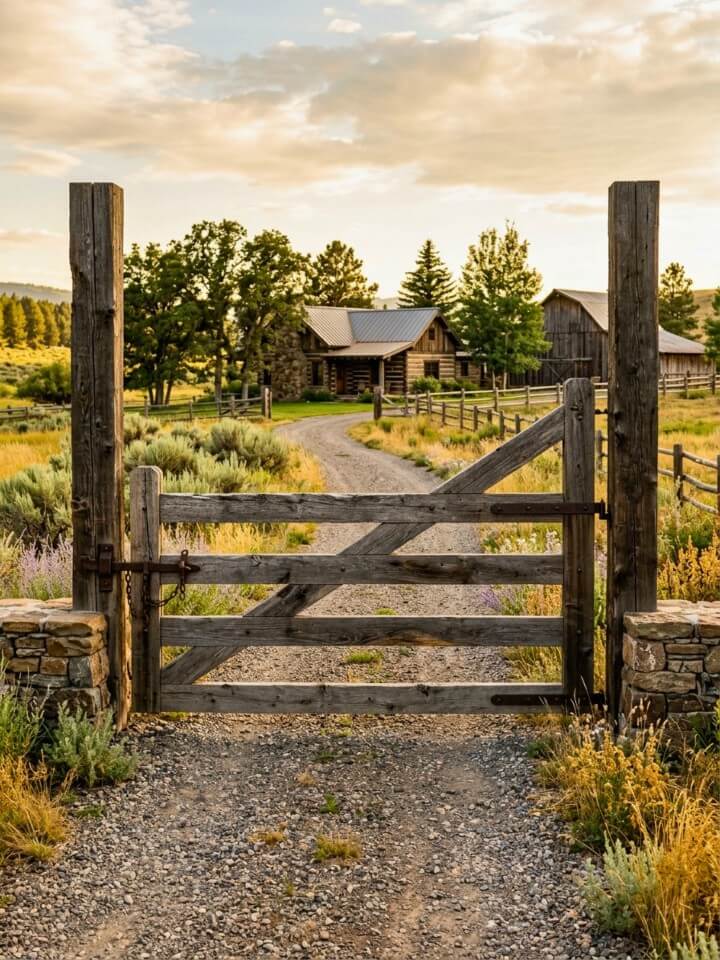
Reclaimed barn wood, fence boards, and salvaged timbers each carry visible history — nail holes, weathering patterns, faded paint traces — that no new material can replicate. Sourcing varies from free (Craigslist, local farmers tearing down old structures) to $8–$25 per board foot for premium reclaimed oak or chestnut.
Total gate cost typically lands at $600–$2,200. Beyond aesthetics, reclaimed lumber is often denser and more rot-resistant than new wood because old-growth trees grew slowly. Inspect carefully for hidden hardware before cutting, and seal with a clear penetrating oil to preserve the patina without making it look refinished. This style suits properties where authenticity and sustainability matter more than uniformity.
16. Ranch Gate with Corrugated Metal Panels
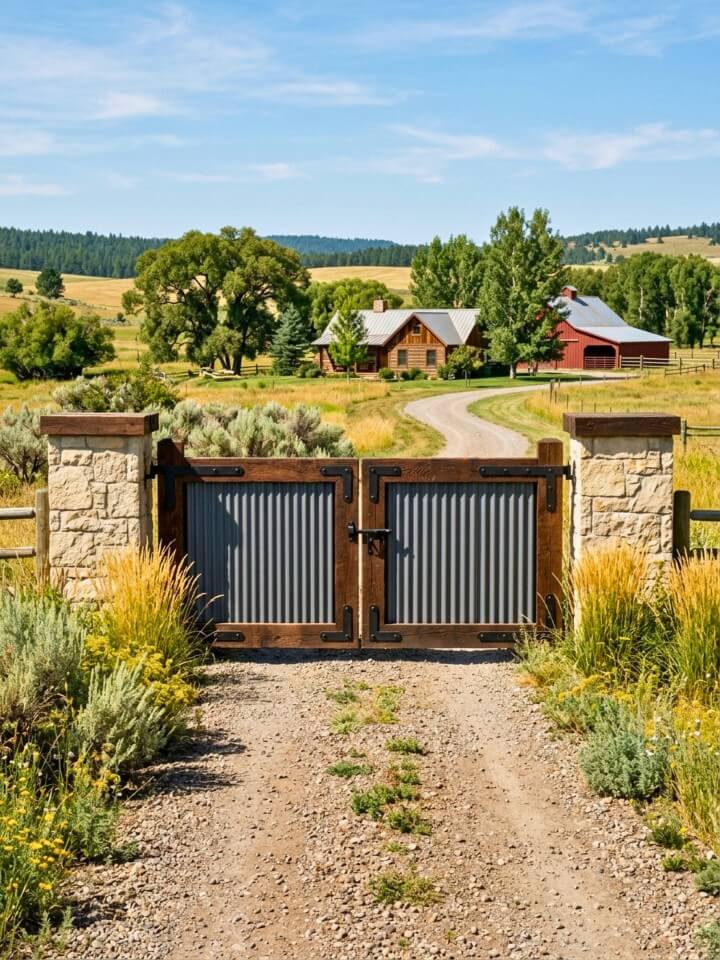
Corrugated metal has moved from utility buildings to design feature in the last decade, and for good reason: it’s cheap, durable, and surprisingly versatile. Galvanized or weathering steel panels cost $2–$5 per square foot and last 40–60 years with minimal maintenance. Frame them in welded steel or wood and you get a gate that handles wind, hail, and sun without complaint.
Corten (weathering) steel develops a stable rust patina over 6–18 months that protects the metal beneath — no painting required. Use this design on working ranches, modern farmhouse properties, or anywhere a low-maintenance entrance matters more than traditional looks. Soften the industrial edge with ornamental grasses or sagebrush along the base.
17. Gate Framed by Large Timber Posts
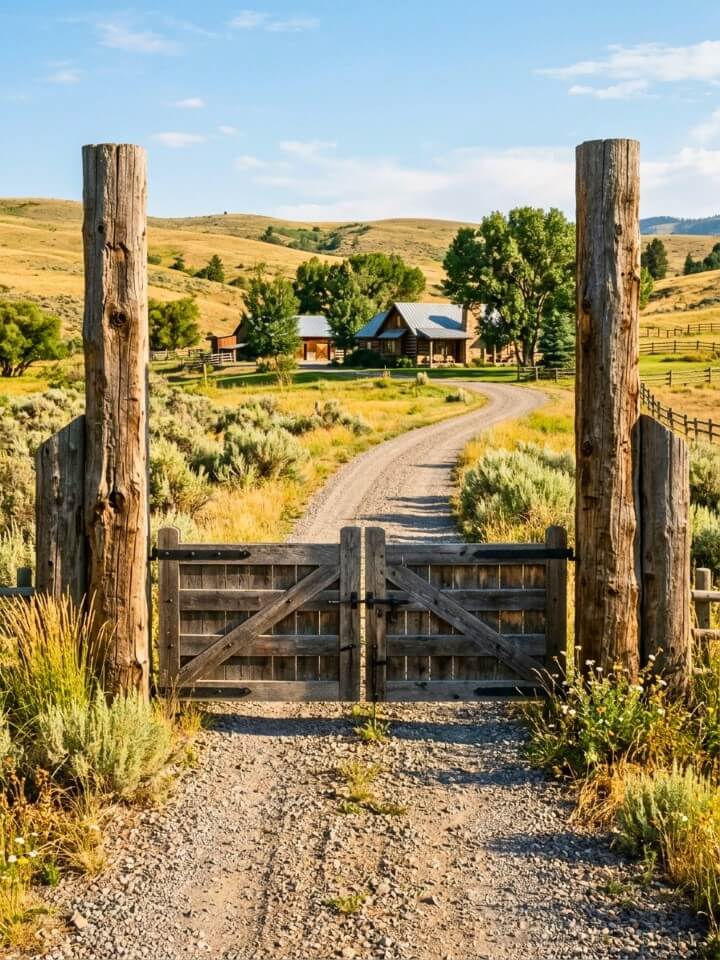
Oversized timber posts — typically 8×8 or 10×10 inch cedar, Douglas fir, or oak — create a substantial frame that makes even a modest gate look intentional. Each post runs $200–$600 in materials plus concrete footing costs, and they must be set at least 3–4 feet deep below frost line for stability. Rough-sawn or hand-hewn surfaces hold stain better than smooth-planed wood and read more authentic.
The scale of the posts also gives you mounting space for substantial hardware: ranch brand plaques, antler mounts, ironwork brackets, or gooseneck lanterns. Treat the buried portions with copper-based preservative before installation. With proper treatment and routine sealing, timber posts of this size easily last 25–40 years.
18. Curved Top Gate with Rustic Ironwork
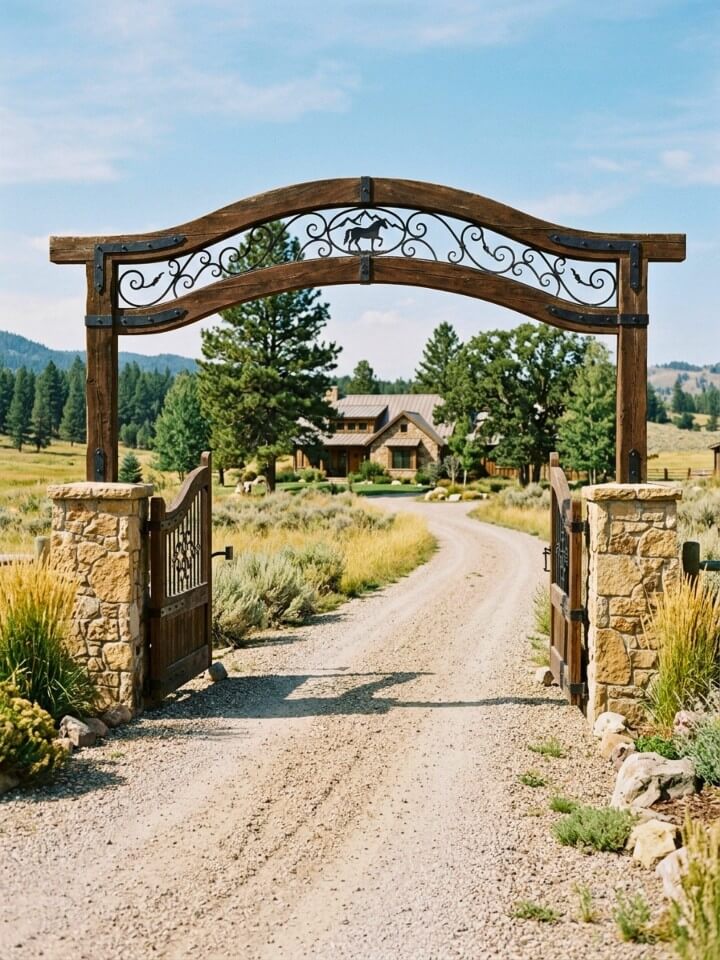
A gentle arch across the top edge of a gate softens the entire entrance and tells visitors that thought went into the design. The curve doesn’t need to be dramatic — even a 4–6 inch rise across an 8-foot span reads as deliberate. Custom-arched gates run 20–40% more than straight-top equivalents due to the additional fabrication, putting most options at $1,400–$4,800.
Add scrollwork, twisted bar details, or simple ring accents in matching ironwork for visual interest without overdoing it. Hand-forged hardware costs more than mass-produced equivalents but holds up better against weather and looks better with age. This style bridges rustic and refined, suiting properties that lean elegant without going formal.
19. Minimalist Gate with Clean Lines
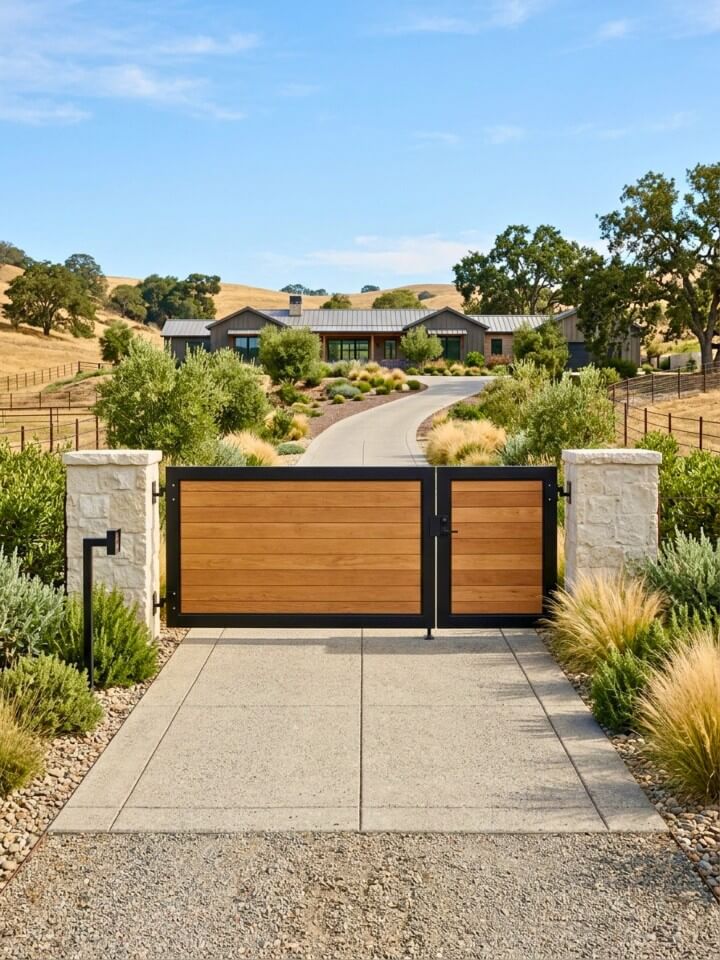
Sometimes the strongest design statement is restraint. A minimalist gate uses flat steel panels, simple horizontal or vertical members, and hidden hardware to create an entry that feels calm and confident. Materials run $1,500–$4,000 for a quality 12-foot version. The trick to minimalism is precision — every weld, every gap, every alignment has to be exact because there’s nothing decorative to distract the eye.
Cheap fabrication shows immediately. Pair with smooth concrete or steel posts, gravel or paver driveways, and intentional plantings rather than wildflower scatter. For a cleaner overall approach, uncommon ideas for landscaping can help connect the gate, driveway, and front yard into one cohesive scene. This style suits modern ranch architecture, contemporary farmhouses, and anyone whose taste runs more Scandinavian than Western.
20. Gate with Integrated Mailbox and Signage
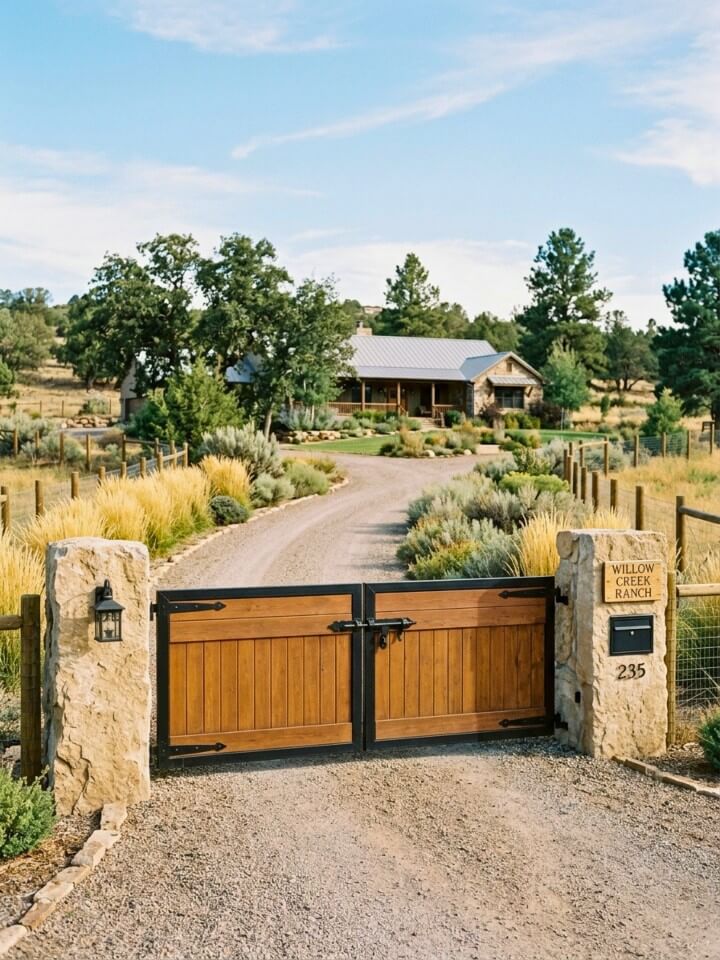
Building the mailbox and ranch name signage directly into the gate structure consolidates everything visitors need at the entrance into one organized feature. Custom integrated designs run $1,800–$5,500 depending on materials and detail level. The mailbox must meet USPS requirements: the bottom of the box positioned 41–45 inches above the road surface and the opening set back 6–8 inches from the curb or road edge.
Place signage where headlights catch it — typically 4–6 feet above ground and angled slightly toward the road. Use reflective lettering at least 4 inches tall for night visibility. This solution removes the cluttered look of separate posts, boxes, and signs spread across the entrance.
21. Gate with Decorative Scrollwork Panels
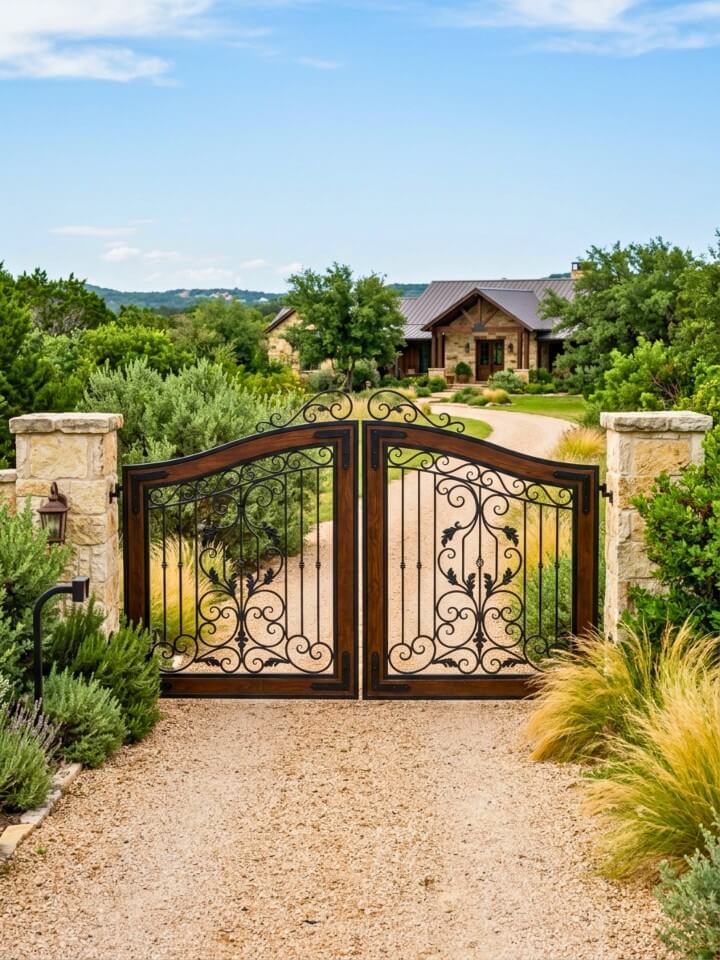
Scrollwork panels turn a gate into a piece of architectural art. Traditional ironwork uses S-curves, C-scrolls, and leaf or vine motifs hand-bent over a forge; modern versions use plasma-cut steel sheets for similar effect at lower cost. Hand-forged panels run $200–$800 per square foot, while plasma-cut designs cost $40–$150 per square foot.
The scrollwork doesn’t have to fill the entire gate — a 2–3 foot decorative band across the top or center often delivers more impact than full coverage. Powder-coat in matte black, oil-rubbed bronze, or weathered steel for finishes that age well. This style fits Spanish, Mediterranean, and Western ranch homes especially well, where ornament is part of the regional vocabulary.
22. Rustic Gate with Stone Archway
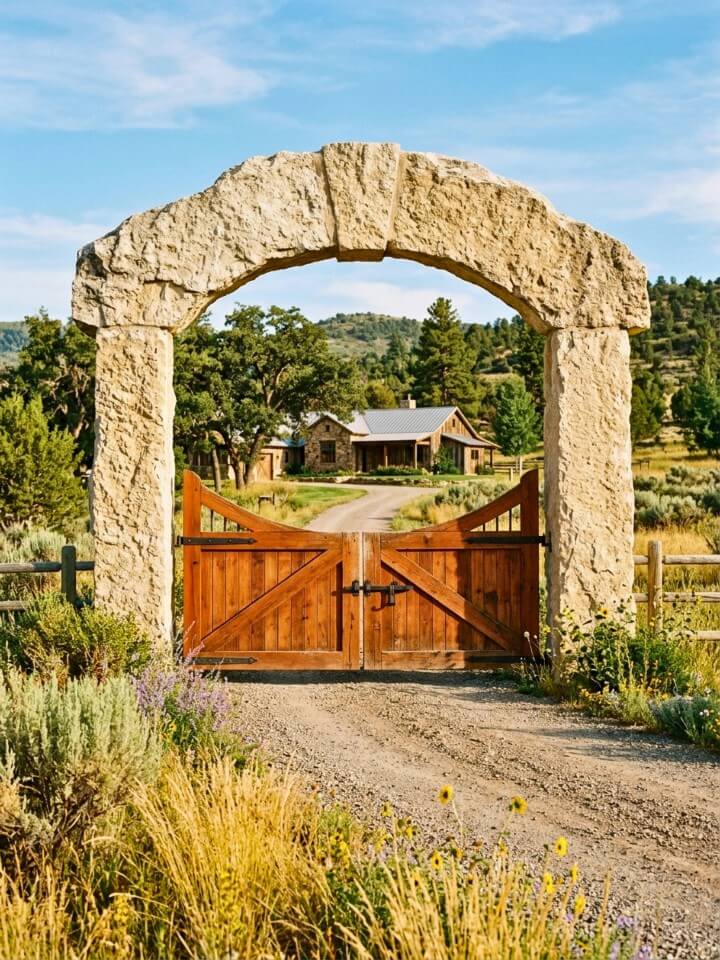
A full stone archway over the gate creates the single most dramatic entrance design available, and it’s also the most expensive — typically $8,000–$25,000 for a proper masonry arch spanning 12–16 feet. The structural engineering matters here: a true arch transfers load to the side pillars through compression, requiring careful keystone placement.
Hire a mason with arch experience, not a general stoneworker. The gate beneath should be relatively simple to avoid competing with the arch — heavy timber, simple wrought iron, or weathered steel all work. Add recessed lighting in the underside of the arch for nighttime drama. This design suits large properties where the entrance is visible from a distance and meant to be remembered.
23. Gate Featuring Native Wood and Natural Patina
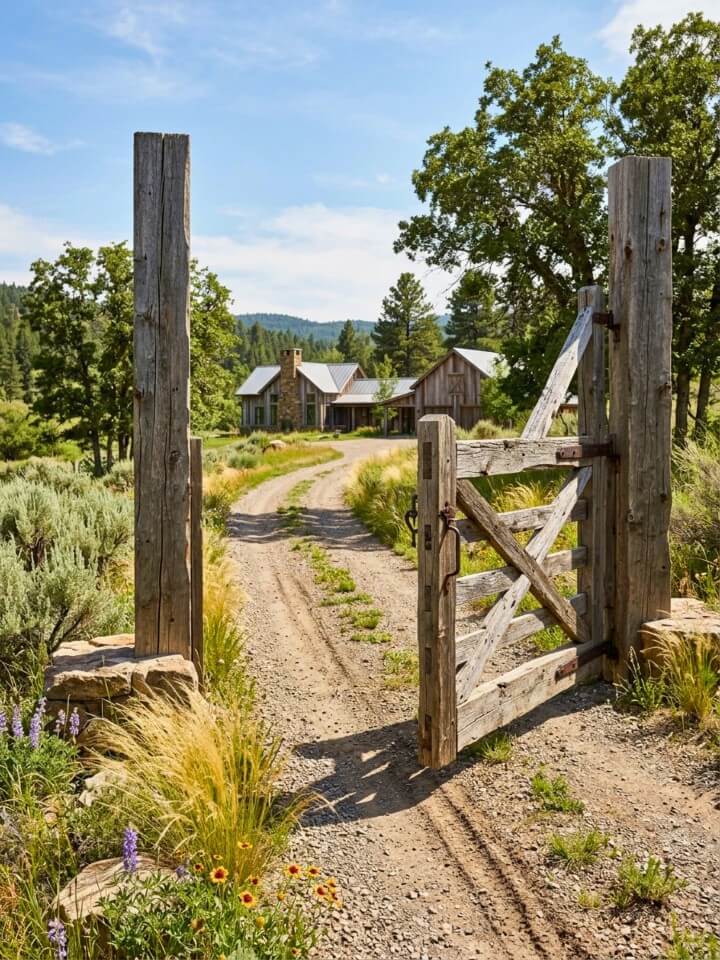
Using wood from species that grow naturally on or near your property creates an entrance that belongs to the land in a way imported materials never can. Cedar in the Pacific Northwest, mesquite in the Southwest, oak in the Midwest, and cypress in the Southeast all weather beautifully without treatment, developing silver-gray patinas over 1–3 years.
Sourcing from local sawmills usually costs 20–40% less than retail lumber and often produces lower carbon impact from reduced shipping. Skip sealants and stains — let the wood age naturally for the patina effect, just plan to replace boards every 12–20 years as the lower portions reach the soil line. Pair with native plantings for an entrance that reads as a continuation of the landscape.
Frequently Asked Questions About Ranch Gate Entrance Ideas
Picking a gate gets complicated fast once you move past the inspiration phase. These five questions tackle the stuff most articles quietly ignore – the practical, sometimes awkward details that determine whether your entrance actually works for your land.
How Much Does a Typical Ranch Gate Cost Installed?
A basic wooden farm gate runs $400–$900 installed. Mid-range steel-and-wood combinations land between $1,500 and $4,000. Custom designs with stone pillars, automation, or extensive ironwork commonly reach $8,000–$25,000. Site conditions like rocky soil or slope can add 15–30% to installation costs.
How Wide Should a Ranch Driveway Gate Be?
Standard pickup trucks need at least 10 feet of clearance, but 12–14 feet is the practical minimum if you ever expect deliveries, trailers, hay equipment, or emergency vehicles. For double-axle trailers or RVs, plan on 16 feet. Fire codes in many rural counties require 14-foot minimum widths for primary access.
Do I Need a Permit to Install a Gate?
Requirements vary by county, but most rural areas don’t require permits for simple residential gates under 6 feet tall. Automated gates, gates within a certain distance of public roads, or gates with structural pillars often do require permits. Check with your local building department before starting, and always confirm setback requirements from property lines and easements.
How Long Do Wooden Ranch Gates Last?
Cedar and locust gates typically last 15–25 years with basic maintenance. Pressure-treated pine reaches 12–20 years. Untreated softwoods like spruce may only last 7–10 years in wet climates. The biggest factor isn’t the wood species but where the gate contacts soil — the bottom 12 inches of any wooden post fails first, regardless of material.
Can I Automate Any Gate, or Do I Need a Specific Design?
Most swing and slide gates can be automated, but the gate must be built to handle motorized operation. Light residential gates often need reinforcement before adding an opener, and slide gates need sufficient run-off space for the gate to retract into. Factor automation into the original design when possible — retrofitting typically costs 30–50% more than including it from the start.
What’s the Best Gate Style for High-Wind Areas?
Open designs like split-rail, slat gates with gaps, and wrought iron handle wind far better than solid panels. If you want privacy in a windy region, choose horizontal slats with 1-inch gaps or perforated metal panels rather than solid wood. Solid gates over 6 feet tall in 50+ mph wind zones often require engineered bracing or anchor systems.
Choosing the Right Gate for Your Property
The best ranch gate isn’t the most expensive or the most decorative — it’s the one that fits your land, your daily use, and your maintenance willingness. Start with function: how wide, how often used, what level of security. Then layer in style choices that match your home’s architecture and your region’s character. A modern slat gate on a 1920s farmhouse will always look borrowed; a heavy log gate in front of a sleek glass-and-steel home creates the same disconnect.
If budget is tight, prioritize good posts and hardware over a fancy gate panel — you can always upgrade the panel later, but replacing failed posts is a much bigger project. If you live in extreme climate (heavy snow, salt air, intense sun), choose materials proven in that environment by your neighbors, not by Pinterest. And whatever you build, plan for the day in year 10 when something needs replacement, because every gate eventually does.
Pick the design that makes you happy to come home. That’s the real measure of a successful ranch entrance.