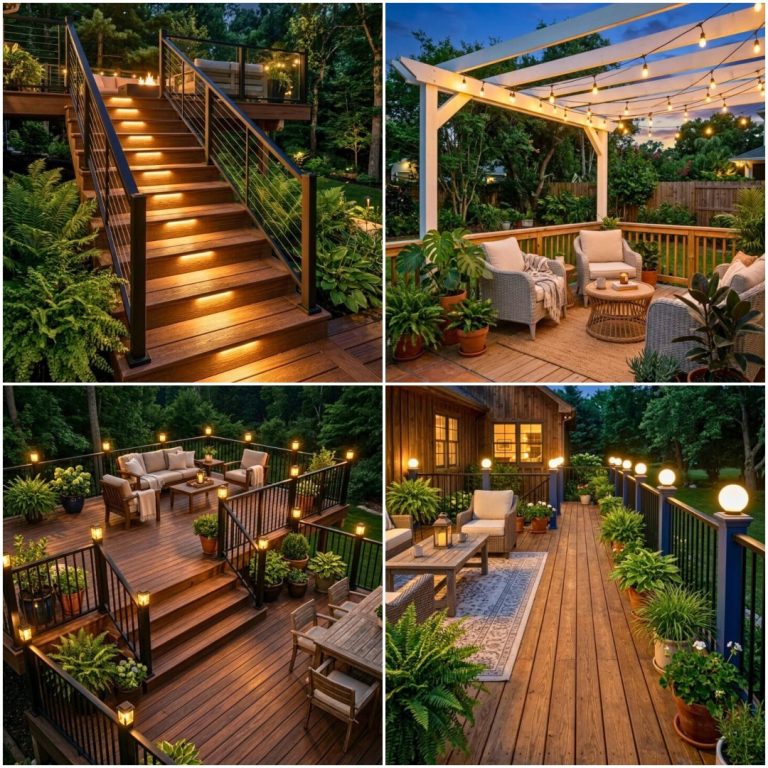
25 Outdoor Tree Lighting Ideas for A Magical Backyard Glow
There’s a moment right after sunset when your yard goes flat — the trees you spent all summer admiring just vanish into a wall of black. A single warm bulb at the base of a maple fixes that faster than any patio furniture upgrade ever could. That’s the quiet magic behind these 25 radiant outdoor tree lighting ideas: you’re not decorating the tree so much as giving it a second shift.
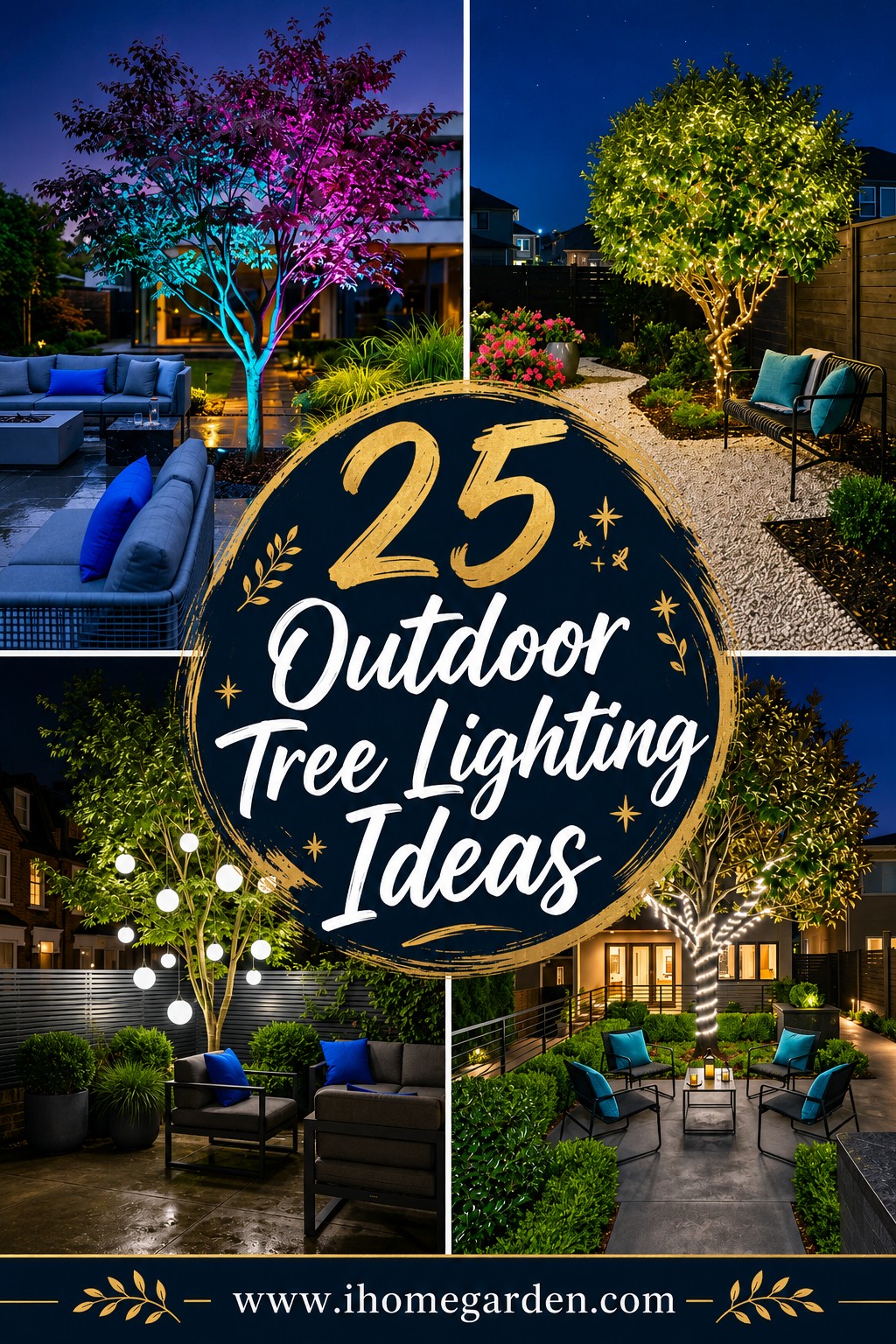
I’ve spent more evenings than I’d like to admit untangling strands, repositioning spotlights two inches to the left, and arguing with solar panels that lied about their runtime. What I’ve learned is that good tree lighting isn’t about buying more — it’s about placing less, better. Whether you’ve got a sprawling oak begging for drama or a skinny dogwood near the front steps, there’s something here that’ll work without turning your yard into a runway. Grab a coffee, scroll slow.
1. String Lights Wrapped Around Trunks
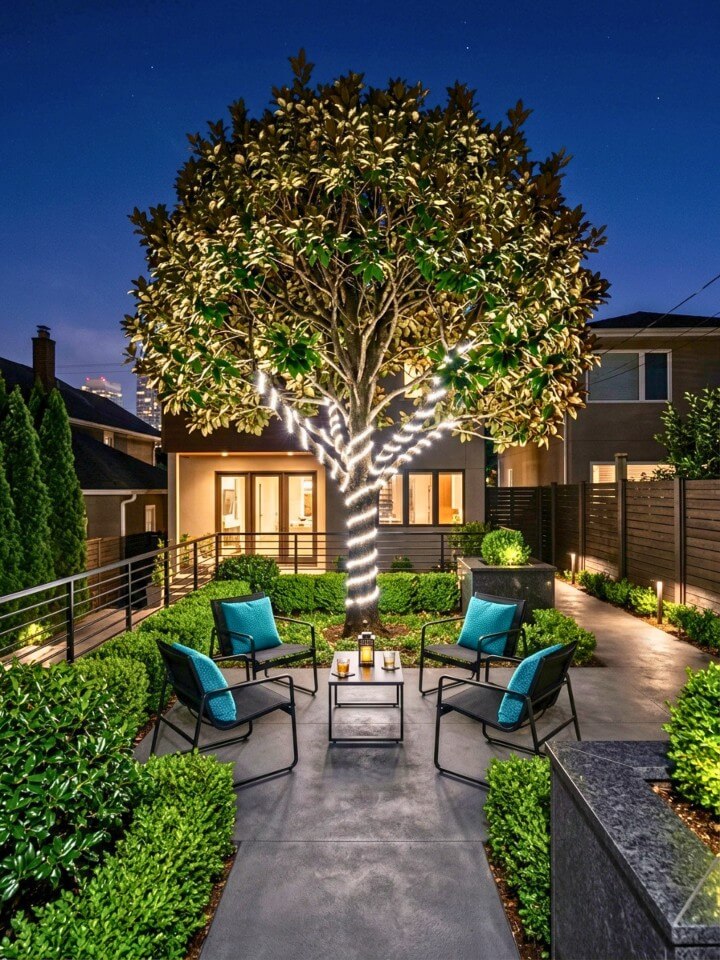
Few techniques transform a yard faster than spiraling string lights up a thick trunk. I prefer warm-white commercial-grade strands (G40 or G50 bulbs around 2700K) because cheap indoor sets fade after one rainy season. Start six inches above the soil, wrap at roughly a four-inch pitch, and anchor every two feet with black UV-resistant zip ties so the cord disappears against the bark. A 48-foot strand usually covers a 10-inch-diameter trunk up to about seven feet high. Plug into a GFCI outlet, ideally through an outdoor smart plug set to a dusk-to-dawn schedule. Skip nails or staples — they wound the cambium and invite pests.
2. Uplighting for Dramatic Shadows
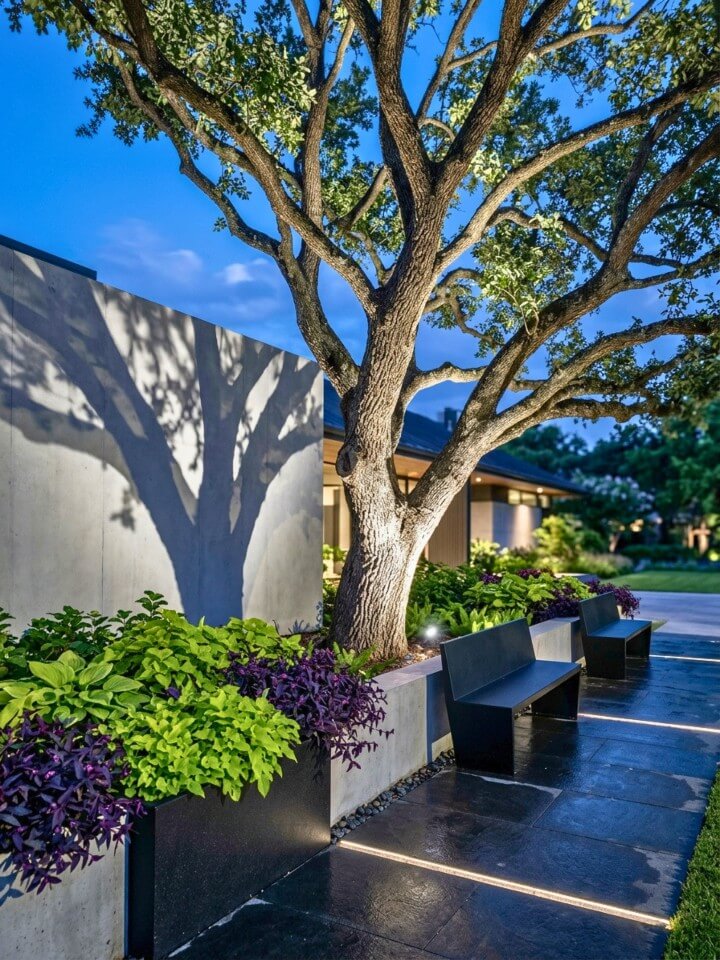
Uplighting is the single biggest upgrade for any mature oak, maple, or magnolia. Place two 5-watt LED well lights about 18 inches from the trunk, angled at roughly 35 degrees so the beam climbs the bark and fades in the upper canopy. A narrow 25-degree spread sculpts the trunk; a wider 60-degree flood washes the whole crown. Stick with 2700K to 3000K — anything cooler turns green leaves an unnatural blue at night. Bury the low-voltage cable two inches deep under mulch and feed it through a 12V transformer with a photocell. Aim fixtures away from bedroom windows, or neighbors will not stay neighbors for long.
3. Lanterns Hanging from Branches
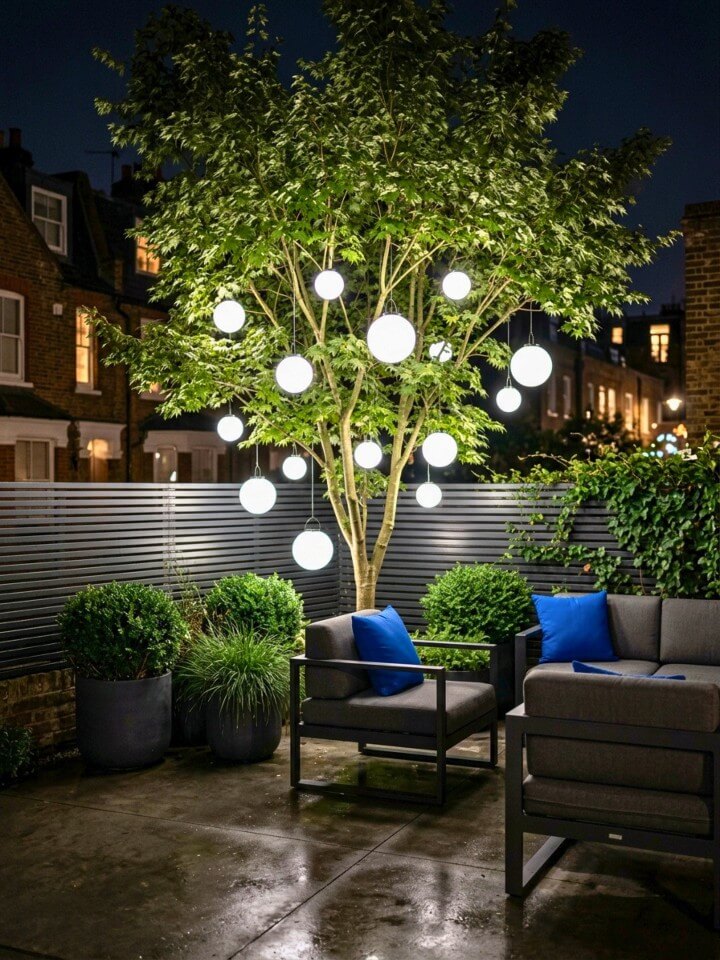
Transform dull evenings into magical nights with backyard tree lights that spark wonder and warmth. Hanging lanterns shine where string lights feel overdone — small ornamental trees like Japanese maples, crepe myrtles, or dogwoods.
Choose metal-frame lanterns under two pounds each so the branch does not droop or scar; anything heavier needs a bough thicker than your wrist. I use stainless steel S-hooks looped over the branch with a rubber sleeve protecting the bark. Battery-powered LED pillar candles with built-in six-hour timers eliminate the cord problem entirely, and a fresh set of D-cells lasts most of a season. Stagger heights between four and seven feet so guests do not headbutt them walking to the patio. Bring lanterns indoors before the first hard freeze.
4. Spotlights Highlighting Focal Trees
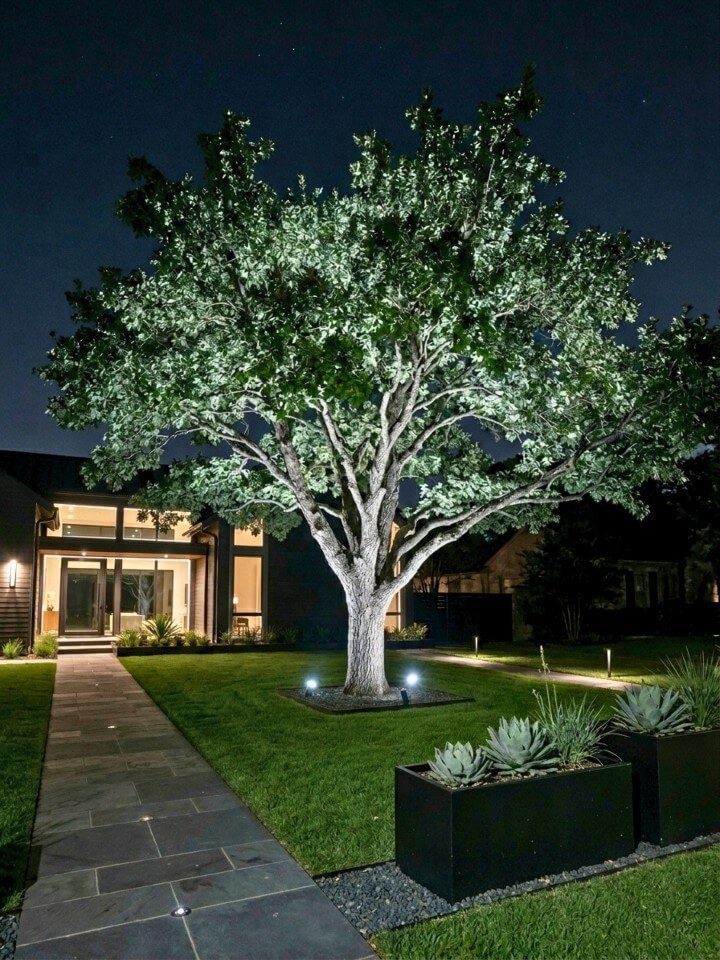
A focal tree deserves a fixture that disappears by day and performs at night. Brass or copper bullet spotlights age into the landscape better than the black plastic kits at big-box stores — pay the extra $30 each, you will thank yourself in year three. Position the light eight to ten feet from the trunk so the beam grazes rather than blasts. For a 25-foot tree, one 7-watt MR16 LED at 3000K usually does the job; double up if the canopy spreads wide. Tuck the fixture behind a hosta or boxwood, never in open turf where a mower will find it. Match beam angle to canopy: narrow for columnar, wide for spreading.
5. Solar-Powered Twinkle Lights
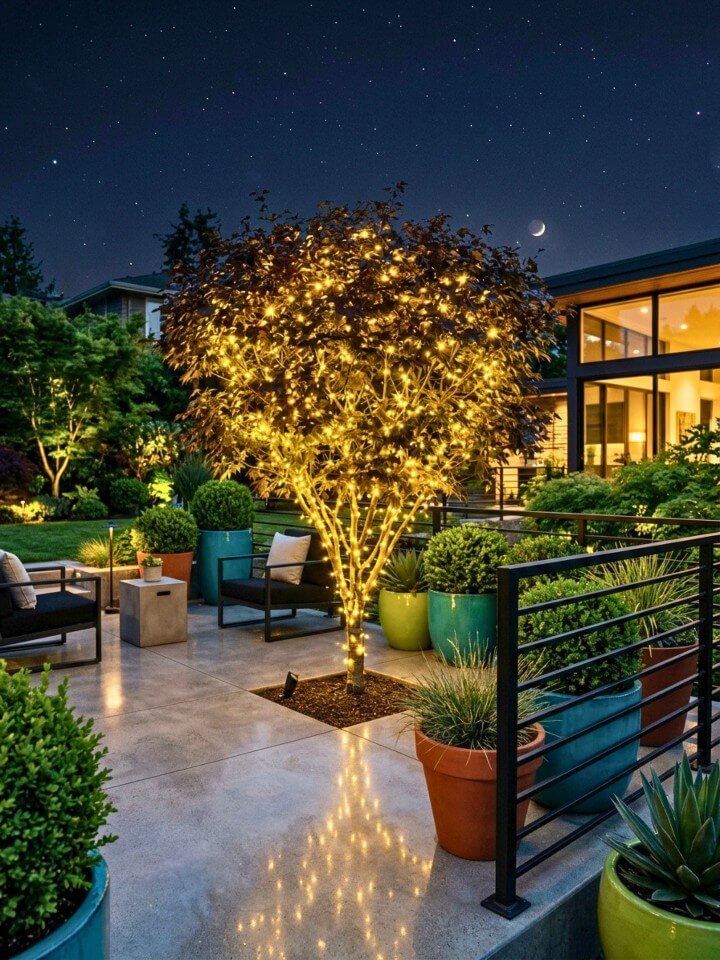
Solar twinkle strands are the lazy gardener’s friend — no trenching, no transformers, no electrician. The catch is honest expectations. Even a “100-hour runtime” panel needs six hours of direct sun, which rules out trees under heavy shade. I mount the small panel on a separate stake angled south, then run the lead wire up the trunk so the solar cell never lives where the lights live. Brands like Brightech and Lumify offer 33-foot copper-wire strands with replaceable 18650 batteries — a huge advantage, since most solar lights die when the sealed battery fails. Budget two seasons of life before replacing cells. Cool-white settings drain faster than warm.
6. Rope Lights Along Branch Lines
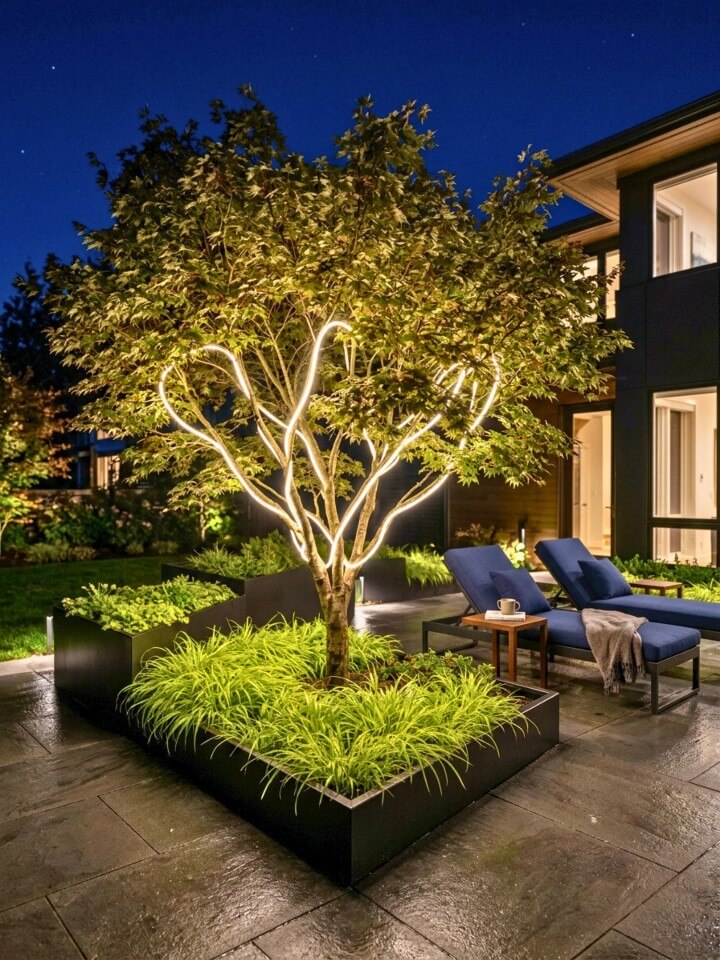
Rope light is the wrong tool when it is wrong, and a brilliant tool when it is right. Rigid PVC rope tubes hate cold and crack below 20°F, so look specifically for silicone-jacketed LED neon-flex rope rated to −4°F. Run a continuous length along a single major limb — splices in rope leak. Half-inch cable clamps screwed into a sacrificial wood batten (never the bark) hold the rope without girdling the branch. A 50-foot run draws roughly 18 watts in LED form, so a small 24V driver handles a whole mature dogwood. Edges of the rope take the brunt of sun damage; rotate the tube 90° once a year to extend life.
7. Fairy Lights Nestled in Foliage
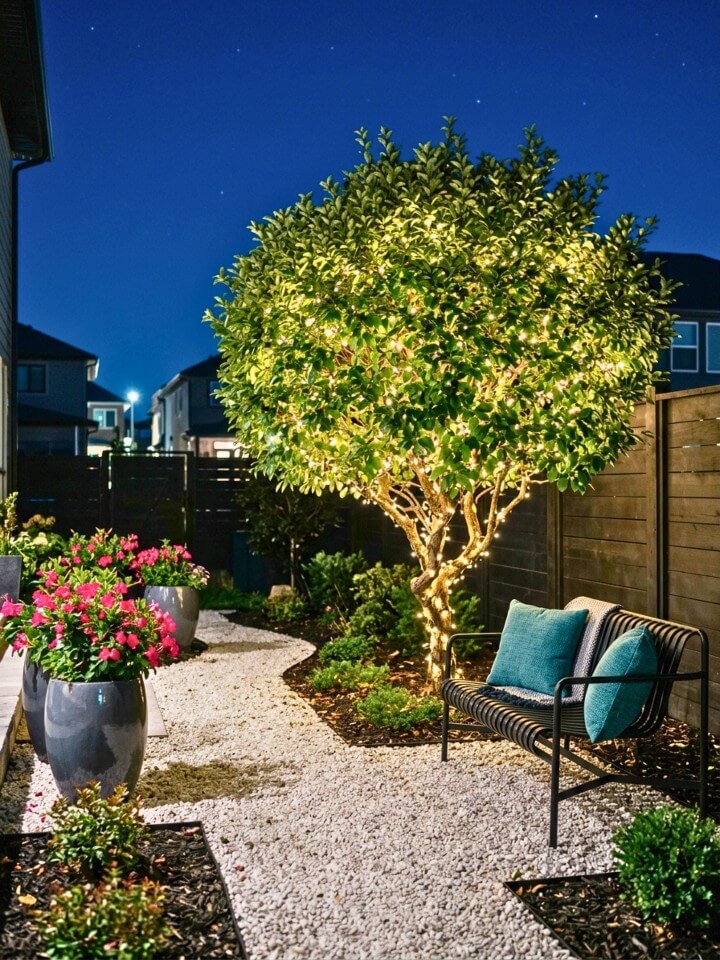
The trick with fairy lights — those hair-thin copper-wire strands with rice-grain LEDs — is hiding the wire, not the bulbs. I push the strand deep into the interior of the canopy from the trunk side, so the copper vanishes against branches and the lights appear to float. Battery-powered sets with a six-on, eighteen-off timer are simplest; expect six to eight weeks of nightly runtime on three AAs at warm-white settings. For evergreens like Alberta spruce or boxwood pyramids, a 200-LED strand covers a four-foot tree generously. Wear thin gloves while threading — the copper wire kinks if you grip too hard, and kinked strands develop dead segments fast.
8. Colored LED Accent Lighting
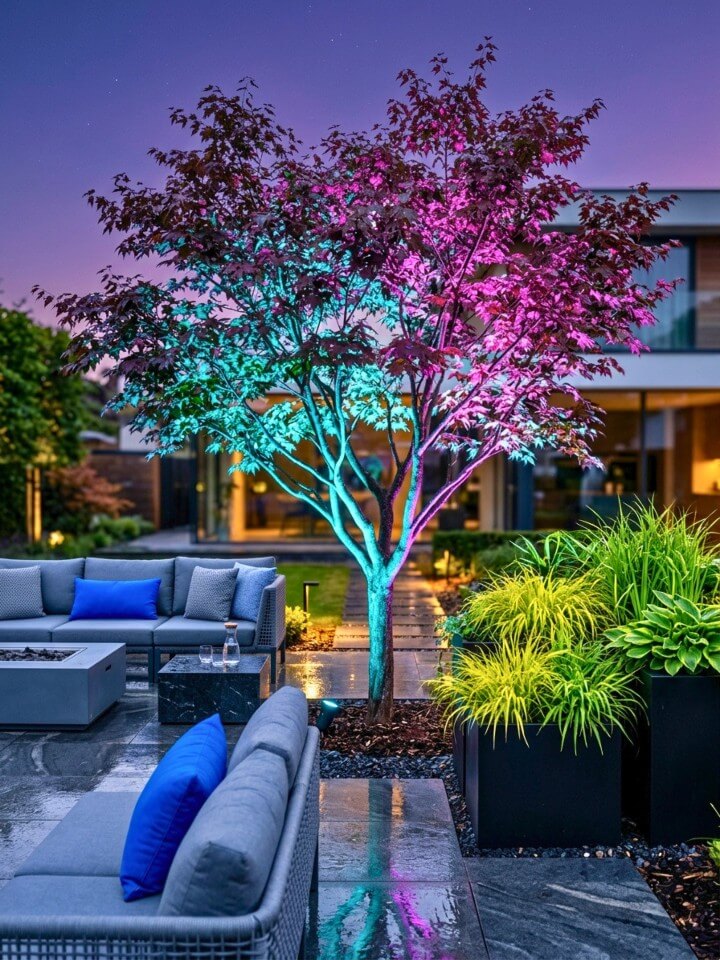
Color is the spice of a lighting plan — a dash transforms, a tablespoon ruins. Smart RGBW fixtures like the Govee outdoor floods or Philips Hue Lily series let you dial saturation down to a tinted white rather than a cartoon red or green, which is almost always the better choice. Anchor on amber or soft pink for autumn, deep blue for winter, mint green for spring. Avoid pure red and pure green together at all costs — your yard will look like a tire shop. App-based zoning means one fixture can throw a different hue than its neighbor without rewiring. Pair color washes with a single warm-white uplight to keep the scene grounded.
9. Lantern Paths Around Tree Bases
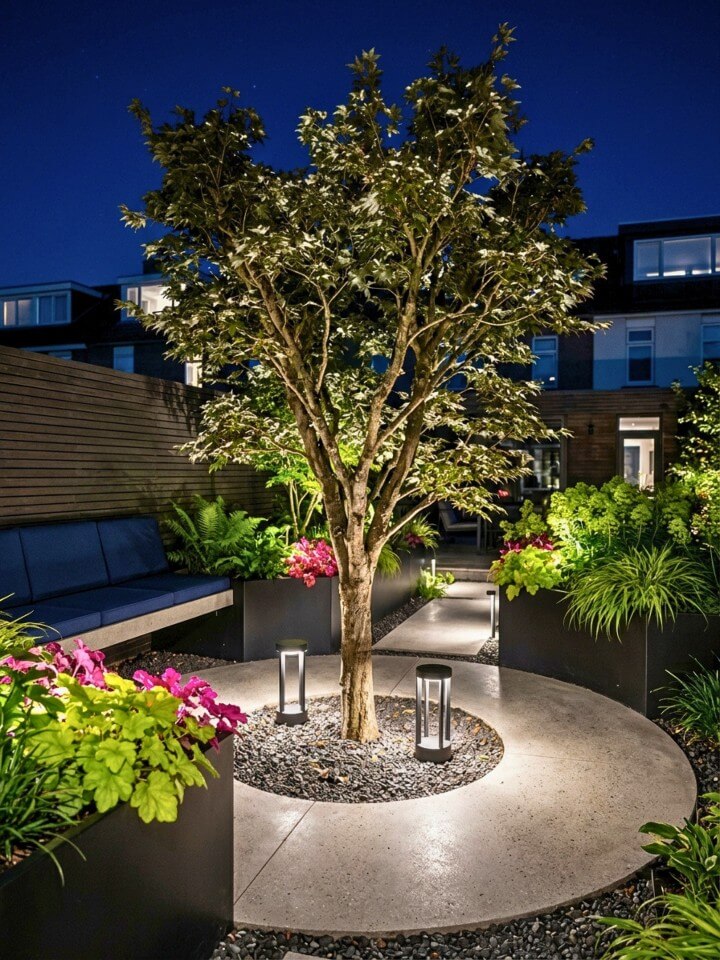
Ringing a tree with low lanterns does two jobs at once: it defines the dripline so guests stop trampling shallow roots, and it pulls the eye toward the trunk. Space the lanterns at three-foot intervals — closer crowds the look, wider breaks the rhythm. Pier-style solar lanterns with frosted glass diffuse better than the clear-pane budget versions, which throw blinding hotspots. For a 15-foot canopy, you typically need six to eight lanterns to close the ring. Set each one on a brick paver to keep the base level and prevent sinking after heavy rain. Replace internal NiMH batteries every 18 months; brown-outs almost always trace back to dying cells, not bad panels.
10. Candle-Style Stake Lights Near Trees
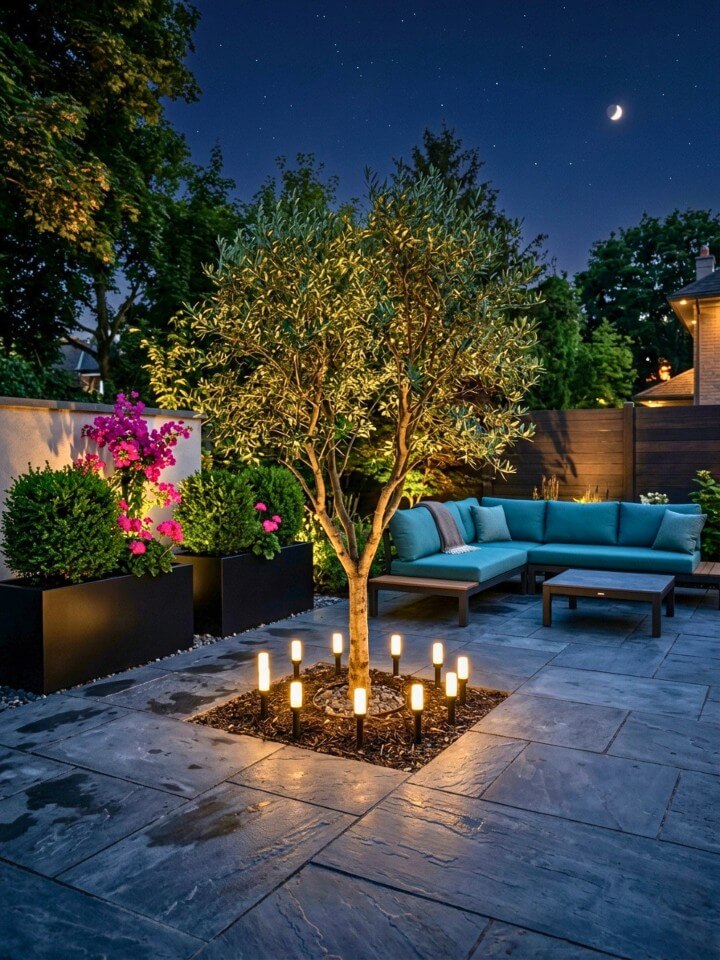
Glow all season long with outdoor tree lights for summer that turn breezy nights into starlit escapes. Stake-mounted candle lights solve a specific problem — they put a warm flicker at knee height without committing to fixed wiring. The flame-effect LEDs from brands like Hampton Bay and Smart Solar wobble convincingly thanks to a small offset weight inside the bulb. Push the stakes into damp soil, not bone-dry summer ground, or the spike will bend before it seats.
Group three or five together rather than placing one alone — odd numbers read as intentional, even numbers read as forgotten. For a small ornamental tree, a tight cluster near the trunk plus a looser pair at the dripline gives depth. Bring them inside during freeze-thaw cycles to prevent cracked housings.
11. Projection Lights Casting Patterns
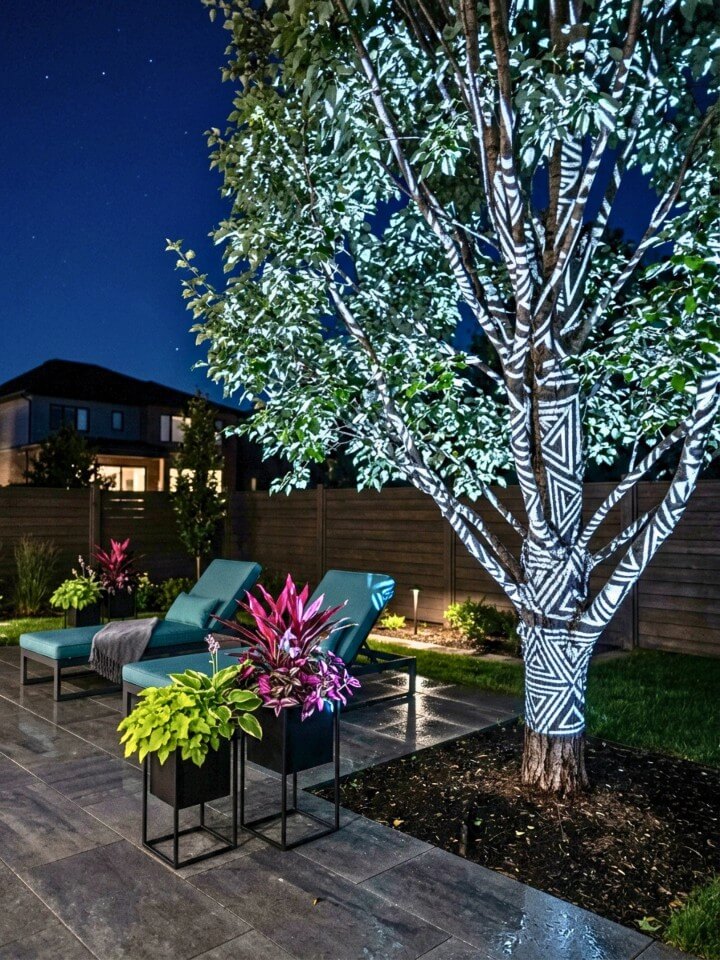
Projection fixtures throw moving leaves, falling snow, or constellations across a canopy without touching the tree itself. Pick a unit with a metal housing and glass gobos — the plastic disco-style versions sold for $25 burn out their LED chip within a season. Place the projector 12 to 20 feet back, angled up at roughly 30 degrees, so the pattern wraps the trunk and lower branches. Spike-mount models like Mr. Beams or BlissLights Spright sit flush with mulch and survive a freeze cycle. Cover the lens with a soft cloth weekly; pollen and spider silk dull the projection faster than people expect. Avoid pattern projectors near a bedroom window — movement at the edge of vision wakes light sleepers.
12. Icicle-Style Hanging Lights
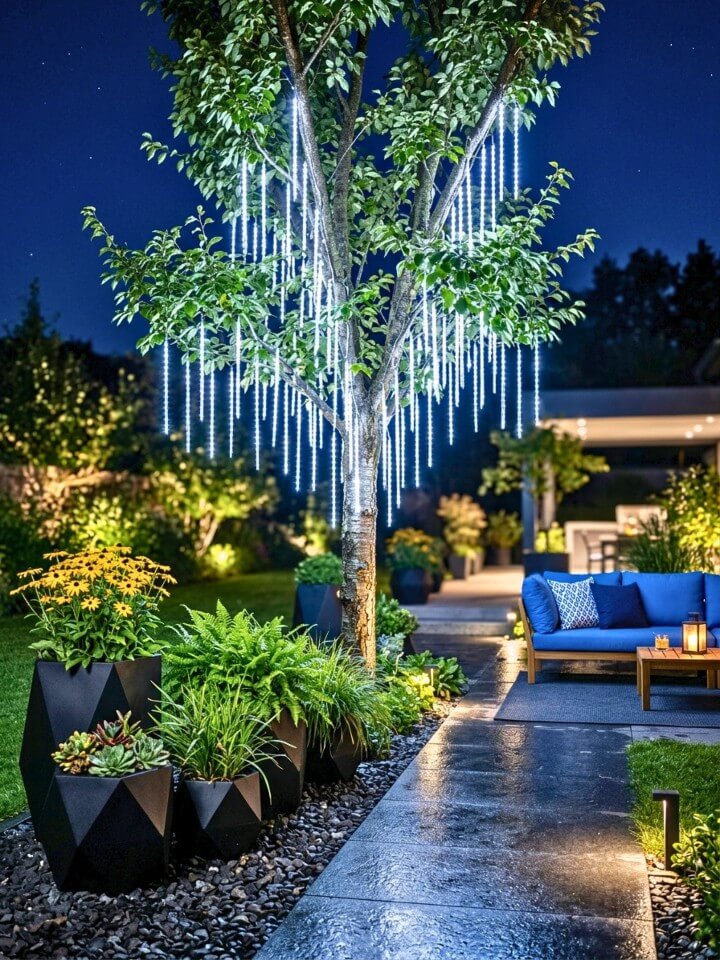
Icicle strands borrowed from holiday displays earn a permanent place when they hang from broad, horizontal limbs. The trick is choosing strands with drop lengths between nine and eighteen inches — anything shorter looks like a fringe, anything longer tangles in wind. T8 LED icicle sets in steady-on mode read elegant; the flickering “meteor shower” versions read tacky after the first week of January. Clip each drop to the branch with insulated gutter clips, never bare wire on bark. A single 70-count strand spans about eight feet of branch. Run them on a separate circuit from your patio string lights so one tripped GFCI does not kill the entire scene.
13. Fiber Optic Tree Wraps
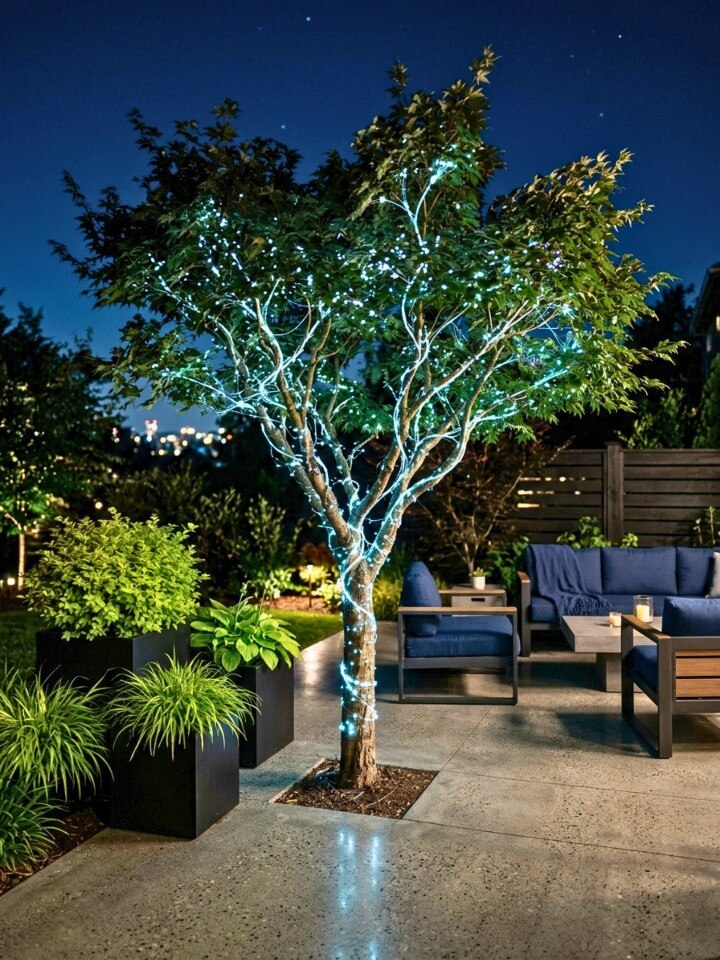
Fiber optic tree wraps are the closest thing to fake bioluminescence — pinpoints of light at the tip of each strand with no visible source. The illuminator box, usually a 5- to 10-watt LED engine, sits at the trunk base and pushes light through a bundle of acrylic fibers fanned out across the branches. Spread the fibers individually using a comb or your fingers; bunched fibers create a hot cluster instead of scattered stars. Color-wheel illuminators give a slow shift between hues, but solid warm-white reads more refined for everyday use. Keep the engine elevated on a paver — direct contact with wet mulch kills the driver within a year, and replacements run $40 to $80.
14. Motion-Activated Accent Lights
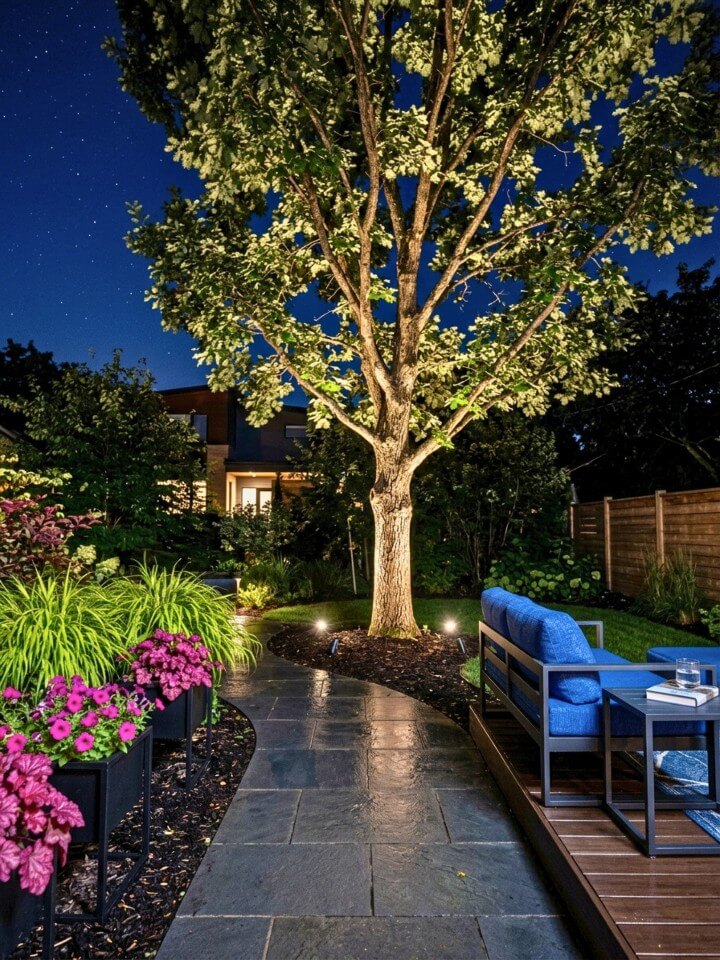
Motion-activated fixtures near a tree solve two problems with one install: deterring nighttime visitors and pulling visual attention to the canopy when someone passes. Look for sensors with adjustable sensitivity and a tunable hold time — factory defaults usually trigger on cats and stay lit for five wasteful minutes. Ring Smart Lighting and Mr. Beams both sell battery and wired versions that integrate with existing security setups. Mount the fixture on a separate stake two feet from the trunk, never screwed into the bark, and aim the sensor across a walking path rather than at it. Pair the unit with a low ambient uplight so the tree is not completely dark between triggers.
15. Twinkling Net Lights Draped Over Trees
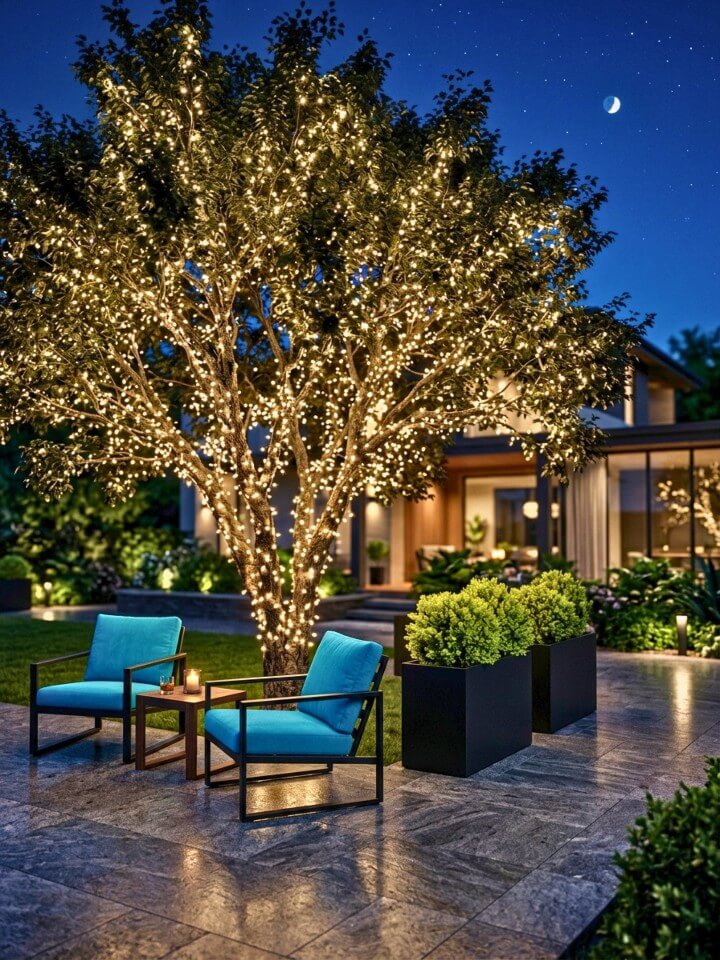
Discover dazzling outdoor lighting ideas for trees that blend artistry, ambience, and effortless charm. Net lights are the fastest way to light a shrub-form tree like a boxwood ball, dwarf Alberta spruce, or a young arborvitae. A four-by-six-foot net drapes over a three-foot canopy in under sixty seconds — no spiraling, no clips, no patience.
Look for nets with copper-wire LEDs rather than fat PVC strands, which sit heavily on tender new growth and snap branches under ice. Two nets on a single tree, layered at slightly offset angles, eliminate the grid-pattern look that makes cheap installations obvious. Secure the bottom edge with tent stakes to prevent windblown shifting. Net lights are not meant for tall trees — anything over five feet, the grid stretches and gaps become visible.
16. Ground-Level Path Lights Circling Trees
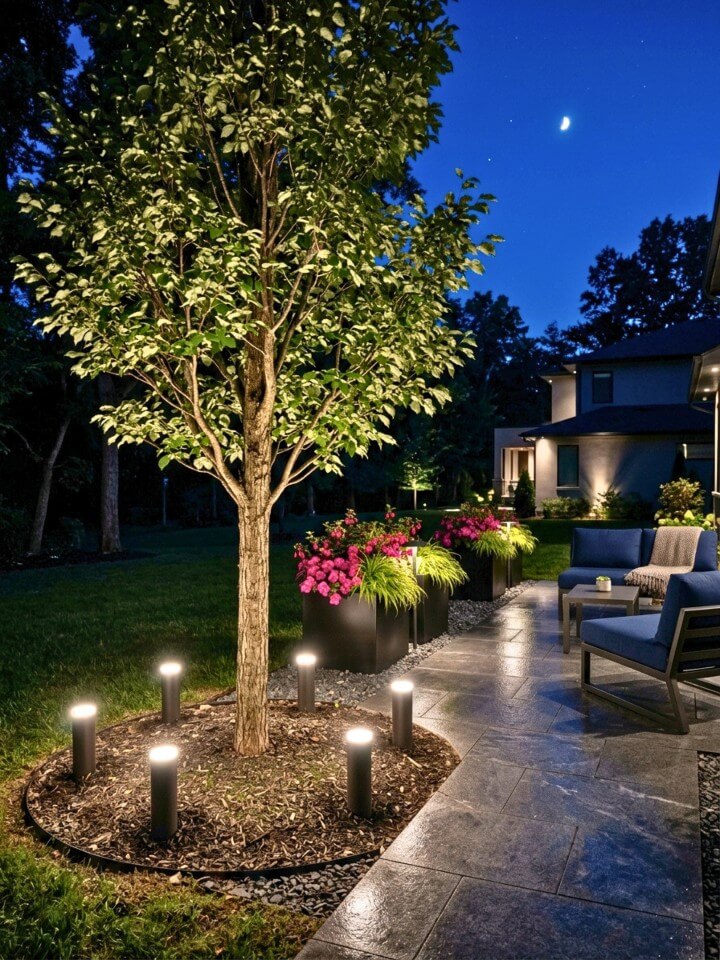
Path lights set in a ring around a tree borrow from professional landscape design — the trunk reads as a sculpture mounted on a lit pedestal. Choose fixtures with a downcast hat shade rather than an open globe; the hat keeps light on the ground where it belongs and stops the glare that ruins photos. Hardwired 12V kits from Volt or Kichler last a decade; solar versions need replacement every two to three years. Space fixtures four to five feet apart in a circle just inside the dripline. Run the cable through a shallow trench under the mulch line, not across the lawn, so aeration spikes do not chew it apart. For a more complete layout, pair this circular lighting plan with cool ideas for landscaping.
17. Hanging Globe Lights for a Festival Feel
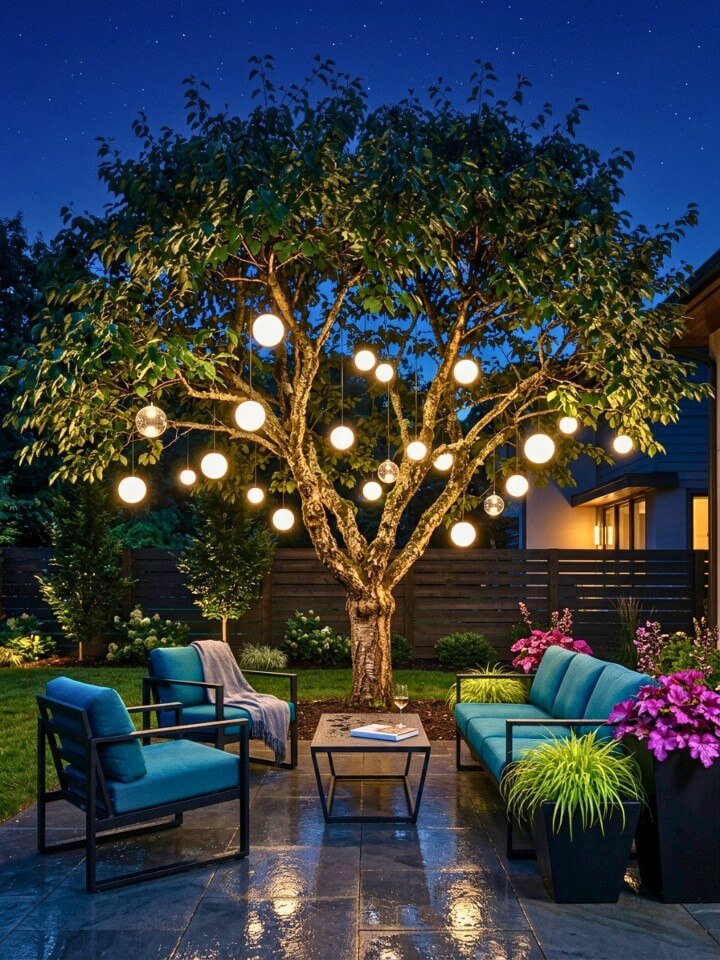
Globe-bulb café strings — the kind with G40 or G50 bulbs every twelve inches — turn a single mature tree into an outdoor room. Suspend the strands from branch to house, branch to fence, or branch to a 4×4 anchor post sunk in concrete, never branch to branch alone or the load will pull. Steel guy wire run alongside the string takes the weight and protects the wire from stretching. Shatterproof acrylic bulbs survive hail and curious raccoons; glass bulbs look better but break expensively. A 48-foot strand draws around 10 watts in LED — leave them on all evening without flinching at the meter. Replace any bulb with a cracked rubber gasket immediately.
18. Up-Lit Water Features Near Trees
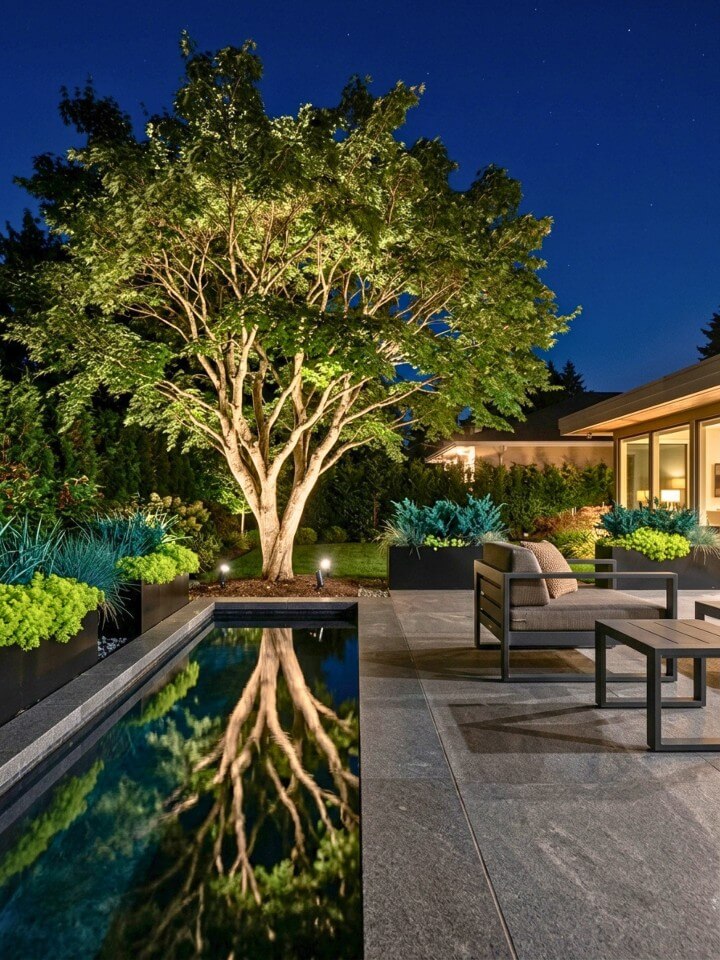
A tree beside a pond, fountain, or birdbath doubles its lighting impact through reflection alone. Submersible LED pucks like the Aquascape Garden Pond series sit on the basin floor and uplight from below the waterline, casting wavering caustics across the trunk and lower canopy. Stick with low-voltage 12V fixtures rated IP68 — anything less and a freeze cycle will crack the housing by year two. Two five-watt pucks in a four-foot basin produce more drama than a single ten-watt.
Keep the water clear; algae blooms scatter the beam and turn the projection muddy. If the basin freezes solid in winter, pull the fixtures in autumn rather than gambling on the seals. Around larger water zones, the same reflective-light principle can complement rectangular pool landscaping ideas without adding too many extra fixtures.
19. Vintage Edison Bulb Strings
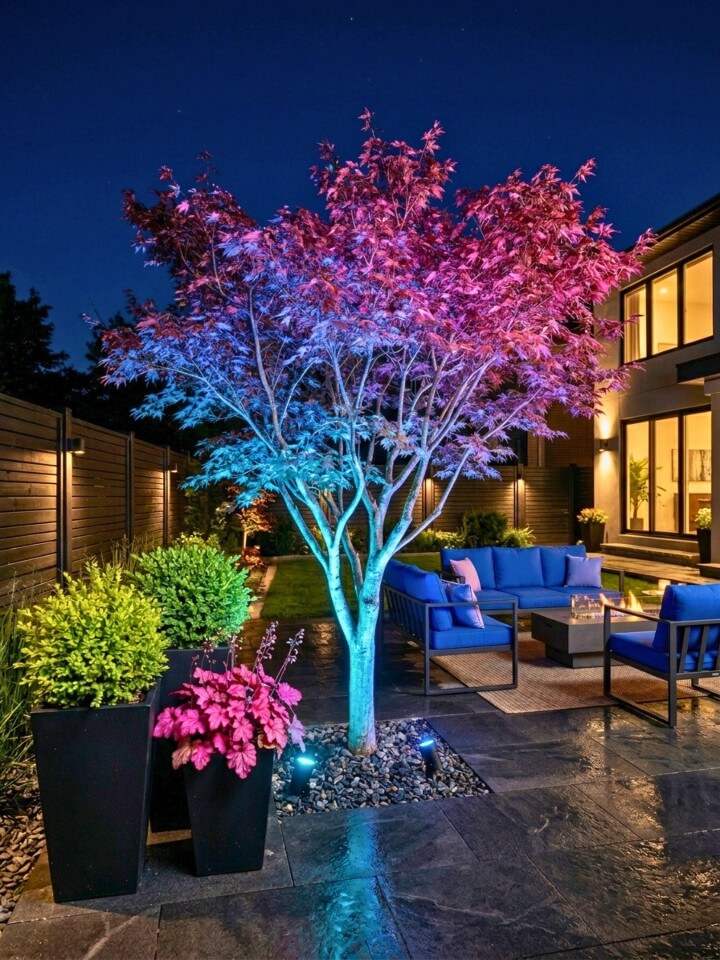
Edison-bulb strings carry a warmer color than standard café lights — the visible filament glows around 2200K, closer to a real flame than to a modern LED. The “vintage” look comes from the bulb shape (ST38, ST58, or G80) rather than from incandescent guts; LED filament versions deliver the same amber tone at one-fifth the power. Brands like Brightech Ambience Pro and Hometown Evolution run reliably outdoors with weather-sealed sockets. Pair the strands with a dimmer plug to soften them further for dinner — full brightness is rarely flattering. Avoid stringing Edison sets through dense foliage; the heat from each filament-style LED, while modest, still wilts tender new leaves over time.
20. Lighted Ornaments for Seasonal Decor
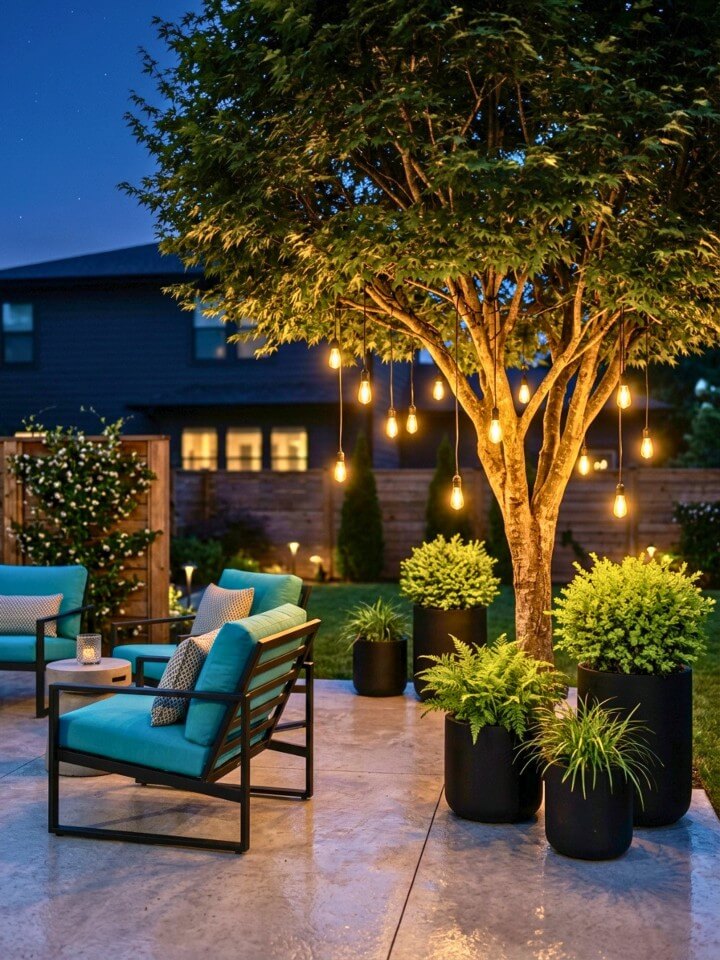
Brighten every branch beautifully with the best lights for outdoor trees built to shine through seasons. Lighted ornaments — illuminated stars, frosted spheres, oversized berries — extend a tree’s seasonal range without rewrapping it four times a year. Battery-powered ornaments with hook clasps swap in and out in minutes; the same dogwood that wore amber pumpkins in October carries silver snowflakes in December, then shifts into softer accents inspired by enchanting spring home decor ideas.
Look for ornaments with replaceable CR2032 cells rather than sealed units, which become landfill after one season. Distribute them at eye level and slightly above — ornaments placed too high read as missed opportunities. Five to eight ornaments suit a small ornamental tree; a larger maple swallows twenty without looking crowded. Store them in a labeled bin with the batteries removed to prevent corrosion.
21. Lantern Poles Surrounding Trees
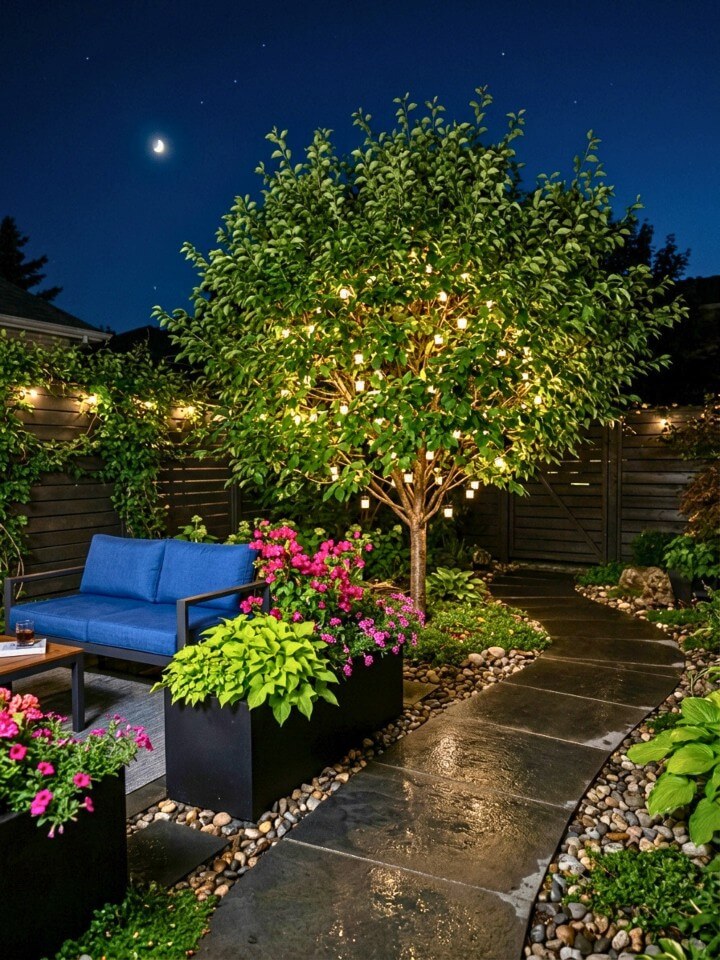
Shepherd’s-hook poles with hanging lanterns frame a tree the way columns frame a sculpture in a museum courtyard. Use poles between four and six feet tall, spaced three to four feet from the trunk in a symmetrical pattern of three, four, or six. Powder-coated steel poles outlast aluminum, which bends in the first windstorm. Hang weatherproof LED lanterns under one pound — heavier units pull the hook crooked within a month. The Smart Solar Mission lantern and similar designs include built-in dusk sensors, sparing you a separate timer. Drive the pole spike to its collar with a rubber mallet, not a metal hammer; the mallet keeps the powder coating intact and the pole upright.
22. Fairy Light Mason Jars Hanging from Branches
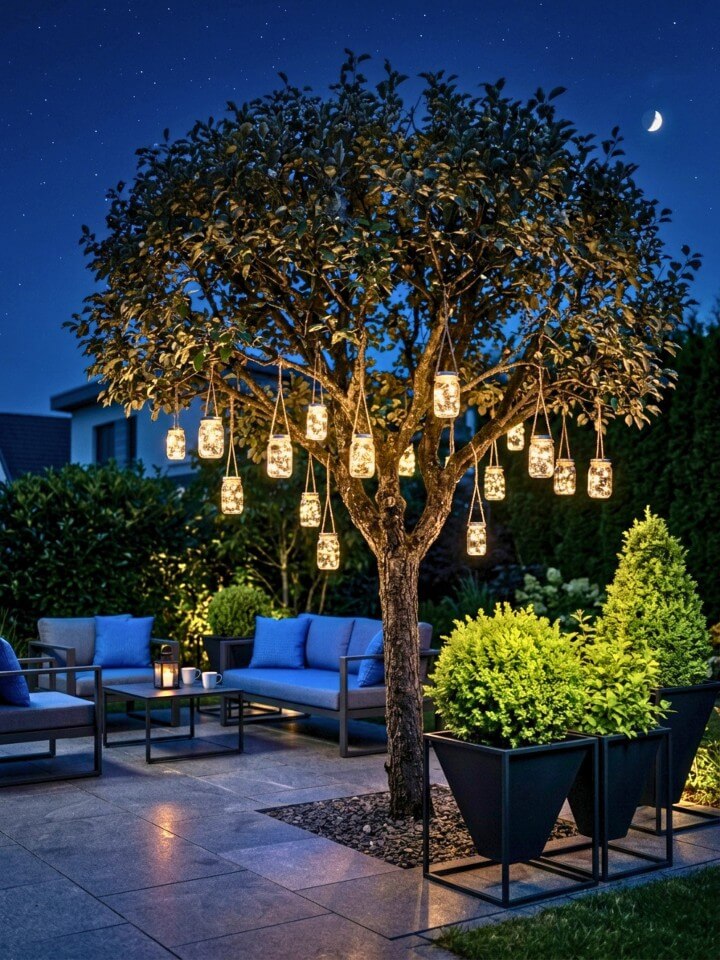
Mason jars wrapped with fairy-light interiors deliver a captured-firefly effect at a fraction of the cost of designer pendants. Use 16-ounce regular-mouth jars rather than wide-mouth — the narrower opening throttles light into a tighter, brighter glow. Coil a 20-LED battery strand inside, tuck the battery pack into a fabric pouch glued to the lid underside, and seal the threaded ring tight. Hang the jar with 16-gauge galvanized wire looped under the lip; twine looks rustic but rots in one wet season. Stagger jars between three and six feet down from the branch for depth. Empty the jars and store the strands indoors over winter — temperature swings crack the glass at the lid seam.
23. Lantern Chandeliers for Large Trees
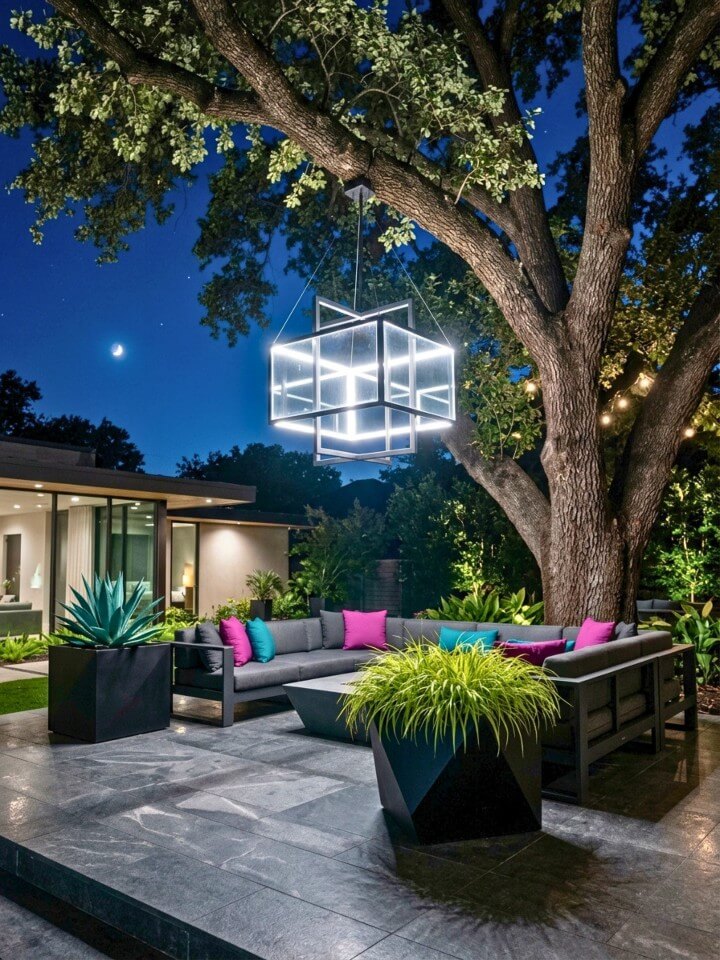
A multi-arm lantern chandelier suspended from a mature horizontal limb borrows from porch lighting and applies it overhead — the patio becomes an outdoor dining room without a roof. The branch must be at least four inches in diameter and free of visible decay; tap it with a mallet and listen for hollow notes before you trust it.
Hang the chandelier from a screw-in tree hook rated for the unit’s wet weight (housing plus rain absorbed by fabric shades). Hardwire through a switched outdoor outlet if possible; battery chandeliers exist but rarely match the depth of a real bulb. Drop the chandelier seven to eight feet above the table — lower obstructs sightlines, higher loses intimacy. If the tree shades a poolside dining zone, connect the lighting style with durable seating from these beautiful pool furniture ideas.
24. Lanterns with Colored Glass Panels
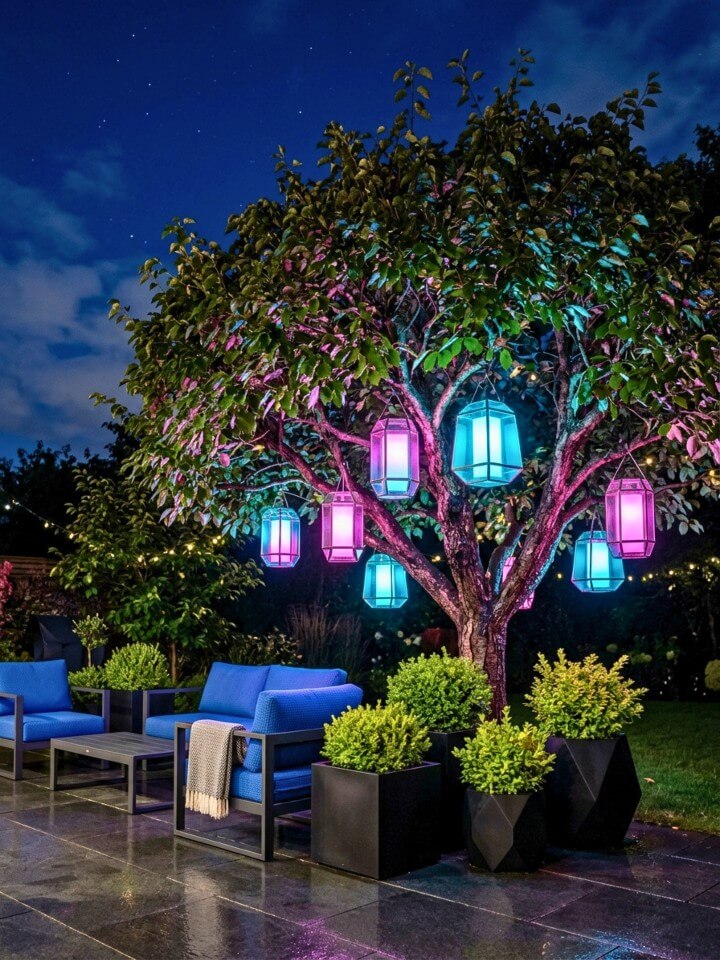
Stained-glass lantern panels — amber, cobalt, emerald, ruby — cast colored pools onto the ground and surrounding foliage in a way that solid-color LEDs cannot mimic. The texture of cathedral or seedy glass scatters the beam unpredictably; a single warm-white candle inside produces a dozen overlapping tints by the time the light reaches the soil. Moroccan-style punched-metal lanterns paired with stained glass create overlapping pattern and color layers, doubling the visual interest. Hang them at varied heights from sturdy branches, keeping each under a pound for safety. Clean the panels with a soft cloth and white vinegar each spring — pollen dulls the colors, and a quick wipe restores the original saturation.
25. Hidden LED Strips for Subtle Glow
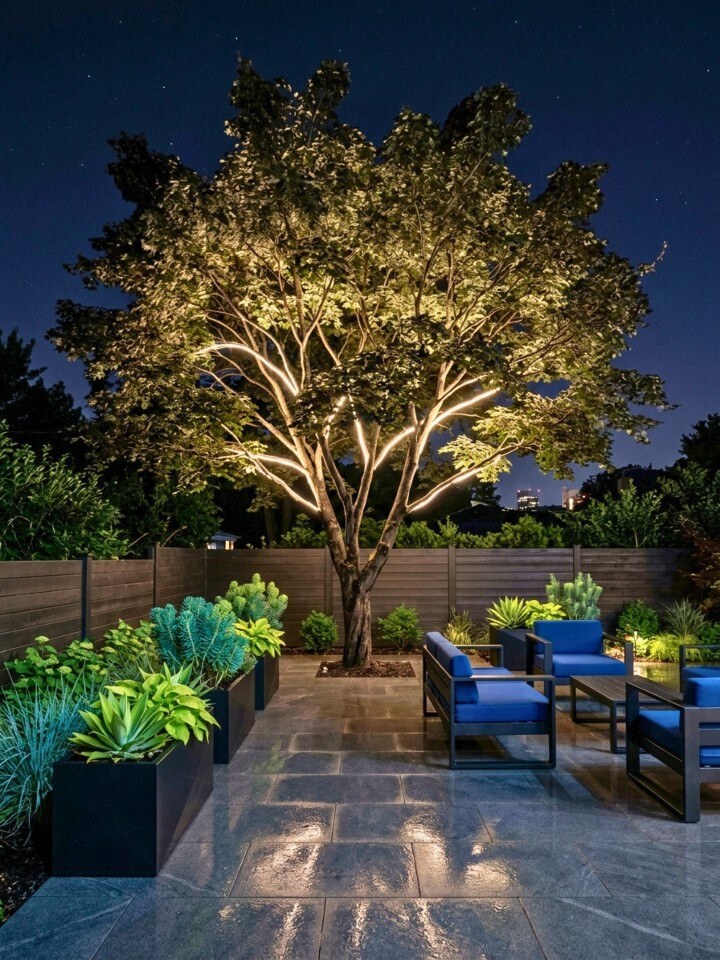
Hidden LED strips tucked under thick limbs deliver the “where is that light coming from” effect that distinguishes professional installations. Use IP67-rated 24V strips at 60 LEDs per meter — denser populations look cleaner than the 30-LED budget tape that shows individual dots through any diffuser. Mount the strip inside an aluminum channel screwed to a wood batten lashed to the underside of the branch with rubber-protected straps. The channel hides the strip from below and protects against UV degradation. Run the lead wire down the trunk inside loose flex conduit to keep it animal-proof. A small 60-watt outdoor driver handles roughly 16 feet of high-density strip with headroom for voltage drop.
FAQs About Outdoor Tree Lighting
A few things tend to come up after the lights are hung — small details that catch people off guard once the project moves from inspiration to install. Here are the answers most readers wish they’d had sooner.
How Many Lumens Do I Actually Need to Light a Mature Tree?
For a 20- to 30-foot tree, aim for 300 to 700 lumens per uplight fixture. Smaller ornamentals do well with 150 to 300 lumens. Going brighter usually flattens the texture instead of enhancing it.
Will Wrapping Lights Around a Trunk Damage the Tree as It Grows?
Yes, if left for years. Bark expands roughly a quarter-inch annually on young trees, and tight wraps can girdle the cambium. Loosen or rewrap strands every spring, and never use staples, nails, or wire ties.
Are Outdoor Tree Lights Safe to Leave on During Rain or Snow?
Only fixtures rated IP65 or higher handle real weather. Check the plug connections too — most failures happen at the joint, not the bulb. Wrap exposed connectors with silicone tape or tuck them inside a weatherproof box.
How Much Will Tree Lighting Add to My Monthly Electric Bill?
LED setups are surprisingly cheap to run. A typical install of 200 bulbs at 0.5 watts each, running six hours nightly, costs roughly $2 to $4 a month depending on local rates. Incandescent strands cost ten times more.
What’s the Best Time of Year to Install Tree Lighting?
Early fall is ideal — soil is still soft for stakes, branches are accessible before leaf drop hides them, and you’ll catch the long autumn evenings when lighting matters most. Avoid installing during active sap flow in spring.
Conclusion:
The best-lit yards I’ve walked through never shout. They glow in layers — a warm uplight here, a cluster of lanterns there, one quiet ribbon of fairy lights doing the heavy lifting. Pick two or three ideas from this list, live with them for a week, then add one more. Your trees have been standing there for years waiting their turn. Give them the spotlight, gently.