23 Pool Patio Ideas: What to Build, What to Skip, and Why It Matters
A pool patio is doing more work than most people realize. It’s the dining room, the lounge, the play area, and the guest space, all rolled into one stretch of concrete or stone. Get it right and the whole backyard opens up. Get it wrong, and you end up with a beautiful pool nobody wants to sit next to for long.
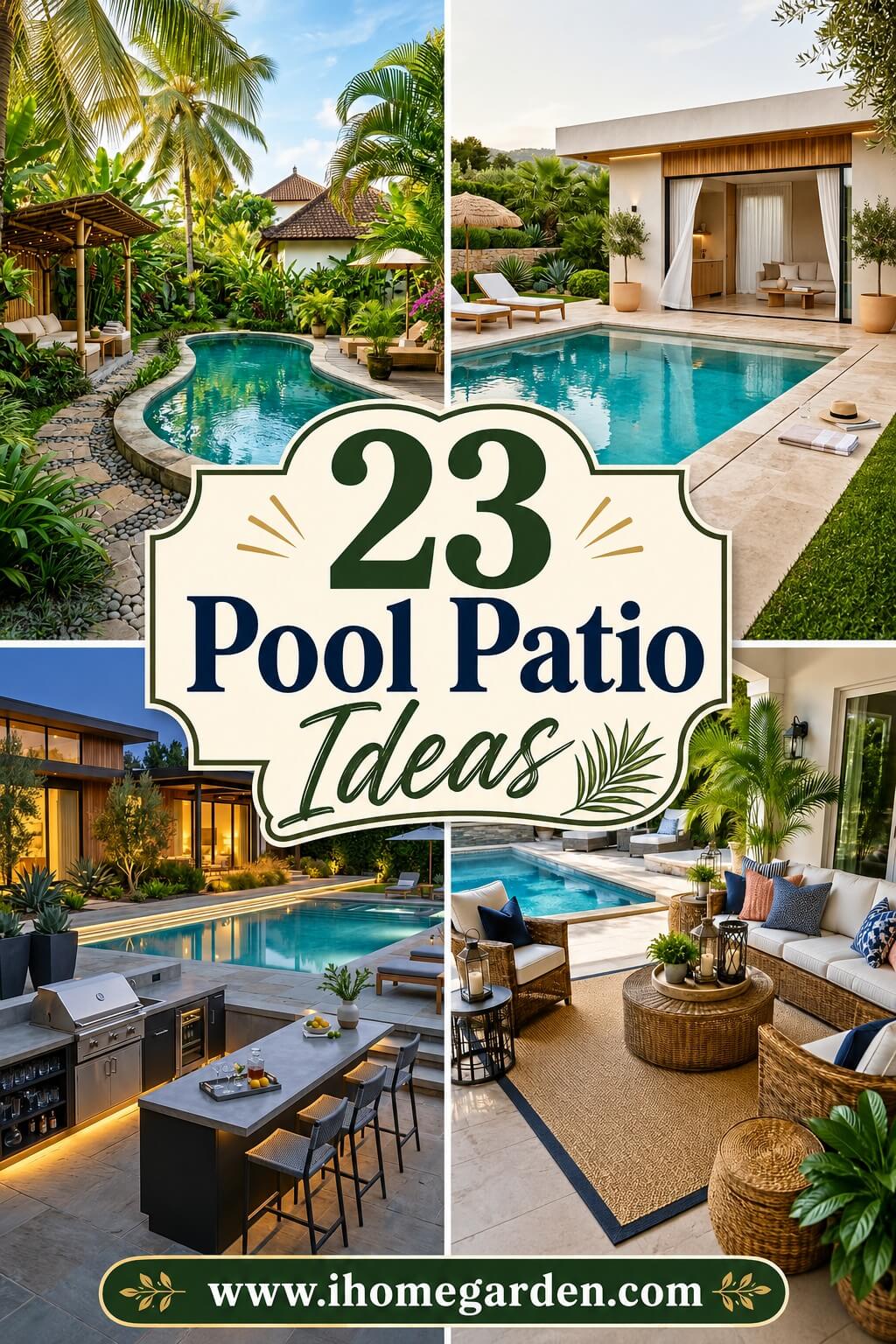
The good news is that a great pool patio doesn’t come down to budget or square footage. It comes down to smart choices: the right materials for your climate, shade in the places that actually need it, seating arranged for how your family really gathers, and small design details that make the space feel finished. Whether you’re starting from scratch or refreshing what you already have, these 23 breathtaking pool patio ideas will help you build an outdoor space that looks good, works hard, and holds up for years.
1. Travertine Stone Decking
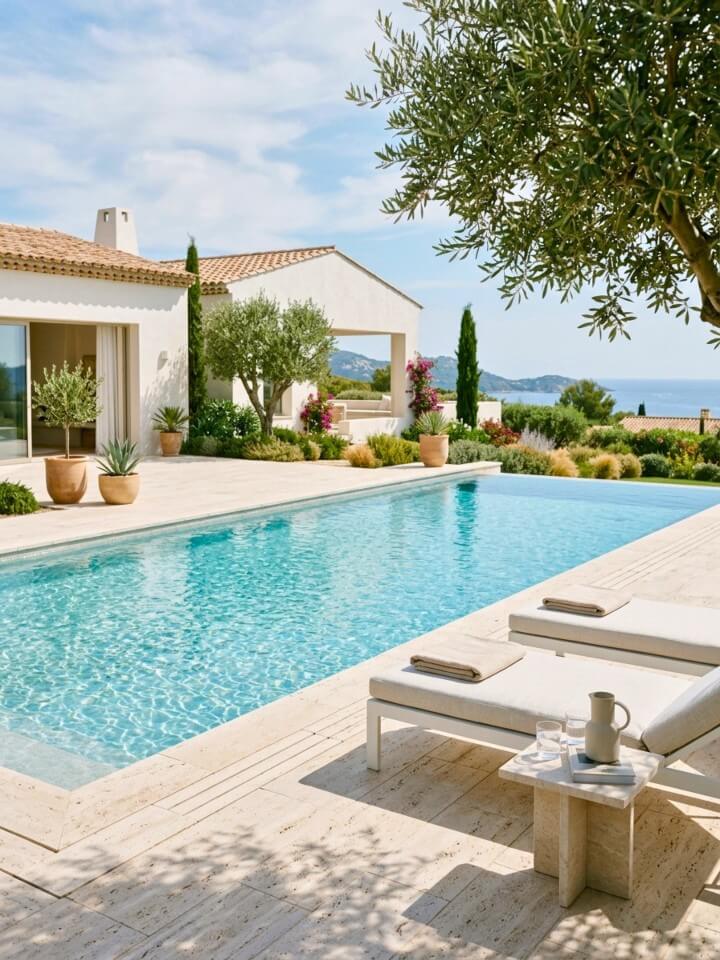
Walk barefoot across a concrete pool deck in August and you’ll understand why travertine exists. The stone is porous, which sounds like a flaw until you feel it under your feet at noon. Those tiny air pockets keep the surface noticeably cooler than poured concrete, sometimes by 20 to 30 degrees in direct sun. The tumbled finish gives you grip; the honed finish looks polished but turns slick when wet. One thing most homeowners learn too late: travertine drinks water. Without resealing every two to three years, mineral streaks creep in around the coping and staining becomes permanent. Pair it with light wood furniture and olive trees for that warm, Mediterranean feel.
2. Built-In Fire Pit Lounge
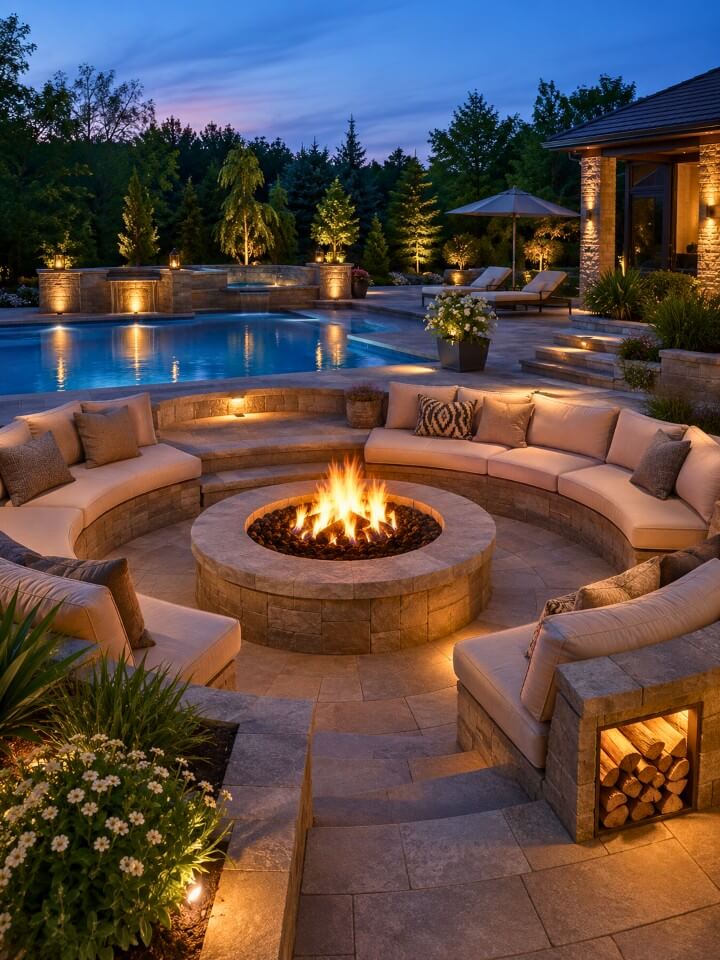
Ask one question before building this: do we actually stay outside after dark? If the answer is no, a fire pit becomes an expensive garden ornament. If yes, it might be the best decision you make for the whole yard. The rule that consistently works is a six-to-eight-foot buffer between the pit and the pool edge. Any closer and you’re dodging splashes; any farther and the two spaces stop feeling connected. Skip the pretty steel fire bowls from big-box stores. Chlorinated air eats them alive within three or four seasons. Cast concrete or stacked natural stone lasts decades. Add a low seat wall around it and you’ve doubled your seating without buying a single chair.
3. Pergola or Shade Structure
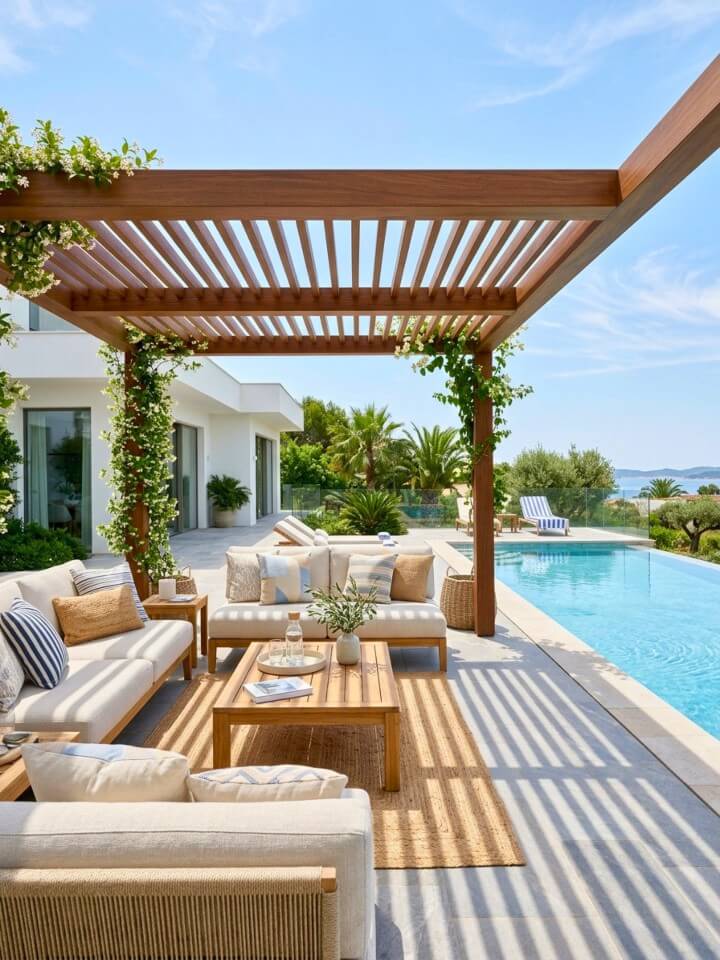
Transform your backyard with stunning pool patios designed for relaxing summer days and nights. Here’s the honest problem with most pool patios: they’re perfect for exactly four hours of the day. Morning is pleasant. Evening is pleasant. The five hours between 11 a.m. and 4 p.m. are unbearable in summer, which is precisely when everyone wants to swim.
A pergola reclaims that window. Wood pergolas give warmth and dappled shade but need restaining every few years. Aluminum louvered roofs cost more and look sharper, with slats that close for rain and angle for sun. If you go the wood route and want climbing plants, choose trumpet vine over wisteria. Wisteria flowers look magical falling onto a patio, right up until they permanently stain your travertine.
4. Tanning Ledge with Lounge Furniture
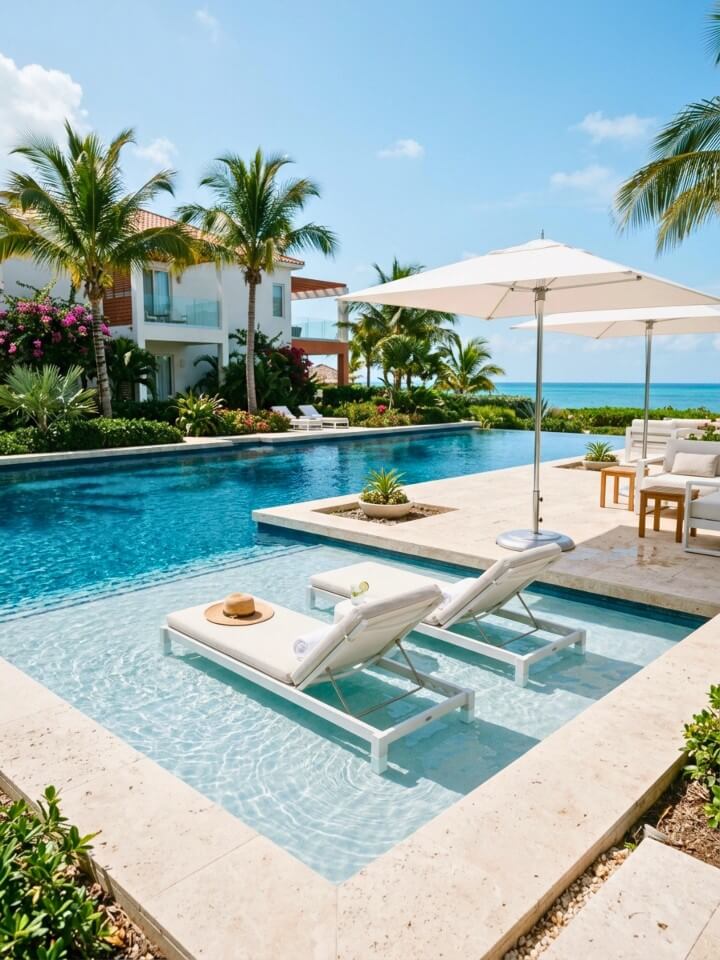
The tanning ledge is the feature people who’ve never had one don’t understand, and people who have one refuse to live without. Picture a shallow shelf built into the pool, roughly 9 to 12 inches deep, running along one end. You sit on it. You lie on it. Your kids play on it while you read. You’re in the water without swimming, which turns out to be exactly what most people wanted from a pool all along. Building one into a new pool is straightforward; retrofitting an existing pool means draining, cutting, and refinishing. Use furniture designed for submersion, and finish the surface with textured pebble, never smooth plaster.
5. Outdoor Kitchen or Bar
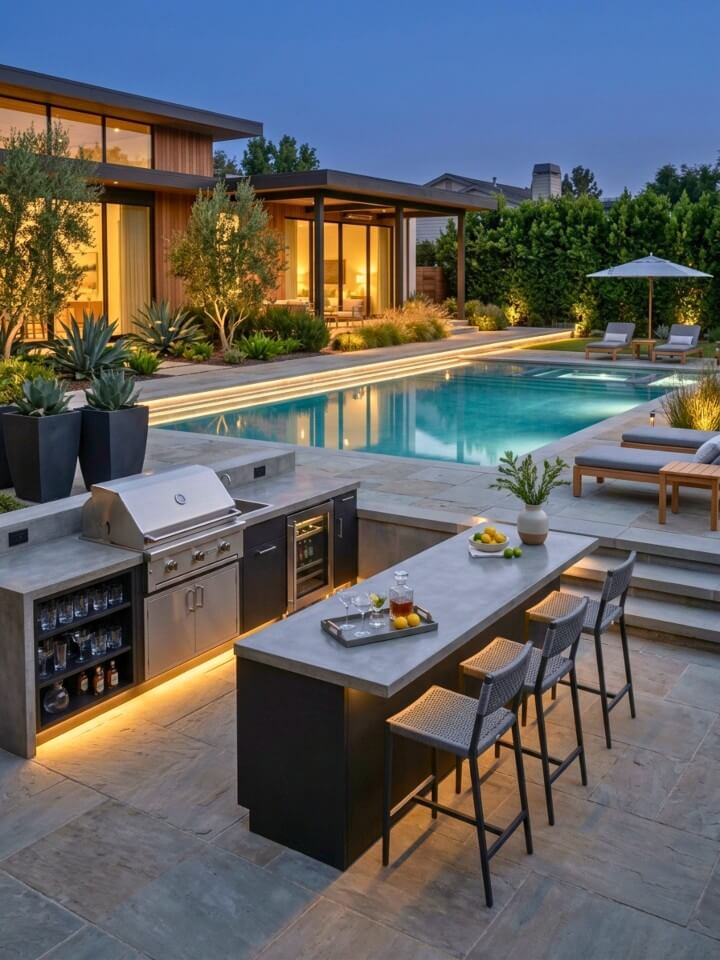
Honest truth most articles won’t tell you: outdoor kitchens are the most overbuilt feature in backyard design. People install pizza ovens they use twice a year. Before building anything, count how many times last summer you actually cooked outside. That number is your starting point. Occasional grillers need a good grill, a small prep counter, and a mini-fridge, nothing more. Constant entertainers need a real setup with a sink, covered roof, and freeze-protected plumbing. Keep the cooking zone at least ten feet from the water. Chlorine vapor corrodes stainless steel faster than anyone expects, and grease splatter on light coping is a stain you’ll fight forever. Porcelain slab counters age best.
6. Glass or Frameless Tile Mosaic Accents
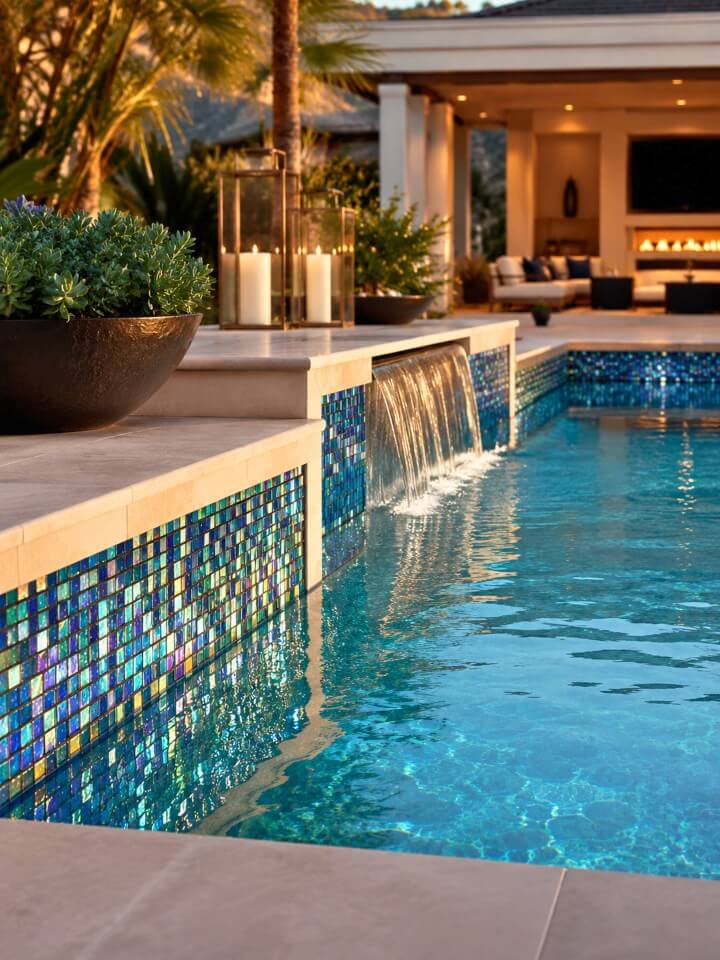
Restraint is the whole game with mosaic tile. Homeowners see one stunning Pinterest photo of a fully tiled pool and start dreaming, then end up with something that looks like a hotel lobby from 2003. The trick is treating mosaic like jewelry, not wallpaper. A thin band along the waterline. A single accent wall behind a spa. The face of a raised bond beam. That’s it. Iridescent glass catches sunlight and throws it back in ways ceramic never will, especially in shallow water where the sun hits directly. Use epoxy grout, not cement-based. Cement grout in a pool environment yellows, cracks, and starts shedding tile within a few seasons.
7. Integrated Spa or Hot Tub
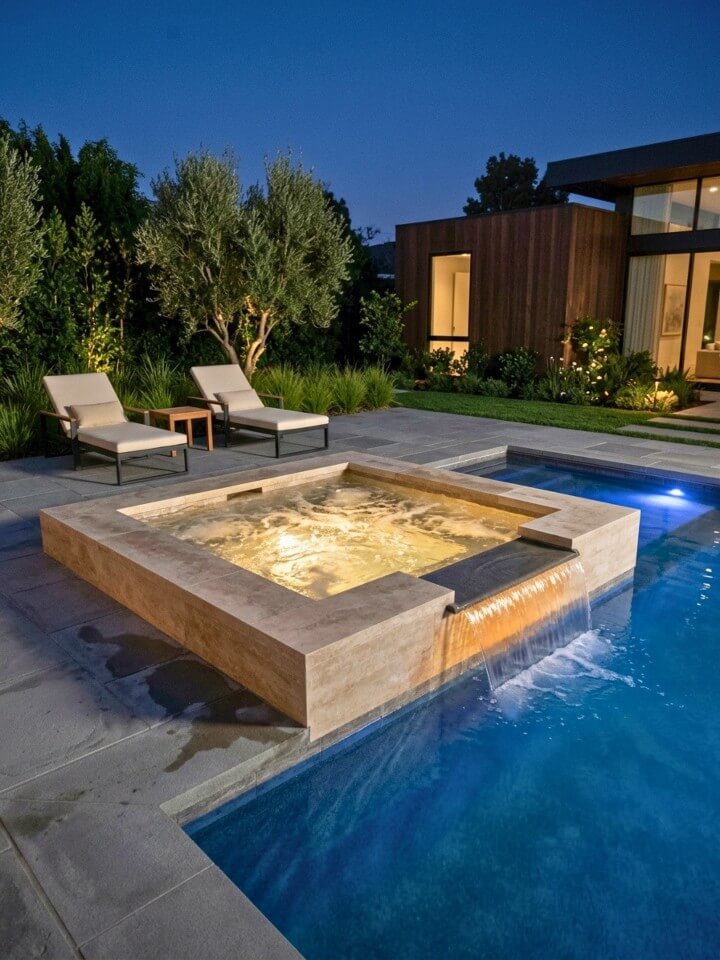
Discover fresh pool patio ideas that blend style, comfort, and outdoor living perfection today. There’s a version of this that works beautifully and a version that looks like someone dropped a jacuzzi next to a pool. The difference is whether the spa was designed with the pool or added to it. Raised spas that spill into the main pool through a small waterfall create movement, sound, and a visual anchor. Flush spas feel more modern but lose the drama.
Either way, position it where afternoon shade reaches by the time you’d actually use it. Nobody sits in 104-degree water under direct sun. One detail worth insisting on: separate heating and filtration systems. Sharing them with the pool sounds efficient and creates constant headaches with temperature control.
8. Privacy Landscaping and Greenery
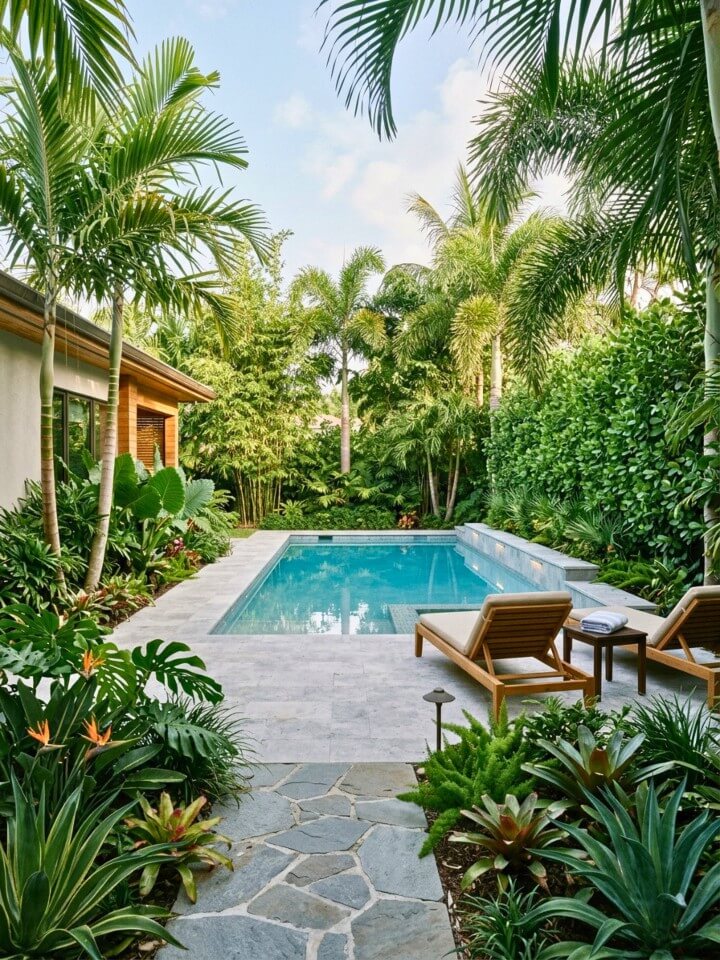
Fences solve privacy the way earplugs solve noise: technically effective, aesthetically defeating. Layered planting does the same job and makes the yard feel bigger instead of walled in. The formula that keeps working: something tall at the back (podocarpus, clumping bamboo, or Italian cypress if the climate allows), something medium in front of it (viburnum, oleander, boxwood), and something low that softens the base. Three layers, three heights, one continuous barrier your eye reads as a garden instead of a wall. Avoid anything that drops heavy fruit, sap, or fine leaves near the pool. Bougainvillea is gorgeous and will fill your skimmer baskets every single week.
9. Water Features and Fountains
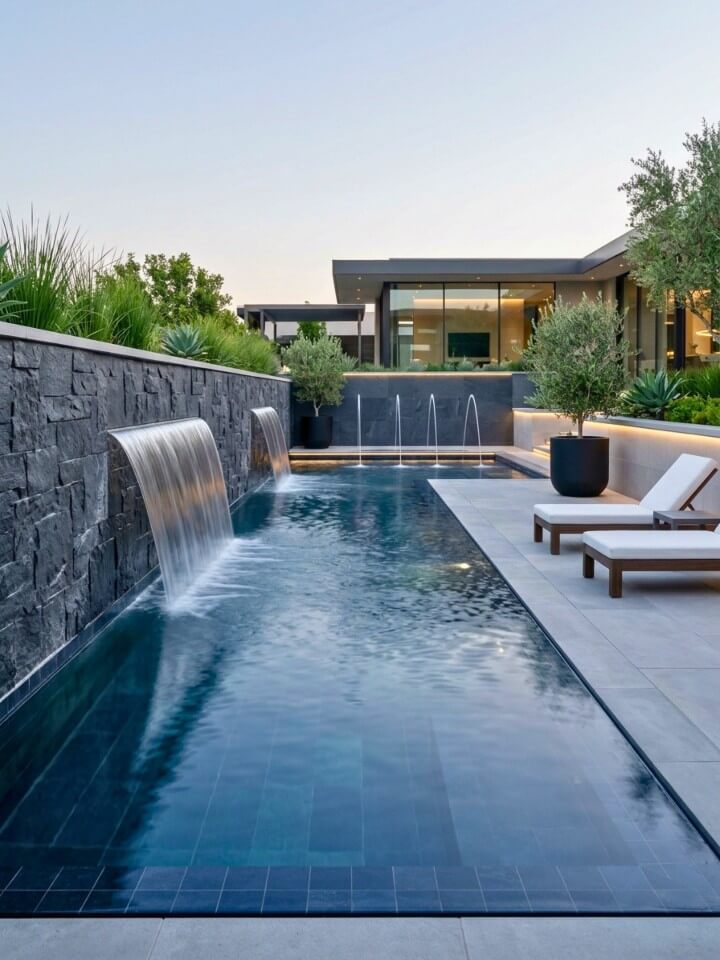
Moving water changes a backyard the moment you turn it on. Not because it looks impressive, though it does, but because it covers the sounds you don’t want: the neighbor’s AC unit, traffic two streets over, the pool pump humming behind the equipment pad. Sheet descents built into a raised wall give you a clean modern look and a wide curtain of water.
Scupper spouts, those simple wall-mounted spouts, offer the same effect at a fraction of the complexity. Bubblers set into a tanning ledge do something different: they’re quieter, more playful, and turn shallow water into something kids gravitate toward. If you want movement without overcomplicating the pool, compare a few pretty pool fountain ideas before choosing the loudest or most dramatic option. Whatever you choose, oversize the pump slightly. Undersized pumps sound like they’re straining.
10. Layered Outdoor Lighting
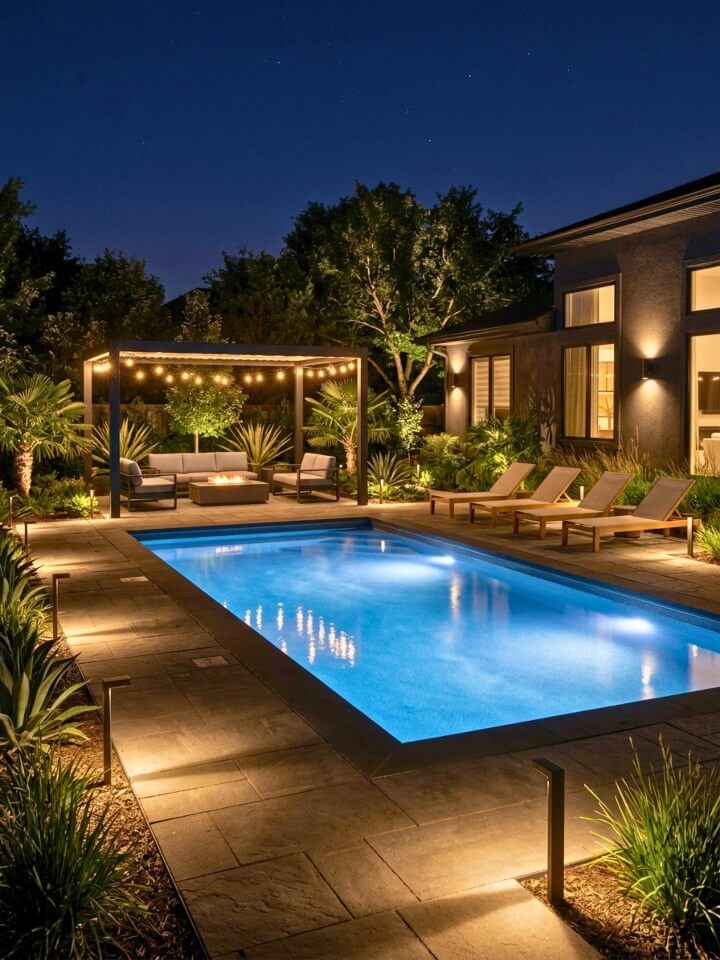
One overhead floodlight ruins a pool patio faster than almost any other mistake. Harsh light flattens everything, throws hard shadows, and turns the water into a mirror you can’t see into. Good pool lighting works in layers, the same principle interior designers use indoors. Low path lights guide movement. Small uplights tucked into planting beds pull trees and shrubs out of the dark. Underwater LEDs (warm white, not blue; blue looks like a public swimming pool) give the water depth. Coping lights add a soft edge that helps at night.
Around the edges of the patio, outdoor tree lighting ideas can make planting beds and shade trees part of the evening design instead of leaving them in darkness. Stick to 2700K color temperature across everything. Mixing warm and cool light on the same patio is what makes a space feel unfinished.
11. Composite or Wood Deck Surround
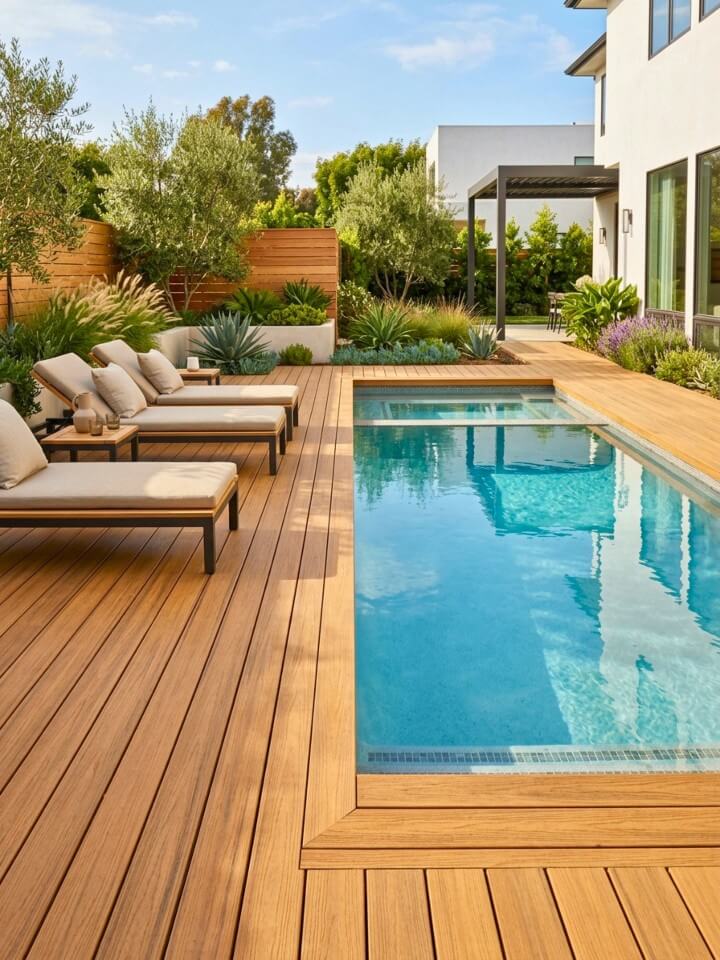
Create the ultimate swimming pool patio for entertaining, lounging, and enjoying sunny weekends. Wood versus composite is the debate that never really ends, and both sides have a point. Real wood, ipe or mahogany especially, ages into something a composite board will never replicate. That silvery patina, the grain shifting with weather, the way it warms under afternoon sun. But wood around a pool means yearly work: cleaning, oiling, checking for splinters where kids run barefoot.
Composite skips all of that and looks convincing from six feet away, less so up close. Whichever you pick, leave gaps between boards for water to drain through instead of pooling on top. And run the boards perpendicular to the main sightline; parallel boards always make a deck look narrow.
12. Cabana or Poolhouse
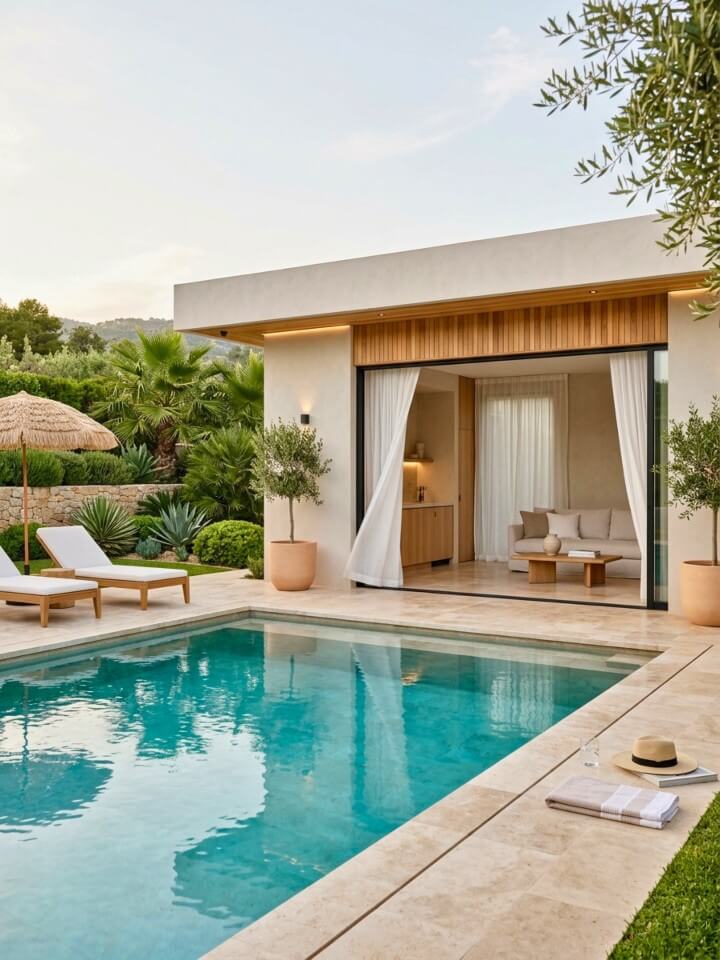
Small structure, big impact, provided you resist the urge to overbuild. The best cabanas I’ve seen are barely more than a roof, three walls, and a place to hang wet towels. Somewhere to change without tracking chlorine through the main house. Somewhere to store floats, goggles, sunscreen, the pool skimmer, all the clutter that otherwise ends up on the patio furniture. The moment homeowners add air conditioning, a full bathroom, and a kitchenette, they’ve built a guest house that happens to be near a pool. That’s a different project with different permits. Keep the roof deep, extend the overhang past the walls, and orient the opening toward the pool.
13. Sunken Lounge or Conversation Pit
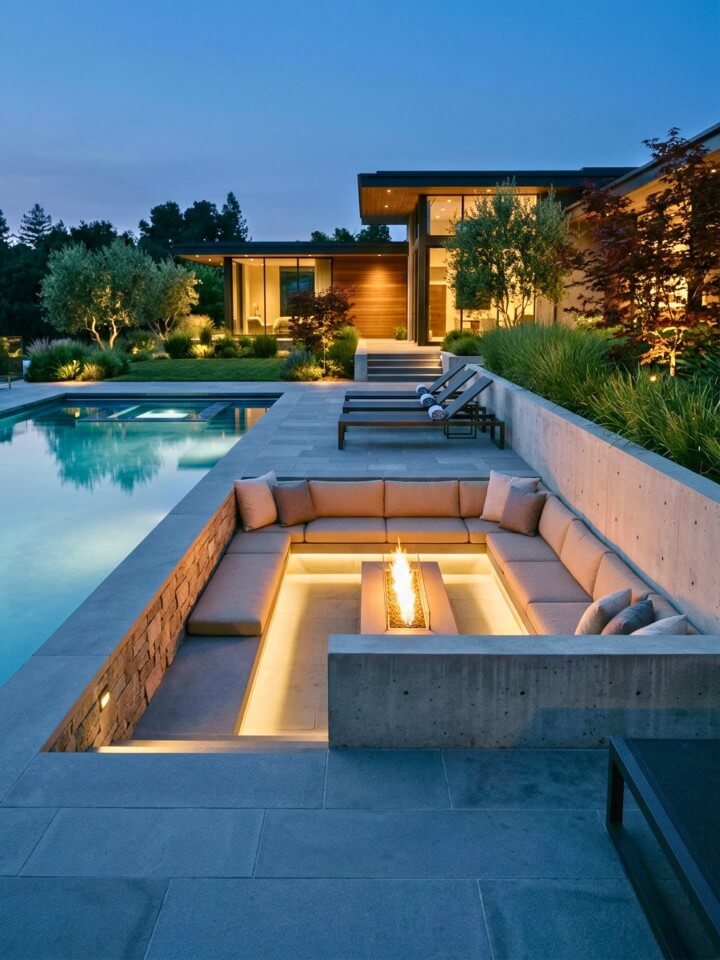
A sunken lounge does something no elevated seating area can: it changes the geometry of the yard. Drop the floor by two feet and suddenly the plants at the edge feel taller, the sky feels wider, and conversation gets more intimate because you’re all held inside the same lowered space. This isn’t a project to tackle without thinking about drainage first. A sunken area is a bowl, and bowls fill with water. You need a drain at the lowest point, gravel underneath, and grading that pushes runoff away from the pit rather than into it. Skip this step and every heavy rain becomes a bailing project.
14. Geometric Modern Concrete
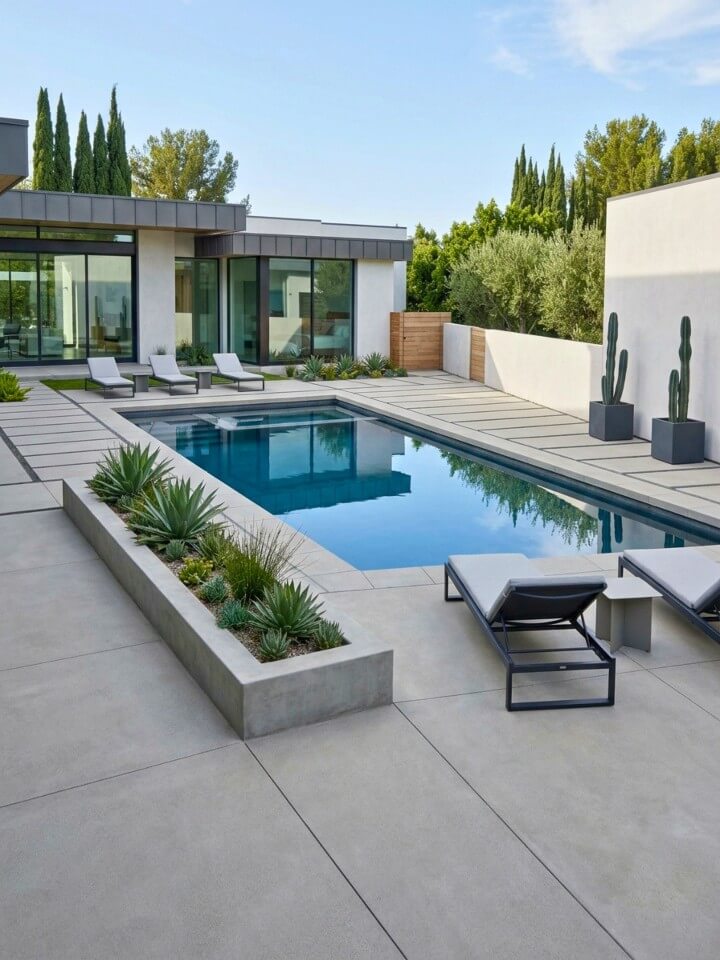
Concrete gets dismissed as boring until you see it done well, at which point nothing else looks quite right. The mistake most homeowners make is pouring one enormous slab and calling it finished. Large monolithic concrete cracks, and it always cracks in the ugliest place possible. The fix is designing the cracks in advance. Score lines every four to six feet, or better, break the slab into deliberate rectangles separated by strips of gravel, moss, or low grass. Now the joints look intentional. Choose an integral color mixed into the concrete rather than a surface stain. Stains fade unevenly; integral color holds for decades. Sand finish reads warmer than smooth trowel.
15. Outdoor Rugs and Cozy Furnishings
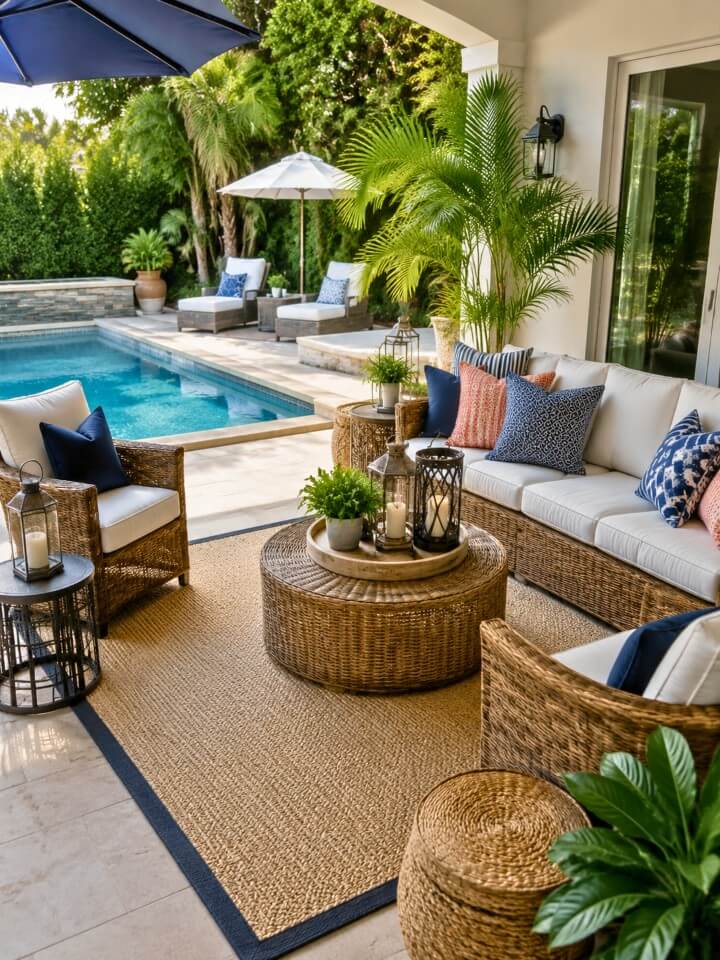
Textiles are the fastest way to make a hardscape feel like a room instead of a slab. A rug under the seating area anchors everything visually. Throw pillows soften the geometry of outdoor sofas. A knit blanket draped over an armrest signals that people actually relax here, not just pose for photos. The two rules that keep outdoor textiles from becoming a disaster: solution-dyed acrylic for anything that lives in the sun, and nothing that can’t survive a hose-down. Sunbrella is the obvious answer for a reason. And check your rug regularly. Moisture trapped underneath will kill any wood or composite surface it sits on within a season.
For covered corners, cabanas, or shade structures near the pool, stunning gazebo furniture ideas can translate well to a softer, more finished poolside lounge.
16. Pool with a Tanning/Sun Deck
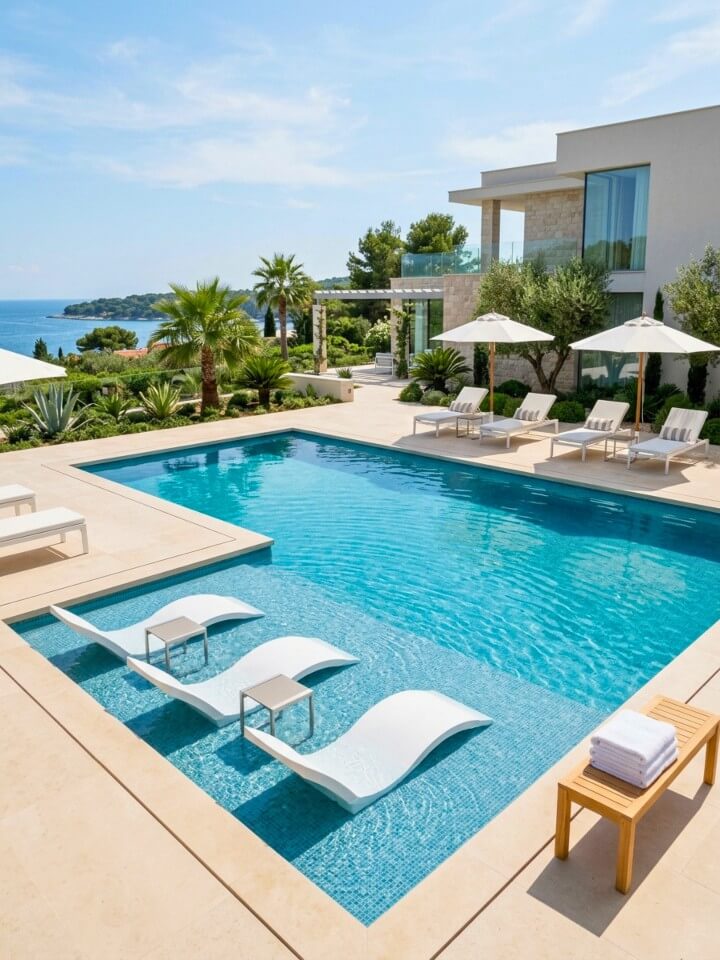
Not to be confused with the tanning ledge from earlier, this one is bigger, bolder, and sits above water rather than in it. A sun deck is a wide flat area attached to the pool where loungers actually live, sometimes with an inch or two of water flowing across for cooling. Think of it as a beach entry that doesn’t slope. What makes or breaks this feature is orientation. Face it south or southwest and you’ll use it constantly. Face it east and it’s shaded by noon, defeating the whole point. Textured finishes matter more here than anywhere else. Wet feet on smooth surfaces are how ankles get broken.
17. Tropical Resort Theme
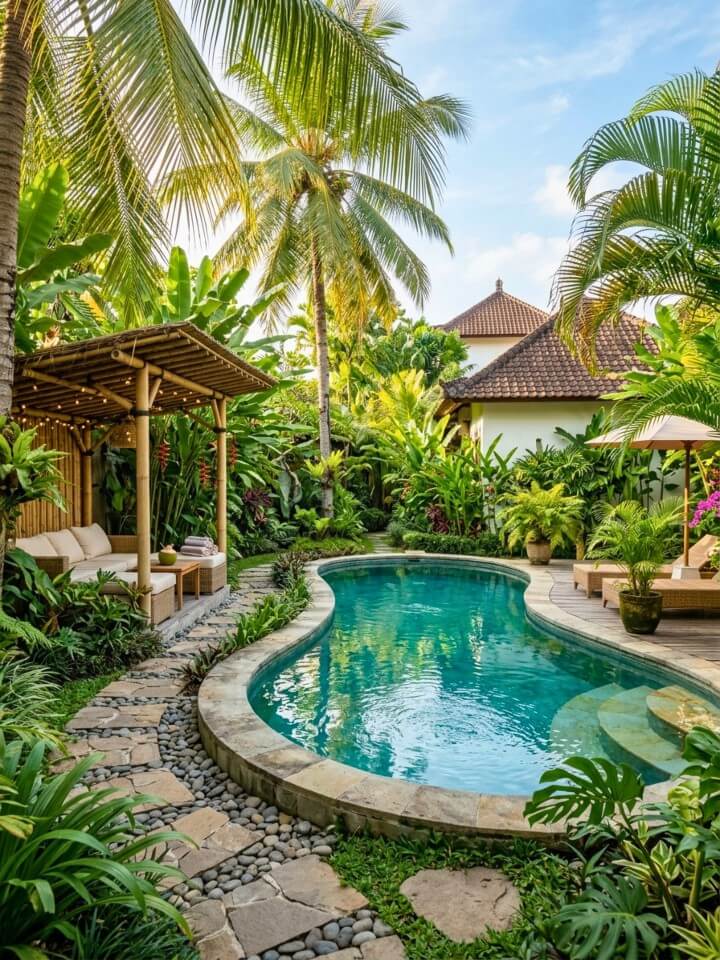
The tropical look is easy to attempt and surprisingly hard to pull off. Most attempts land somewhere between a chain-restaurant patio and someone’s vacation photos. The problem is usually plants. A few palms stuck in the ground don’t create a tropical feeling; they create a lawn with palms in it. Real resort atmosphere comes from density and layering, thick underplanting beneath the taller specimens, broad-leafed things like philodendron and bird of paradise filling the middle, ground cover softening every hard edge. Then add the sound of moving water and torches or lanterns for evening. Skip tiki carvings entirely unless you want the theme to slide into parody.
18. Infinity / Negative Edge
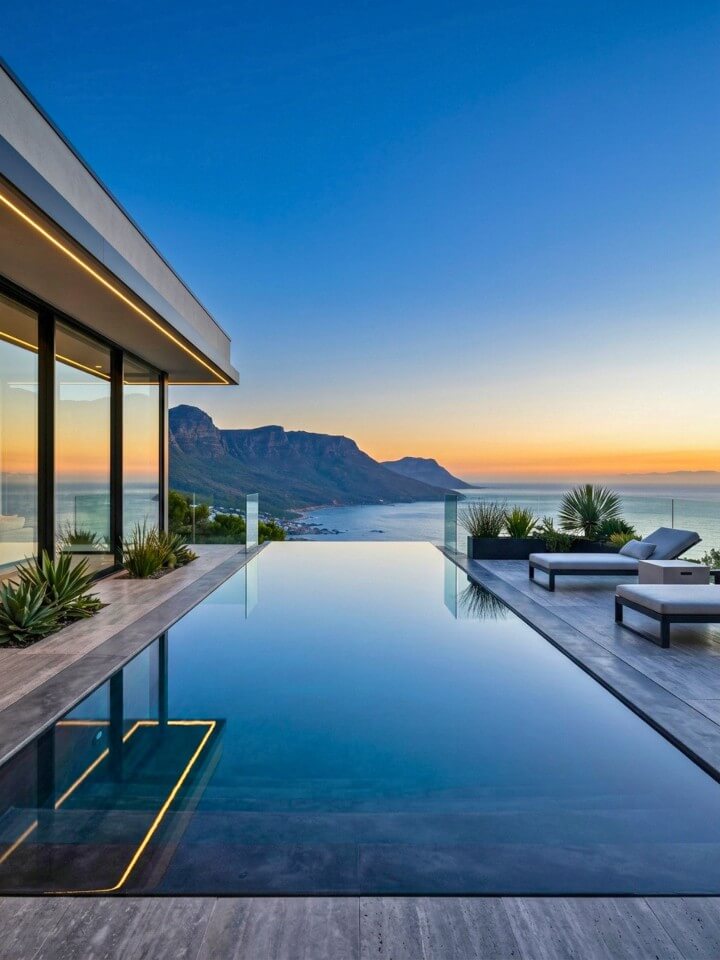
The infinity edge is one of the few pool features where the surrounding landscape does most of the work. Without a view, there’s nothing for the water to disappear into, and you’ve spent a fortune on an expensive illusion that isn’t fooling anyone. Slope, lake, canyon, city skyline, something has to be there. Assuming you have the setting, the technical demand is real. A catch basin sized correctly for the wind conditions in your area, a pump powerful enough to keep the edge running consistently, and a builder who has actually done this before, not one who’s willing to try. Cheap infinity edges look like leaky pools. Nothing else.
19. Plunge Pool for Small Spaces
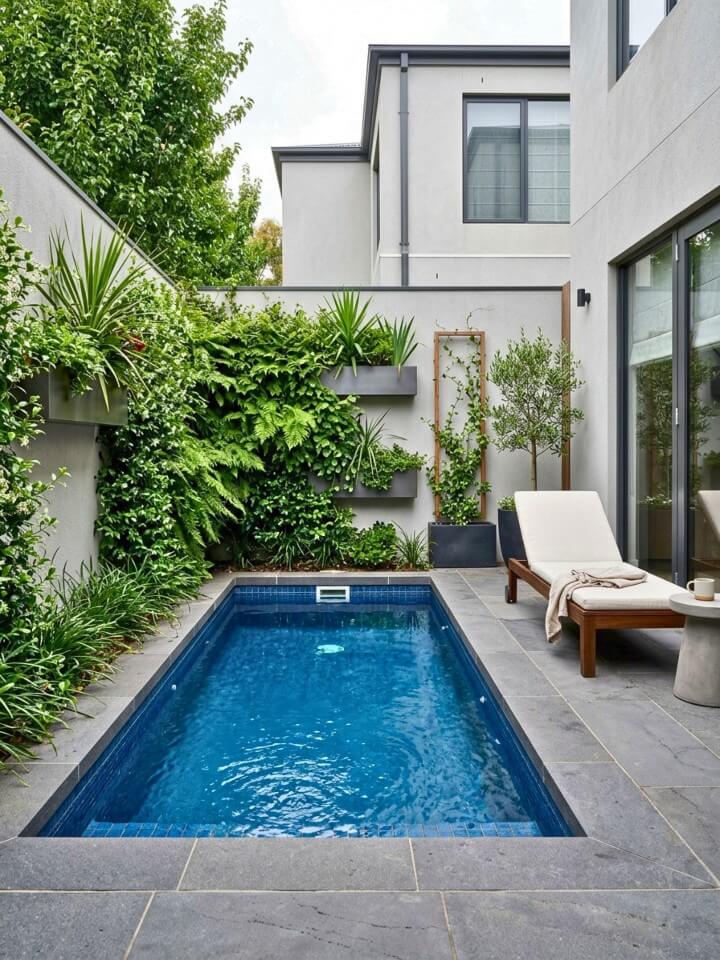
Elevate your backyard with expert pool and patio design built for lasting beauty and function. Small yards used to mean no pool. That assumption ended somewhere around 2015, when plunge pools stopped being a curiosity and became a serious option. Ten by twenty feet is enough. Sometimes twelve by eight is enough.
The point isn’t laps; it’s the water itself, cooling off, sitting on a submerged bench with a drink, giving kids a place to splash without needing an acre. What plunge pools do well that larger pools can’t: they turn the whole thing into a design feature rather than a backyard hog. Frame it with tight decking, one clean material choice, and lighting that treats the pool like an art installation after dark.
When every foot matters, attractive small patio landscaping ideas can help you make the pool, furniture, and planting feel connected instead of cramped.
20. Dining Area with Shade Umbrella
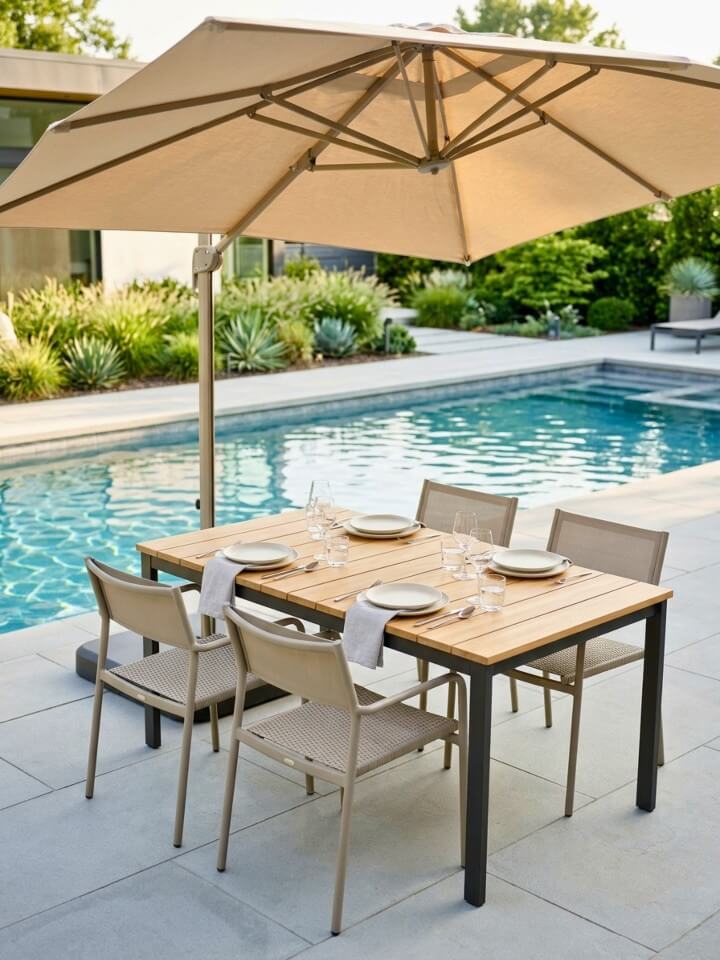
There’s a specific moment this idea is designed for. Sunday afternoon, food on the table, three or four people who don’t want to go back inside just because the sun moved. That’s what the umbrella is solving, the awkward hour when shade shifts and everyone squints through the meal. Cantilever umbrellas beat center-post umbrellas here. No pole through the middle of the table, and the arm rotates to follow the sun. Anchor it properly. A good cantilever umbrella catches wind like a sail, and a tipped-over umbrella has ruined more patio meals than rain ever has. Position the table where the umbrella can shade it from two directions across the afternoon.
21. Natural Stone and Boulder Accents
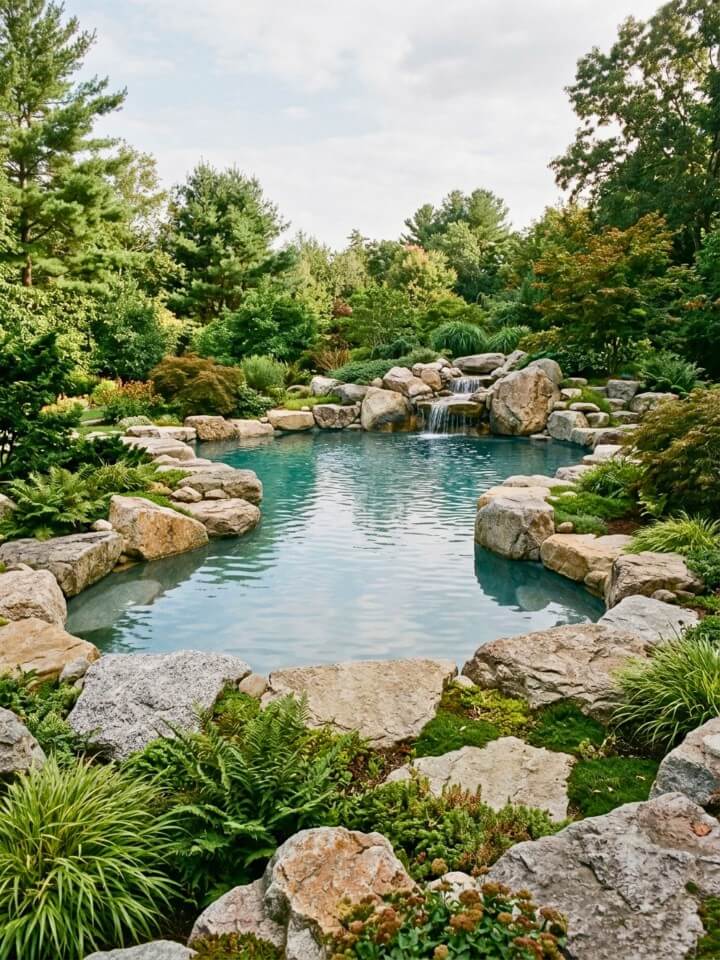
Boulders are the element homeowners either nail or get spectacularly wrong. The wrong version looks like landscape rocks arranged in a circle, evenly spaced, all roughly the same size, sitting on top of the soil like they were dropped from a truck. Which is exactly what happened. Real boulder placement mimics how stones actually sit in nature: partially buried, clustered in odd numbers, varied in size, with the biggest one anchoring the group. A third of the boulder should be underground. That single detail separates a landscape feature from a garden-center display. Match the stone to what geologically belongs in your region. Imported granite next to a stucco house always reads as costume.
22. Hammocks and Relaxation Nooks
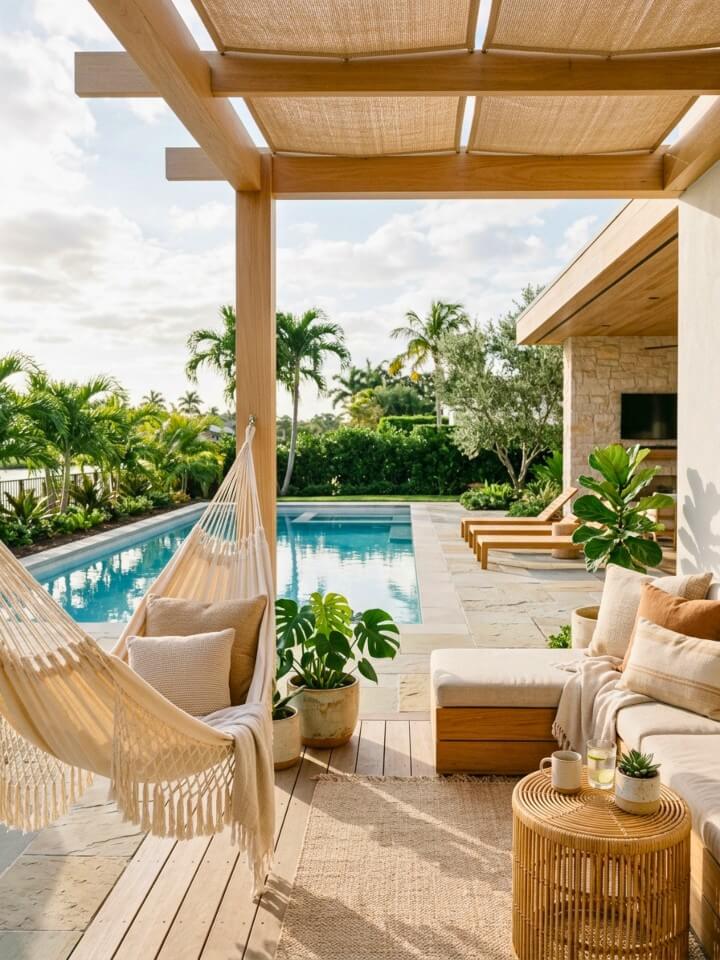
The hammock is the piece of outdoor furniture people romanticize and then never use. Not because hammocks are bad, but because most get hung in the wrong spot. Full sun means it’s too hot by noon. No side table means nowhere for a book, a drink, a phone. Wrong height means climbing in feels like an event. Get these three right and the hammock becomes the most-used seat in the yard. Between two mature trees is ideal, filtered shade all day. A freestanding frame works when trees aren’t available, but pick a heavy powder-coated steel one; the flimsy ones wobble every time someone shifts weight. Rope hammocks breathe better than fabric in humid climates.
23. All-Season Patio with Heaters
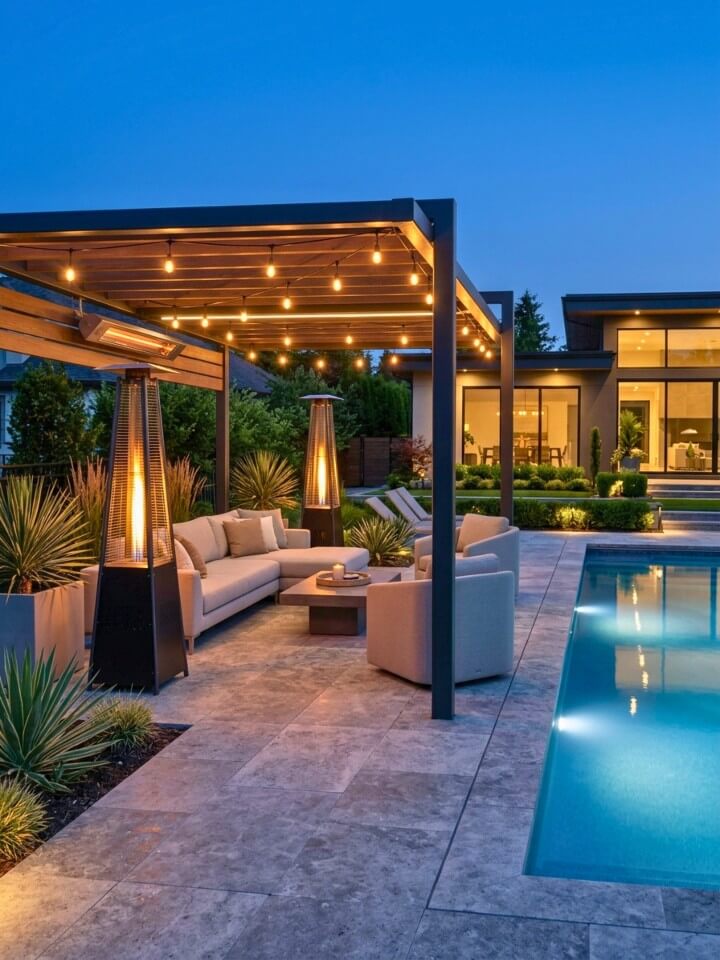
Pool season doesn’t have to end when the water gets cold. The patio can keep going for months longer with the right heating strategy, and this is where most homeowners default to the wrong solution: those tall propane mushroom heaters from the hardware store. They work, technically. They also burn through a tank in a weekend, blow over in wind, and heat the sky more than the people sitting under them. Better options exist. Overhead infrared heaters mounted to a pergola or covered patio warm objects directly, including you, without wasting energy on the surrounding air. A fireplace or fire table adds heat and gathers people around it, which the propane towers never do.
FAQs About Pool Patio Design
Planning a pool patio brings up more questions than most people expect. Here are the practical ones worth answering before any tools come out.
How Much Space Do I Need Between the Pool and The Patio Furniture?
Keep at least four feet of clearance between the pool edge and any seating. This gives room to walk safely, protects furniture from constant splashing, and keeps wet feet from turning cushions into damp, mildew-prone messes.
What Is the Best Time of Year to Build or Renovate a Pool Patio?
Late fall through early spring is ideal. Contractors have more availability, materials often cost less, and the work finishes before swim season. Starting in summer usually means delays, higher prices, and losing months of pool use.
Do I Need a Permit to Build or Expand a Pool Patio?
Most projects involving structures, drainage changes, or electrical work require permits. Simple resurfacing or furniture updates usually don’t. Check with your local building department first, since unpermitted work can cause problems when selling your home.
How Do I Keep My Pool Patio Safe for Kids and Pets?
Choose textured, slip-resistant surfaces, add rounded edges wherever possible, and keep glass items away from bare feet. Good lighting near steps and level changes prevents nighttime falls, which are the most common backyard pool accidents.
What Is the Cheapest Way to Upgrade an Old Pool Patio?
Pressure washing, restaining or resealing existing surfaces, and swapping tired furniture for a fresh set of loungers and cushions transforms the space fast. Add potted plants and better lighting, and the whole patio feels brand new.
Conclusion:
A pool patio isn’t really about the pool. It’s about the hours you spend around it, the meals eaten outside, the quiet mornings with coffee, the nights that stretch longer than expected because nobody wants to go in yet. The best backyards aren’t the ones that look most impressive in photos. They’re the ones that quietly pull you outside without you noticing why. Pick a few ideas that fit how you actually live, skip the ones that only look good on a mood board, and build a space that earns its keep every single day. That’s the patio worth having.