Build Your Backyard Gym: 17 Setups for Every Space and Budget
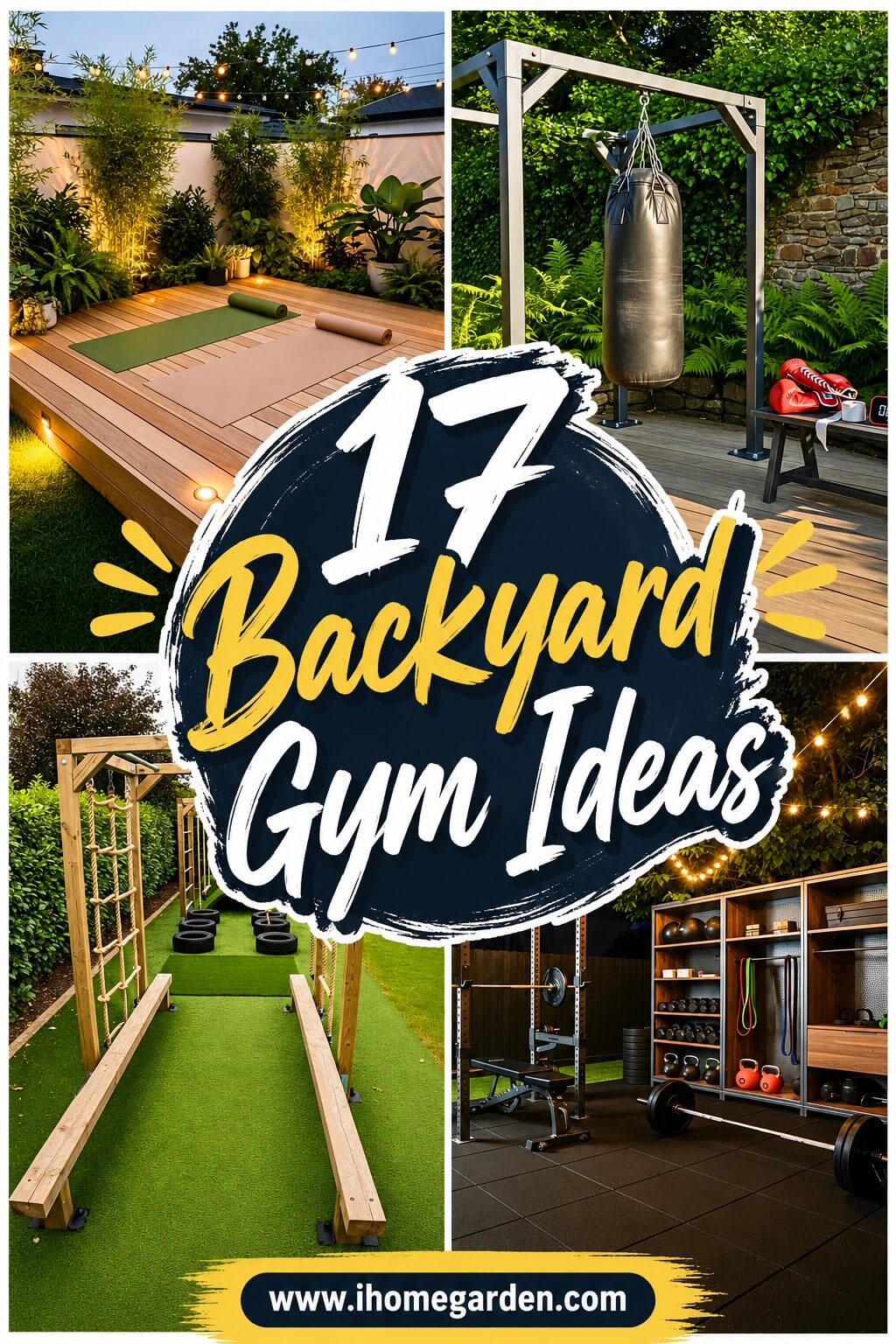
Skip the crowded gym and the monthly fees. A backyard setup gives you privacy, fresh air, and a workout space open whenever you are — 5 AM or midnight. Whether you’re working with a quarter-acre lot or a tight townhouse yard, there’s a setup below that fits. Explore 17 unique backyard gym ideas, each idea include real cost estimates, space requirements, and setup tips pulled from actual backyard builds.
1. Covered Patio Gym
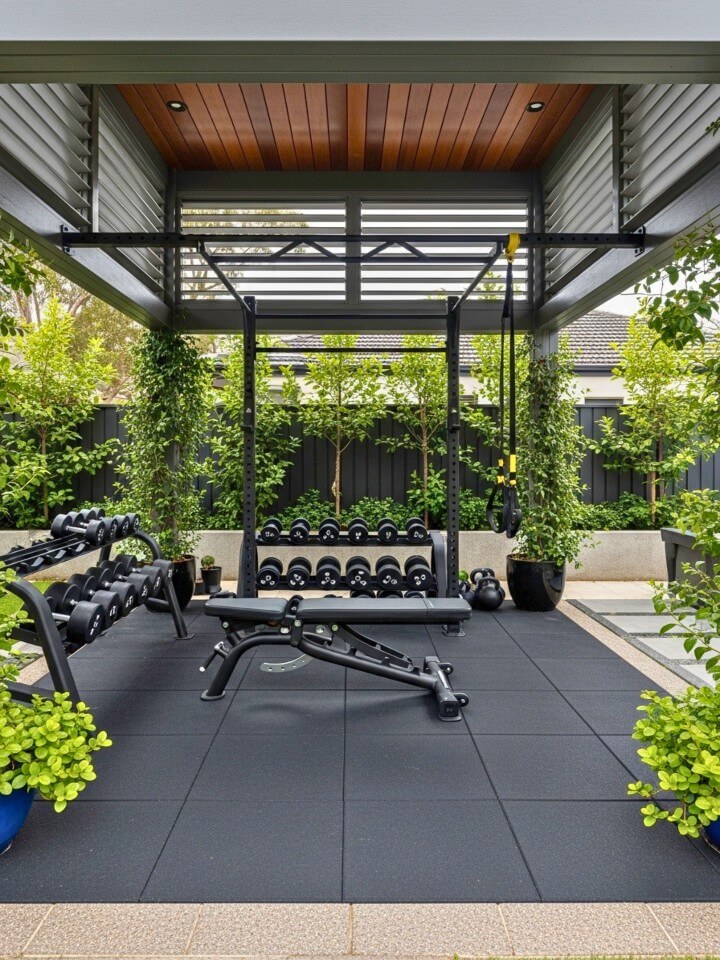
Your existing covered patio is already half a gym — it just needs the right gear layered on top.
What You’ll Need
Interlocking rubber tiles ($2–$4 per sq ft) to protect concrete and joints, an adjustable flat-incline bench, a pair of adjustable dumbbells (Bowflex SelectTech or PowerBlock both work), and a beam-mounted pull-up bar.
Why It Works
The roof keeps morning dew off your equipment and blocks afternoon sun, which is the single biggest reason this build outlasts open-air setups. Budget around $600–$1,500 for a complete beginner kit. Add a clip-on fan for July humidity and you’ve got a year-round training space.
2. Outdoor Calisthenics Station
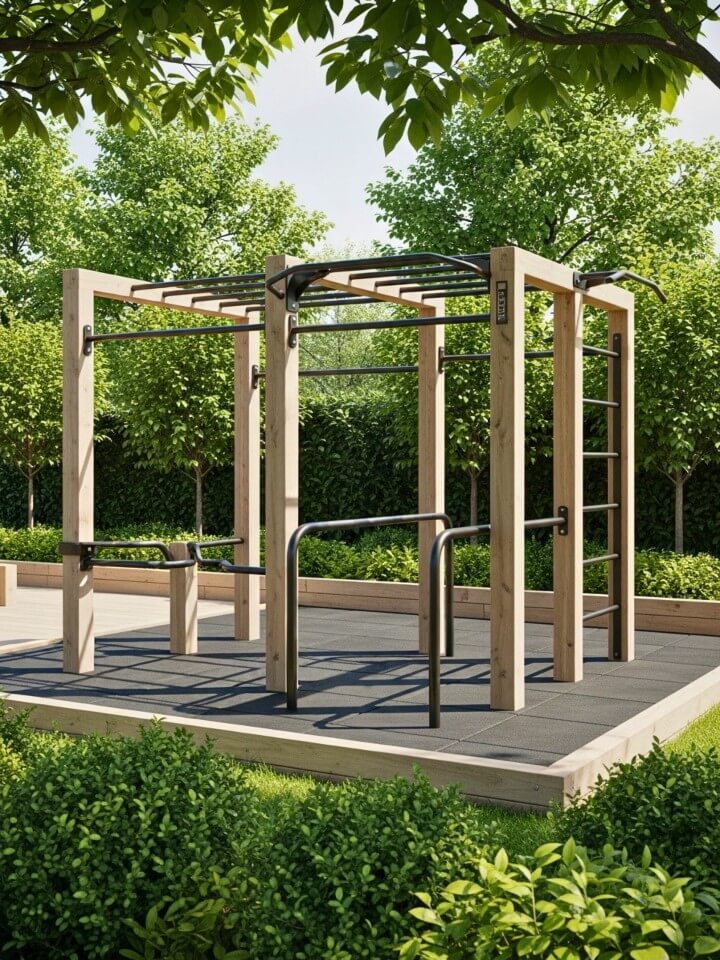
Not interested in lifting heavy? Bodyweight training builds serious strength on a smaller footprint and a smaller budget — and it scales with you for years instead of plateauing in six months.
Free-standing stations from Bar Brothers or Pullup & Dip combine pull-up bars, parallel bars, and dip stations into one anchored frame for roughly $300–$700. Set the legs in concrete footings about 18 inches deep so the rig doesn’t wobble during muscle-ups. You’ll need around 8×8 feet of clear ground, with pea gravel or rubber mulch underneath for soft landings. The progression from basic pull-ups to front levers and planches takes years, so this rig grows with your skill.
3. Shed Gym Conversion
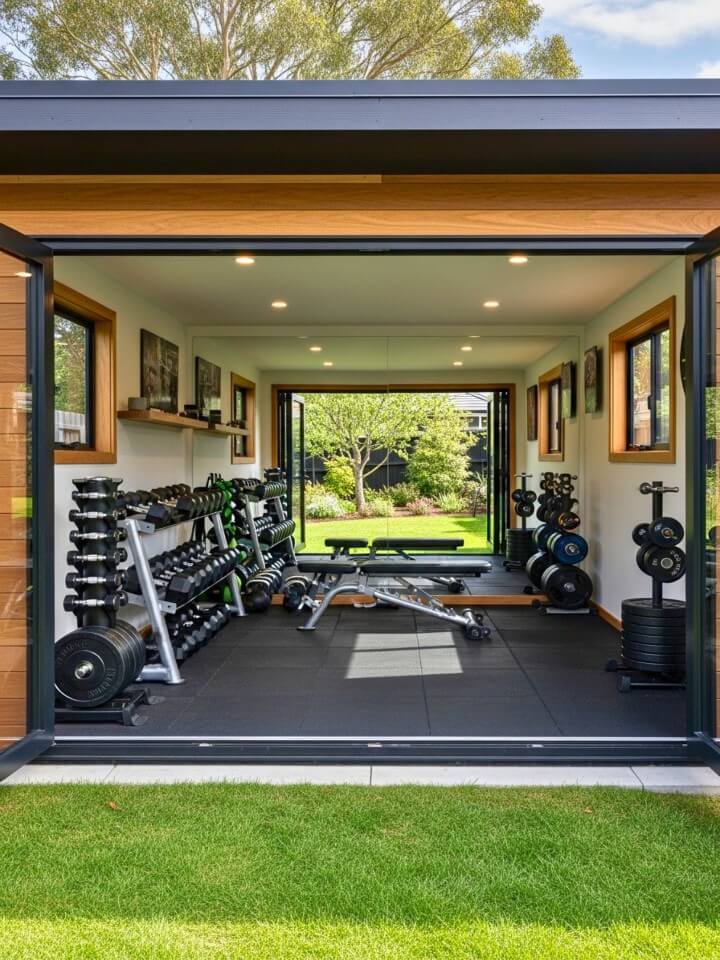
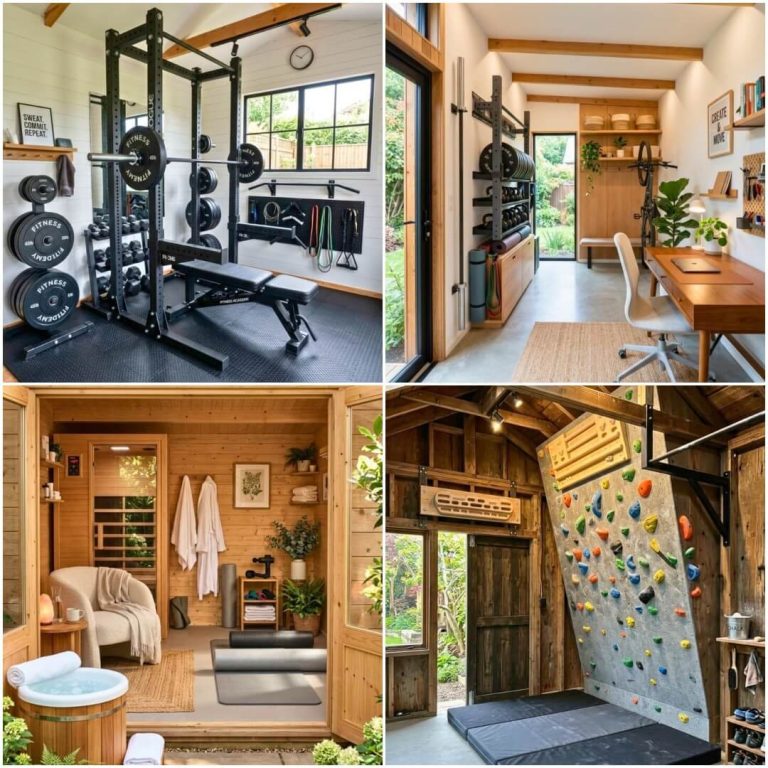
Transform your yard into a powerhouse with a bold outdoor gym setup built for all seasons. A backyard shed in the 8×10 to 10×12 range converts into a private training studio — and it usually sidesteps the permits a full home addition would trigger.
Insulation: R-13 batts in the walls handle winter mornings. Power: Run a dedicated 20-amp circuit for lights, fans, and a wall speaker. Flooring: Horse stall mats (around $50 each) are heavier, cheaper, and tougher than gym-branded rubber. Mirror: A 48-inch wall mirror checks your form and visually doubles the space.
Total build cost lands between $1,500 and $4,000 depending on whether the shed already exists. The privacy alone — no neighbors watching your deadlift PR attempts — sells most people on this option.
4. Pergola Workout Zone
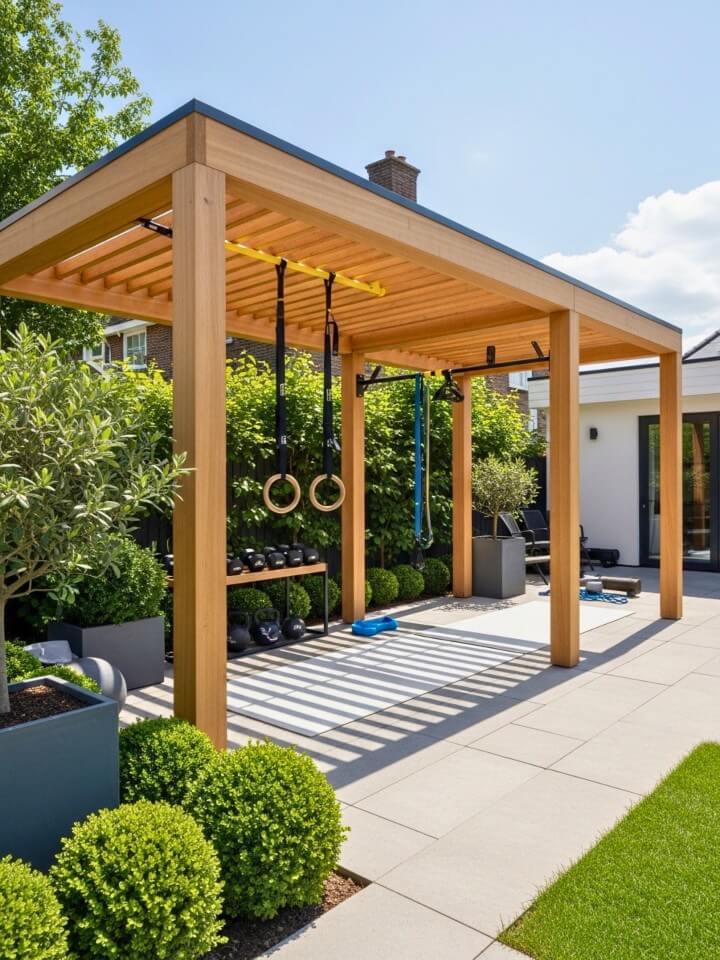
A pergola turns dead lawn into a defined training zone with shade, structure, and a place to mount equipment.
The beams are the real value here. Hang gymnastic rings ($40), TRX straps ($150), or a climbing rope from rated eye bolts drilled into the load-bearing crossbeams — always check that the rated load exceeds your bodyweight plus dynamic force (roughly 3x for swinging movements). Stain the wood every two years to prevent warping. Pair it with a small turf patch underneath for floor exercises, and string up café lights for evening sessions. Total setup including a basic pergola kit usually falls between $1,200 and $2,500, and it doubles as a backyard hangout when you’re not training.
5. Turf Training Area
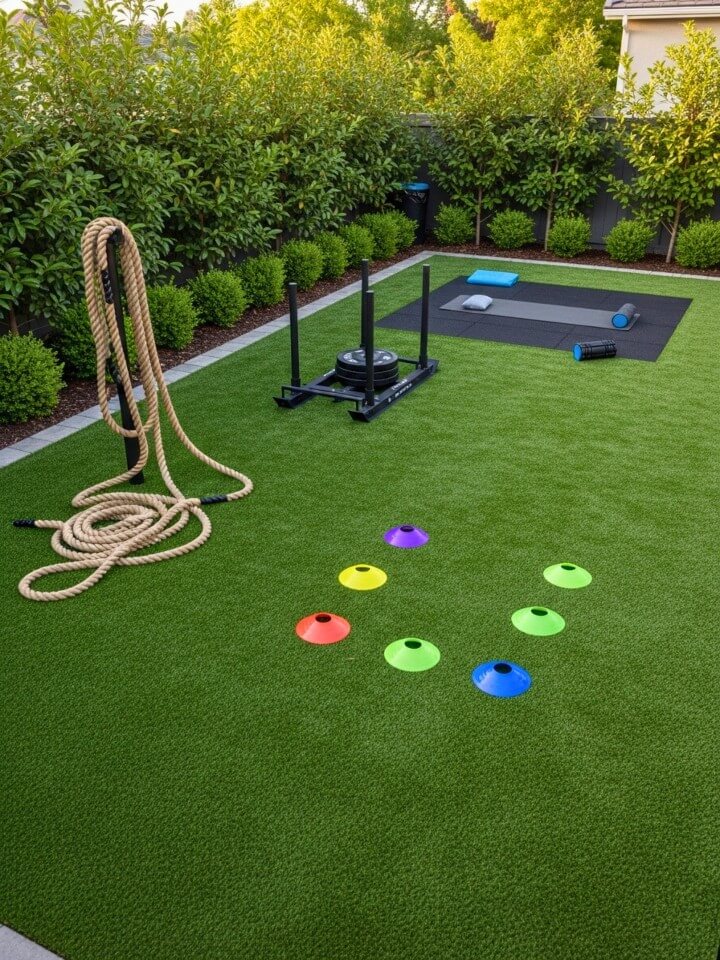
A 10×20 strip of artificial turf transforms how you train outdoors. Sled pushes, prowler drags, sprint work, bear crawls, sledgehammer swings on a tire — all the movements that wreck a lawn or chew up concrete suddenly have a proper home.
Athletic-grade turf with a 1.5-inch pile runs about $3–$6 per square foot. Lay it over a compacted base of crushed stone with a foam pad underneath if you’ll be doing floor work. Drainage matters: pitch the base a quarter-inch per foot away from your house.
Once it’s down, the space feels like a small training facility. That psychological shift is real — you walk onto turf and your mindset switches into work mode.
6. Outdoor Boxing Corner
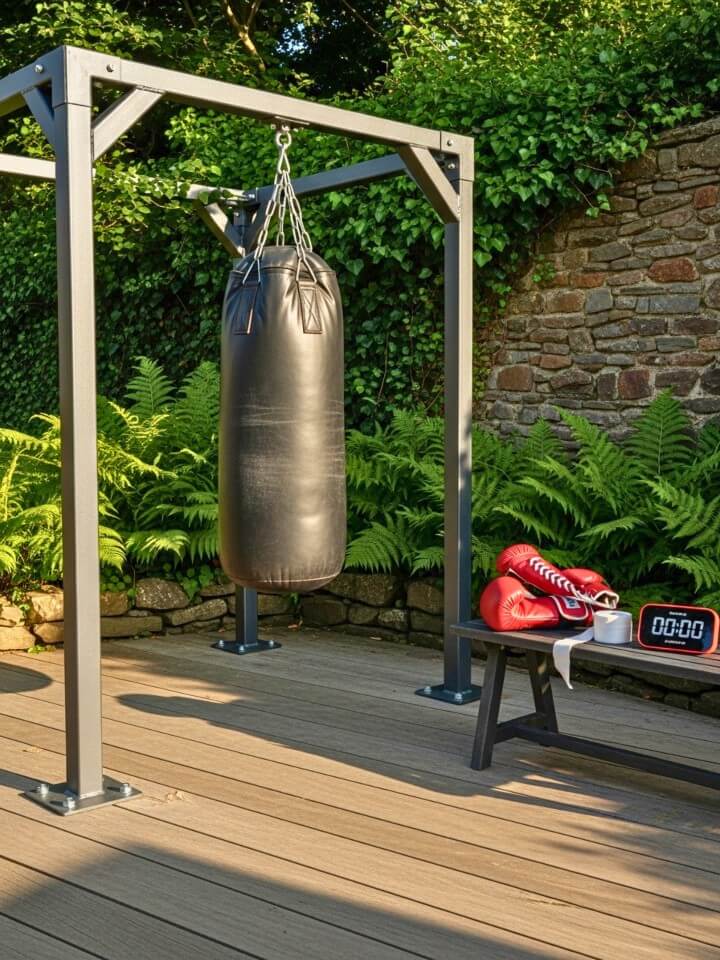
Hanging a heavy bag outside solves the two biggest indoor boxing problems: ceiling height and noise.
A 100–150 lb bag suspended from a sturdy beam, a dedicated stand, or a wall-mount bracket gives you the full range of strikes without low-ceiling restrictions. Pair it with quality 14oz or 16oz gloves, 180-inch hand wraps, and a $20 round timer app on your phone. Add a freestanding bag like the Century Wavemaster if you can’t hang one. Cover the bag with a tarp when not in use — UV breaks down vinyl shells within a couple of summers. A solid setup runs $250–$500. Three rounds of bag work hits harder than any cardio machine.
7. Yoga and Stretching Deck
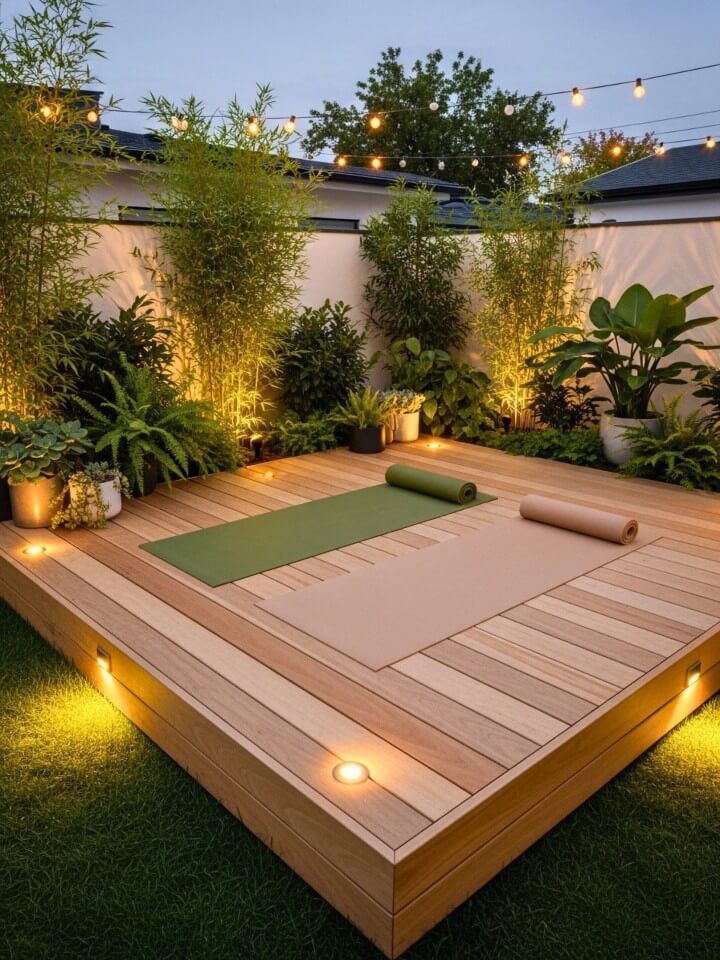
Some training spaces need to feel calm, not aggressive. A small raised deck — even just 8×10 feet — built specifically for floor work creates that mental separation from your strength zone.
Build Notes
Use pressure-treated 2×6 joists with composite decking on top (Trex or similar). Composite stays cooler underfoot than dark-stained wood in summer and won’t splinter where your hands and feet land repeatedly.
The Atmosphere Matters
Surround it with potted plants — snake plants, ornamental grasses, lavender for scent. Add a 6-foot bamboo screen for privacy and warm-toned solar string lights for dawn and dusk sessions. Total build: $800–$2,000. This is where mobility work actually happens consistently because you want to be there.
8. Backyard CrossFit Zone
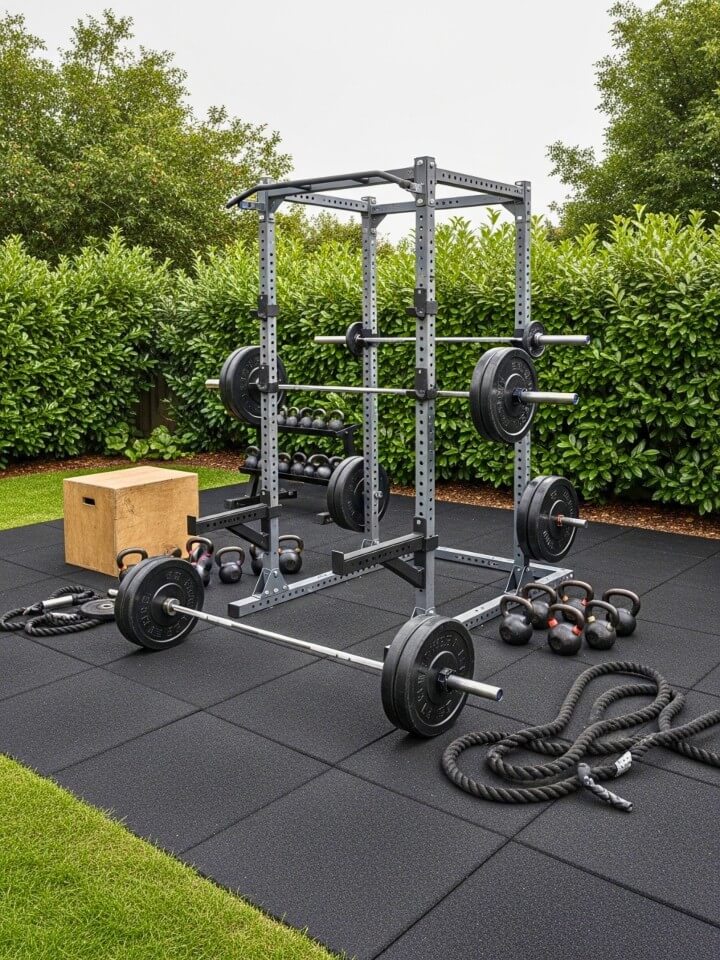
If your training looks like Murph one day and a heavy back squat the next, you need a true functional fitness setup.
Core Equipment List:
- Squat rack with pull-up bar ($400–$900)
- Olympic barbell, 45 lb ($200–$400)
- Bumper plate set, 230 lb ($350–$600)
- Kettlebells in two or three weights ($100–$250)
- 20/24/30-inch plyo box, three-sided ($120)
- Battle ropes, 50 ft ($80)
- Wall ball, 14 or 20 lb ($60)
Pour a 10×12 concrete slab as your platform — bumper plates will crater pavers and shred lawn within a month. Cover with horse stall mats. Expect $2,500–$4,500 for a complete kit, with the slab adding another $800–$1,500. This setup hits everything: strength, conditioning, Olympic lifts, gymnastics movements.
9. Wall-Mounted Workout Station
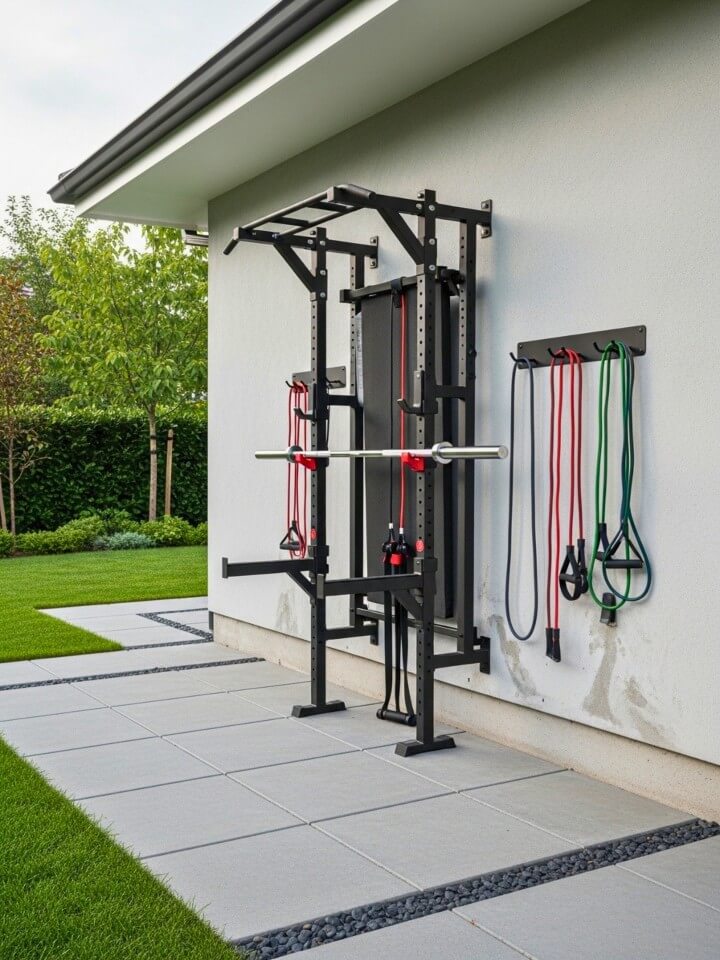
Tight backyard? An exterior wall is unused vertical real estate, and turning it into a training surface costs less than almost any other option here.
A foldable squat rack like the Rogue RML-3WC mounts directly to wall studs and tucks flat against the siding when you’re done — usable space goes from 4 feet deep down to about 6 inches. Add a wall-mounted pull-up bar above it, resistance band anchors at hip height, and a peg board for climbing-style grip training. Make sure you’re anchoring into studs or solid masonry, not just siding. A small awning over the rack adds weather protection. Total cost: $500–$1,200 for a setup that disappears when company comes over.
10. Mini Obstacle Course
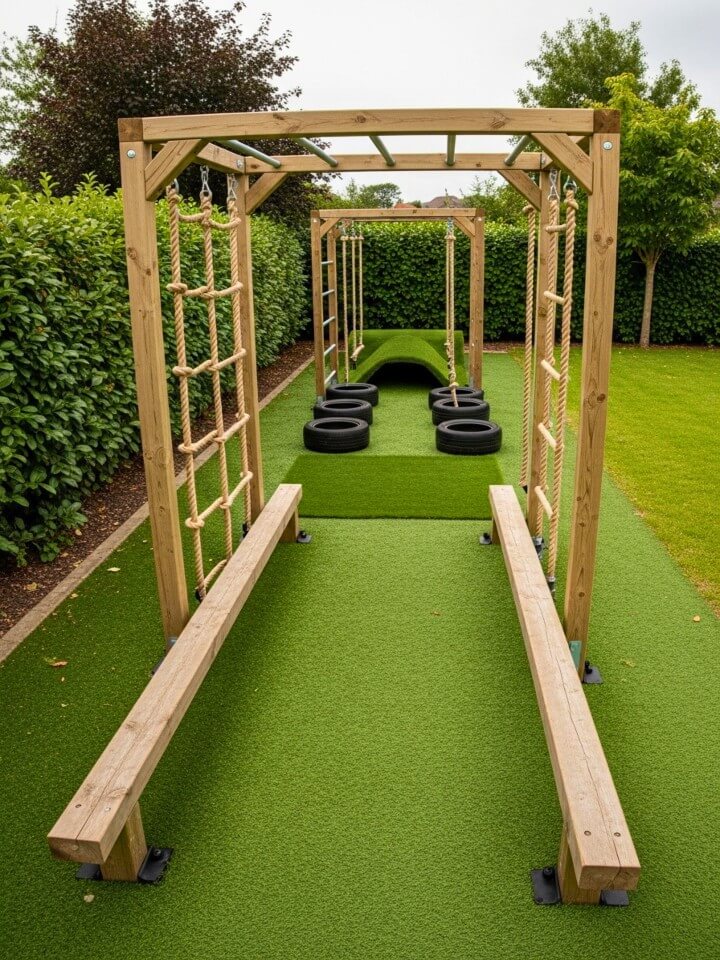
Unlock your fitness potential with a smart backyard gym setup just steps from your back door. This one earns double duty — it’s a workout for adults and an all-day playground for kids, which makes it the easiest backyard gym idea to justify to a skeptical spouse.
Lay out 30–50 feet of yard with stations every 8–10 feet: a monkey bar rig (around $250), a 6-foot balance beam, a 15-foot climbing rope hung from a tree branch or A-frame, three or four tractor tires arranged for high-knee runs (free from local tire shops — just ask), and a low crawl section under a cargo net.
Mulch or pea gravel underneath every station softens falls. The whole build runs $400–$1,500 depending on what you DIY. Run it as a circuit three times through and you’ve trained agility, grip, coordination, and conditioning in under 20 minutes.
11. Garden Gym with Nature Vibe
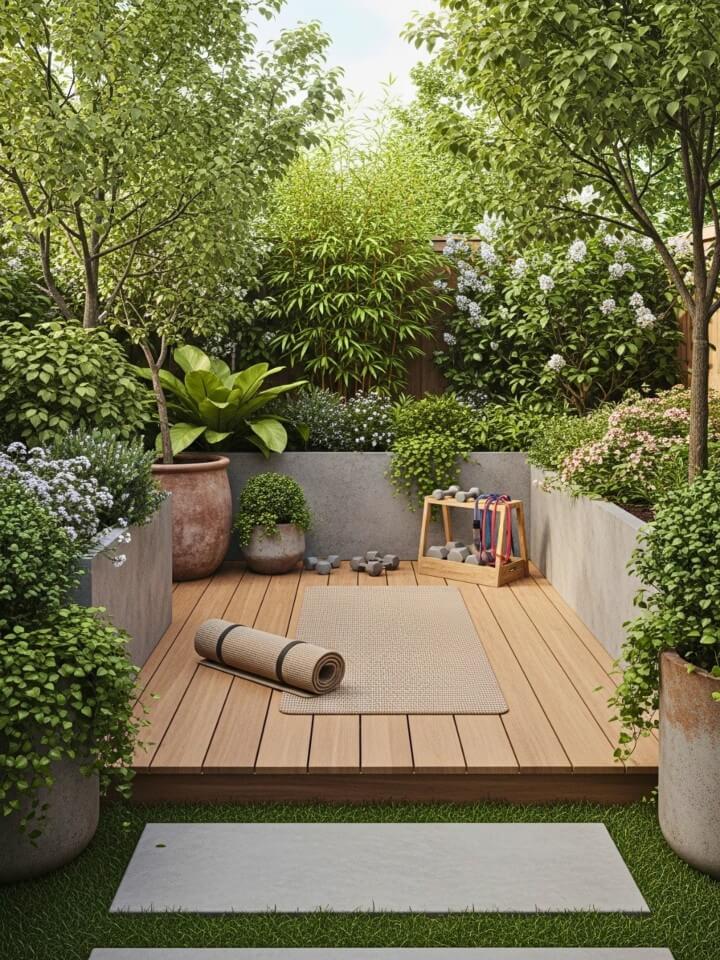
There’s a reason forest bathing became a researched wellness trend: training surrounded by greenery genuinely lowers cortisol and makes workouts feel less like punishment.
You don’t need a botanical garden to get the effect. Border a 12×12 training pad with tall planters holding ornamental grasses, bamboo, or climbing jasmine on a trellis. Use a permeable surface like decomposed granite or rubber-bonded mulch underfoot — both drain well and look intentional. Keep equipment minimal and low-profile so the plants stay the focal point: a yoga mat rack, a kettlebell set tucked in a wooden crate, a single pull-up arch wrapped in climbing vines.
Plant cost: $200–$500. The space invites longer sessions because it doesn’t feel industrial.
12. Portable Fitness Pods
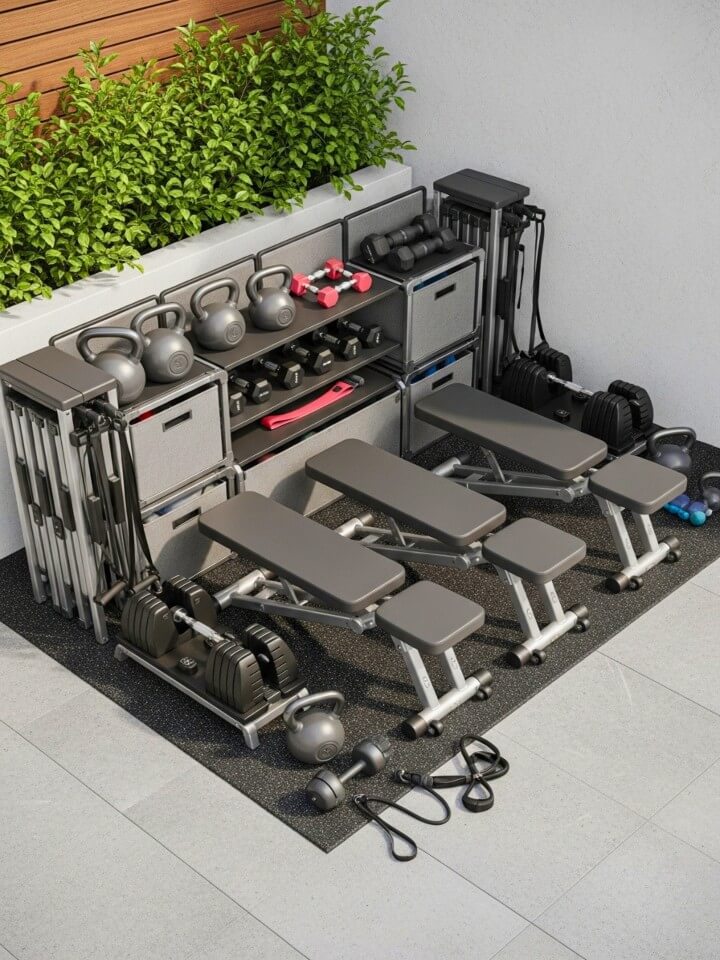
Renting? Planning a move within a couple of years? Permanent installations don’t make sense, but that doesn’t mean you settle for resistance bands and hope.
Everything in A Portable Setup Has to Pack Down or Roll Away:
- Adjustable dumbbells (Bowflex 552s replace 15 pairs in one footprint)
- Folding flat-incline bench that collapses to 5 inches thick
- Resistance band set with door anchor and handles
- Kettlebell in one heavy weight you’ll actually use
- Suspension trainer that loops over any sturdy branch or beam
- Storage deck box doubling as a step platform
Total: $400–$800 and the whole gym lives in one weatherproof box. Pull it out, train, put it back. The garage stays a garage.
13. Swimming + Strength Combo
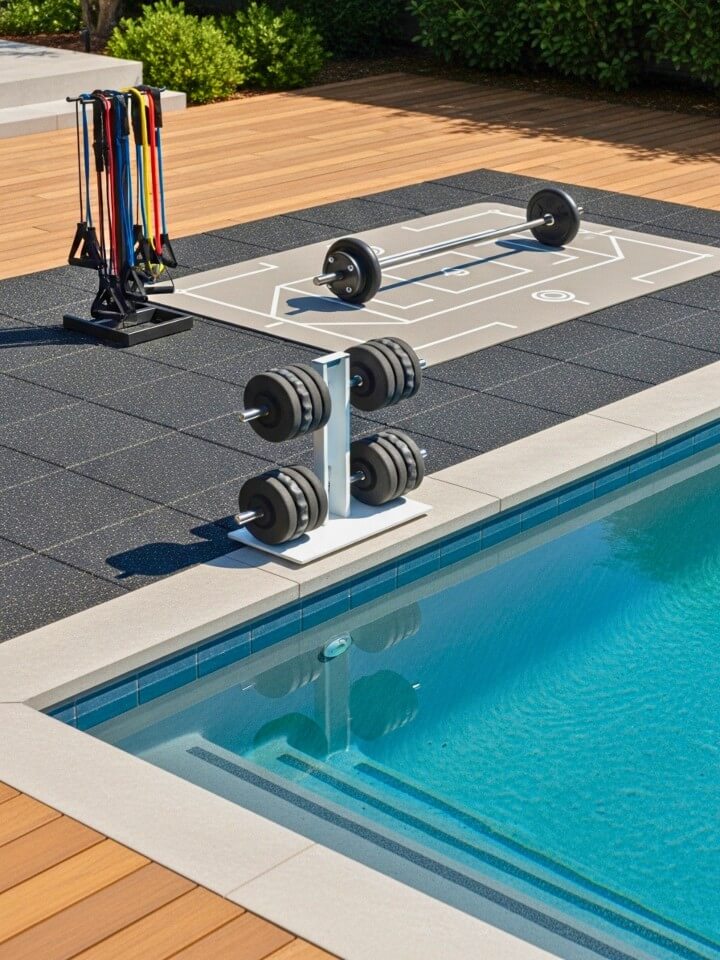
Elevate your training space with a functional and inspiring outdoor gym design made to perform. A backyard pool sitting unused 80% of the day is wasted potential. Pool-based training delivers a low-impact, high-resistance workout that’s especially valuable if you’re managing joint issues, recovering from an injury, or pushing past 50.
The Equipment That Matters
Aqua dumbbells ($25), a resistance belt that anchors to the pool edge ($40), and a kickboard cover the basics. For deep-water work, a flotation belt lets you run in place without impact — 20 minutes feels brutal in the best way.
Pairing It With Land Work
Set up a simple pull-up bar and dumbbell rack at the pool’s edge. Alternate sets on land with active recovery in the water. The contrast between cool water and summer heat keeps sessions surprisingly long.
14. Deck-Mounted Rowing Zone
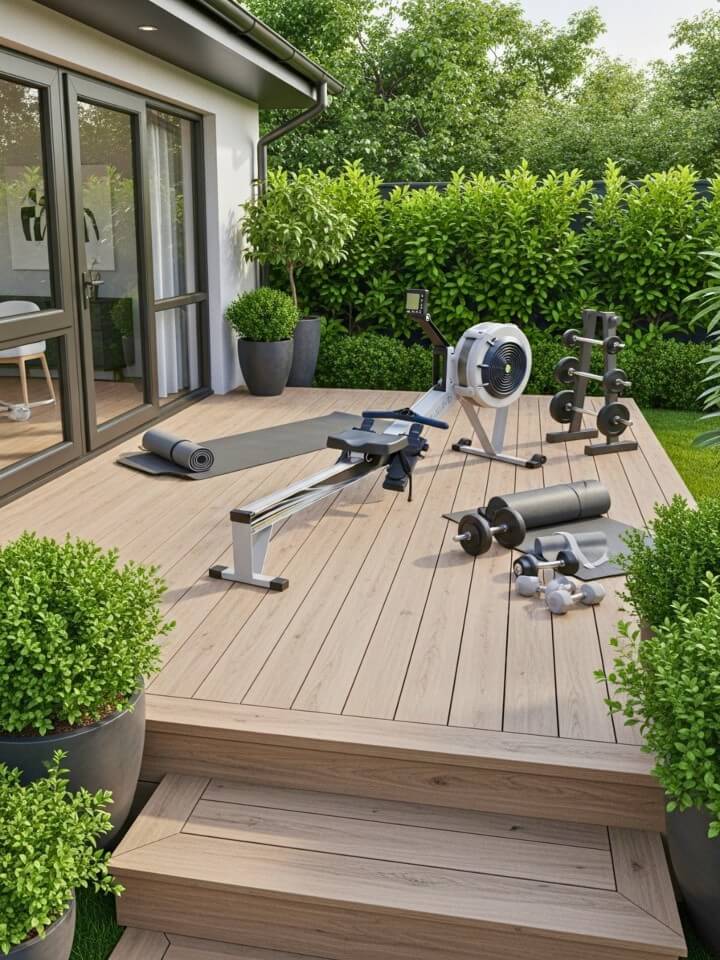
Picture this: 6 AM, coffee finished, you step onto the back deck, sit down at the rower, and pull for 20 minutes while the sun comes up over the treeline. That’s a better start than any commute.
Concept2 RowErgs are the gold standard ($1,000–$1,200 new, often $600–$800 used) and they handle outdoor placement well — chain and flywheel are weather-tolerant if you cover the unit between sessions with a fitted nylon cover ($40). Position it on the deck under existing overhead cover, or build a small 6×4 cantilever roof above it. Add a tablet mount on the monitor arm for follow-along workouts.
The full setup runs $700–$1,500 and trains 86% of your muscles in a single movement.
15. Compact Corner Gym
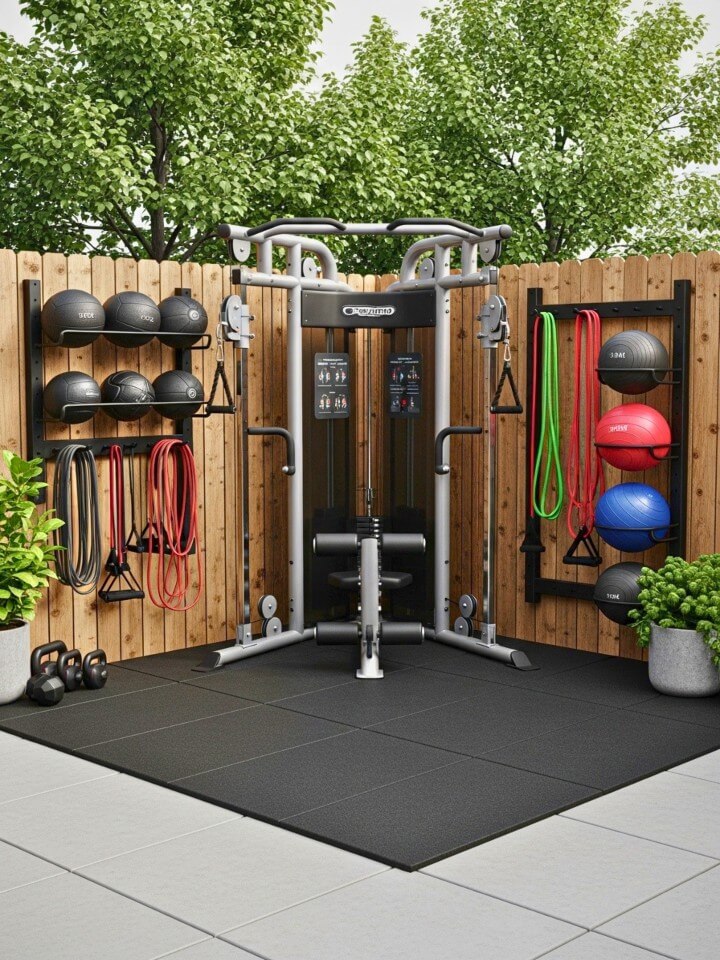
Most backyards have a dead corner — that weird triangular space behind the shed or beside the AC unit where nothing grows and nothing happens. That’s prime gym real estate.
The trick is going vertical. A wall-mounted storage rack holds medicine balls, kettlebells, foam rollers, and bands without consuming floor space. Add a compact cable machine like the Bells of Steel Hydra ($800–$1,200) that handles 200+ exercises through one pulley system. Lay down a 6×8 mat. Hang a folding plyo step against the wall.
The whole footprint is under 50 square feet, but the exercise variety rivals a $50/month gym membership. Total cost: $1,000–$2,000. The corner finally earns its keep.
16. Outdoor Climbing Wall
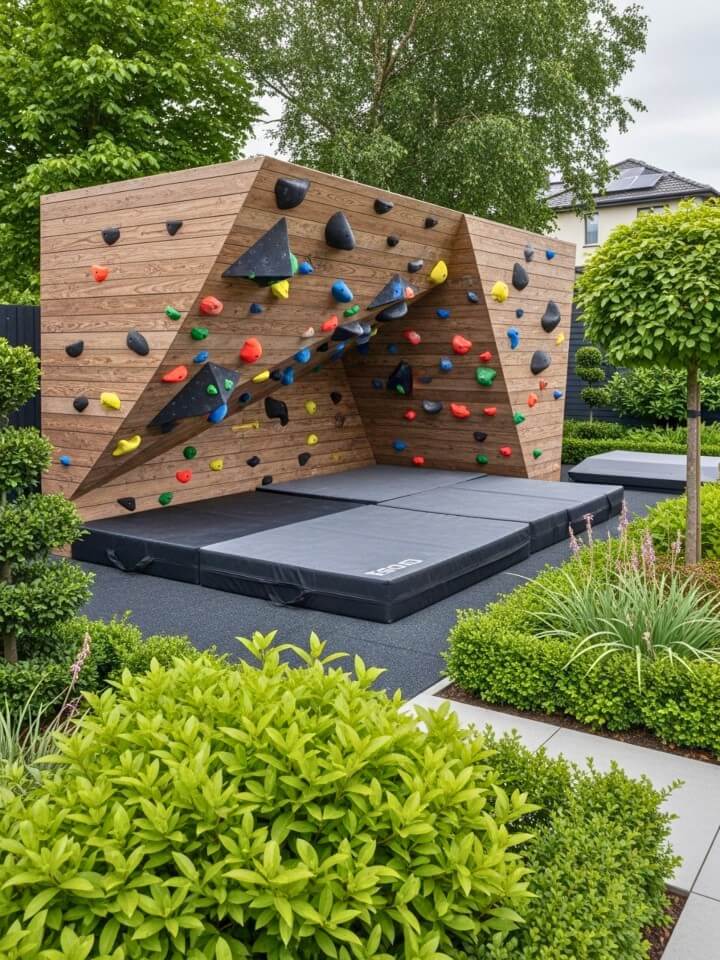
Save big and train harder with these budget-friendly DIY outdoor gym ideas anyone can build. Climbing trains everything strength athletes neglect — finger strength, scapular control, hip mobility, problem-solving under fatigue. A backyard wall makes it part of your weekly routine instead of a one-hour weekend drive.
Build Specs
A 10-foot tall, 8-foot wide bouldering wall built from 3/4-inch plywood on a 2×6 frame angled at 25–35 degrees handles years of use. Pre-drilled t-nuts every 8 inches let you reposition holds as you progress.
Safety Layer
Stack two 4-inch crash pads ($200 each) below the entire wall — no exceptions. Falls happen, and concrete or packed dirt below climbing height causes the bulk of home climbing injuries.
Holds and Cost
A starter set of 40 holds runs $150–$250. Full build: $800–$1,500. It’s the most fun piece of fitness equipment most people will ever own.
17. Night Workout Setup
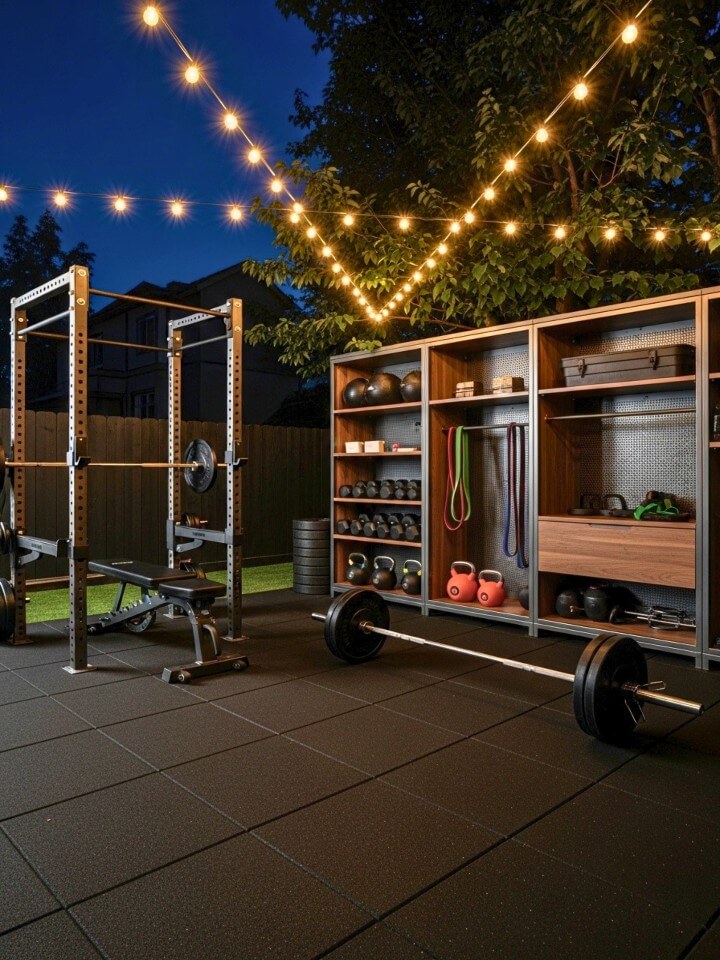
Why does this matter enough for its own section? Because most people training at home work full-time jobs, and the only window available is after sunset.
Lighting drives everything. Mount two 5,000-lumen LED flood lights on motion-and-manual switches at opposite corners — this kills the shadow zones that cause missed steps and dropped weights. Run a 14-gauge outdoor extension or, better, install a weatherproof outlet for the area. Add solar path lights to mark the walkway from your back door so you’re not phone-flashlight-walking at 9 PM.
Secure storage is the other half: a deck box or small locker keeps electronics, gloves, and straps out of dew. Total lighting and storage upgrade: $200–$500. Suddenly every evening is gym time.
Here are 5 unique, SEO-optimized FAQs covering genuine content gaps from the article:
Backyard Gym FAQs: Everything You Need to Know Before You Build
From building permits to rust prevention, these answers cover the real-world details most outdoor gym guides leave out — so you can plan smarter, spend less, and build a setup that actually lasts.
Do I Need a Permit to Build a Backyard Gym?
It depends on your setup. Portable equipment needs no permit. Permanent structures like sheds, concrete slabs, or decks over a certain square footage typically require one. Always check your local zoning and HOA rules before building.
How Do I Protect Outdoor Gym Equipment From Rain and Rust?
Use weather-resistant coatings or galvanized steel equipment, apply silicone-based rust inhibitor spray seasonally, and cover everything between sessions. A weatherproof deck box or small lockable storage unit extends equipment lifespan dramatically in humid or rainy climates.
What Is the Best Flooring for an Outdoor Gym?
Horse stall mats are the top choice — dense, affordable, and nearly indestructible. For turf areas, athletic-grade artificial turf over compacted crushed stone works best. Avoid standard foam tiles outdoors since they degrade quickly under UV exposure and moisture.
Can I Build a Backyard Gym on a Tight Budget Under $300?
Yes. Start with a freestanding pull-up bar, a single kettlebell, and two resistance bands. Add a rubber mat from a farm supply store. That combination covers strength, conditioning, and mobility without permanent installation or high upfront cost.
How Do I Keep Kids Safe Around a Backyard Gym Setup?
Install soft landing surfaces like rubber mulch or pea gravel under all elevated equipment. Anchor free-standing rigs in concrete footings. Store sharp or heavy tools in a locked box. Establish clear usage rules and supervise children on climbing ropes, bars, and obstacle elements.
Final Thoughts
The best backyard gym isn’t the one with the most equipment — it’s the one you’ll actually walk out to four times a week. Start with the setup that matches your current training style, then expand. A $500 covered patio with dumbbells and a pull-up bar used consistently beats a $5,000 CrossFit setup gathering pollen. Pick one idea from this list, commit to a 30-day trial, and let real use guide your next purchase.