23 Outdoor Pool Table Ideas That Actually Hold Up to Weather
Moving a pool table outside changes how a backyard gets used. Evenings stretch longer, guests actually stay, and a plain patio becomes the reason people come over. But outdoor tables live a harder life than indoor ones — sun bleaches rails, humidity swells wood, and one bad storm can ruin unprotected felt overnight.
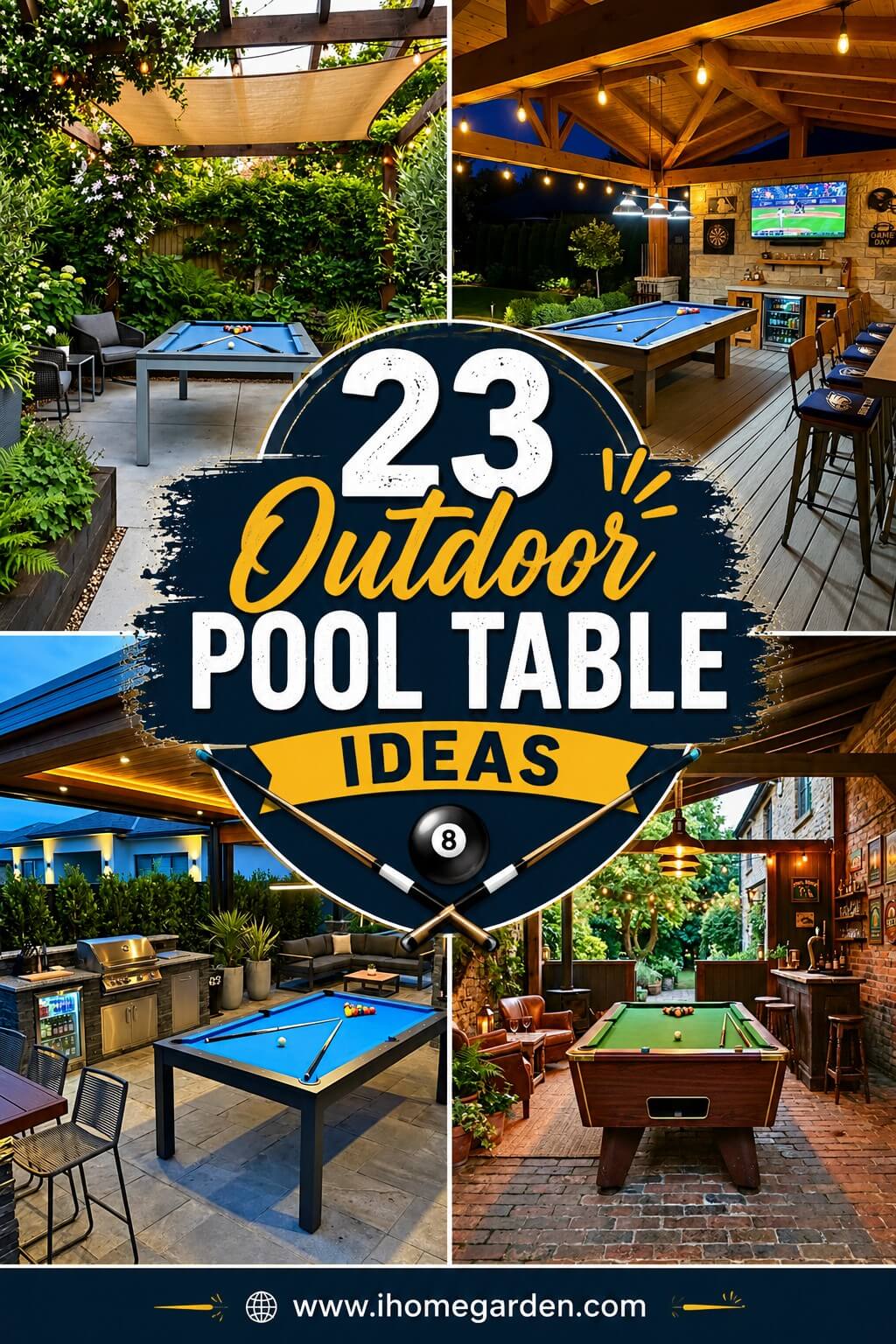
These 23 magnificent outdoor pool table ideas cover different budgets, yard sizes, and climates. Quick note before you start: a real outdoor table uses aluminum or powder-coated steel frames, marine-grade vinyl rails, and synthetic playing surfaces instead of wool felt. Quality tables run $2,000 to $8,000, with another $500 to $3,000 for shelter and lighting.
1. Covered Patio Setup
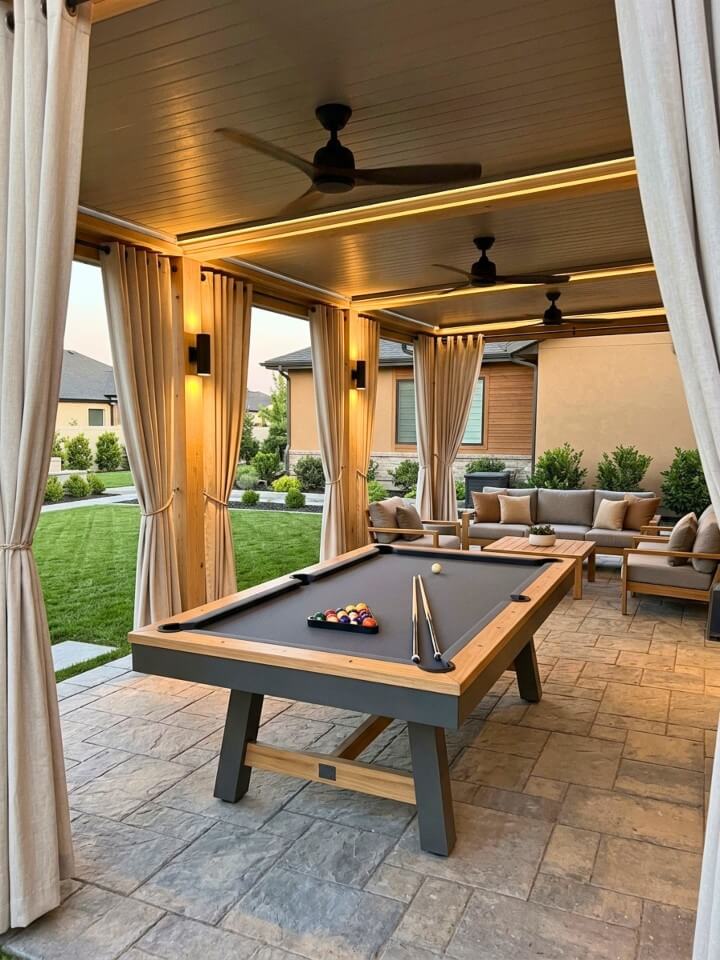
Start here if you want the safest, longest-lasting home for your table. A covered patio blocks the three things that destroy outdoor tables fastest — UV rays, rain, and falling debris — without building a new structure from scratch.
You need 16 by 19 feet minimum for a 7-foot table, with 8-foot roof clearance for break shots. Stick to aluminum frames with powder-coated finishes and synthetic playing beds. Sealed concrete or porcelain tile flooring holds up better than wood decking, which warps under concentrated weight.
Center a dimmable LED fixture 32 to 36 inches above the rails. Add roll-down side shades for wind-driven rain. Total cost lands around $3,500 to $7,000.
2. Poolside Entertainment Zone
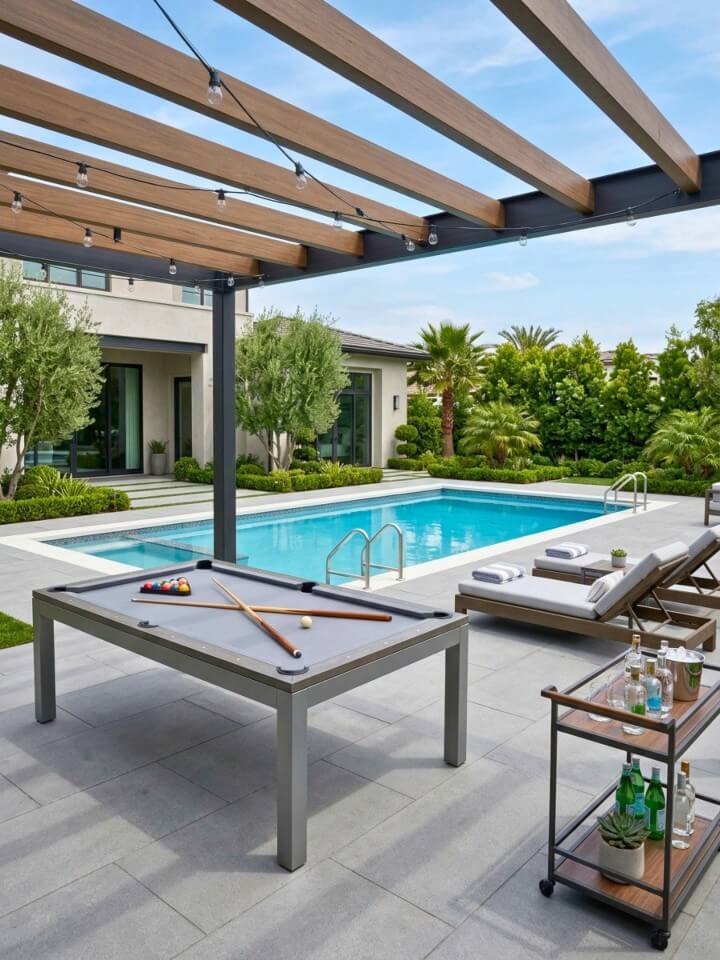
Pool tables near rectangular swimming pools look great in photos and cause problems in real life. Chlorine mist corrodes metal, splash zones warp rails, and wet feet track water onto felt.
The non-negotiable rule: 10 feet minimum between water’s edge and table, with a solid roof panel overhead — not lattice, not a shade sail. Where owners get this wrong is hardware. Standard steel screws rust within a season near chlorinated water, so demand stainless steel throughout.
3. Rustic Barn-Style Pavilion
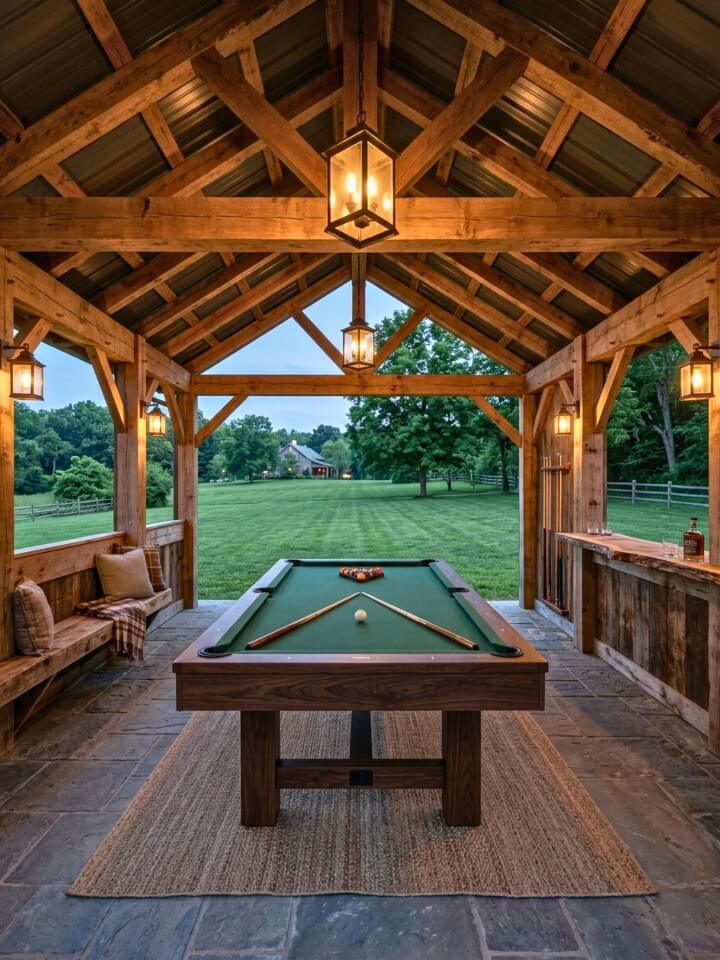
This one is for owners with real acreage. A quarter-acre backyard cannot absorb a 20-foot pavilion without swallowing the whole yard.
Picture cedar posts holding up a metal standing-seam roof, exposed trusses, stone flooring, and a matte black table sitting dead center under the ridge line. Iron pendant lights hang low. A reclaimed wood ledge runs along one side for drinks.
The build is the real cost — a 20-by-24-foot pavilion runs $8,000 to $18,000, with table and finishes adding $3,000 to $6,000. Where this beats every other idea: cue swing room. Gable roofs give tall players overhead space that flat patios cannot match, and pavilions add real property value.
4. Tropical Tiki Lounge
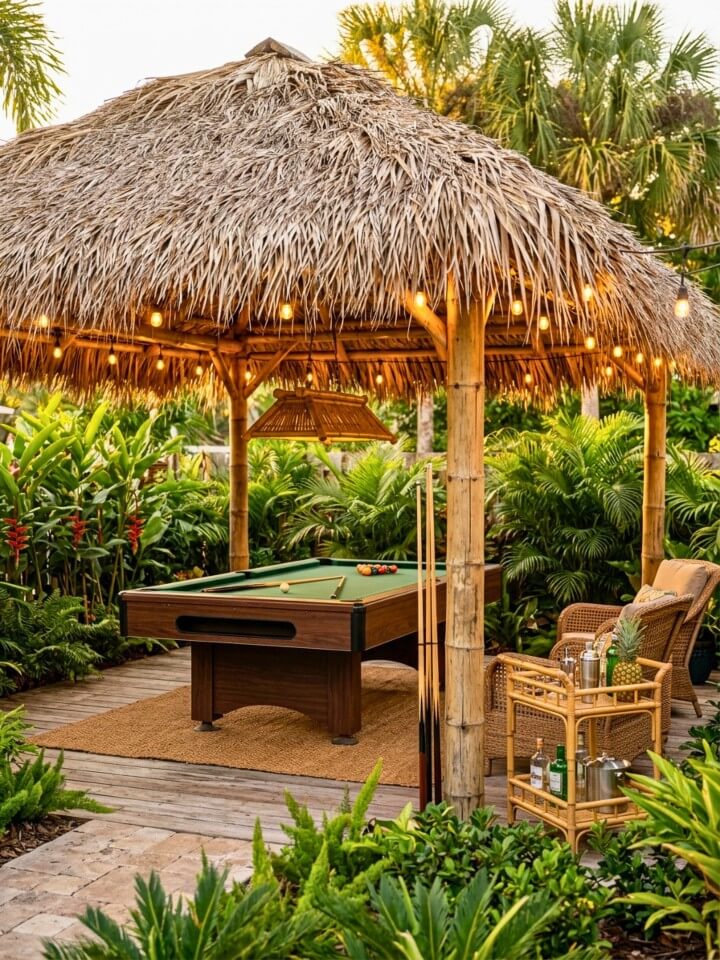
Discover stunning backyard pool table ideas that transform your yard into a stylish game-night haven. Skip this idea if you live somewhere with real winters. Everywhere else, it delivers a vacation feel no other setup matches.
The center of a tiki lounge is the roof, not the table. A thatched palapa or pergola dressed with palm thatch panels sets the tone. Pitch the roof steeply so rain runs off instead of dripping through onto the felt.
Humidity is the enemy — choose a marine-grade synthetic playing surface, sealed rails, and stainless hardware. Standard indoor tables will not survive one summer in humid conditions.
5. Modern Minimalist Deck
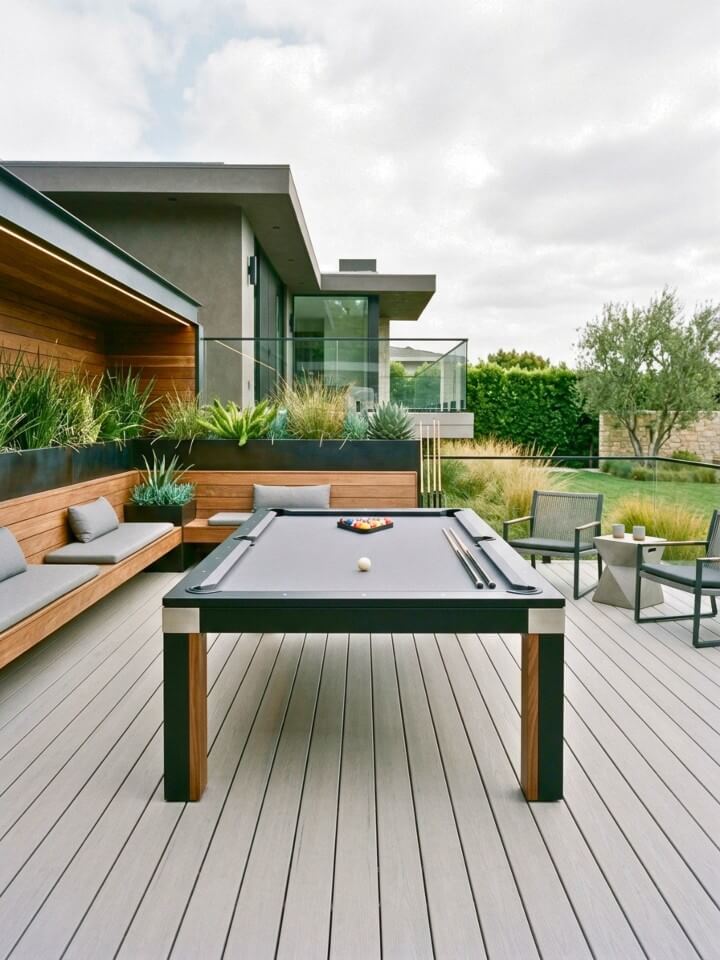
Minimalist design is harder than it looks because every wrong element shows. One mismatched planter ruins the whole space.
Three principles run this setup. First, restraint in color — pick two or three tones total. Black table with natural oak decking, or charcoal with light gray composite. That is the whole palette. Second, clean sightlines — low built-in benches instead of chairs, ground-level planters, recessed deck lights instead of pendants. Third, quality over quantity — one well-made table, one good light bar, one sculptural planter.
6. Outdoor Kitchen Combo
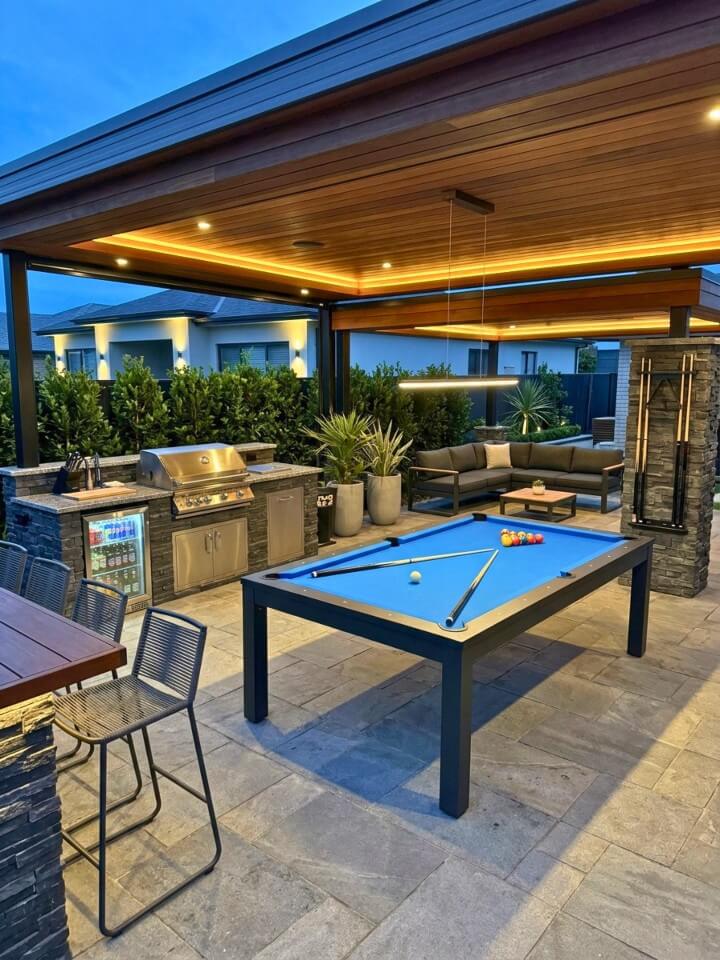
Six feet. That is the distance grease splatter can reach from an active grill, and it is the number most people ignore when they place a pool table next to their outdoor kitchen.
Get that spacing right and this becomes the best social setup on the list. Guests move between food, drinks, and the table without ever leaving the zone. Get it wrong and you spend every cookout wiping oil off your rails.
A working layout puts the grill island on one side, the table centered in the open space, and bar seating along the opposite edge — never between them. Foot traffic should flow behind the seated guests, not across shot lines. Stone or stamped concrete underneath handles spills and dropped tongs. Cue racks mount on the kitchen’s back wall to save room.
7. Fire Pit Gathering Spot
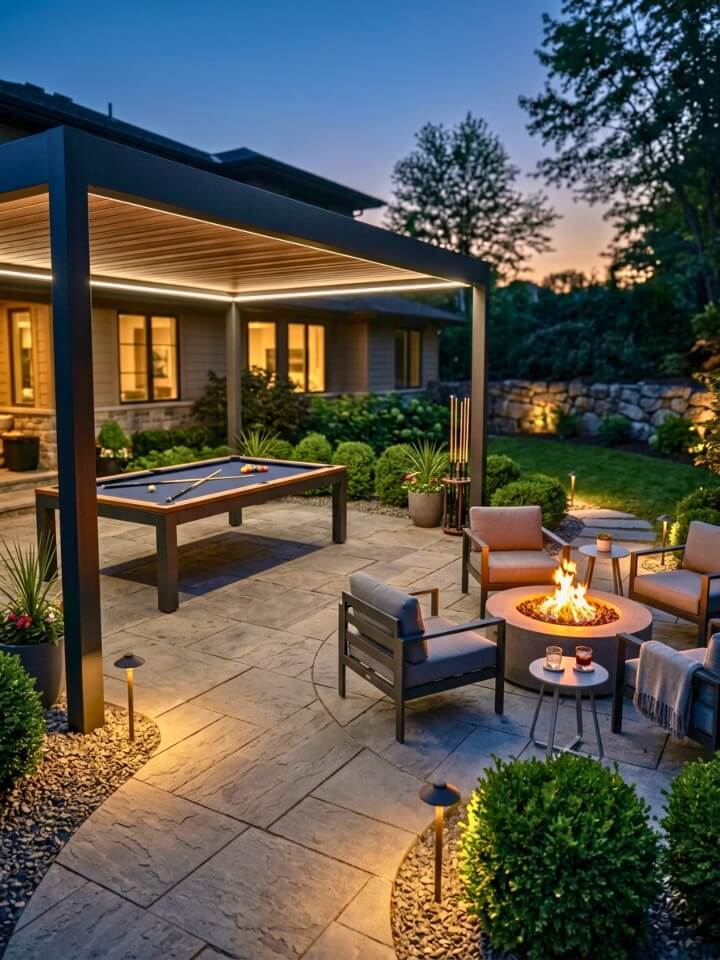
Before anything else, answer one question: which direction does the wind usually blow across your yard?
Sit outside for a few evenings and watch. Whatever direction the smoke would drift, that is where the table cannot go. Ash on felt is not a stain you clean off — it embeds into the fibers and gradually shortens the table’s playable life.
Once you know the wind, the rest falls into place. Put the fire pit at least 12 feet from the table, on the downwind side. Gas pits eliminate the ash problem entirely and are worth the $600 to $2,500 they cost for this specific setup. Wood pits look better but demand more thought.
Connect the two zones with flagstone or matching pavers so the eye reads them as one space. Low Adirondack chairs around the pit keep sightlines toward the table open, which matters when someone at the pit wants to watch the game without getting up.
8. Garden Oasis Setup
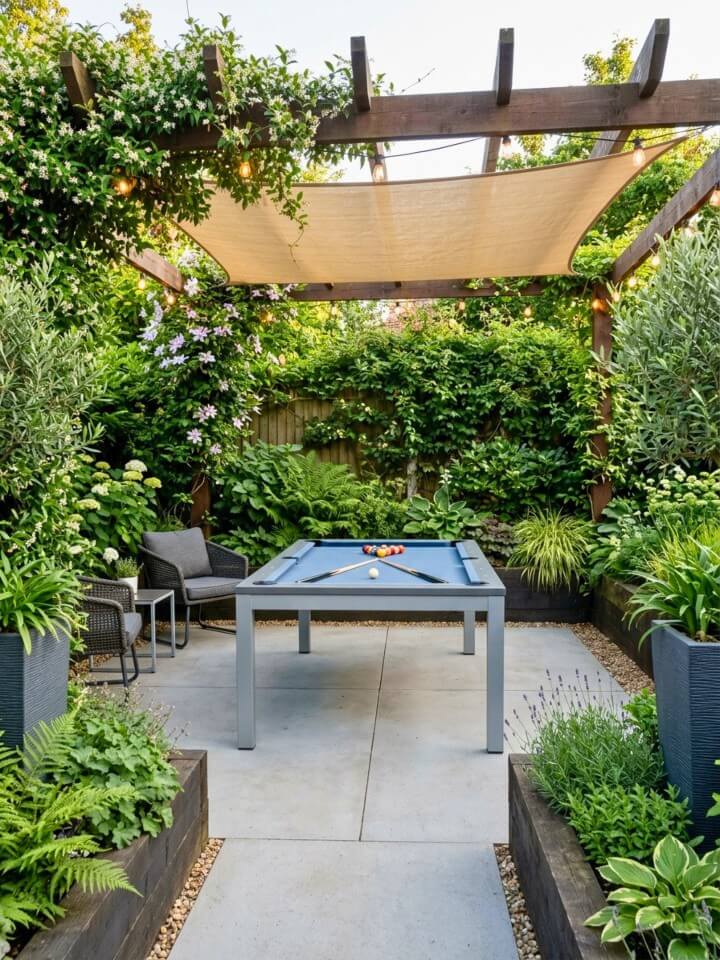
Plant choice makes or breaks this one.
Trees to avoid within 15 feet of the table: maples (helicopter seeds), mulberries (staining berries), magnolias (large waxy leaves), oaks (acorns and tannin drip), and any fruit tree. All of them will punish your felt.
Plants that actually work: boxwood hedges hold their shape without shedding, ornamental grasses sway without dropping debris, lavender adds scent and repels mosquitoes, and climbing jasmine on a trellis gives vertical interest with minimal cleanup. Rosemary in raised planters doubles as kitchen herbs.
Height is the second consideration. Raise beds to hip level so foliage frames the table at eye height instead of interfering with cue swings. Anything taller than 4 feet needs to sit at least 6 feet back from the rails.
9. Rooftop Terrace Table
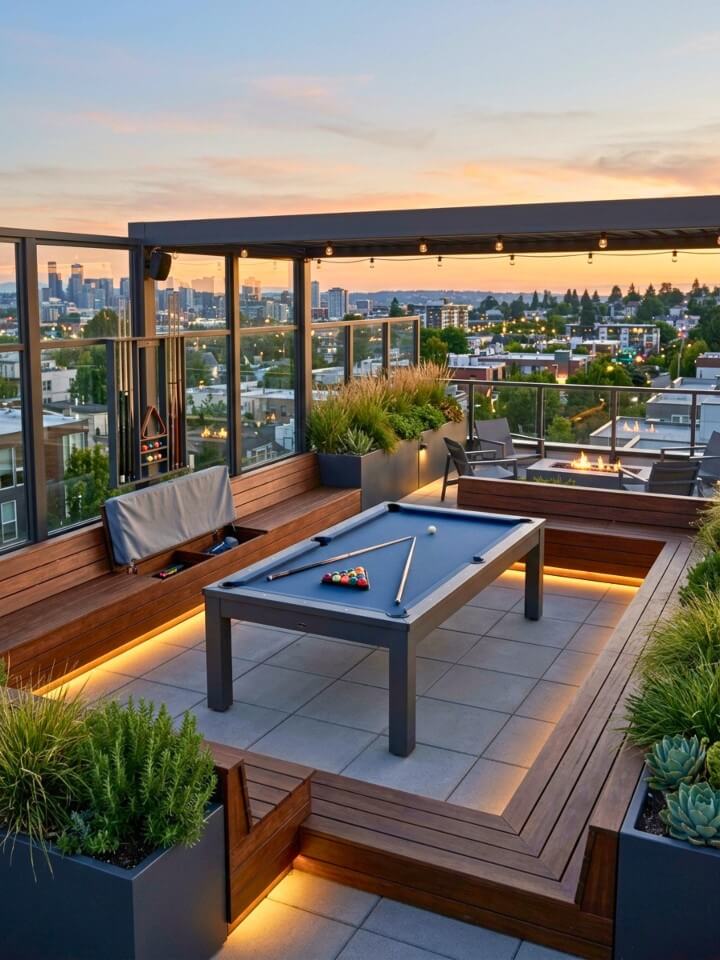
Do not skip the structural engineer.
A slate-bed pool table weighs 700 to 1,000 pounds concentrated over about 24 square feet. That is roughly triple the point load of a hot tub. Modern residential roofs usually handle it, but older buildings, converted spaces, and additions frequently cannot. A one-hour engineering consultation costs $150 to $400 and prevents a five-figure disaster.
Assuming the roof passes, everything else follows from two constraints — weight and wind.
For weight, choose an all-aluminum frame with a synthetic playing surface instead of slate. This cuts the load nearly in half without sacrificing playability for casual games. For wind, you need solid barriers on at least two sides. Glass windbreaks around the perimeter look clean and preserve the view. Storage benches along the walls double as ballast and hold cues, covers, and balls.
Lighting stays anchored — deck lights or wall-mounted fixtures only. Pendants swing in gusts and become hazards.
Full setup lands between $6,000 and $14,000.
10. Convertible Dining-to-Pool Table
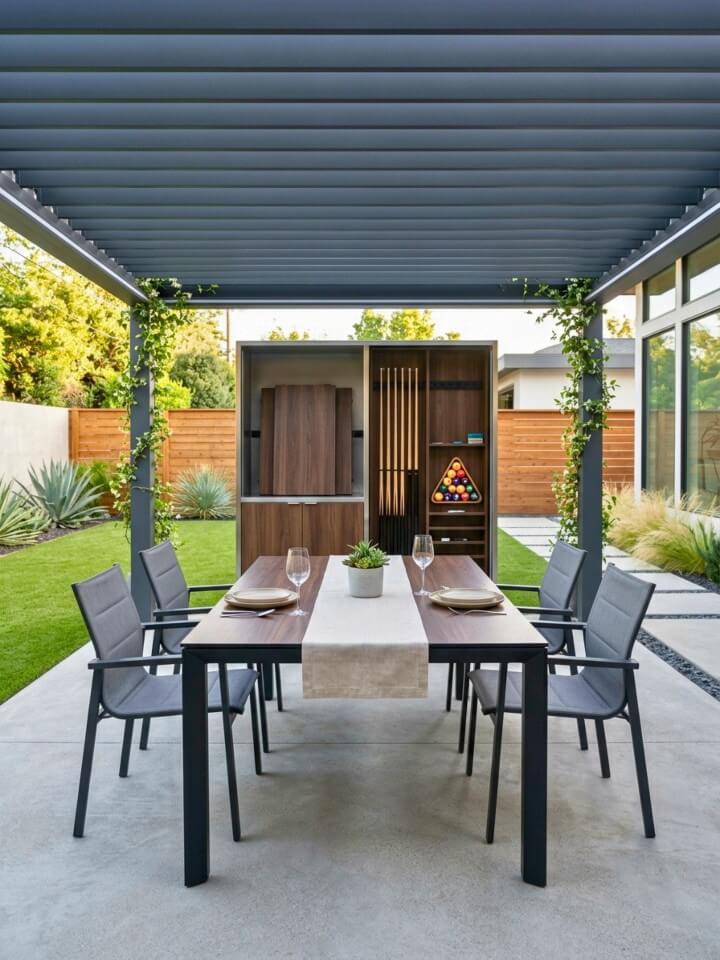
Build a stunning DIY outdoor pool table with budget-friendly materials and easy weekend-project steps. Every convertible table involves a compromise. The question is whether you can live with it.
Here is what actually changes when you buy a convertible instead of a dedicated table: the rails sit slightly higher because they need to clear the dining top’s storage brackets, pockets are often shallower, and the removable top adds seams that can catch cue tips if the top is not stored properly between uses. For casual family games these differences barely register. For anyone learning to play at a competitive level, they add up.
Now the case for buying one anyway: if your patio has to serve as dining space, work-from-home lunch spot, and game area, a convertible is the only piece of furniture that does all three without dominating the yard.
Look for solid one-piece dining tops rather than folding leaves. Confirm there is a wall-mounted storage bracket for the top — leaning it against a wall damages both the top and whatever it leans on. Place the whole setup under a covered pergola.
11. Lakeside or Waterfront Setup
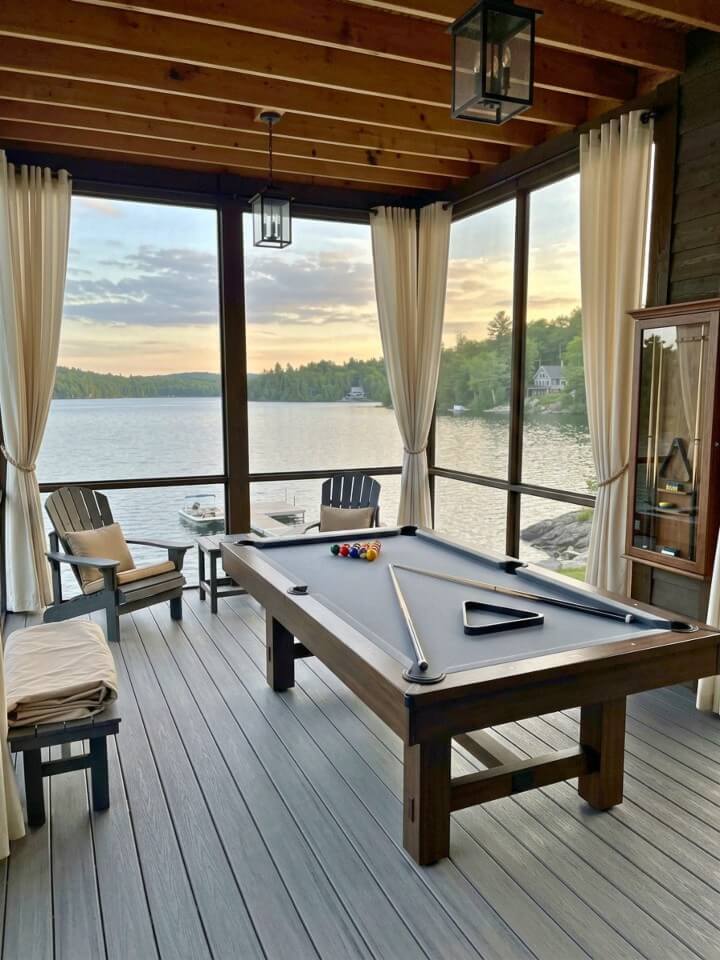
Waterfront homes face constant ambient moisture that inland setups never deal with. Even on dry days, the air carries humidity that works on your table around the clock.
Rails fail before felt does. Wood swells, contracts, then splits along the grain after two or three untreated seasons.
Three defenses actually work: a screened porch instead of an open patio, composite decking underneath instead of pressure-treated wood, and a fitted cover used every single time — no exceptions.
Choose a table rated for high humidity and ask the manufacturer directly about the internal frame. Hidden particle board is common and disqualifying here.
12. Industrial Loft Patio
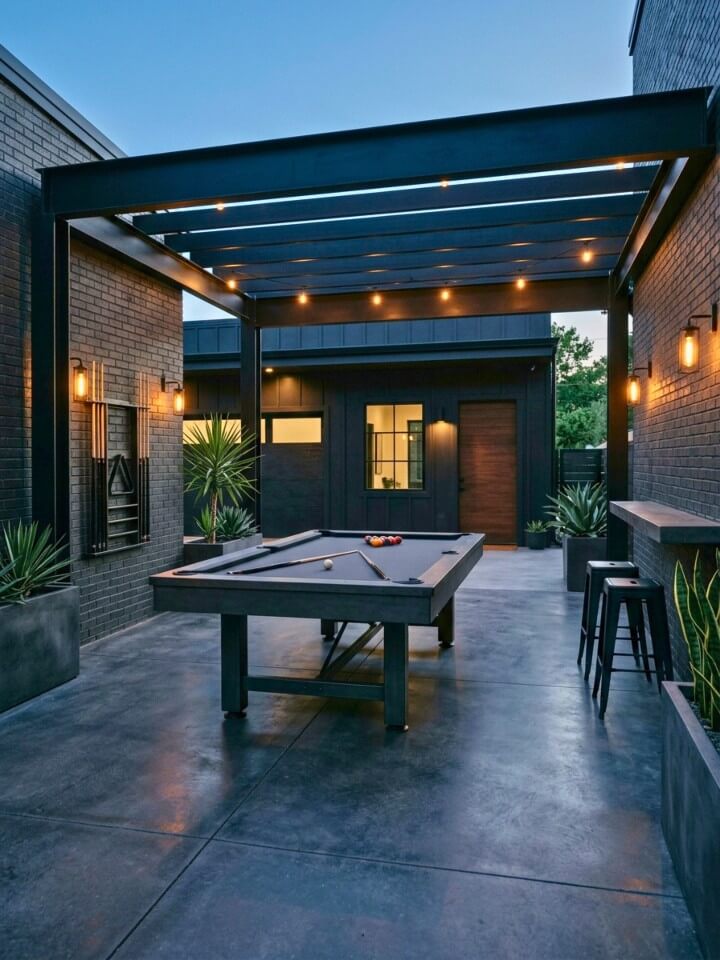
The industrial look works outdoors because the materials it depends on — concrete, steel, weathered wood — are already built for weather. You are not fighting the elements with delicate finishes.
Start with a poured concrete slab, polished or acid-stained. Add a black powder-coated steel pergola overhead. The frame itself is the design element, no fabric needed. Table in charcoal, matte black, or reclaimed wood. Steel bar stools along one edge.
Lighting earns its rent here. Caged Edison bulbs on black cord between the pergola beams, one statement pendant centered over the table. Stick to 3000K to 3500K bulbs, never warm yellow.
13. Glass-Enclosed Sunroom Extension
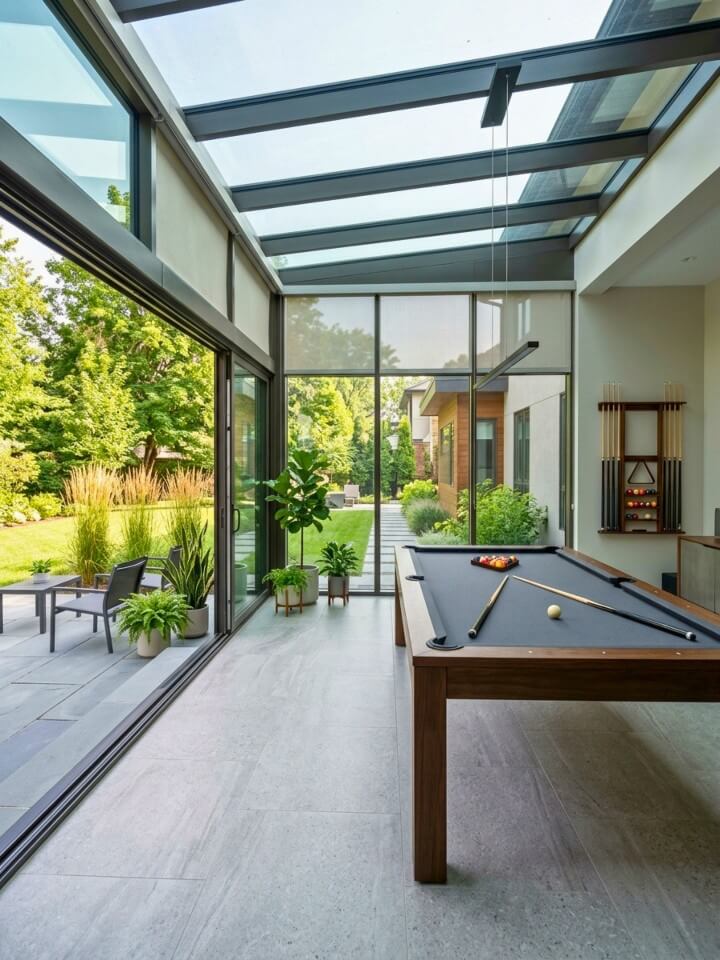
Glare is the main design problem. South-facing glass turns a pool table into a mirror by mid-afternoon, and you cannot make a shot when you cannot see the cue ball’s contact point.
Solutions ranked by effectiveness: exterior solar screens block heat before it hits the glass, interior cellular shades soften light control, low-E tinted panels work permanently but cost more, and light-filtering film is the cheapest option.
Flooring matters here more than elsewhere. Luxury vinyl plank handles temperature swings without expanding and shrugs off dropped balls. Real hardwood telegraphs every season change.
Sunroom builds start around $15,000, plus $3,500 to $7,000 for the table setup.
14. Vintage Pub-Style Patio
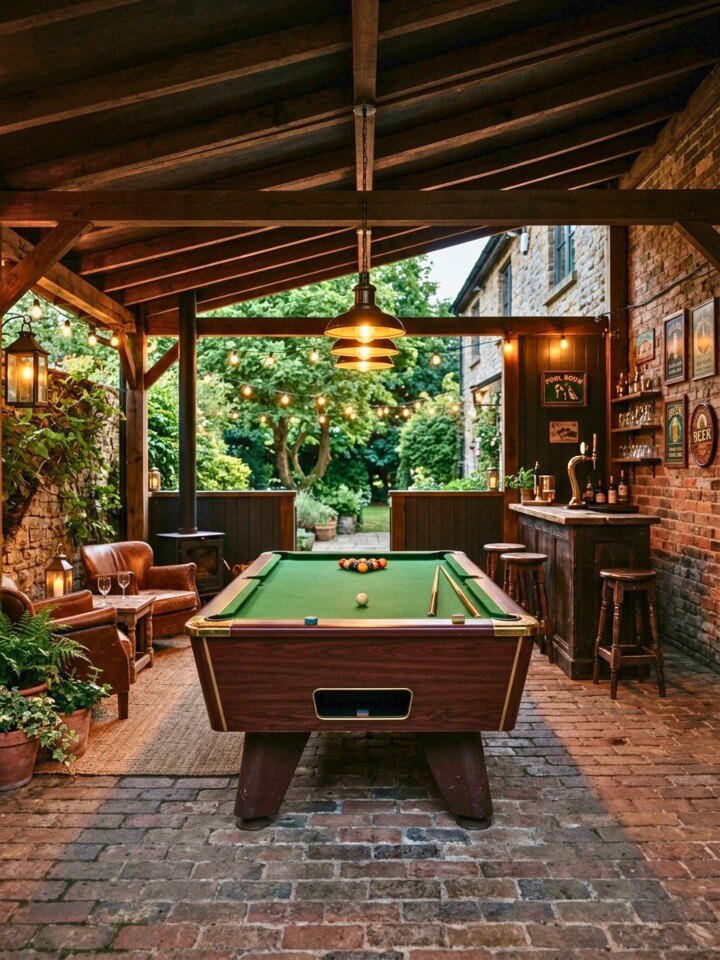
Good pubs feel enclosed but not cramped, dim but not dark, lived-in but not messy. Translating that outdoors requires a covered patio with three defined walls — real walls, tall fencing, or dense evergreens — plus a solid roof.
Dark green felt reads more classic than blue or red. Hang a single row of 2700K pendants 32 inches above the rails. Brick or reclaimed wood on the walls. A short bar counter with three or four stools, never more.
Mood-builders: chalkboard scoring, framed vintage signs, one shelf with old books or bar glassware. Skip anything that says “man cave” — it undoes the pub feel instantly.
15. Zen Japanese-Inspired Courtyard
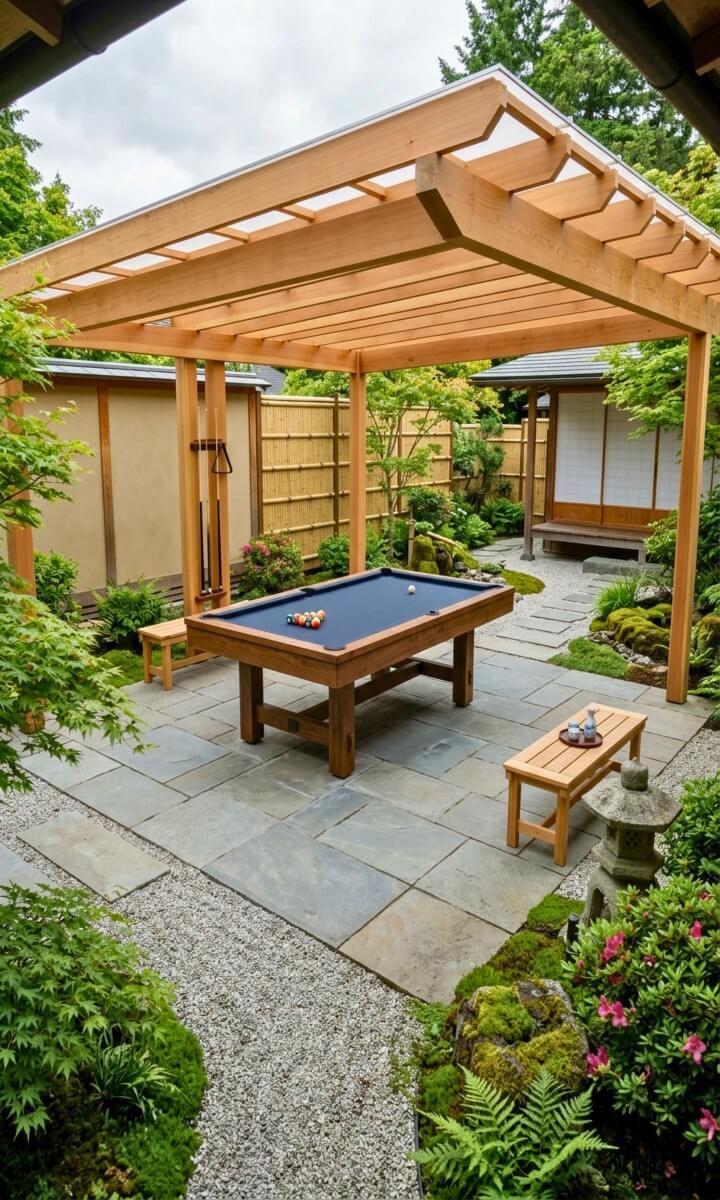
Upgrade your entertaining space with a sleek patio pool table built for style, fun, and all weather. Negative space does the work in this style, and it only reads as intentional when everything in it is intentional. One rule guides every choice: if an element does not serve function or composition, remove it.
Start with the ground plane. Large-format stone pavers — 24-inch bluestone or basalt — with a two-foot border of raked white gravel. The gravel defines the room’s edges more clearly than a wall.
The table should be dark, matte, and unornamented. Black or deep walnut, no brass fittings. Two low wooden benches nearby. Bamboo screens on two sides. One Japanese maple. One stone lantern with warm LED.
Setup: $4,500 to $10,000, most of it stonework.
16. Mediterranean Villa Style
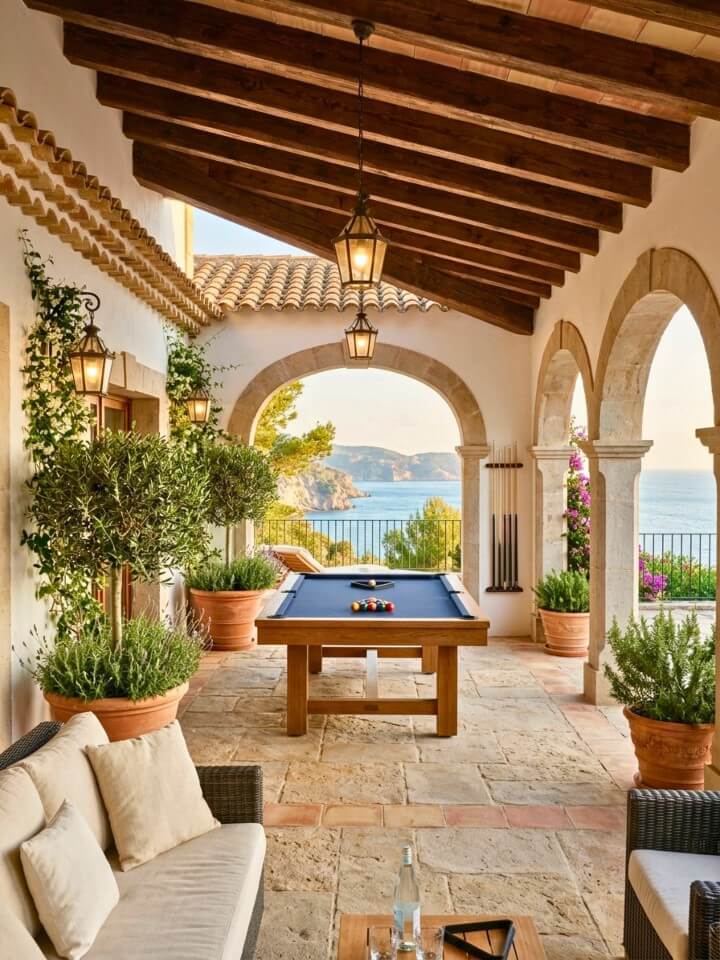
Warm climates built this style, and warm climates are where it still works best. Dry heat, strong sun, cool evenings — the design answers all three.
Clay tile roof over the play area, either as a full covered terrace or a deep pergola with tile-topped beams. White stucco walls behind. Travertine or terracotta pavers underfoot, both of which stay cooler than concrete in direct sun.
The table should sit in warm wood tones — walnut, teak, or aged oak — never black. Wrought iron pendants above the rails. Terracotta planters holding olive trees, lavender, or rosemary along the edges.
Cushioned seating in cream or rust tones. Skip anything bright.
17. Sports Bar Backyard
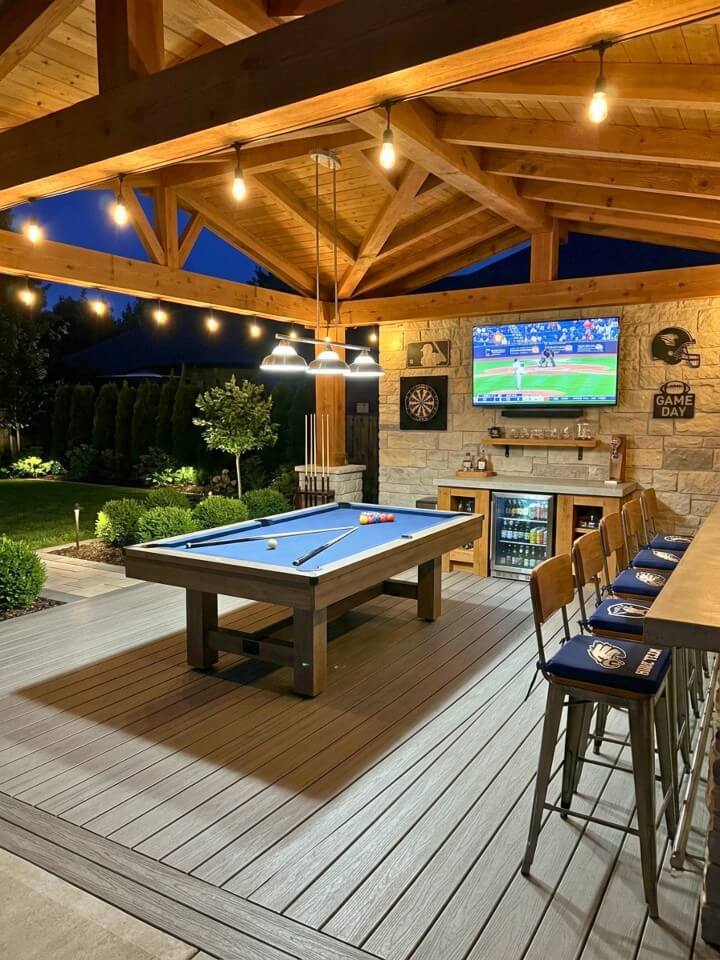
The mistake most people make: treating this as a decorating project instead of a viewing-angle problem.
Start with the TV. Mount it where players can glance up between shots without turning their backs to the table. That usually means the long wall, centered, at 65 to 72 inches high. Never above the table itself — glare from overhead lights makes it unwatchable.
Weatherproof outdoor TVs run $1,500 to $4,000. Do not use an indoor TV under a covered patio. Humidity kills them within a season.
Bar seating faces both the screen and the table. Mini fridge within arm’s reach. Bright task lighting over the rails, separate switch from the ambient lights so you can dim one without the other.
18. Detached Game House
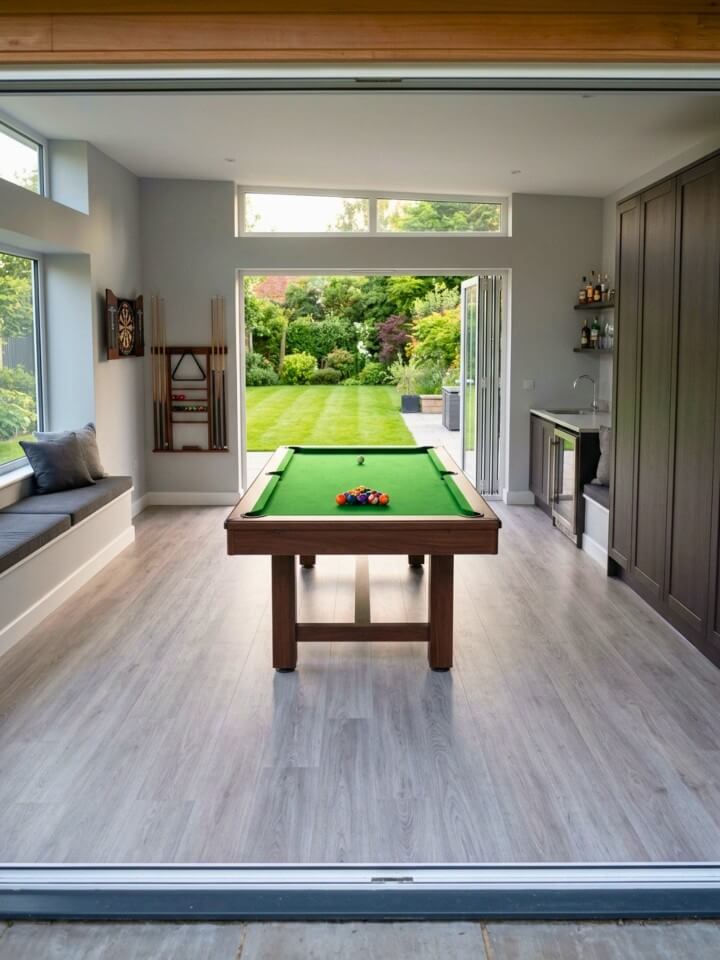
At some point, the backyard structure stops being a shed and starts being a small building. That threshold matters for one reason — permits.
Most areas require permits for structures over 120 square feet. A pool table needs 340 square feet minimum for comfortable play, which means every real game house build involves the permit office. Budget four to eight weeks for approval before construction starts.
Once cleared, the build itself is straightforward. Wide double doors or a garage-style roll-up for airflow and moving furniture. Insulated walls if you want year-round use. Epoxy or luxury vinyl flooring. Cue racks along one wall, a small bar along another, seating opposite the table.
19. Desert Modern Retreat
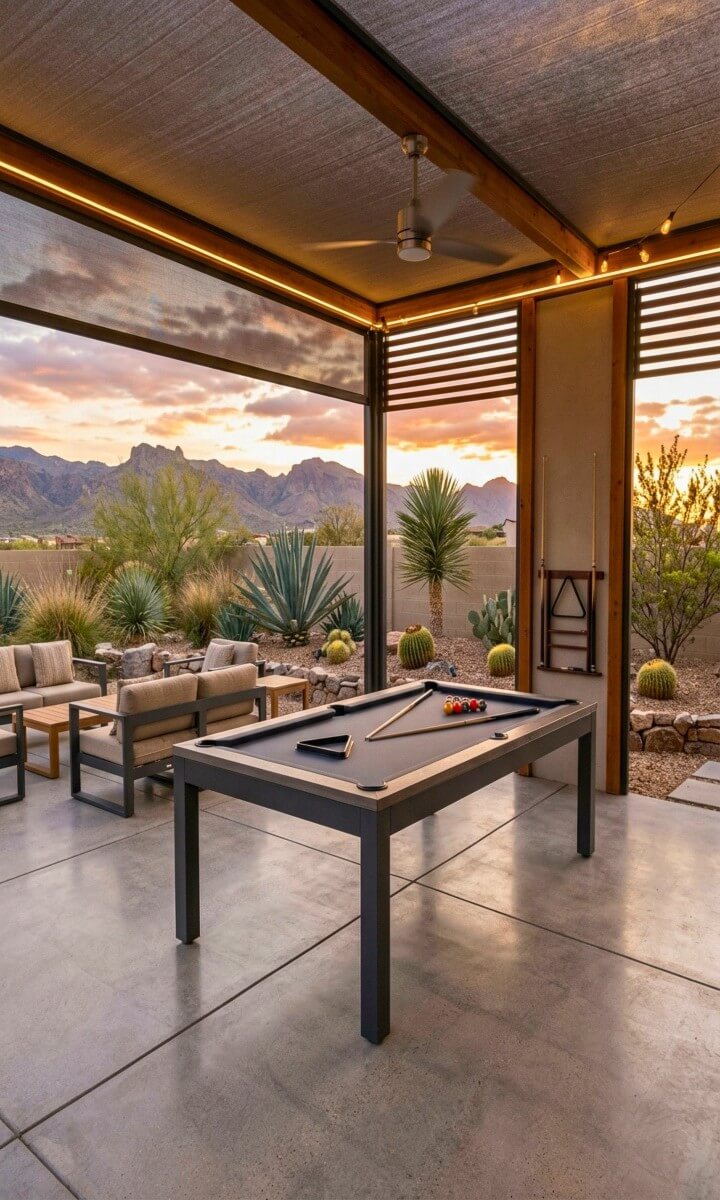
Explore weatherproof outdoor pool tables designed to bring premium billiards fun right to your yard. Heat is the design problem here. Everything else follows from how you handle it.
Shade comes first. A flat-roof steel or wood shade structure above the table — solid roof, not slats. Slats create striped shadows across the felt that mess with shot reading during the day.
The playing surface itself needs UV-stabilized synthetic materials. Standard outdoor tables warp in sustained 100-plus temperatures. Ask the manufacturer specifically about desert-rated models.
Ground plane: large-format concrete or stone pavers in light tones. Dark surfaces absorb heat and radiate it upward for hours after sunset.
Around the edges, drought-tolerant plants — agave, yucca, desert spoon. A ceiling fan under the shade structure moves air enough to matter.
20. Bohemian Hideaway
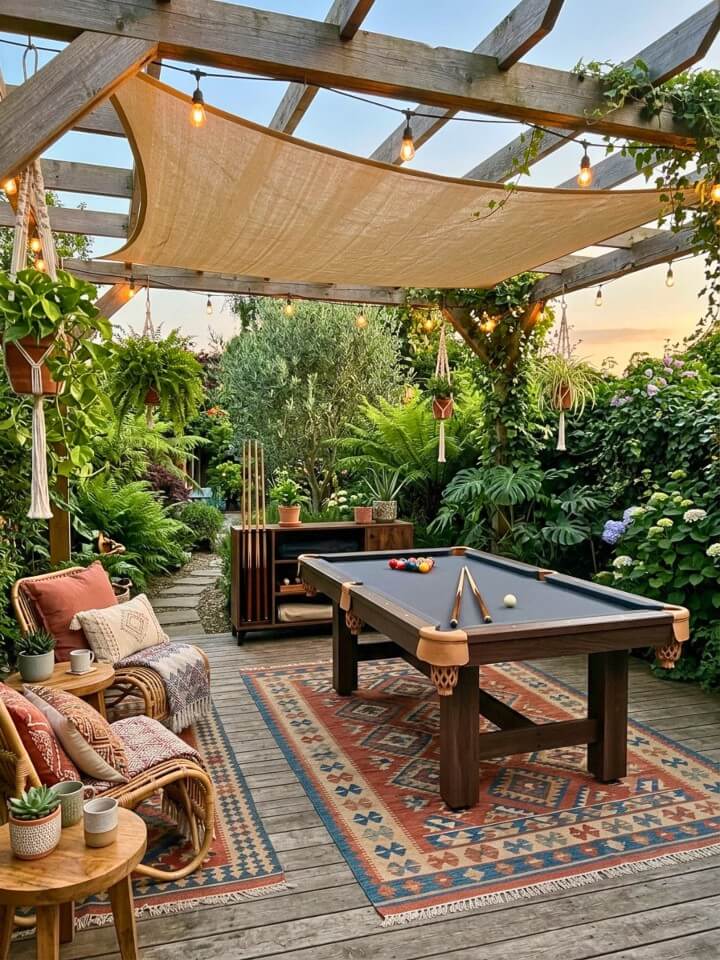
Boho works because it hides its rules underneath the layered, casual look. There are actually only three.
Rule one: mix textures, not colors. Rattan, macramé, kilim rugs, jute, raw wood. If everything has a different texture, the eye reads richness. If everything has a different color, the eye reads chaos.
Rule two: keep the palette earthy. Terracotta, mustard, cream, deep green, faded rose. No neon, no primary colors, no black-and-white contrast.
Rule three: layer heights. Hanging plants overhead, medium seating at knee height, floor cushions, low side tables. Vertical variety is what makes boho feel intentional instead of cluttered.
Pergola or shade sail overhead. Storage basket for cues. Warm string lights only.
21. Mountain Cabin Deck
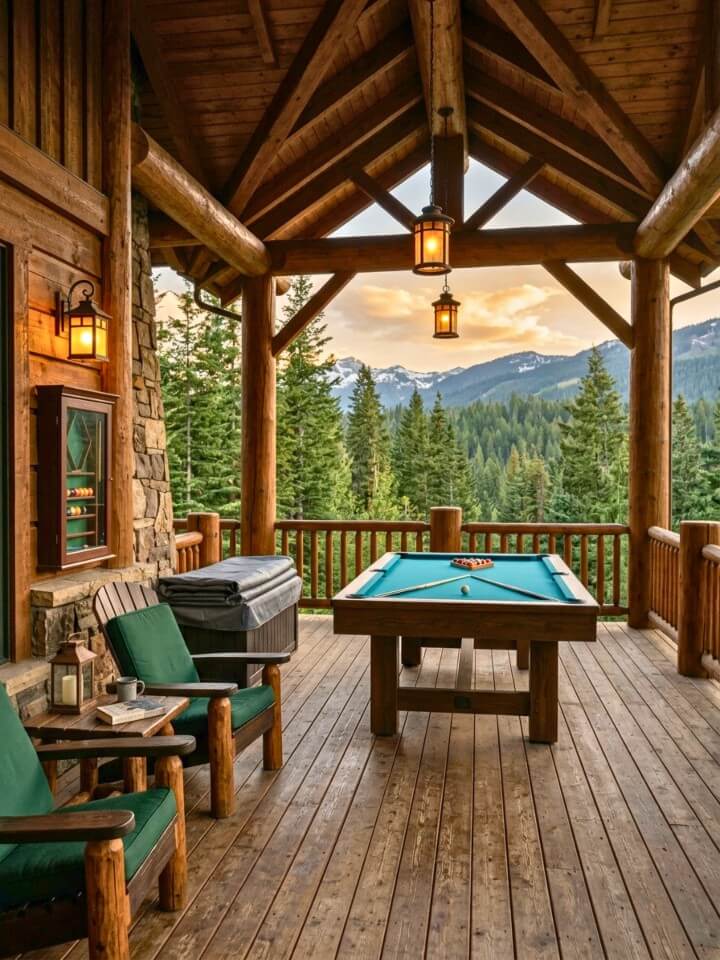
Snow load is the number nobody talks about until a roof collapses.
If you live above 4,000 feet elevation, or anywhere with heavy winter snowfall, the covered structure over your table needs an engineered snow rating for your region. A standard patio cover rated for 20 pounds per square foot will fail under 40 inches of wet snow. Local rating requirements run 40 to 90 pounds depending on the area.
Beyond that, this setup is about matching the cabin. Timber-frame roof over the table, cedar or pine decking, stone accents. Wrought iron lantern lights on warm bulbs. Heavy Adirondack chairs that stay put in mountain wind.
Closed cue storage matters — humidity swings between summer and winter warp exposed wood shafts.
22. Beachside Cabana
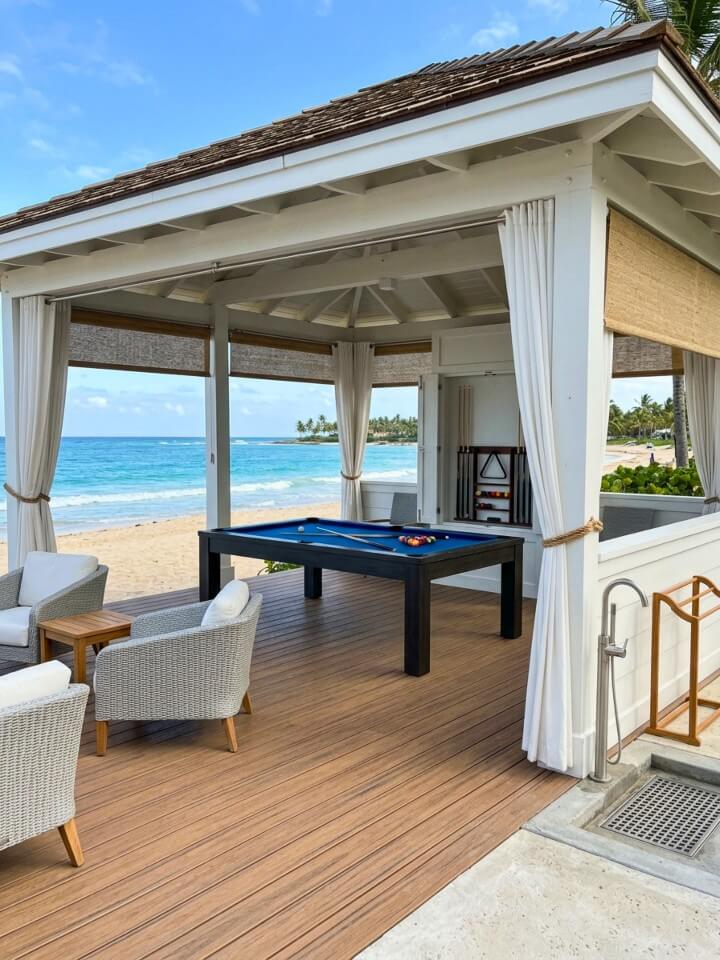
Salt is the enemy. Not sand, not sun, not wind — salt.
Airborne salt corrodes standard steel hardware within a single season on coastal properties. It pits aluminum more slowly but visibly. It works its way into felt fibers and never fully rinses out. Every design decision here starts with that reality.
Marine-grade stainless hardware throughout. 316-grade specifically, not 304 — the difference is corrosion resistance in salt air. Composite decking, never wood. Roll-down shades on all cabana sides for wind and salt spray.
A rinse foot station between beach access and the play area cuts down on tracked sand. Sealed cue and ball storage kept inside a cabinet, never open racks.
23. Multi-Level Entertainment Patio
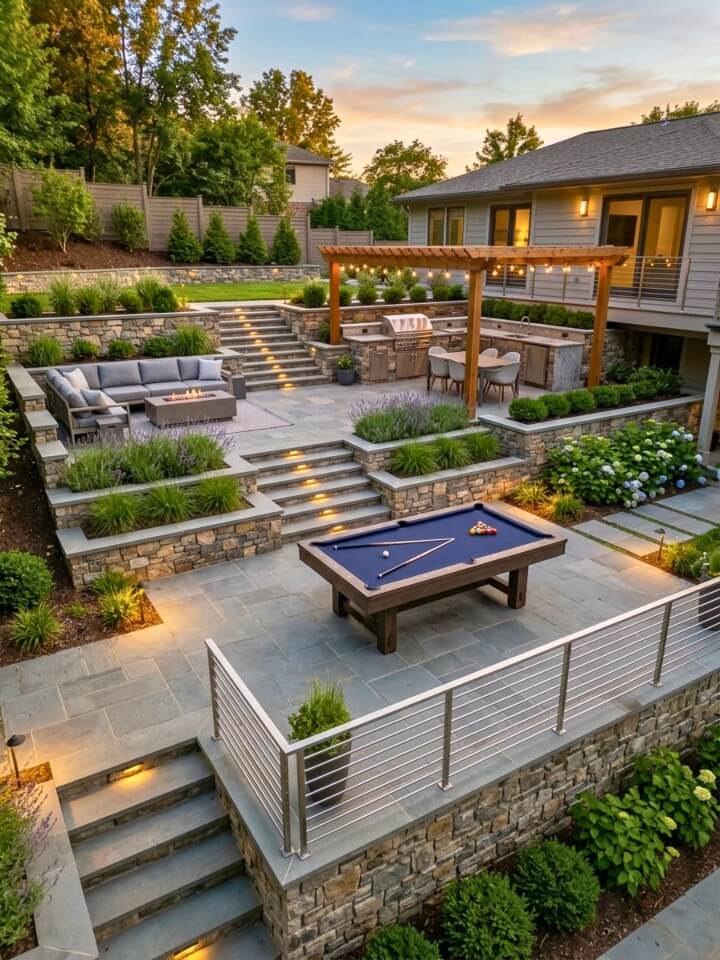
Sloped yards get treated as problems. They are actually opportunities — grade change lets you separate zones without walls.
The pool table goes on the flattest, largest terrace. That is non-negotiable. Uneven ground under a table means uneven play, and no amount of leveling feet fully corrects a sloped base.
From there, use the grade change to define the other zones. Dining one level up, lounge seating one level down, grill on its own tier. Connect them with wide stone steps, matching pavers throughout, and low landscape lighting along the rail lines.
Five feet of clearance minimum around the table on every side. Never place stairs within cue-swing range.
Frequently Asked Questions About Outdoor Pool Tables
These common questions cover installation, protection, and long-term care details most buyers overlook before setting up their backyard table for the first time.
How Long Does an Outdoor Pool Table Typically Last?
A quality outdoor table lasts 8 to 15 years with proper cover use and shelter. Cheaper models rated for occasional use often fail within 3 to 5 seasons, especially in humid or coastal areas.
Do I Need a Permit to Install a Covered Structure for My Pool Table?
Most areas require permits for permanent covered structures over 120 square feet or attached to your home. Pergolas, freestanding shade sails, and small canopies usually do not, but always check local building codes first.
Can I Level an Outdoor Pool Table Myself, or Do I Need a Professional?
Small leveling adjustments using the table’s built-in feet work for minor issues. Anything beyond a quarter-inch tilt across the playing surface needs a professional with a machinist’s level — poor leveling ruins gameplay permanently.
What Is the Best Way to Protect the Felt from Bird Droppings and Tree Sap?
A fitted heavy-duty cover is the only reliable defense. Bird droppings contain acids that eat felt within hours, and tree sap bonds permanently once dry. Never rely on shelter alone if trees or bird activity exist nearby.
Should I Remove My Outdoor Pool Table During Winter?
Tables rated for outdoor use can stay outside year-round if covered and sheltered. However, in freezing climates, remove the balls, cues, and accessories indoors — cold cracks phenolic resin balls and warps wood cue shafts quickly.
Choosing the Right Setup for Your Yard
Three questions narrow the field faster than any style guide.
First, how much shelter can you commit to? Full covered structures unlock the widest range of options but require the biggest budget. Pergolas and shade sails work in mild climates. Open patios only work with premium weatherproof tables and diligent covering.
Second, what is your climate’s dominant threat? Humidity, sun, snow, salt, and wind each demand different materials. Match the setup to the actual challenge, not the aesthetic.
Third, how will the space get used beyond pool? Cookouts, gatherings, quiet evenings, and family use all pull the design in different directions. The best setups do two or three things well rather than trying to do everything.
An outdoor pool table earns its space when the surrounding design supports the way you actually live. Start there, and the style choices get easier.