19 Low Maintenance Front Yard Succulent Garden Ideas
Your neighbor waters her lawn three times a week, fights weeds every Saturday, and her grass still looks tired by July. Meanwhile, the house down the street with the gravel beds and chunky aloe plants looks sharp in every season — and nobody’s ever out there sweating over a mower. That’s the quiet power behind a succulent front yard. These 19 low-maintenance front yard succulent garden ideas let your space look intentional and alive without eating up your weekends or your water bill.
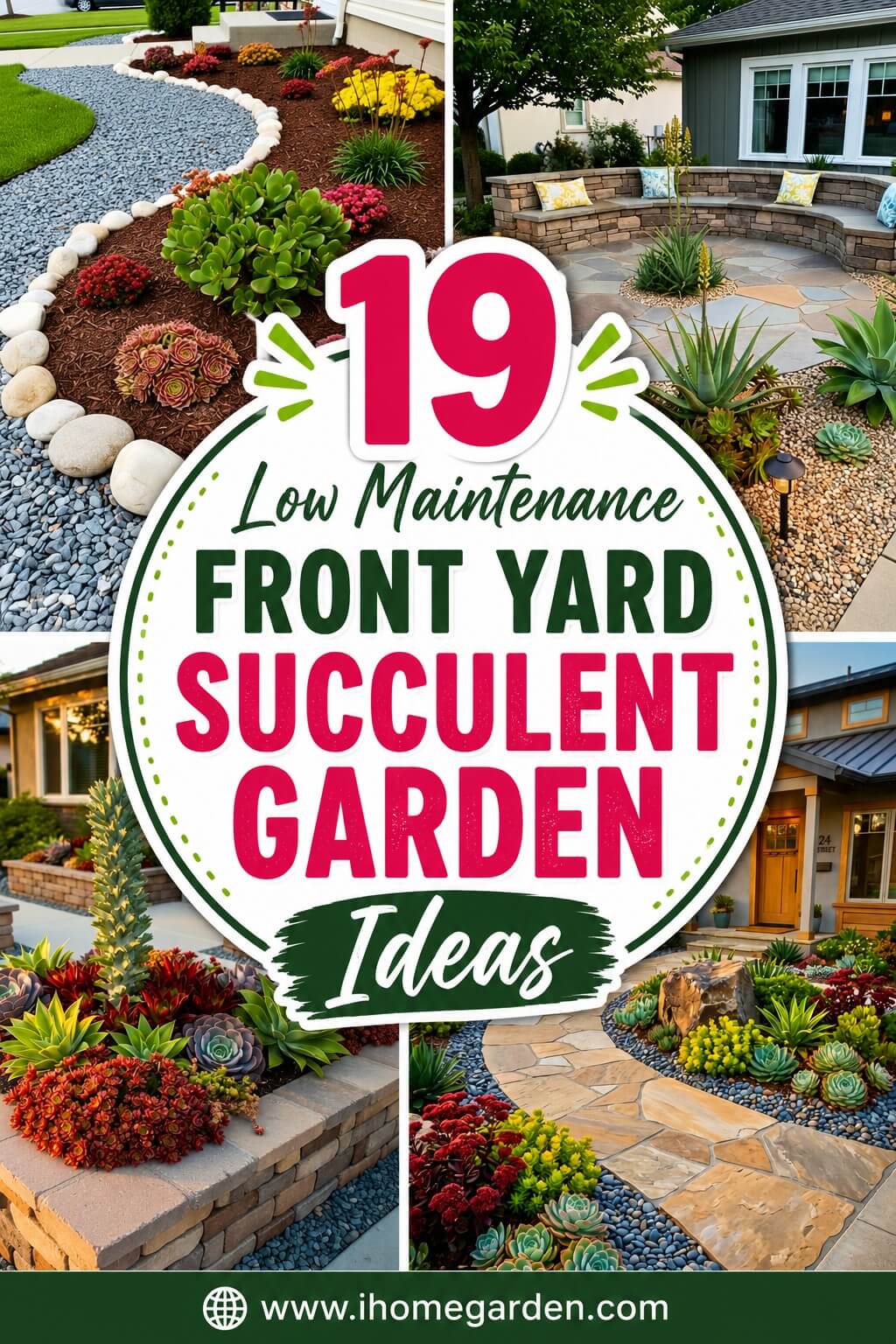
Succulents are stubborn in the best way. They store their own water, shrug off heat, and actually look better when you leave them alone. Pair them with stone, gravel, and a few well-placed boulders, and you’ve got a front yard that holds its shape for years.
The front yard succulent garden ideas ahead range from small weekend projects to full lawn replacements. Pick what fits your space, your style, and how much effort you actually want to spend outside.
1. Low Maintenance Front Yard Flagstone Pathway
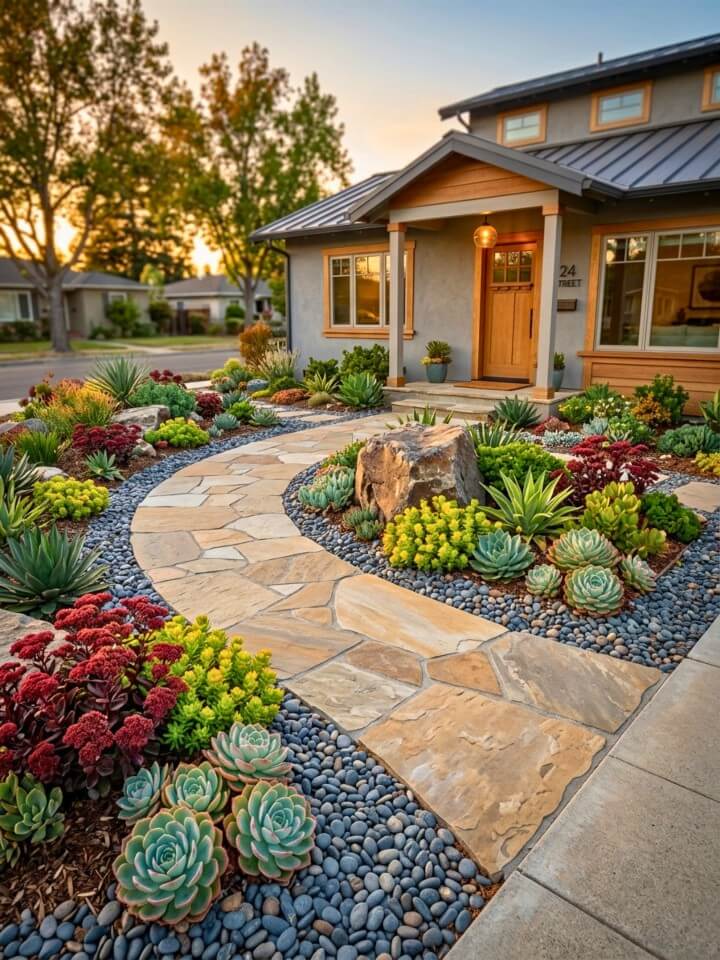
A flagstone pathway gives your entryway instant character while solving a practical problem: where do feet actually go? Set wide, irregular flagstone pieces with two to three inches of space between them, then fill the joints with pea gravel, coarse sand, or tight clumps of creeping sedum. The stone anchors the design, while the planted gaps soften the edges so the walkway never feels rigid or industrial.
Plants that work well along the edges
- Hens-and-chicks for tight rosette texture
- Echeveria in soft blue and pink tones
- Creeping sedum to fill the joints
Lay the stones on a compacted crushed-rock base so they stay level through freeze-thaw cycles.
2. Stone-Edged Succulent Garden Beds
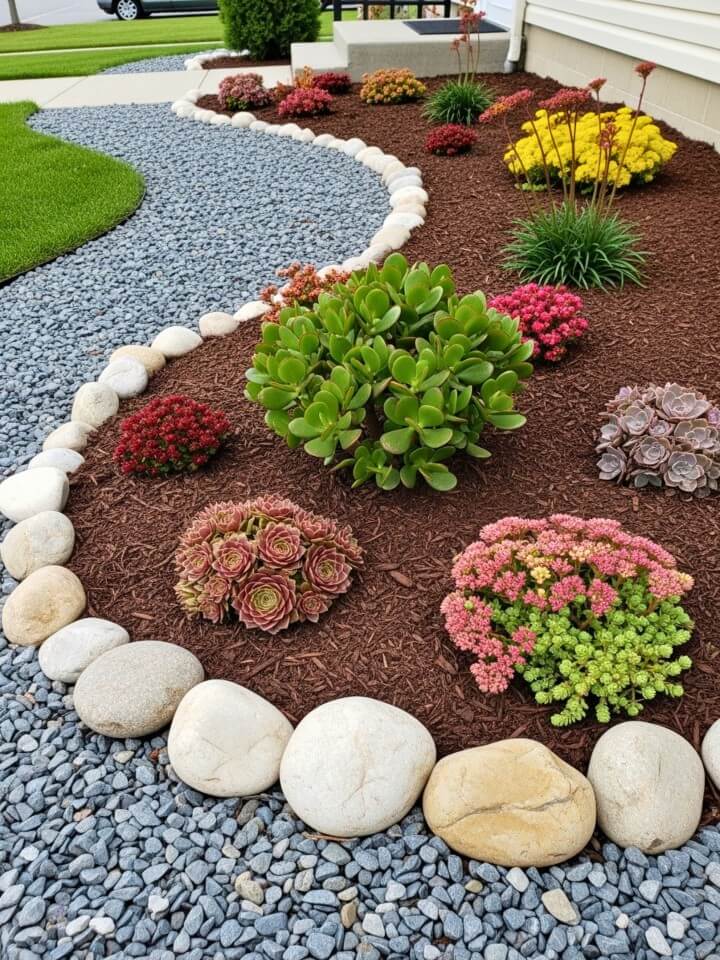
Defined edges are what separate a yard that looks designed from one that looks accidental. Frame your planting zones with stacked fieldstone, rounded river rock, or chunky border blocks so the eye reads a clear line between gravel mulch and walkway. Inside the border, mix upright agave or yucca for height with low-spreading sedum to fill the gaps near the edge.
The stones do real work too. They hold soil during heavy rain, slow erosion on gentle slopes, and keep gravel from migrating into the lawn or driveway. One color family reads cleaner; mixed tones feel more natural — pick whichever matches the rest of your home’s exterior.
3. Low Maintenance Layered Stone Retaining Wall
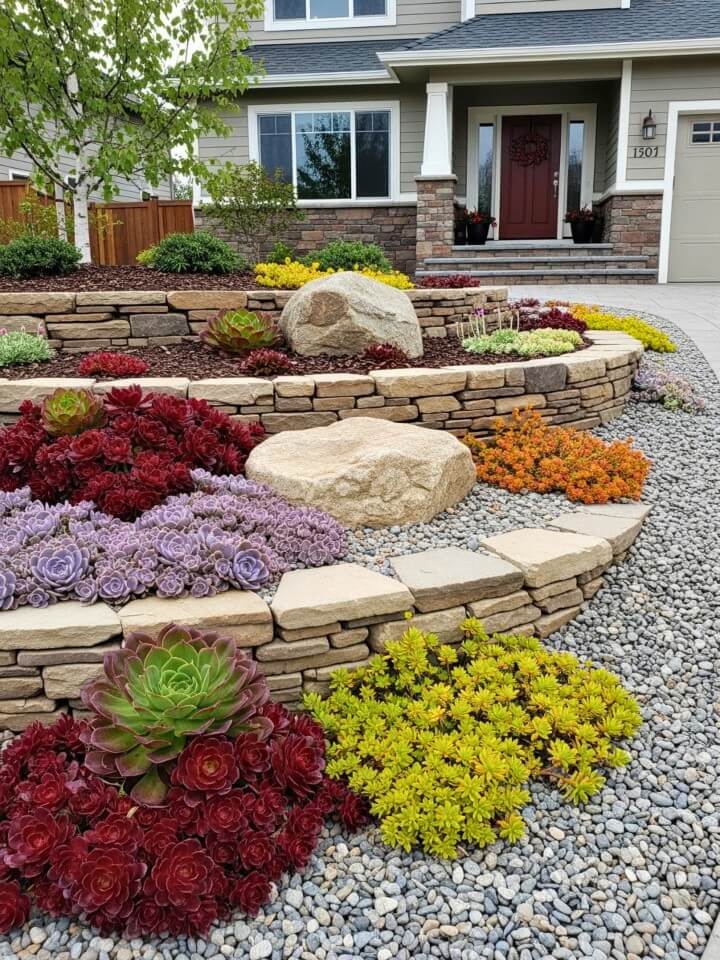
Discover front yard succulent garden ideas that turn boring lawns into drought-proof masterpieces. Sloped front yards are usually treated as problems, but a short stacked-stone retaining wall turns that slope into the most interesting part of your landscape. Build two or three low tiers — eighteen to twenty-four inches each is plenty — and tuck succulents into the planting pockets so foliage drapes naturally over the front face of each level.
What to plant on each tier
Top tier: Architectural pieces like aloe or small agave that read from the street Middle tier: Echeveria rosettes and compact sedums Bottom tier: Trailing ice plant and string of pearls that spill over the stone
The wall also redirects rainwater and stops the slow soil migration that ruins flat beds at the base of slopes. For awkward side slopes or underused edges near the street, this same tiered look can connect nicely with awful corner landscaping ideas that make forgotten spaces feel finished.
4. Natural Stone Patio
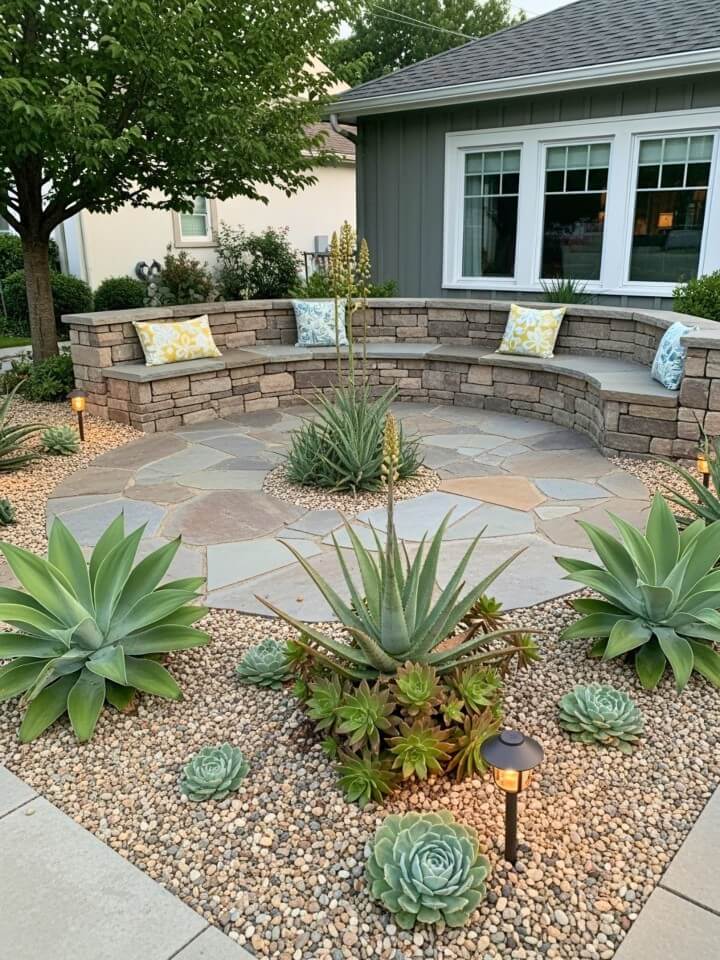
You don’t need a backyard to justify a patio. A small natural stone landing near the entryway — even just six by eight feet — creates a place to set down groceries, greet visitors, or add a couple of chairs. Flagstone, slate, and bluestone all work; the choice mostly comes down to your home’s color palette and what’s available locally at a reasonable price.
Surround the patio with a band of decorative gravel, then anchor each corner with a sculptural succulent in a weathered ceramic pot. Aloe striata, blue agave, and paddle plant all read as intentional focal points without demanding anything beyond occasional rain.
5. Rock Garden with Succulents
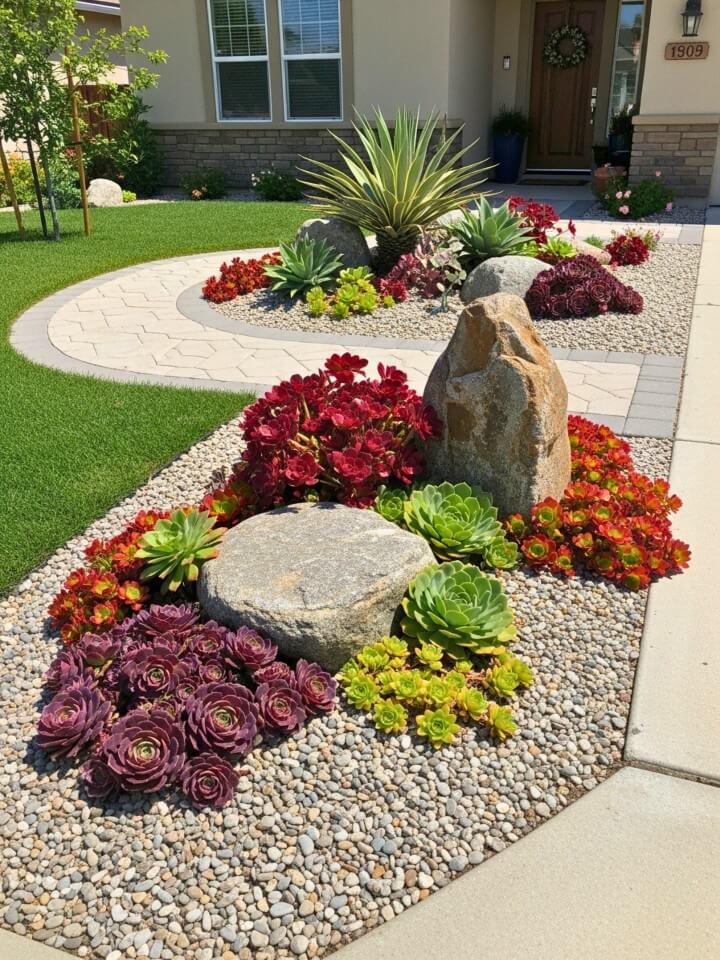
A rock garden is the easiest way to fake decades of garden maturity in a single weekend. Start with three or four anchor boulders placed off-center — never in a straight line — then build outward with progressively smaller stones, gravel, and plants. The illusion you’re chasing is geological: stones look like they’ve always been there, and plants look like they found their way between them.
Quick plant pairings that always look good together
- Blue agave + golden sedum + black lava rock
- Echeveria + chick chicks + light gray pea gravel
- Aloe vera + ice plant + warm-toned river rock
Vary plant heights so the eye has somewhere to travel. If you want a darker, more dramatic contrast around pale succulents, astounding black mulch landscaping ideas can help you decide where deep tones make the biggest visual impact.
6. Low Maintenance Front Yard Dry Creek Bed
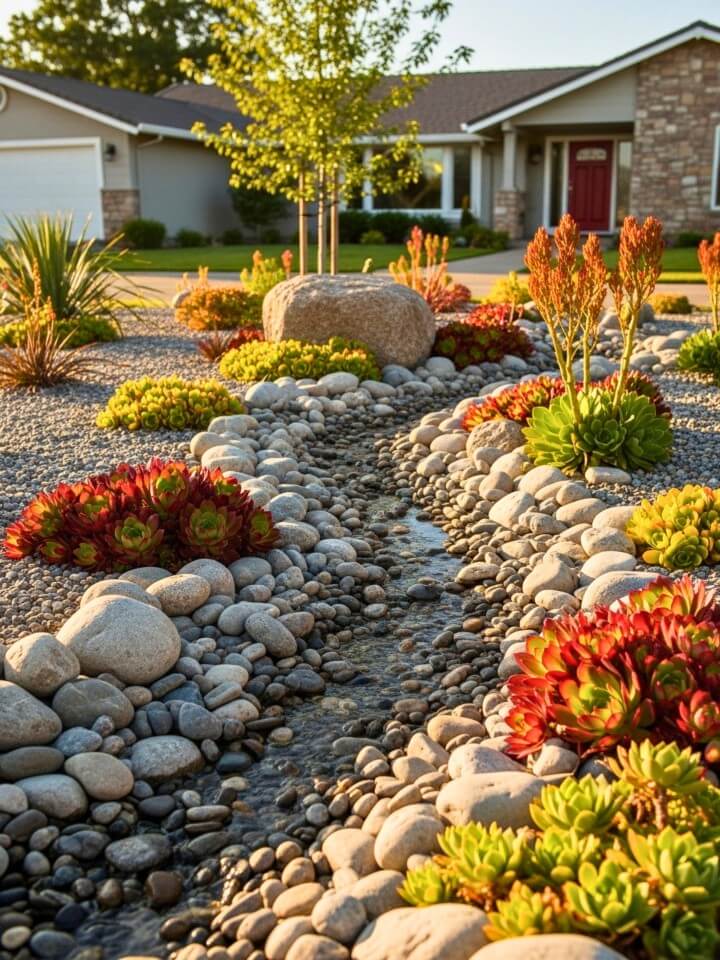
A dry creek bed is one of those design moves that solves two problems at once. If water pools in one part of your yard after every storm, dig a shallow winding channel along that natural drainage line, line it with landscape fabric, and fill it with smooth river rock graded from large stones in the center to smaller pebbles at the edges. The curve matters — a straight line reads as a ditch, but gentle bends read as a creek.
Plant succulents along both banks where they’ll get the runoff but not sit in standing water. The whole feature looks intentional even when it’s dry, which is most of the time.
7. Bold Boulder Accents
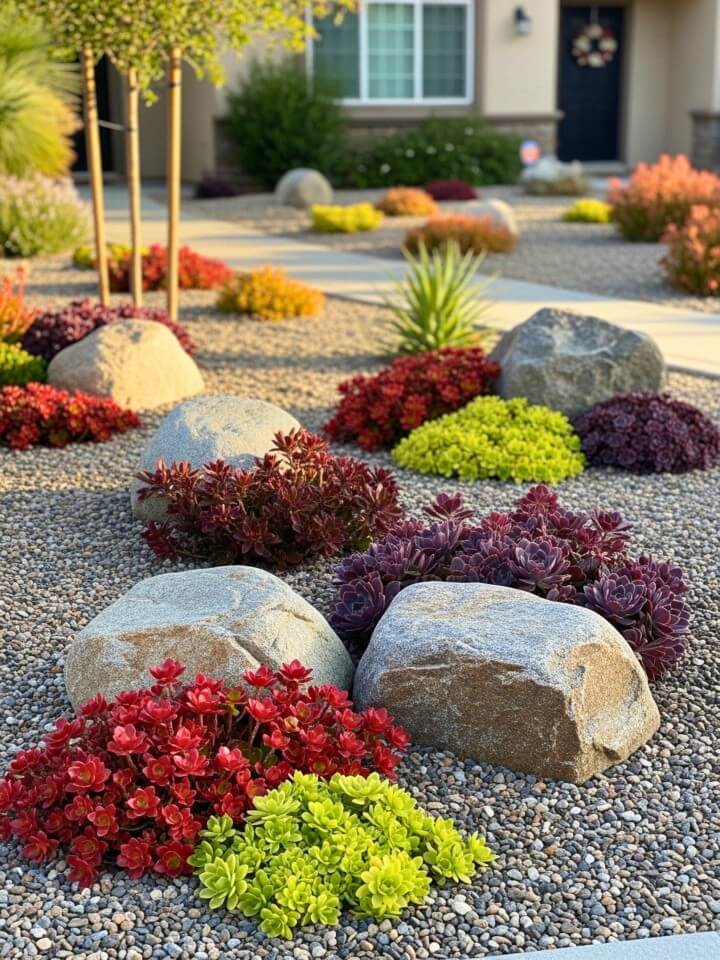
Boulders are the bones of a good succulent landscape. A single large stone, partially buried so it looks like it grew there, does more for curb appeal than a dozen scattered plants. Group them in odd numbers — three or five — and vary the sizes significantly. Two boulders of the same size next to each other look like a mistake; one large with two smaller companions looks like nature.
Common mistake to avoid: Setting boulders on top of the soil. A boulder needs to be buried at least one-third of its height to look like it belongs. If it looks like you could roll it away, it’s sitting too high.
8. Gravel Mulch Around Succulents
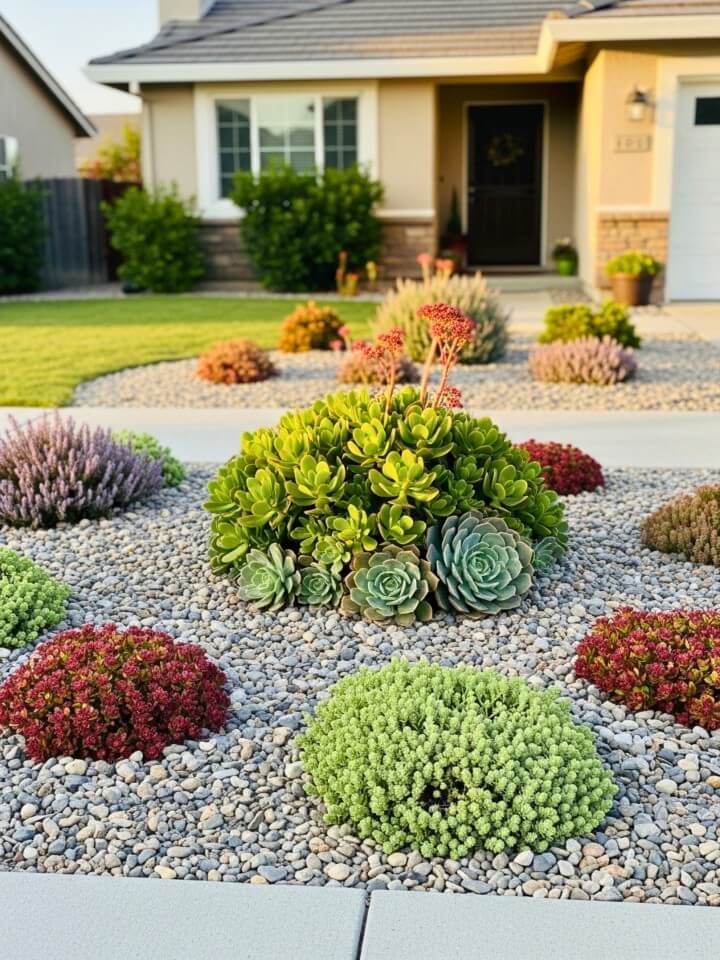
Gravel mulch quietly does the job that bark mulch can’t around succulents. Bark holds moisture against stems and rots them; gravel drains instantly, reflects heat away from delicate roots, and keeps mud from splashing onto leaves during storms. A two to three inch layer is enough — any deeper and seedlings struggle to establish.
Pea gravel reads soft and informal. Crushed granite reads modern and sharp. River rock reads natural. Match the color to your home’s trim or roof for a finished look that ties the landscape into the house. Lay landscape fabric underneath only in pure-gravel zones, never around plants, where it blocks proper root expansion.
9. Low Maintenance Front Yard Zen Succulent Garden
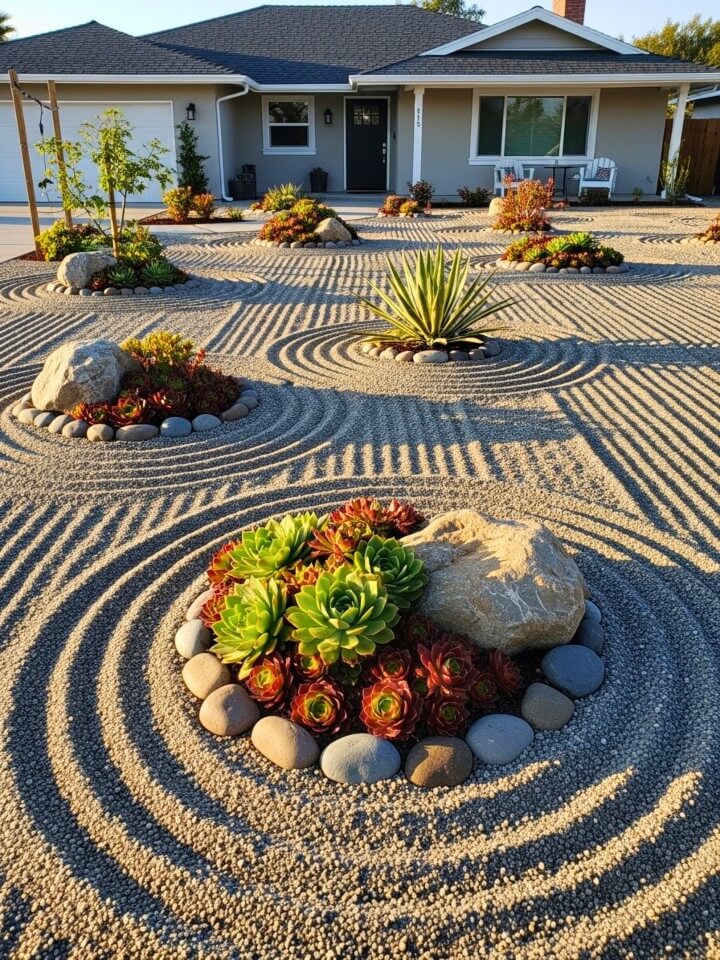
Your dream front yard low maintenance succulent garden starts with one bold, thirsty-free plant. The Zen approach asks you to subtract rather than add. Instead of filling every square foot with plants, you leave deliberate empty space — raked gravel, a single weathered stone, one carefully placed agave — and trust that the negative space does the talking. It’s the hardest style to get right and the most rewarding when you do.
Choose three or four sculptural plants total, not twenty. Stick to a tight color palette: silvery blue agave, gray-green aloe, and the warm tan of decomposed granite, for instance. Rake the gravel into soft parallel lines once a month. The whole front yard becomes a place that visibly slows people down as they walk up to the door.
10. Stepping Stones Through Ground Cover
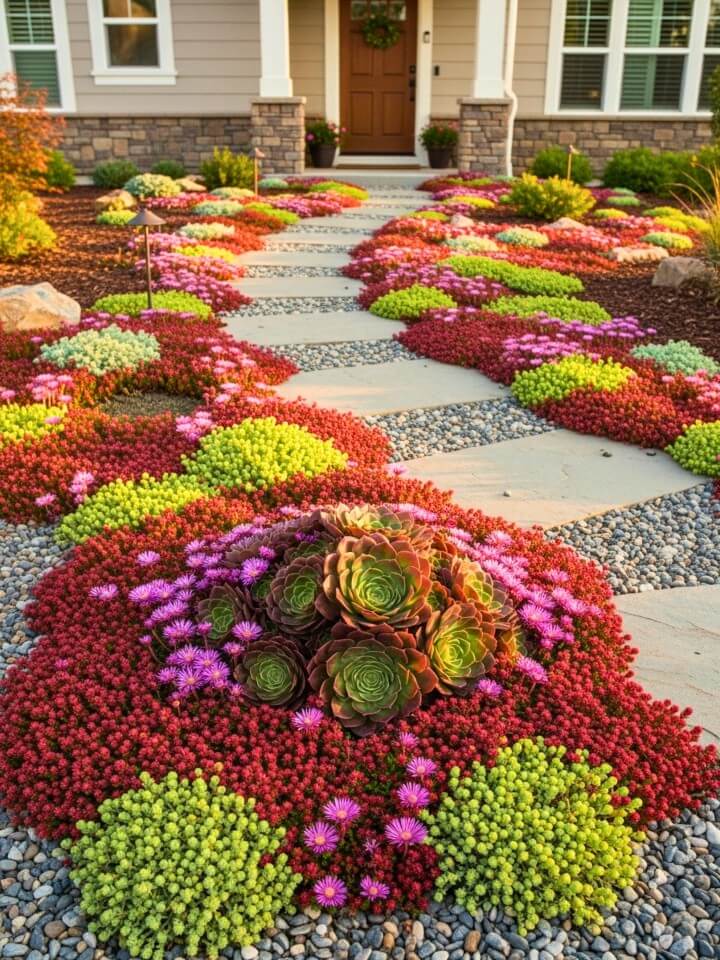
Stepping stones turn a planted area into something you can actually walk through. Set flat stones at a natural stride length — roughly eighteen to twenty-four inches center to center — and let low-growing succulents grow right up to and slightly over the edges. Over time the ground cover knits together between the stones, and the path looks less like construction and more like discovery.
Best ground covers for foot traffic
Creeping sedum handles occasional steps and bounces back quickly. Ice plant spreads aggressively and tolerates being brushed against. Stonecrop holds up in hot, exposed spots. Avoid echeveria here — the rosettes crush easily and don’t recover.
Here are sections 11-19 with varied formats, plus the conclusion and FAQ section to complete the post.
11. Stone Water Feature with Succulents
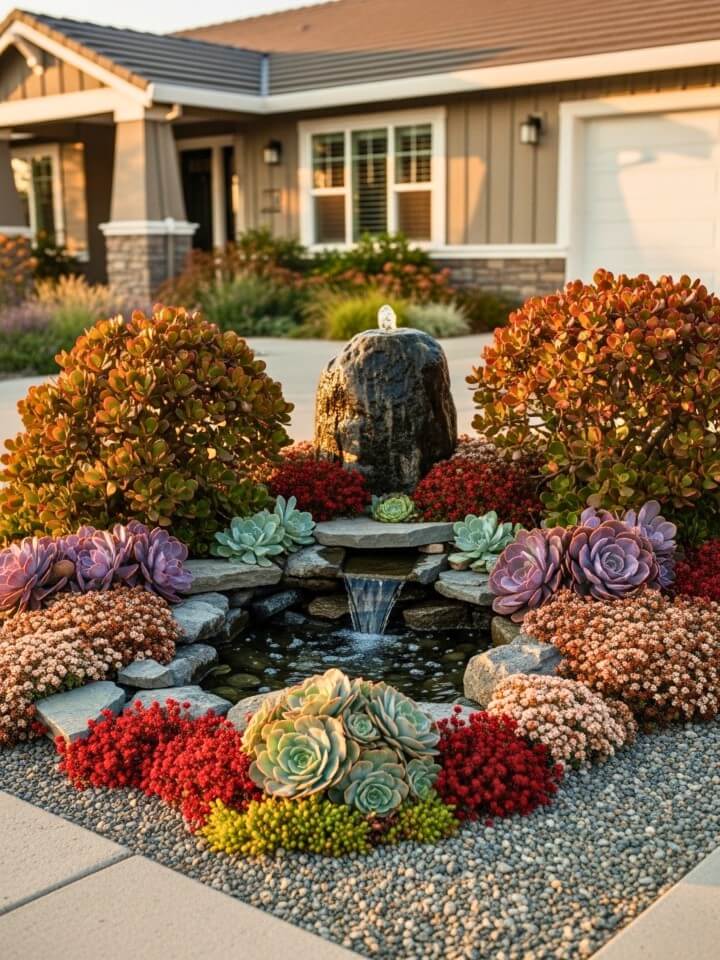
There’s something counterintuitive about water in a drought-tolerant landscape, but a small recirculating fountain uses surprisingly little — most of it just moves the same gallon or two in a closed loop. A drilled basalt column, a bubbling boulder, or a simple urn fountain all work, and each one transforms the soundscape of your front yard. Suddenly the dominant sound near your door is moving water instead of traffic.
Set the feature where you’ll hear it from the porch or front window, not buried in a corner where the sound is wasted. Surround it with aloe, echeveria, and a band of dark river rock so the wet stone reads as part of the design.
12. Succulent Garden Mixed Rock Beds
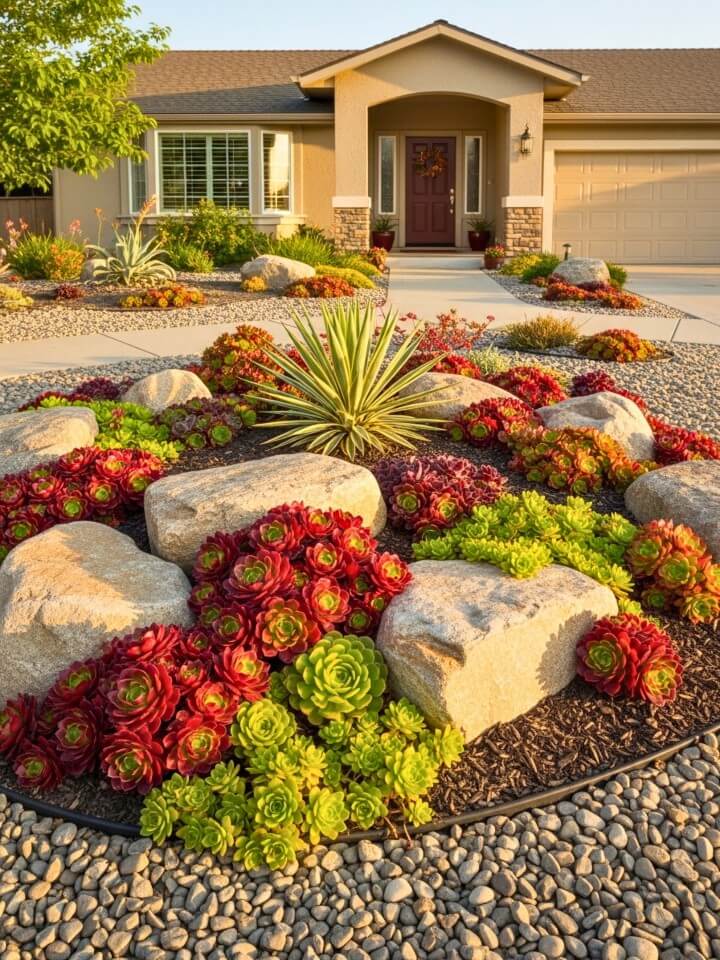
The mixed bed is where you stop following rules and start composing. Think of it like arranging a still life: one tall vertical element (an agave or yucca), a medium mounding plant (aloe or paddle plant), low rosettes filling the middle distance (echeveria, hens-and-chicks), and trailing edges (sedum, ice plant) that soften where the bed meets the gravel. Layer in two or three statement rocks that anchor the composition.
Color matters more than people think. Cool blue-gray succulents read calm and modern. Warm reds and oranges from stressed sedum and certain echeveria varieties read vibrant and Mediterranean. Pick a lane and commit to it.
13. Raised Succulent Planters
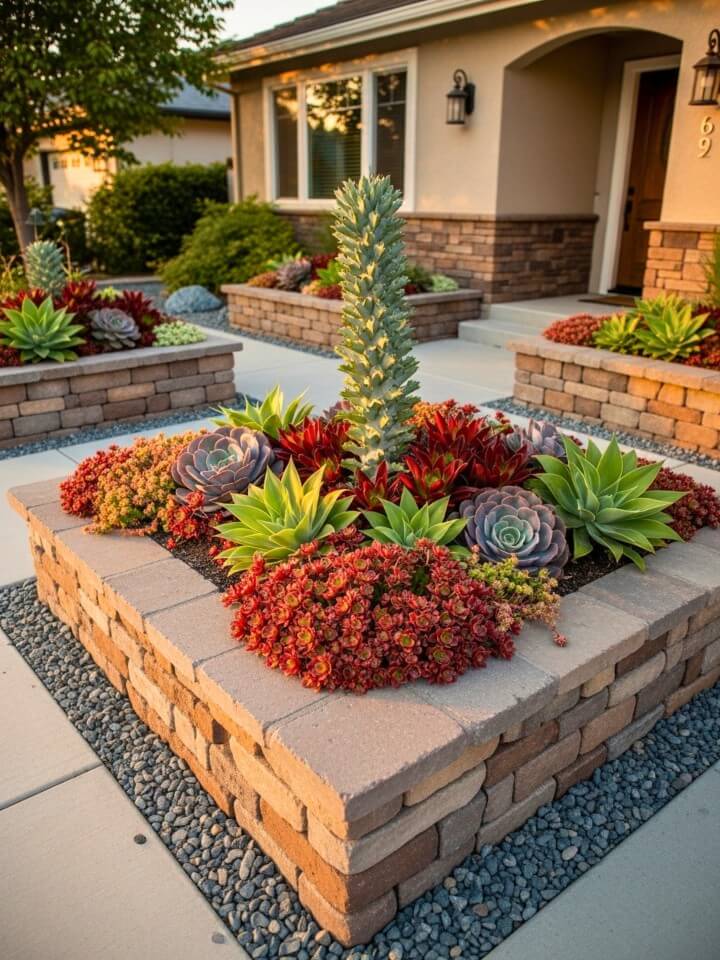
Raised planters solve the single biggest cause of succulent death: bad drainage. When you build the bed yourself — twelve to eighteen inches tall, made from stacked stone, brick, or board-formed concrete — you control the soil mix entirely. Most yards have heavy clay that holds water against roots for days; a raised planter filled with cactus mix drains in minutes.
When Raised Planters Are the Right Move
- Your existing soil is dense clay or compacted construction fill
- You want to garden without bending or kneeling
- You need a clear visual structure near the entryway or driveway
- Drainage in the chosen spot has historically been poor
Pick stone or brick that echoes a material already on your house. Raised beds near a porch or front walk can also connect with breathtaking herb garden ideas if you want one section to be both decorative and useful.
14. Creeping Succulent Ground Cover
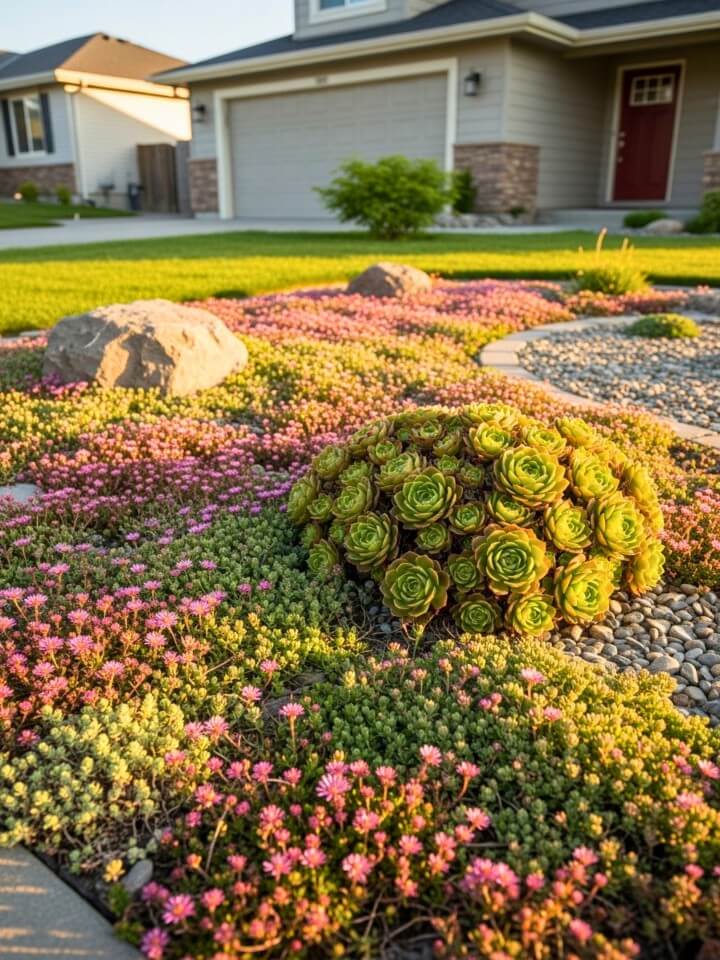
Replacing turf with creeping succulents is the single highest-impact change you can make to a front yard, both visually and practically. A solid carpet of sedum or ice plant looks like lawn from twenty feet away but never needs mowing, never needs fertilizer, and survives weeks without water once established.
The trick is establishment. The first three months matter. Plant plugs about six to eight inches apart, water lightly every few days until you see new growth radiating outward, and pull weeds aggressively during that window — they’ll lose to the succulents eventually, but only if you keep the field clear while the ground cover knits in. After that, the plants do everything themselves.
15. Low Maintenance Front Yard Succulent Rock Terraces
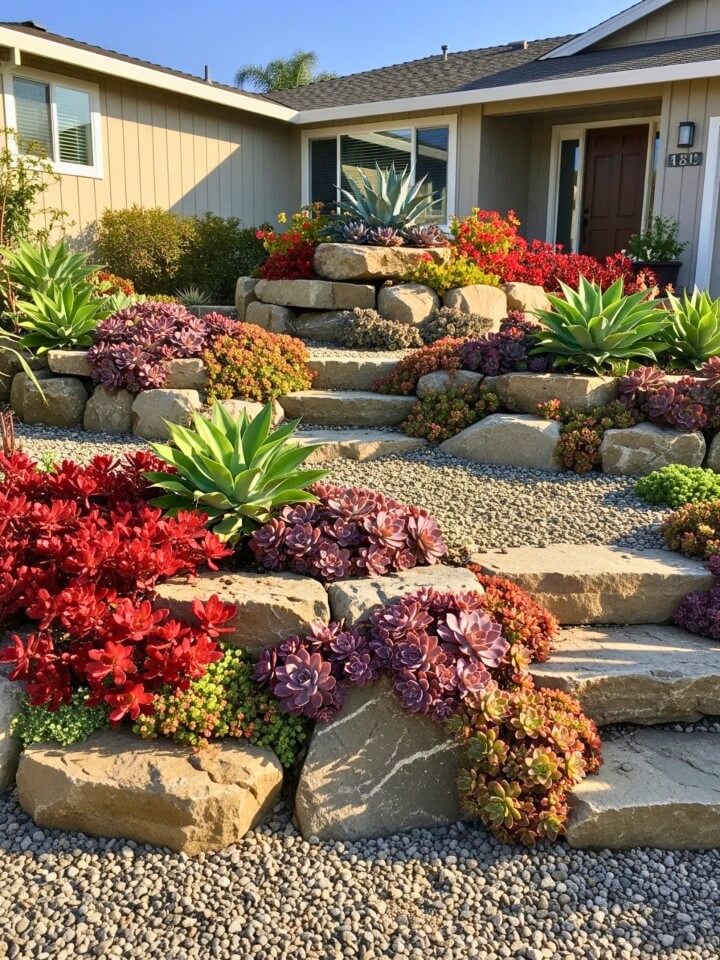
These outdoor succulent garden ideas blend rugged beauty with zero-fuss, sun-loving charm daily. Terraces are retaining walls that have learned to share. Instead of one tall wall holding back a slope, you build three or four shorter ones that step up the grade like a staircase. Each terrace becomes its own planting bed, and the visual rhythm of the steps does most of the design work for you.
The structural side matters: anything over two feet tall benefits from professional input, and you’ll want gravel backfill behind each tier for drainage. But aesthetically, terraces give you something flat beds never can — distinct elevations where different succulents live at eye level depending on where you’re standing. A trailing sedum that’s invisible at ground level becomes a focal point on tier three.
16. Naturalistic Boulder Cluster with Succulents
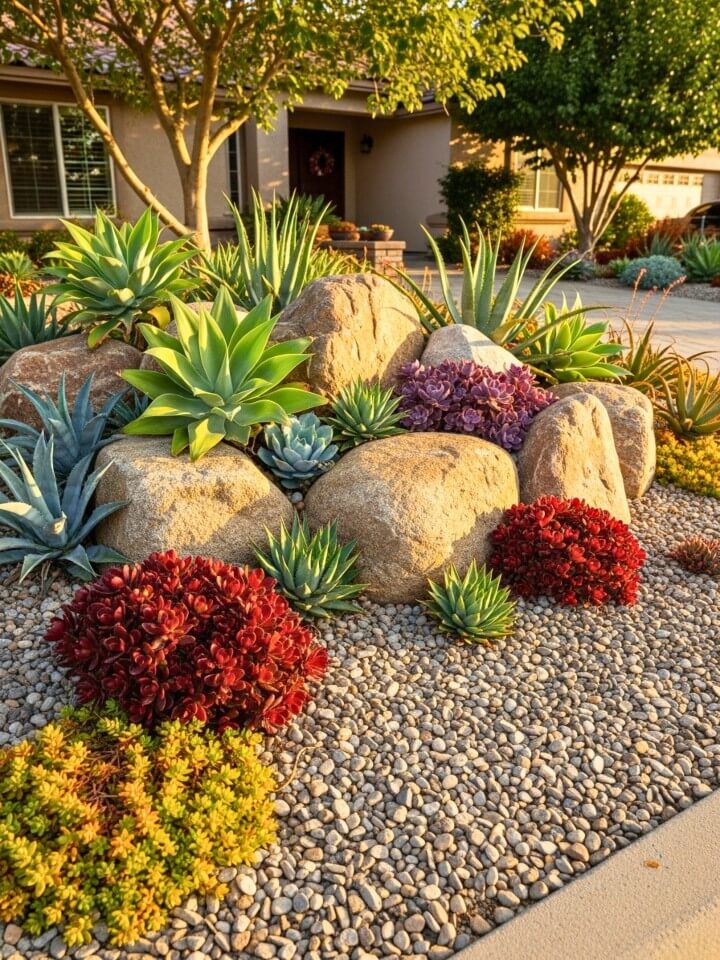
A naturalistic cluster reads differently from a single boulder accent. Where one large stone is a sculpture, a cluster is a landscape — a small piece of mountain dropped into your yard. Group five to seven boulders of varying sizes, bury each one at least a third deep, and arrange them so their grain or banding all runs the same general direction. Real rock formations don’t have stones pointing every which way.
Plant succulents in the gaps between rocks, not around the perimeter. The illusion only works if the plants look like they colonized the spaces the rocks left behind. Agave, jade, and tight clumps of sedum sell the effect best.
17. Decomposed Granite Pathway
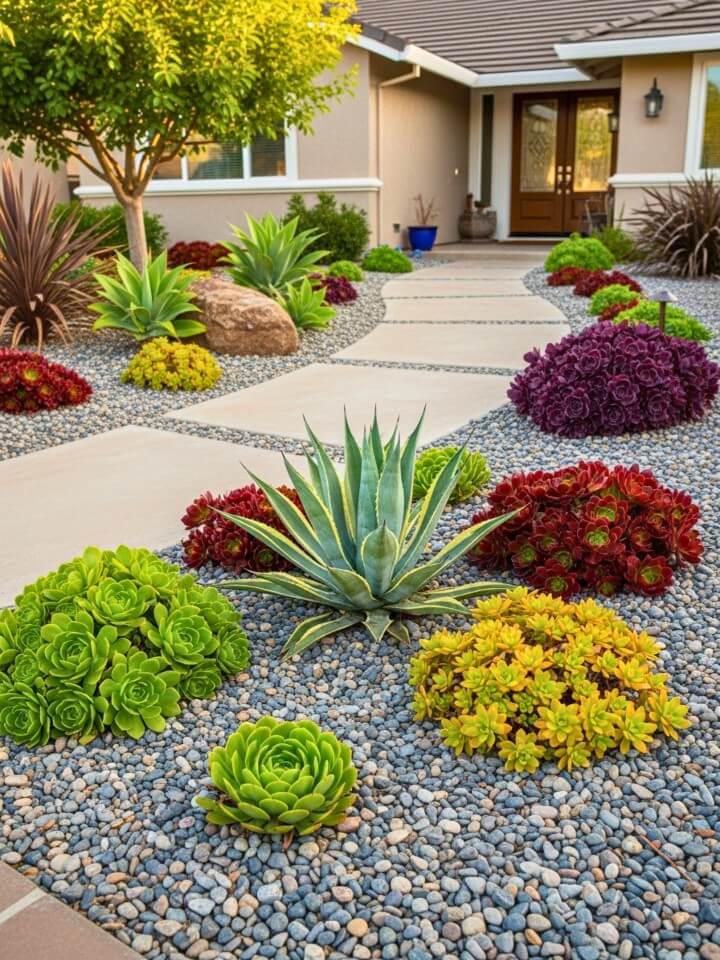
Decomposed granite — usually shortened to DG — is the unsung hero of low-maintenance landscaping. It’s affordable, drains well, compacts into a firm walkable surface, and ages into a soft warm color that flatters almost any planting palette. A four-inch base of road base topped with two inches of DG, each layer wetted and tamped, gives you a path that holds up for years.
What to know before you order
DG comes in stabilized and unstabilized forms. Stabilized DG mixes in a binder that hardens the surface and reduces tracking into the house — worth the extra cost for paths near the front door. Unstabilized works fine for secondary paths and casual seating areas.
18. Stone Edging with Contrasting Gravel
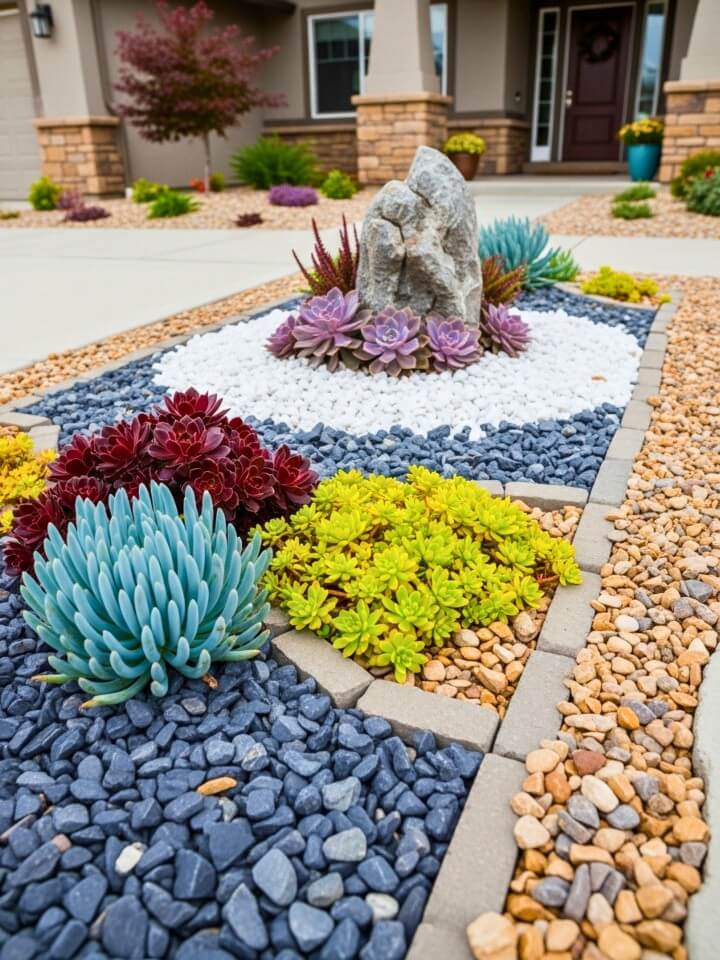
Contrast is what makes a design photograph well, and stone edging paired with deliberately contrasting gravel is the cheapest way to manufacture it. Dark basalt edging around a bed of white marble chips makes pale succulents glow. Light limestone edging around a bed of black lava rock makes red and orange echeveria look almost lit from within.
Use the contrast strategically, not everywhere. One bold contrasting bed near the entrance reads as a deliberate focal point. Three contrasting beds scattered across the yard read as chaos. The rest of the landscape should use quieter, more harmonious tones so the contrast bed has somewhere to stand out from.
19. Full Stone Front Yard Transformation
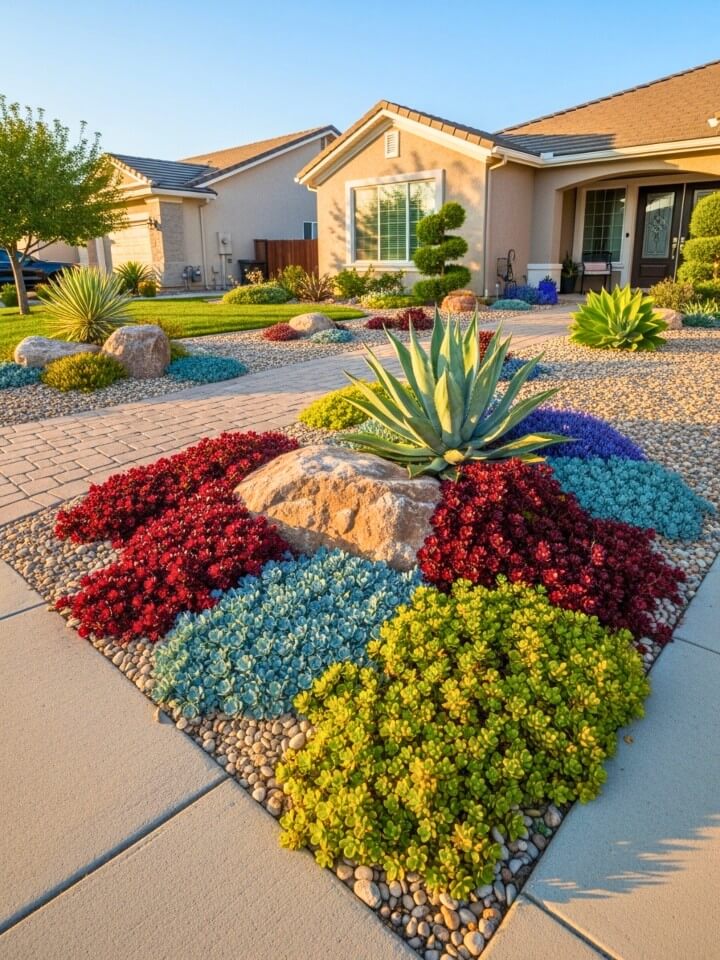
Crisp lines meet living color — modern succulent landscaping redefines what curb appeal can be. The complete transformation is the endpoint of this whole approach: no lawn, no irrigation system running daily, no weekend mowing. Everything is replaced by some combination of pathways, gravel zones, planted beds, boulder accents, and drought-tolerant succulents arranged into a cohesive whole.
Budget realistically. A full conversion typically runs anywhere from a few thousand dollars for a DIY job on a small yard to twenty thousand or more for a designer-built installation on a larger lot. But the math works out within a few years through water savings, eliminated lawn service, and the absence of seasonal replanting. And every year after that, the yard quietly pays you back in time you would have spent maintaining grass that never really thrived anyway.
FAQs About Front Yard Low-Maintenance Succulent Gardens
Transform your front yard with beautiful, drought-tolerant succulents — expert answers to all your low-maintenance garden questions.
How Often Should I Water a Succulent Front Yard Once It’s Established?
Most established succulents need water roughly every two to four weeks during hot, dry stretches and almost nothing during cool or rainy seasons. The bigger risk is overwatering — yellowing or mushy leaves mean you’re watering too often, not too little. Always let the soil dry completely between waterings.
What’s the Best Soil for An Outdoor Succulent Bed?
A fast-draining mix is non-negotiable. If your native soil is clay, either build raised beds with cactus mix or amend the planting area heavily with coarse sand, perlite, and small gravel. Standard topsoil holds far too much moisture for healthy succulent roots.
Will Succulents Survive Freezing Temperatures?
Some will, many won’t. Cold-hardy varieties like sempervivum (hens-and-chicks) and many sedums handle hard freezes without protection. Echeveria, aloe, and most agave species need either a sheltered microclimate or freeze cloth on the coldest nights. Check the cold hardiness of every plant before installing it permanently.
How Much Does Converting a Lawn to A Succulent Landscape Actually Cost?
DIY conversions on small yards can run a few thousand dollars in materials. Mid-sized professional installations typically land between ten and twenty thousand. Larger designer projects can go well beyond that. Water bill savings, eliminated lawn care, and increased curb appeal usually recover the investment within three to seven years.
What’s the Single Biggest Mistake First-Time Succulent Gardeners Make?
Treating succulents like regular plants. They want neglect, not attention — too much water, too rich a soil, and too much shade kill more succulents than any pest or disease ever will. When in doubt, do less.
Conclusion
A succulent front yard isn’t just a design choice — it’s a decision to stop fighting your climate and start working with it. Whether you start small with a single stone-edged bed near the mailbox or commit to a full lawn replacement, every step in this direction means less water, less mowing, less weekly upkeep, and a landscape that looks better in August than most lawns look in May.
Pick two or three ideas from this list that match your yard’s slope, sun exposure, and your own taste, then build outward from there. The best succulent gardens aren’t planned in a single weekend — they evolve as you learn which plants thrive where, which combinations catch the light, and which corners of your yard you’ve been ignoring for years.