31 Pallet Raised Garden Bed Ideas for Beginners on a Budget
A bare backyard corner or an empty patio edge can feel like wasted square footage. The fix doesn’t need a landscaper or a big budget — just a pallet, some soil, and an afternoon. These 31 jaw-dropping pallet raised garden bed ideas show how a single piece of scrap wood can become the prettiest, most productive feature on your property. Every design here is built for real homes, real yards, and real beginners.
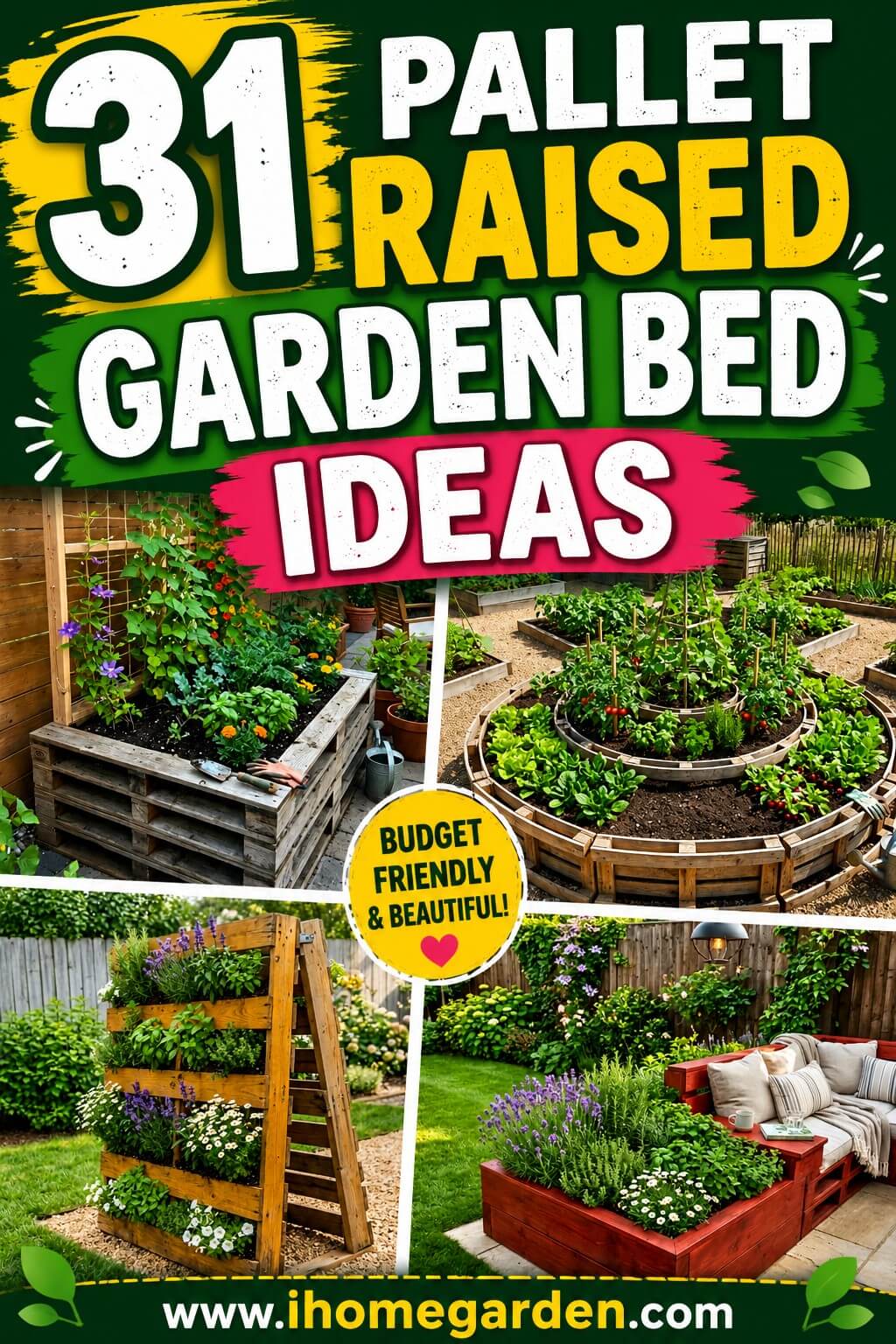
Each project tackles something different. A few suit shoebox balconies. Others fix sloped lawns, dead corners, or fence lines that have looked tired for years. Some focus on growing food. Others lean into flowers, herbs, or pure visual appeal.
You’ll get build steps, soil depths, honest costs, and the small details that separate a sharp-looking bed from a sagging one. Pick what fits your space, skip what doesn’t, and you’ll end up with a yard that finally pulls its weight
1. Circular Pallet Vegetable Bed
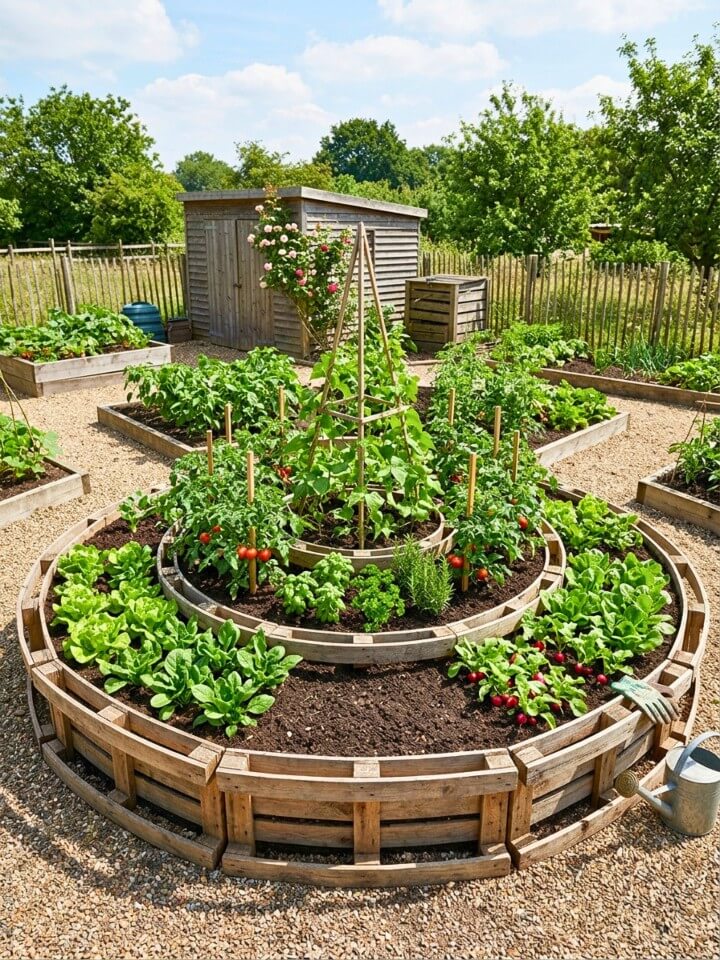
Air circulation is the underrated advantage here. A circle has no stagnant corners where humidity pools, so mildew-prone crops like squash, cucumbers, and tomatoes stay noticeably healthier through humid stretches. The shape also gives full 360-degree access — no awkward stretching across a 4-foot square to reach the middle row.
Putting It Together
Cut six to eight pallet sections to 3 feet each, mitered at 22.5 degrees on the joining edges. Galvanized corner brackets hold the angles tight once soil pressure builds up. Skip the temptation to chase a perfect circle — an octagon reads as round once plants fill in and is dramatically easier to assemble.
2. Classic Square Pallet Bed
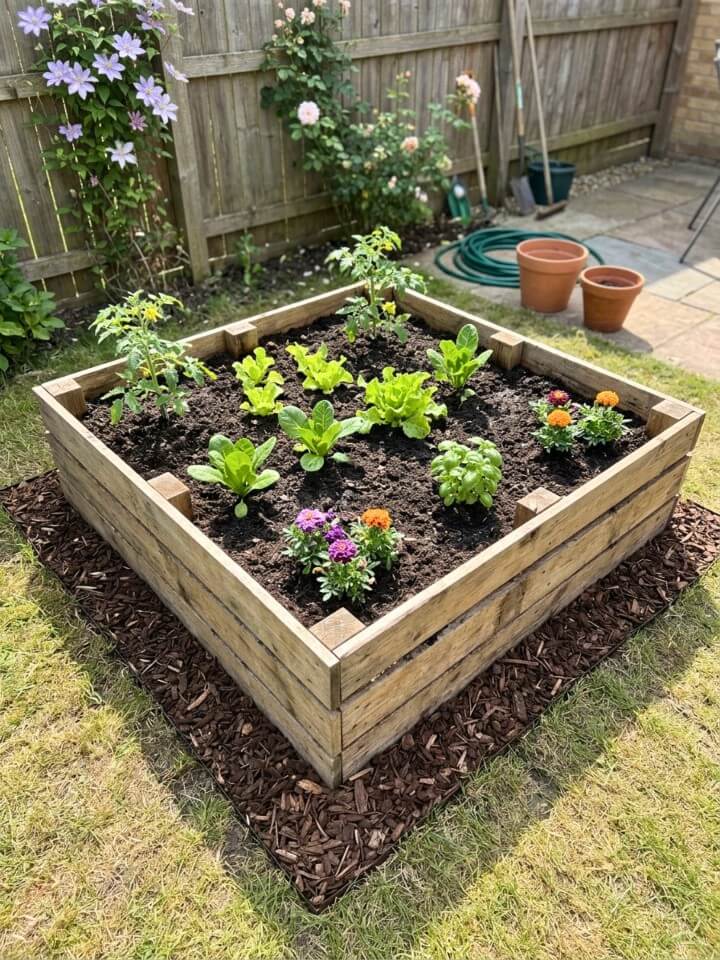
Turn old wood into a stunning pallet garden bed and grow your green dreams affordably! This is the build for anyone who’s never touched a power tool. Two pallets become four walls, the math is simple, and small mistakes don’t show.
The Five-Step Build
- Cut two pallets in half across the middle stringer
- Stand the four halves on edge with slats running horizontal
- Drive 3-inch deck screws through each corner
- Staple landscape fabric to the inside walls
- Drill quarter-inch drainage holes every 6 inches along the base
Soil Depth by Crop
Lettuce and radishes thrive in 8 inches. Carrots and beets need 12 or you’ll get stunted roots. Tomatoes demand 14 inches plus staking, since shallow beds can’t anchor heavy fruiting plants in summer wind.
3. Pallet Bed with Companion Planting Sections
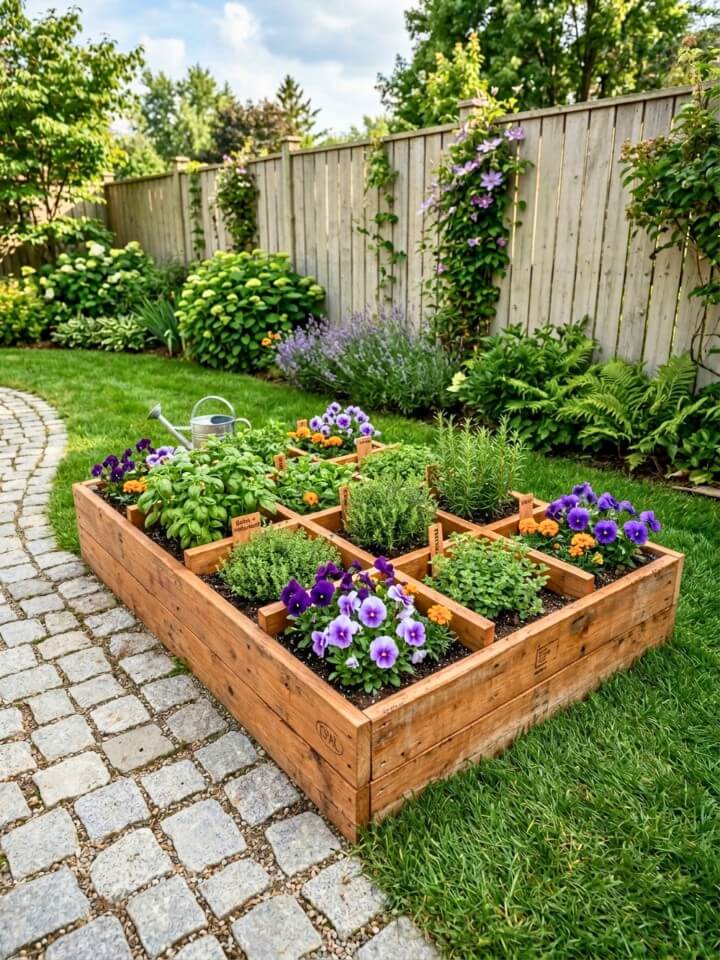
Lay a pallet flat, line each slat gap with landscape fabric, fill with soil — one pallet becomes six to eight isolated planting pockets. The wood acts as a root barrier, which finally solves the mint problem (mint that no longer strangles everything within reach).
Pairings that Genuinely Work Here
- Tomato + basil — basil masks scents that attract hornworms
- Carrot + onion — onion scent confuses carrot fly
- Cucumber + dill — dill draws predatory wasps that hunt cucumber beetles
- Lettuce + radish — radishes mature first; harvest before lettuce shades them
Pairings to Skip
Onions next to beans or peas — sulfur compounds stunt legume nitrogen fixation. Avoid tomatoes near brassicas too; they compete hard for the same nutrients and both suffer.
4. Corner Stack Pallet Planter
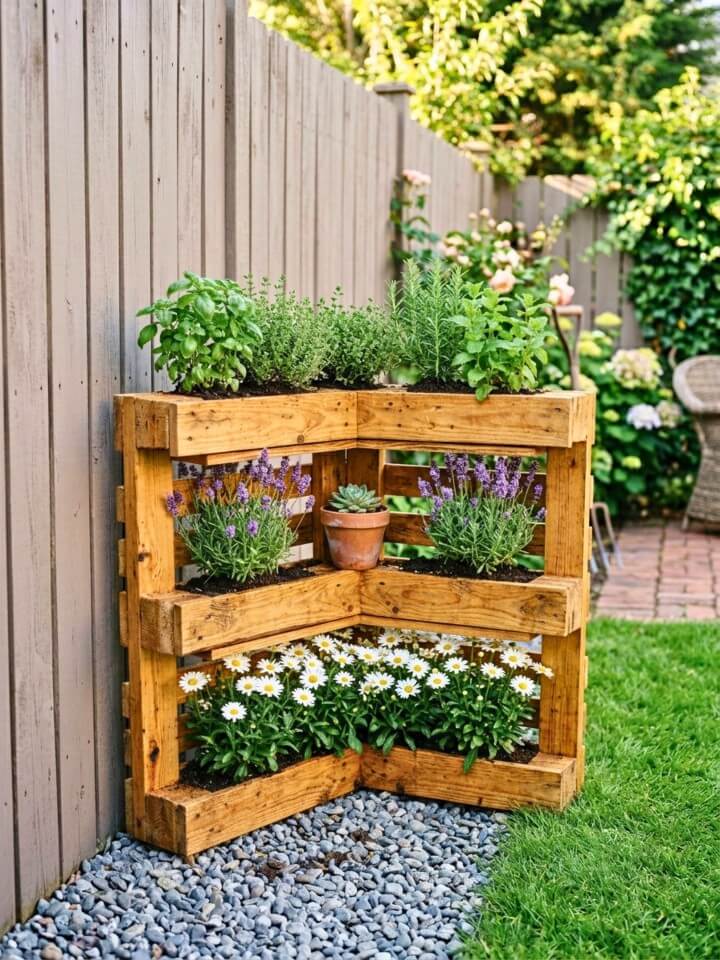
Most yard corners get awkward sun — a few direct hours, then deep shadow as the fence or house cuts it off. A flat planter there grows leggy, sad plants reaching for light they’ll never get.
The Stacking Fix
Three pallets stacked at staggered rotations (bottom flat, middle turned 30 degrees, top flat) tilt each level toward a different sun angle. The same corner now produces three growing zones instead of one bad one.
What to Plant Where
Top tier catches the most light — strawberries, trailing nasturtiums, or cherry tomatoes. Middle tier handles partial sun — lettuce, kale, chard. Bottom tier is shade-friendly — mint, parsley, or chives.
5. Curved Pallet Garden Bed
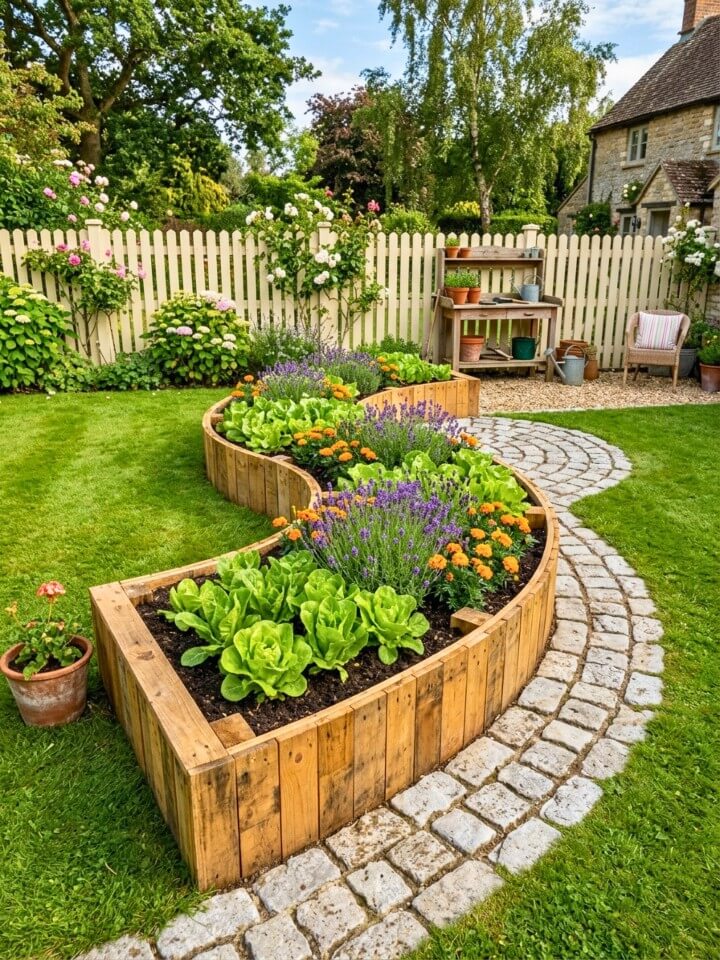
Curved beds break the boxy monotony of most backyards and follow natural lines — a winding path, a sloped lawn edge, or wrapping around a tree. They’re also where first-time builders make their worst mistakes.
Three Mistakes that Ruin Curved Beds
- Building too tight. Anything tighter than a 6-foot radius gives you cramped pockets that are punishing to weed. Lay a garden hose on the ground and walk the shape twice before cutting.
- Skipping interior bracing. Soil pressure concentrates at inside angles. Any bend under 120 degrees needs a 2×4 brace across the back, or the wall will bow outward within months.
- Using full pallets. Cut them into 18-inch segments and join with hinged brackets so each piece pivots independently along the curve.
6. Double-Stacked Pallet Planter
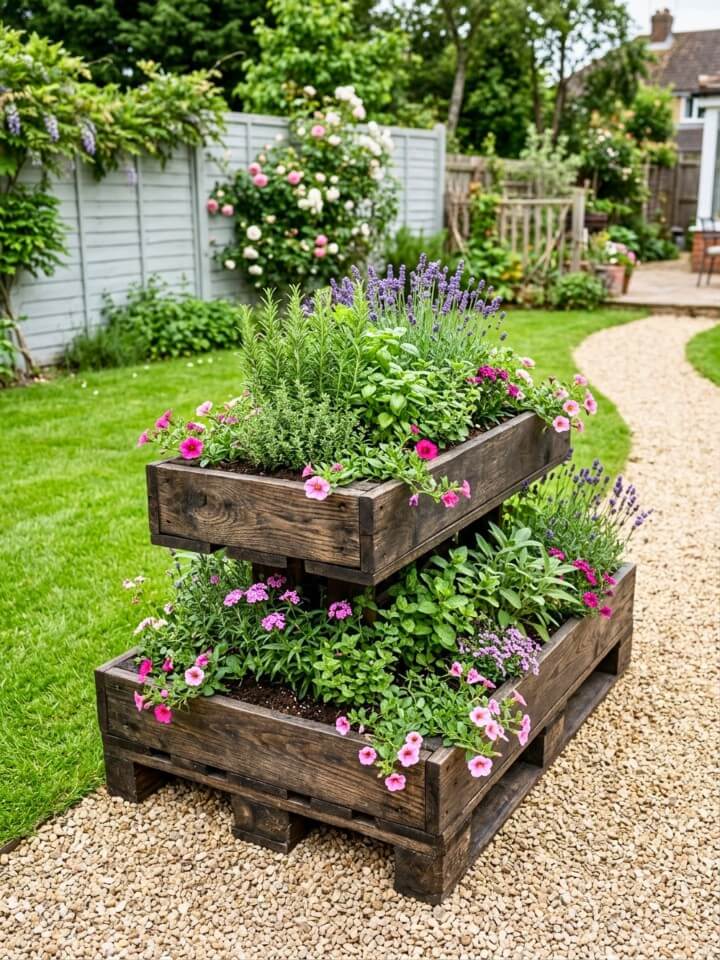
Build an easy raised pallet garden bed this weekend — no tools, no stress, just growth!
- Won’t the Bottom Pallet Rot from Soil Weight? Only if you skip drainage. Two stacked pallets hold roughly 200 pounds of wet soil — the bottom needs gravel underneath, not direct dirt contact.
- Can I Stack Three Instead of Two? Technically yes, but the top tier dries out so fast you’ll be watering daily by July. Two is the sweet spot.
- Do I Need to Anchor It? If kids or large dogs share the yard, yes. Two 4-foot rebar stakes driven through the back into the ground stop any tip-over risk.
Best Crops for Each Level
Top tier: heat-lovers like peppers and basil. Bottom tier: cool-tolerant lettuce, spinach, and chives that appreciate the partial shade thrown by the upper level.
7. Eco-Friendly Reclaimed Pallet Bed
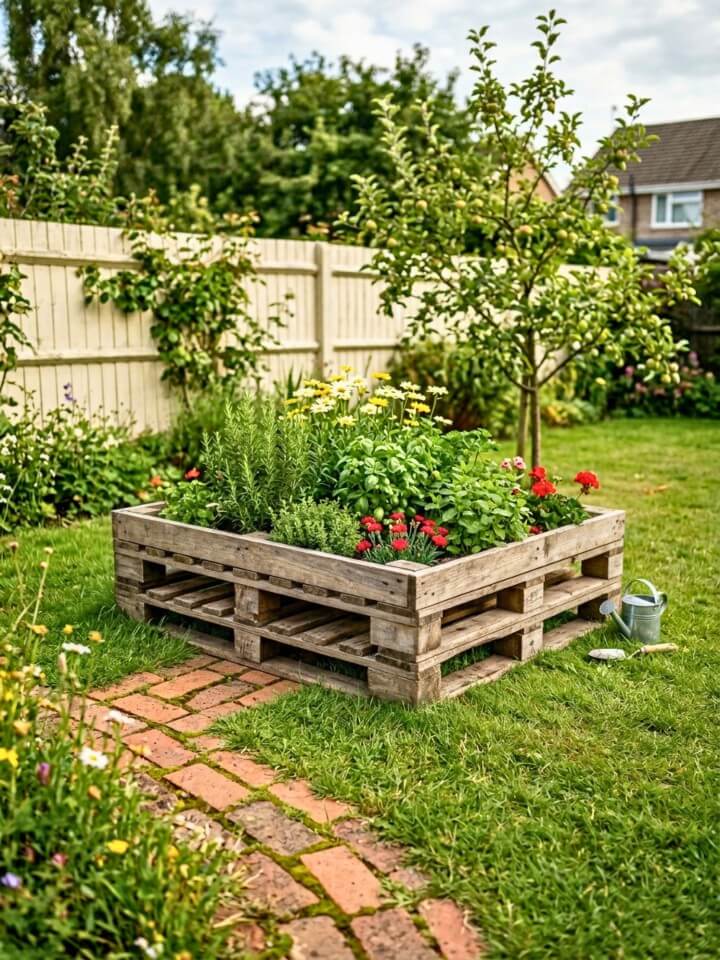
Free pallets are everywhere if you know where to ask — but half of them shouldn’t go near a vegetable garden.
Where to Source Them Safely
Hardware stores, garden centers, and feed supply shops rotate pallets weekly and usually give them away. Avoid anything from chemical plants or auto shops — oil staining means contamination has soaked deep into the wood grain. Print shops are surprisingly reliable: clean wood, low contamination risk.
The Stamp Check that Matters
Look for “HT” branded on the side. Heat-treated wood is safe. “MB” means methyl bromide fumigation — that one’s a hard no, especially for edible crops. Unstamped pallets are usually plain domestic shipping wood, but treat them as unknown and reserve them for ornamental beds only.
8. Freestanding Pallet Garden Wall
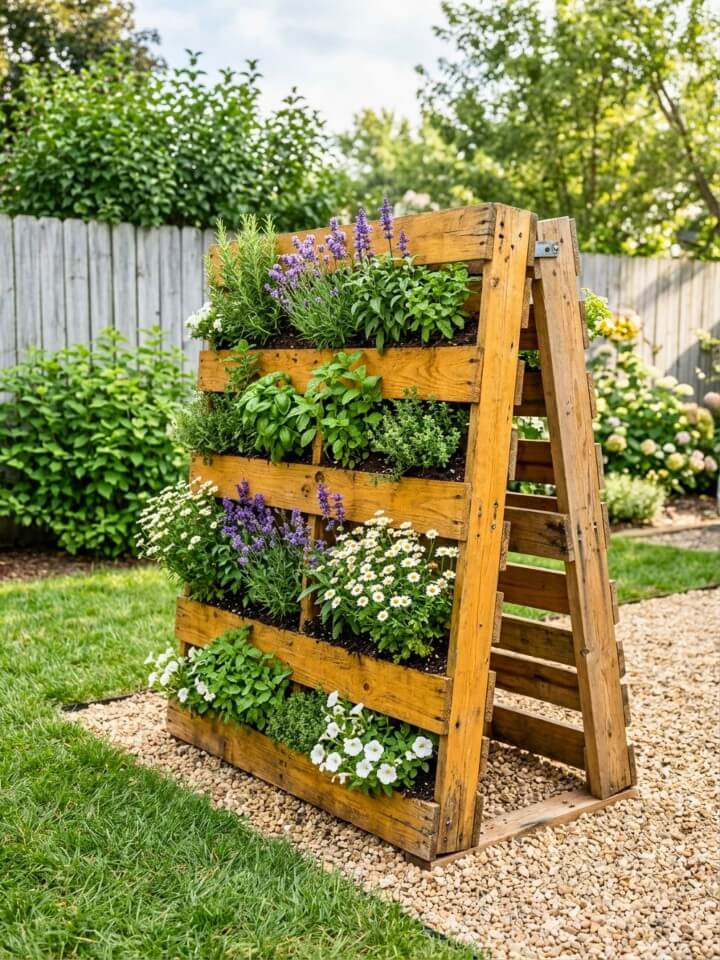
Not every pallet project goes flat on the ground. A vertical wall does double duty — growing space plus privacy or zoning.
Three Real-World Uses
- Patio privacy screen. A 6-foot pallet wall planted with climbing jasmine or sweet pea blocks neighbor sightlines within one growing season.
- Outdoor room divider. Splits a long yard into dining and play zones without committing to permanent fencing.
- Wind barrier for tender plants. Place it on the windward side of a vegetable bed; the wall breaks gusts that shred tomato leaves and snap pepper stems.
Stability Essentials
Freestanding means no fence to lean on. Build a 2-foot-wide base of treated 4x4s and bolt the pallet vertically into that base. Anything narrower tips in moderate wind, especially once foliage adds sail area.
9. Pallet Bed with Pathway Integration
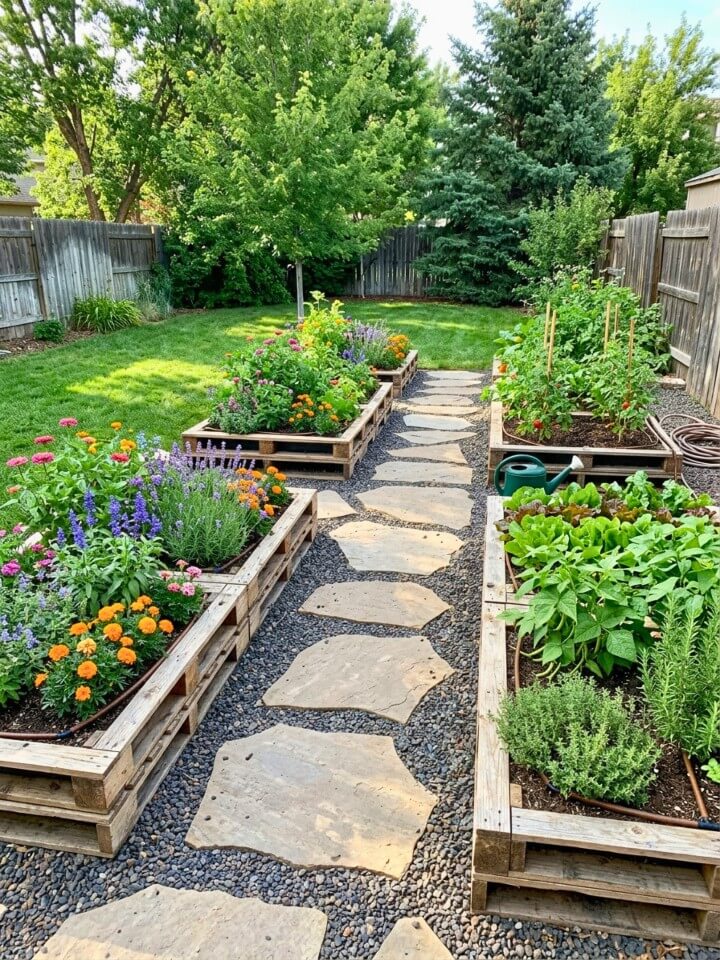
A bed that interrupts a walking path frustrates people. A bed that frames one makes the whole yard feel intentional.
Design Rules that Actually Matter
Keep paths at least 30 inches wide — anything narrower forces sideways shuffling when you carry a watering can or harvest basket. Beds should sit 6 inches lower than the path surface so soil doesn’t spill onto pavers after heavy rain. Stagger beds on alternating sides of the path rather than placing them directly across from each other; perfect symmetry looks rigid and feels institutional.
Path Material Pairings
Crushed gravel suits rustic, unstained pallet wood. Flagstone or large pavers pair better with stained or painted pallets. Avoid wood chips directly against pallet beds — they hold moisture against the wood and accelerate rot.
10. Pallet Bed with Hanging Pots
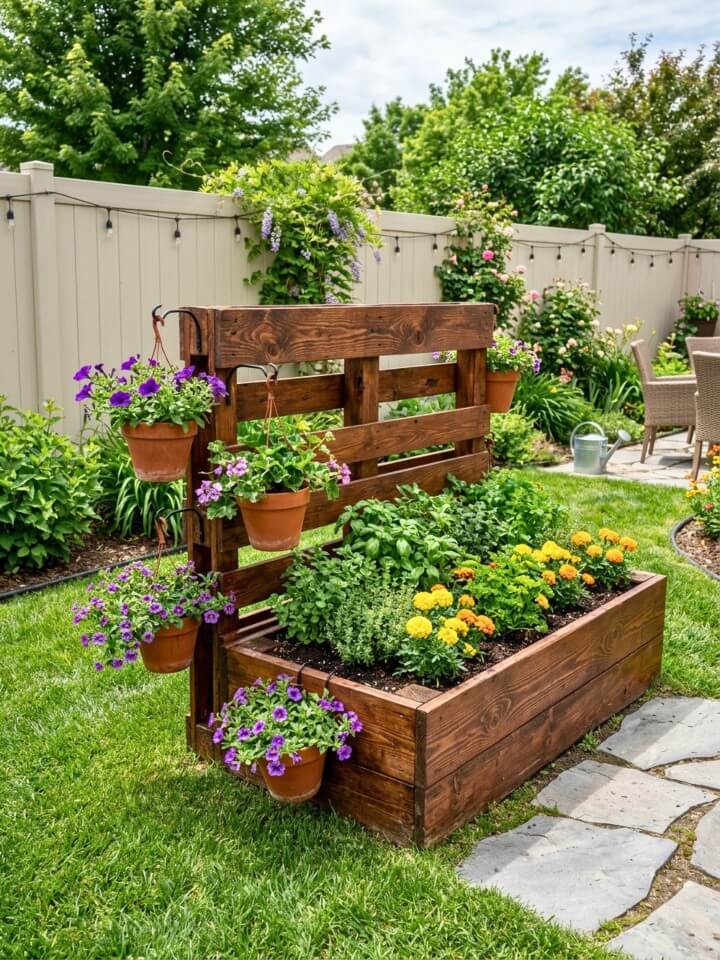
An above ground pallet garden bed beats weeds, pests, and poor soil — grow smarter now!
What You’ll Need
- Six to eight terracotta pots, 6-inch diameter
- S-hooks or coated wire
- Drill with quarter-inch bit
- Eye screws rated for at least 25 pounds each
- One sturdy pallet screwed to a wall or fence
Cost Reality Check
Pots run $18–$30 if you skip the glazed ones. Hardware comes in under $10. Total project under $50 buying everything new — far cheaper than wall-mount planter systems at garden centers, which start at $120 for similar capacity.
Watering Note
Hanging terracotta dries out roughly twice as fast as ground soil because heat hits the pot walls from all sides. Drip emitters threaded through the pallet slats above each pot solve this — otherwise plan on daily watering through peak summer.
11. Pallet Herb Spiral
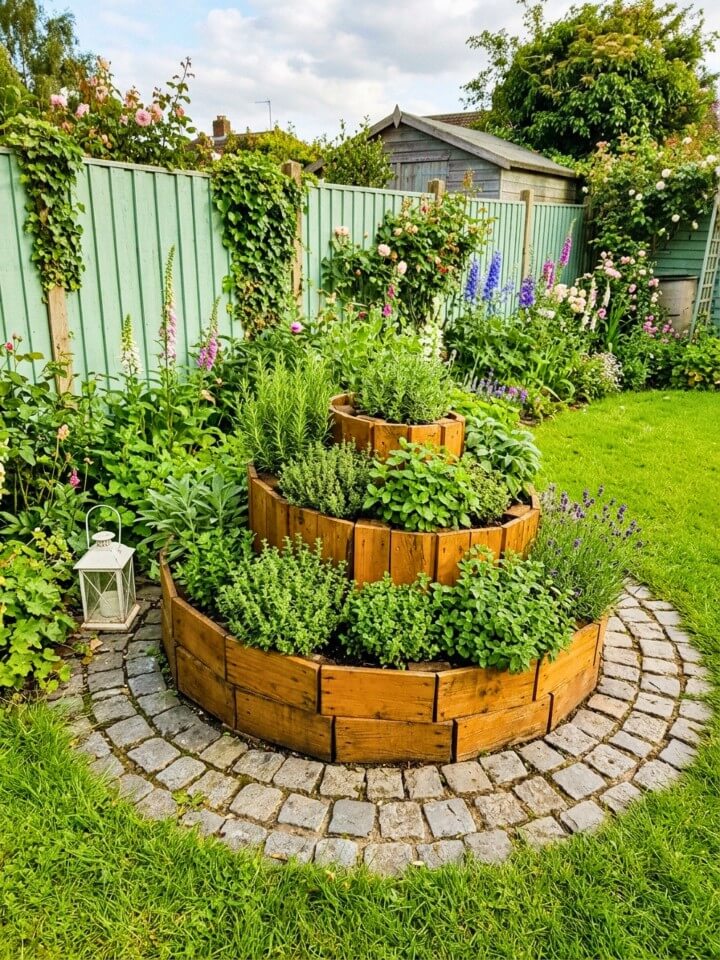
The whole point of a spiral is microclimates — different moisture and sun exposure at each height let you grow herbs that would normally need separate beds.
Top Zone (Driest, Hottest)
Rosemary, thyme, oregano, and sage — Mediterranean herbs that thrive in lean soil and full sun. Skip mint here; it’ll crisp by midsummer.
Middle Zone (Moderate Moisture)
Basil, parsley, chives, and cilantro. These want even moisture without waterlogged roots.
Base Zone (Coolest, Dampest)
Mint, lemon balm, and watercress. The pallet structure physically contains mint’s aggressive runners — the only way I’ll grow it without regretting it.
Build Note
Stack pallets in a tightening spiral, 4 feet wide at the base and narrowing to 18 inches at the peak. Three tiers is the maximum; taller becomes unstable once saturated soil multiplies the weight.
12. Mini Pallet Garden for Small Spaces
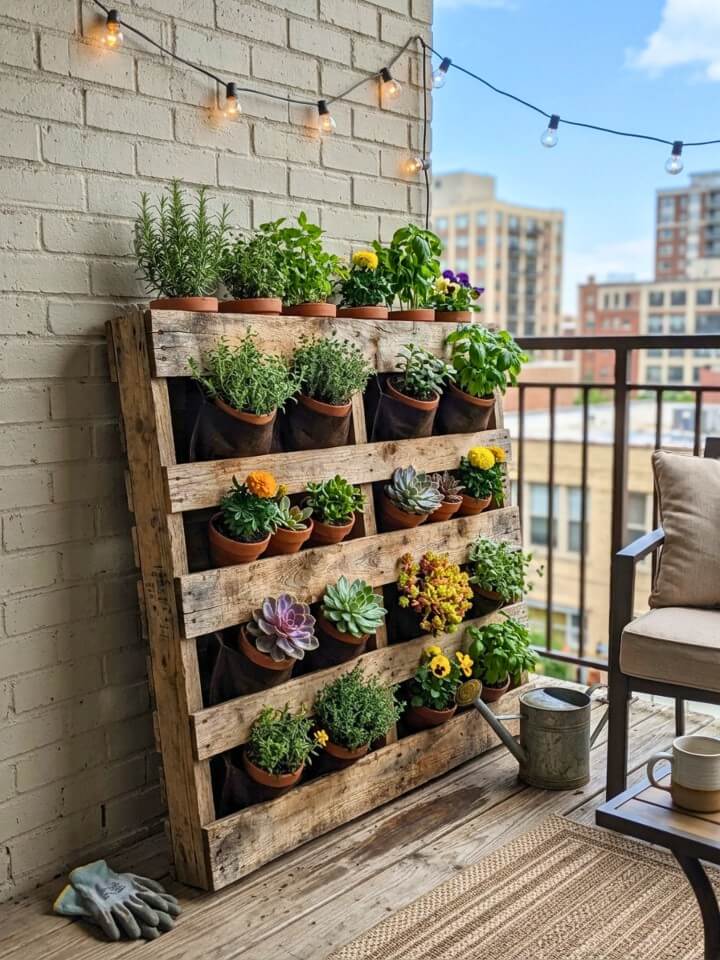
A standard 48×40-inch pallet laid flat needs about 14 square feet of clear floor — that’s a balcony corner or a 4×4 patio section. Vertical mounting drops the footprint to roughly 4 square feet.
Realistic Yield from One Pallet
- 8–10 lettuce heads per growing cycle
- 4 pepper plants, or 2 tomatoes, or 12 strawberry crowns
- Mixed herbs: enough basil, parsley, and chives for a household of three
What Won’t Work
Sweet corn, pumpkins, melons, and most squash varieties need 30+ square feet of root space. Crowding them into pallet pockets produces yellowed leaves and zero fruit. Stick with shallow-rooted crops or compact bush varieties — labels usually say “patio” or “bush type.”
13. Pallet Bed with Mixed Materials
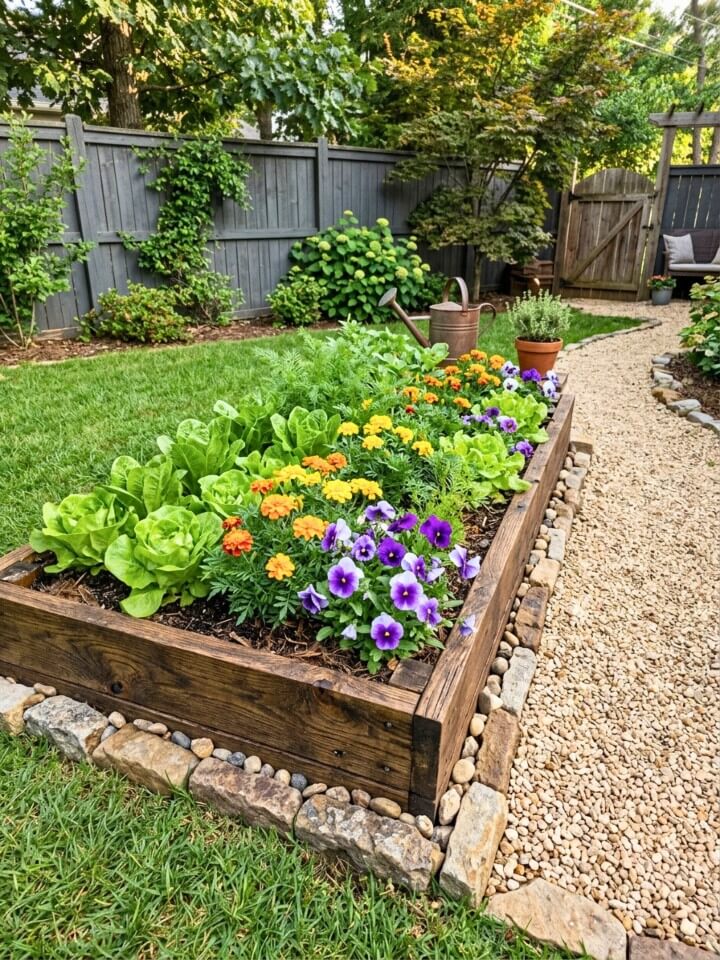
Build a DIY pallet raised garden bed in hours and grow fresh food on any budget easily!
Material Comparison
- Pallet wood alone: Cheapest option, easiest to cut, 3–5 year lifespan even with sealing.
- Pallet + stone base: Adds 10+ years to wood life by lifting it off wet ground. Stone also blocks gophers and voles. Costs about $40 extra per bed.
- Pallet + metal corner brackets: Industrial look. Brackets prevent the corner warping that ruins most untreated pallet beds by year three.
- Pallet + brick edging: Best for heat retention — bricks store daytime warmth and release it overnight, extending growing season by 2–3 weeks at each end.
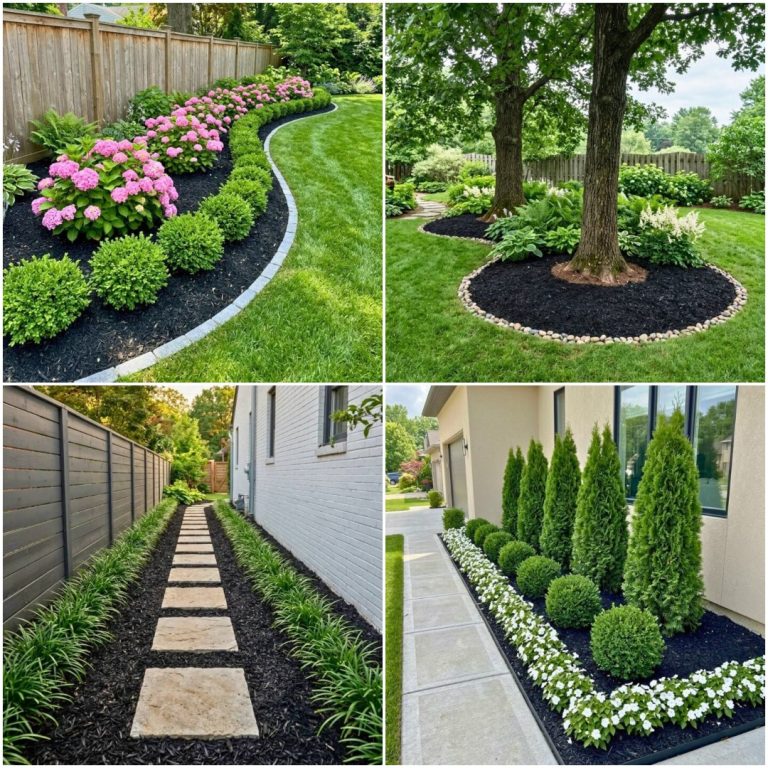
A finished pallet bed also looks sharper when the surrounding ground is handled intentionally; even simple black mulch landscaping can make reclaimed wood feel more polished instead of temporary.
Pairings that Look Wrong
Galvanized metal against rustic unfinished pallet wood reads as construction-site debris. If you want metal accents, stain the pallet a darker tone first to tie the materials together visually.
14. Pallet Bed on Wheels
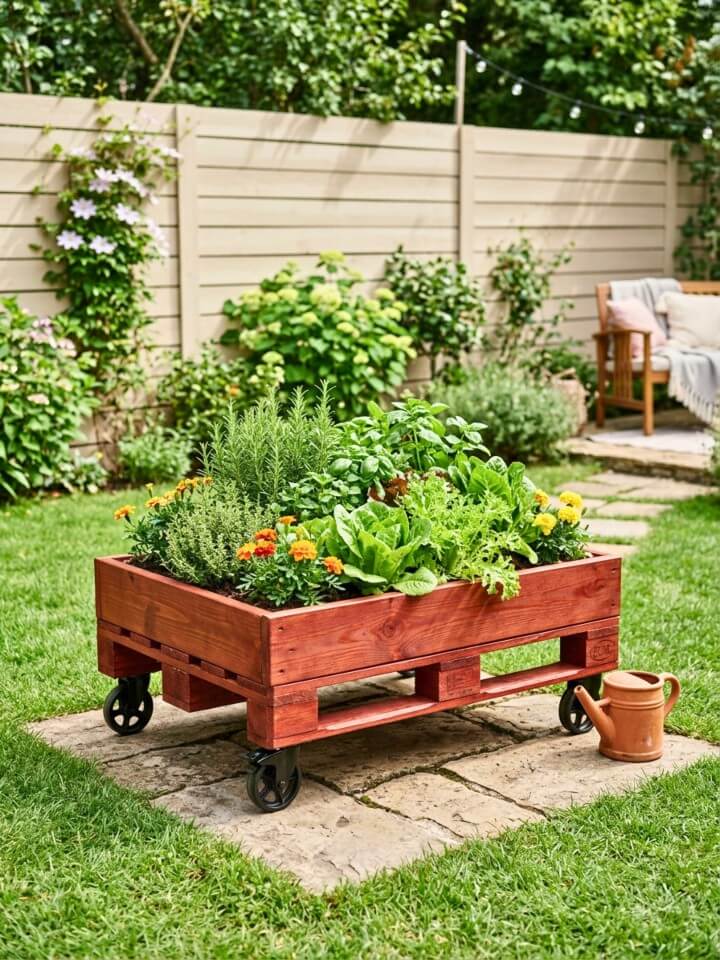
A wheeled bed is only as good as its casters. Skimp on hardware and you’ll end up with a 300-pound planter you physically cannot move.
Caster Checklist Before Buying
- Load rating of at least 150 pounds per caster (you need four)
- Wheels at least 3 inches in diameter — smaller wheels stick on uneven pavers
- Locking mechanism on at least two of the four
- Polyurethane or rubber tread, not hard plastic (plastic cracks under cold weather and heavy loads)
Mounting Reality
Pallet bottoms aren’t flat enough to mount casters directly to the slats. Screw a 3/4-inch plywood square to the underside first, then attach casters to that plywood. Skipping this step is the number one reason wheeled pallet beds collapse within a few months.
15. Modular Pallet Planter System
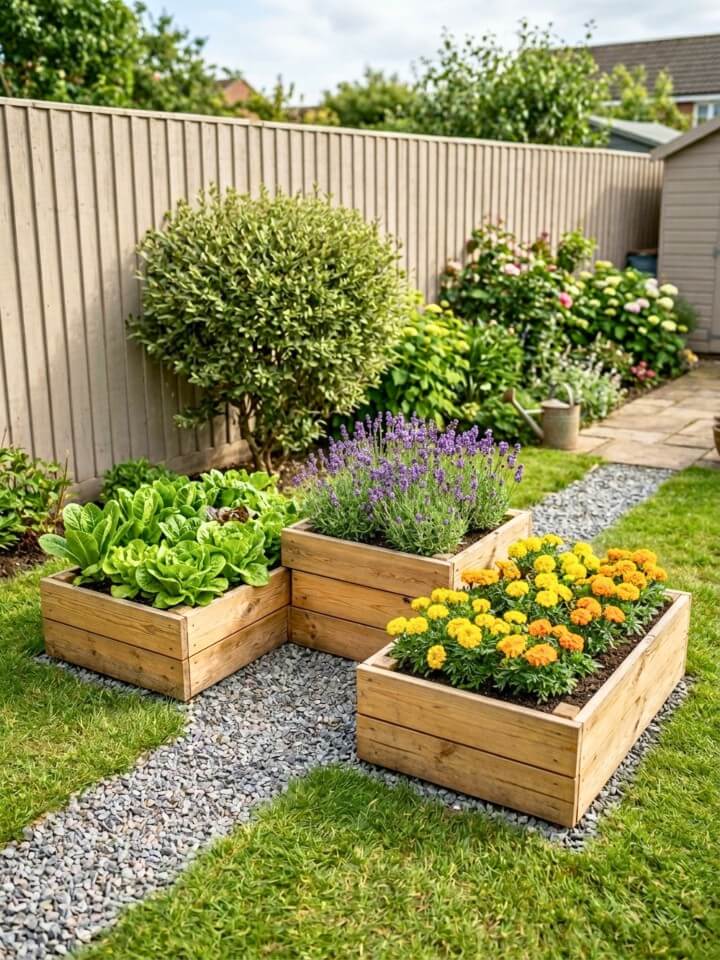
- Year one: Start with two modules. You’ll learn what crops actually thrive in your conditions before committing to more lumber and soil.
- Year two: Add two or three modules based on what produced. Most gardeners discover they want more salad greens and fewer “exotic” crops the seed catalogs pushed.
- Year three: A six-to-eight module setup covers most household vegetable needs without tipping into overwhelming weekend maintenance.
Why Modular Beats One Giant Bed
Crop rotation becomes trivial — physically move modules between sun-heavy and shaded spots each season. Soil-borne disease in one module doesn’t spread to the rest; quarantine it, replace the soil, and your system keeps producing while you fix the problem.
16. Multi-Level Pallet Flower Bed
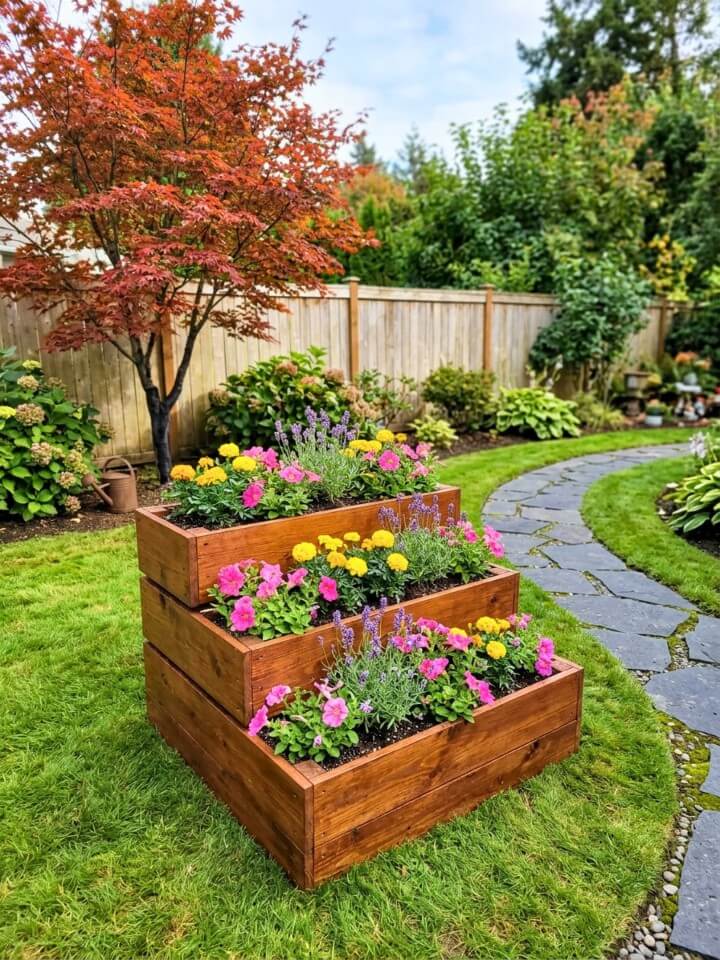
Don’t just stack pallets and plant whatever’s at the nursery. Map blooms by tier and season so something is always flowering.
Bloom Calendar by Tier
- Spring: Top tier — tulips, daffodils. Middle — pansies, primrose. Bottom — hellebores, bleeding heart.
- Summer: Top — zinnias, marigolds. Middle — petunias, salvia. Bottom — hostas, coral bells.
- Fall: Top — chrysanthemums, ornamental kale. Middle — asters, sedum. Bottom — Japanese anemone.
Color Placement that Actually Shows
Tall tiers register first when guests walk into the yard. Put bold colors up top — red, hot pink, deep purple. Save soft pastels for lower tiers where they’re seen at closer range and won’t disappear into the background of the lawn.
17. Painted Pallet Garden Box
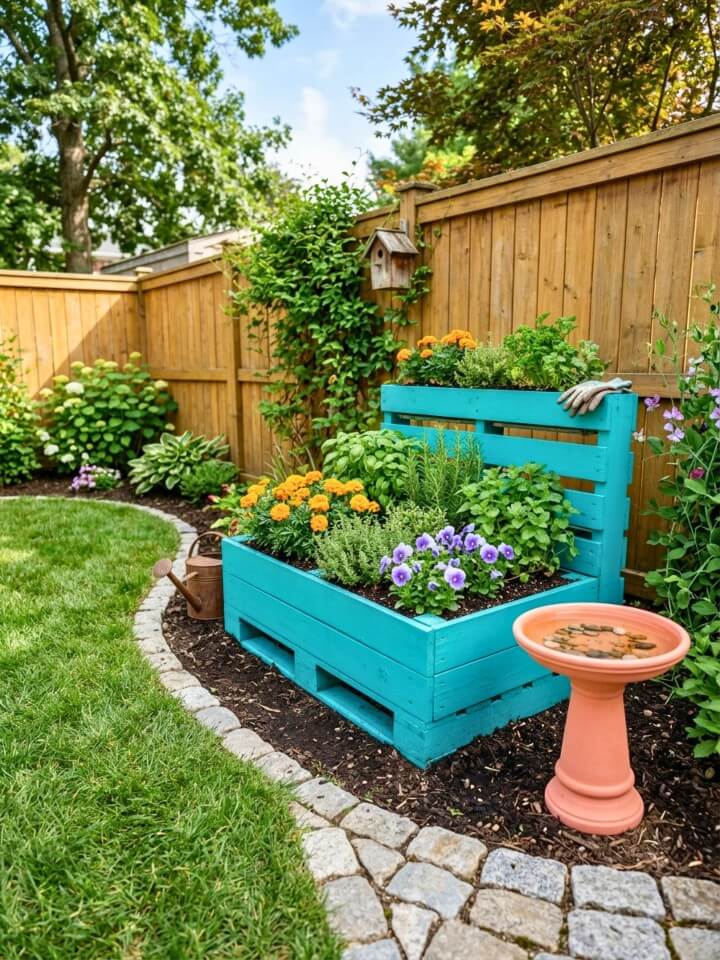
A pallet garden box is the smartest way to organize small-space planting beautifully.
- Latex exterior: Cheapest workable option at $15–20 per gallon. Needs reapplication every 2 years.
- Acrylic exterior: Better adhesion to weathered wood and resists peeling on hot, south-facing surfaces. Around $30 per gallon.
- Milk paint with sealer: The chalky, aged finish that designer magazines love. Requires a hemp oil or beeswax topcoat or it washes off in the first heavy rain.
- Don’t use: Interior paints, chalkboard paint, or basic spray paint. None survive a wet spring without flaking.
Prep that Determines how Long It Lasts
Sand splintered areas, wipe with a damp cloth, let dry 48 hours minimum, then prime with exterior wood primer. Skipping primer is the single reason most painted pallet beds look ragged by year two.
18. Pallet Bed with Integrated Lighting
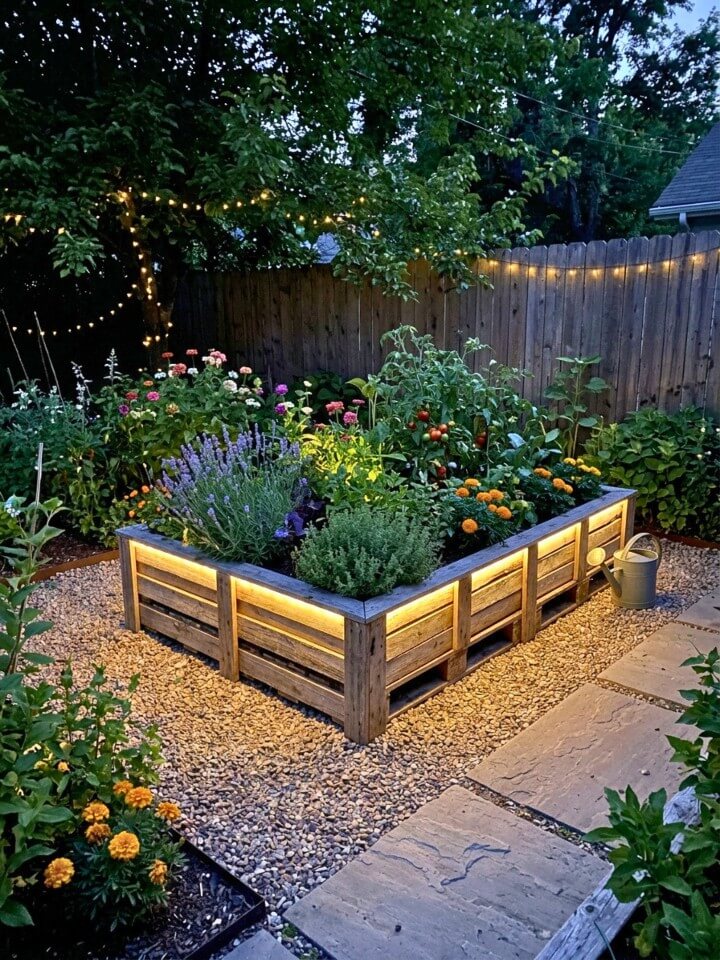
Outdoor lighting near soil and water needs more thought than indoor strips. Get the basics wrong and you risk electrical hazards or scorched leaves.
Lighting Options Ranked by Hassle
- Solar puck lights: Zero wiring, around $25 for a six-pack. Dim glow only — fine for ambiance, useless for actually seeing plants at night.
- Low-voltage 12V LED strips: Brighter, requires a transformer plugged to an outdoor GFCI outlet. Budget $80–120 including transformer and 20 feet of strip.
- Battery fairy lights: Replace batteries every 2 months in heavy use. Cheap but high maintenance.
Heat Warning
Skip any bulb that runs hotter than LED. Halogen or incandescent within 6 inches of leaves will scorch foliage and dry soil unevenly. LED is the only safe choice for direct slat mounting.
19. Pallet Bed with Built-In Irrigation
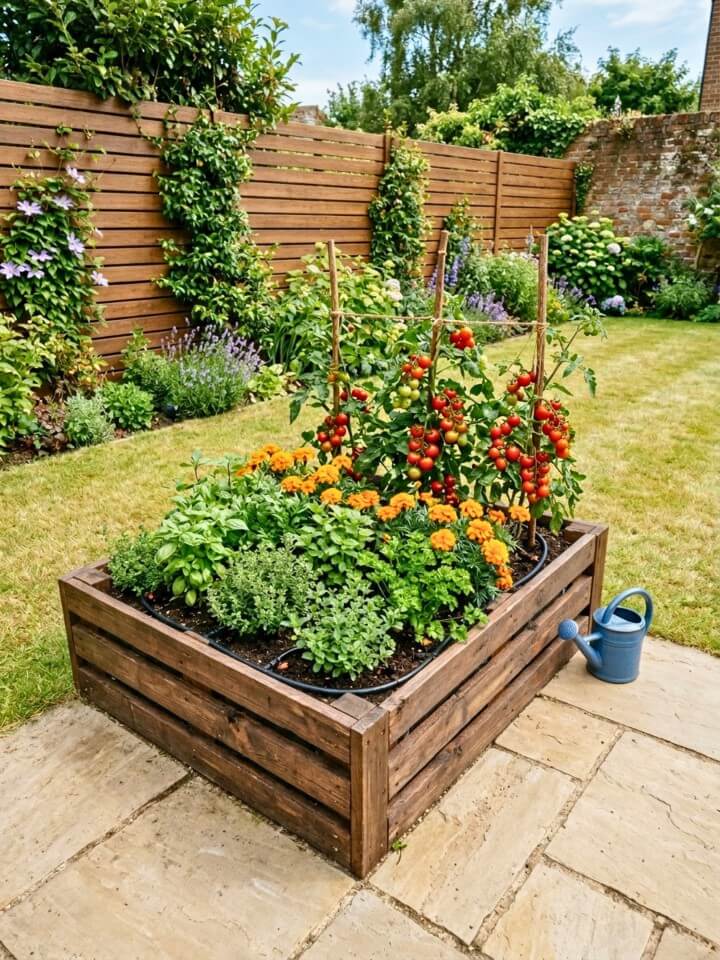
Start a raised pallet garden to enjoy cleaner growing, better drainage, and less mess.
- Drip emitters deliver water to specific plants. Best for spaced crops like tomatoes or peppers. Costs $40–60 for a pallet-size kit but uses 30% less water overall. Clogs easily in hard water areas.
- Soaker hose sweats water along its full length. Best for densely planted greens or herbs. Half the price ($20 for 25 feet) and harder to clog, but waters everything equally — weeds included.
Setup Mistakes to Avoid
Don’t bury lines under more than 2 inches of soil. Deeper placement makes roots grow toward the hose and eventually crush it. Always install a pressure regulator — standard hose pressure (around 50 PSI) blows fittings right off drip systems rated for 25 PSI.
20. Pallet Bed with Climbing Support
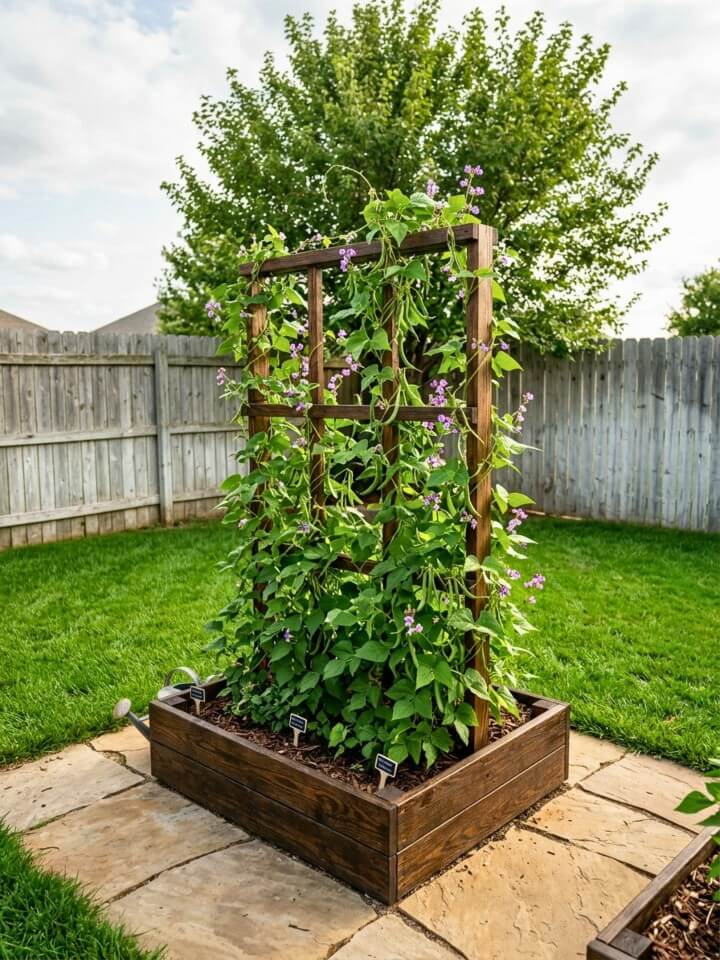
A trellis covered in mature cucumber vines weighs more than people expect. Plan for the load before the vines do the planning for you.
Plant Weight at Maturity (per Square Foot of Trellis)
- Pole beans: 4–6 pounds
- Cucumbers: 8–12 pounds
- Indeterminate tomatoes: 15–25 pounds
- Grape vines, third year: 30+ pounds
Match the Trellis to The Load
- Twine and bamboo: Beans and peas only. Anything heavier shears supports by midseason.
- Cattle panel or galvanized mesh: Cucumbers, squash, and lighter tomatoes. Self-supporting up to 6 feet.
- Welded steel or pressure-treated 2×4 frame: Mandatory for grapes, kiwi, or heavy indeterminate tomatoes. Anchor to the pallet bed AND drive ground stakes — the bed alone can’t resist lateral pull when wind catches mature vines.
21. Pallet Bed with Storage Compartments
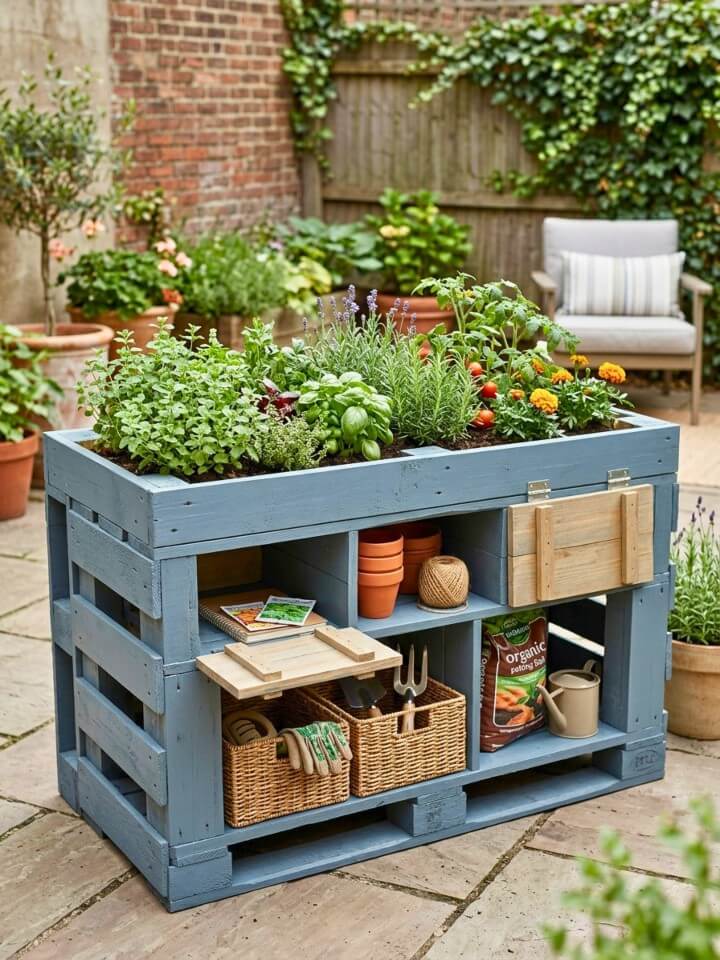
Tool sheds are expensive, and most weekend gardeners only own a handful of tools that need housing. A pallet bed with hidden storage under the planting zone handles both jobs in one footprint.
What Actually Fits in The Compartments
A standard pallet’s lower cavity, once lined with weatherproof board, holds the working set most home gardeners actually use: hand trowel, pruners, gloves, a small bag of potting mix, twine, plant labels, and a kneeling pad. Skip storing anything with a wooden handle longer than 14 inches — they won’t fit horizontally and standing them vertically pokes through the soil above. Mount the access door on the long side facing your path; corner-access doors force crouching that gets old fast.
22. Pallet Raised Bed with Trellis
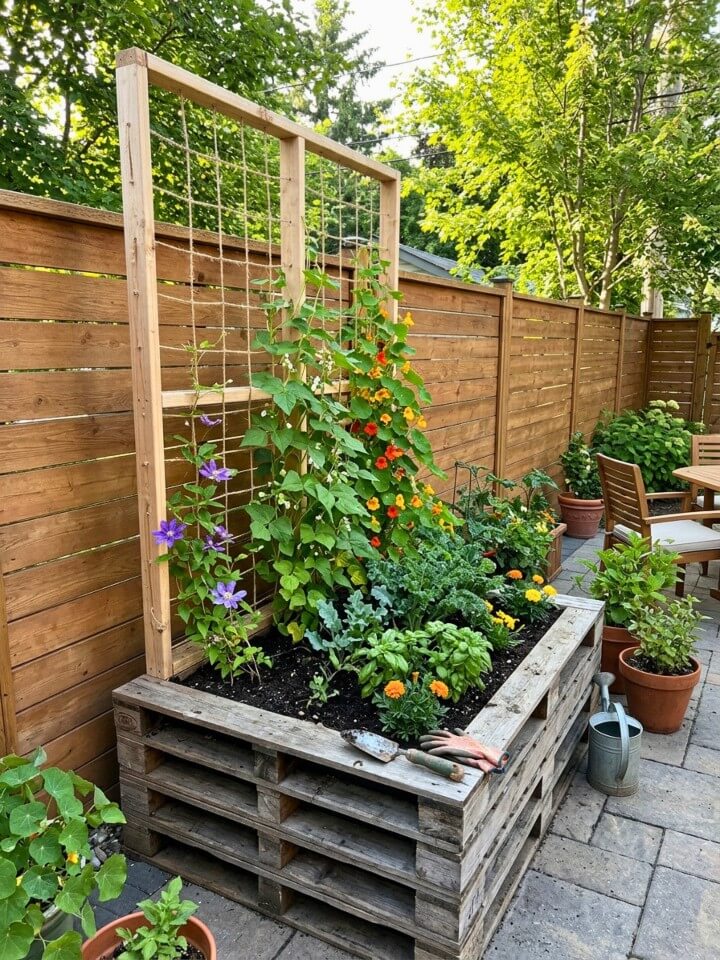
A pallet bed with an attached trellis turns one yard footprint into two productive zones — ground crops below, vertical crops climbing above. The catch: the trellis-to-bed joint is where these projects usually fail.
How to Attach the Trellis so It Doesn’t Pull Free
Don’t screw the trellis directly into the pallet’s top slats — those slats are nailed to thin stringers and pop loose under sustained vine pull. Instead, run two pressure-treated 2×4 posts down through the soil to the ground inside the bed, then attach the trellis to those posts. Soil packs around the posts and locks them in place. The pallet walls just contain soil; the trellis carries its own structural load independently of the bed.
23. Pallet Bed with Built-In Seating
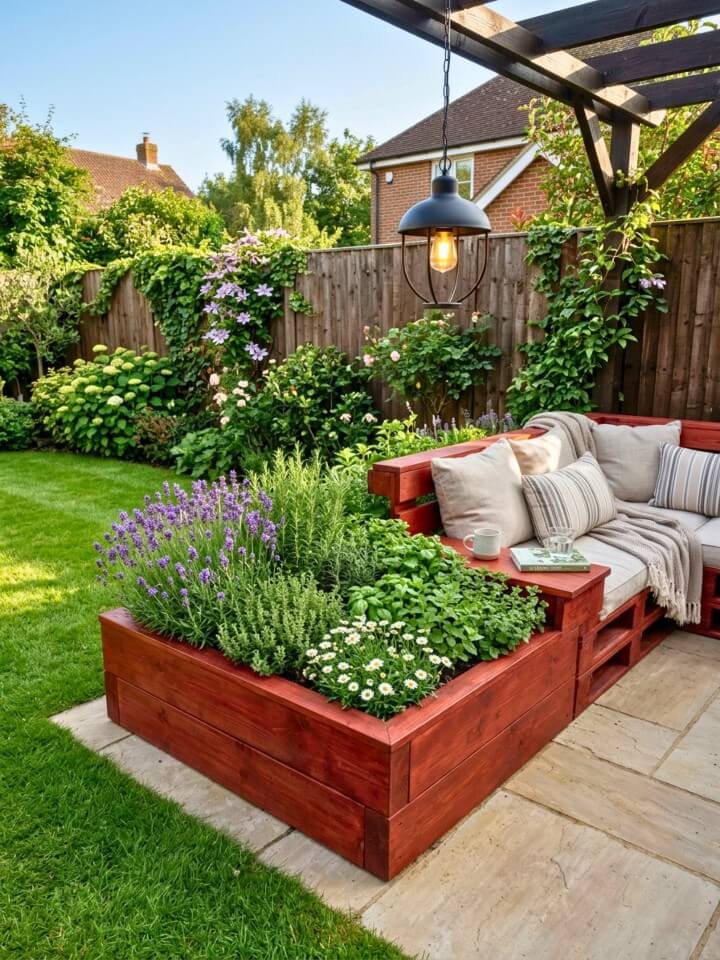
Most “garden bench plus planter” combos end up uncomfortable to sit on because nobody planned the seat dimensions properly. Plants don’t care if the bench is wrong — you will.
Bench Dimensions that Work for Actual Humans
Seat height: 17–19 inches from the ground. Below 16 makes standing back up a workout; above 20 leaves shorter people dangling. Seat depth: 15–18 inches — deeper feels lounging but won’t fit on most pallet edges. Add a 10-degree backward tilt if you include a backrest; vertical backs are torture after ten minutes. Top the seat with cedar planks ripped to 3 inches wide so rainwater drains through the gaps instead of pooling under your cushion.
24. Rustic L-Shaped Pallet Planter
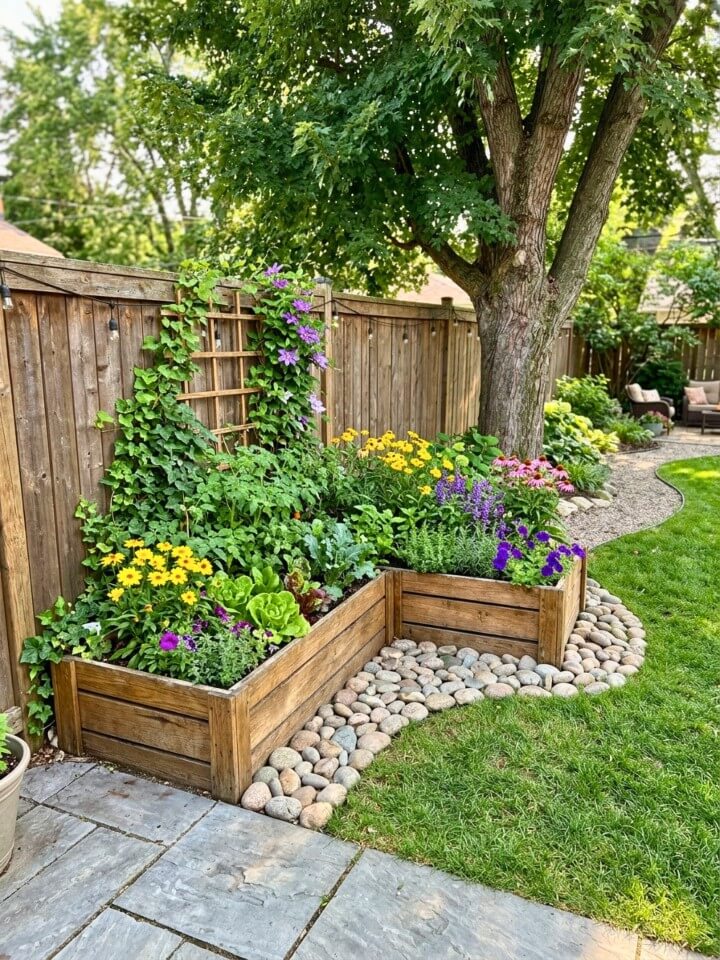
The L-shape wraps a corner that would otherwise sit empty — under a window, against a fence intersection, or along the edge of a patio where a rectangular bed would just look stuck.
How to Handle the Inside Corner
The inside angle of an L holds twice as much soil mass as the rest of the bed, which means twice the lateral pressure concentrated at one joint. Reinforce that corner with a vertical 4×4 post sunk 18 inches into the ground at the inside angle, then screw both pallet walls into that post. The post does the structural work; the pallets just look pretty. Skipping this step gives you an L that slowly splays open into a wider angle over two or three seasons.
25. Rustic Pallet and Stone Garden Bed
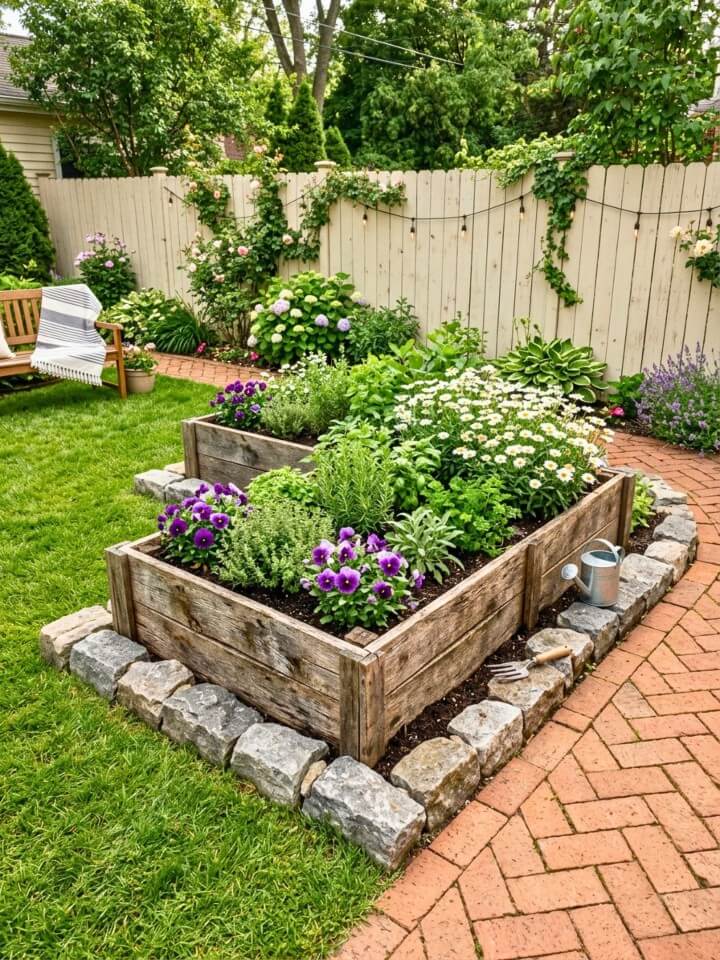
Stone at the base of a pallet bed isn’t decoration — it’s the single biggest factor in how long the wood survives. Direct soil contact kills untreated pallet wood in 3–5 years; a stone footing extends that to 12–15.
The Right Stones for The Job
Skip smooth river rock — it shifts under pressure and creates gaps where the wood settles into wet soil anyway. Use angular crushed stone or flat fieldstone. Both lock together tightly when compacted and create a stable platform. Build the footing at least 4 inches deep and 2 inches wider than the pallet footprint on all sides, so rain splash off the stones doesn’t hit the wood directly.
26. Rustic Pallet Window Box
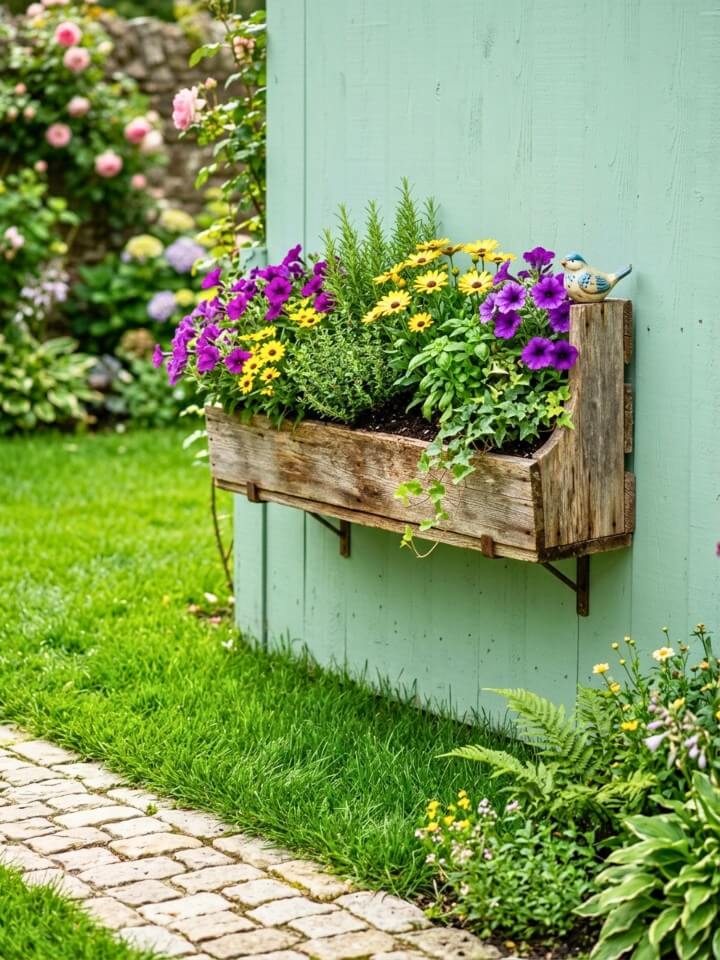
Window boxes look effortless in magazine photos but fail constantly in real life — and the failure point is almost always the mounting hardware, not the box itself.
Weight Reality and Bracket Selection
A 3-foot pallet window box filled with wet soil and mature plants weighs 60–80 pounds. Standard plastic brackets sold at garden centers are rated for 15–25 pounds and snap by midsummer, usually taking siding with them on the way down. Use cast-iron or steel shelf brackets rated for at least 100 pounds, and anchor them through siding into wall studs — not just the siding itself. Vinyl and aluminum siding hold nothing; the screws need wood underneath. Use a magnetic stud finder before drilling anything permanent.
27. Pallet Bed with Seasonal Rotation
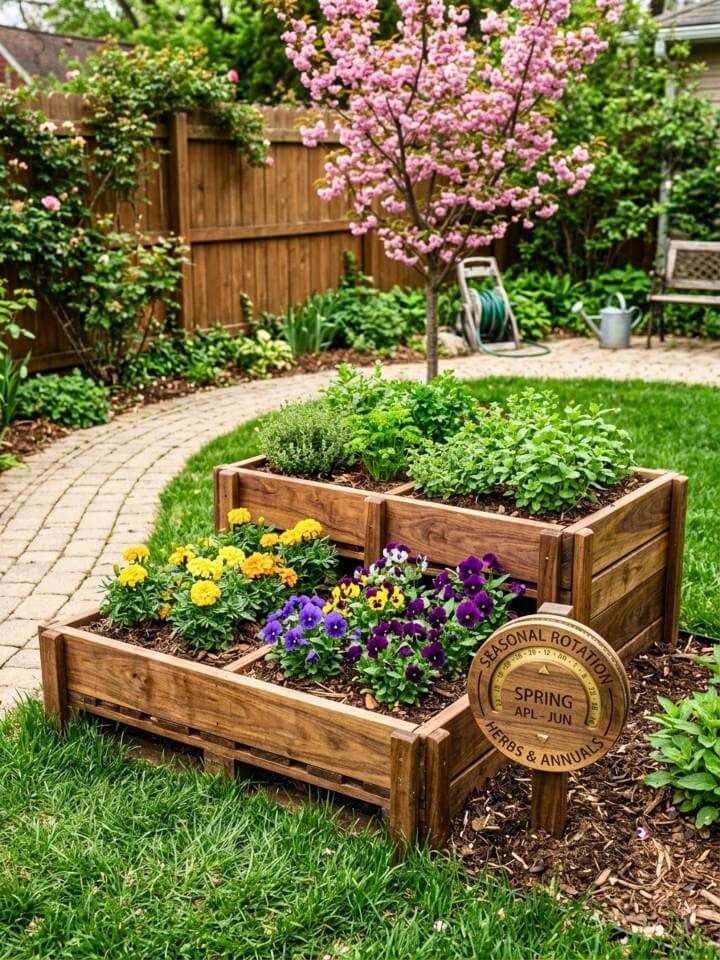
A bed that produces year-round isn’t magic — it just runs on a schedule most beginners skip. Plant something the moment something else comes out.
A Four-Season Planting Schedule
- Late winter (Feb–Mar): Direct-sow peas, spinach, radishes, lettuce. Tolerates light frost.
- Late spring (May): Pull spent cool-season crops. Transplant tomato, pepper, and cucumber starts.
- Late summer (Aug): Pull tired summer crops mid-month. Direct-sow kale, chard, beets, and a second round of lettuce for fall harvest.
- Mid-fall (Oct): Plant garlic cloves and a winter cover crop — crimson clover or winter rye. Both feed soil through dormancy; garlic harvests the following June.
Skipping any window costs 6–8 weeks of empty bed time annually.
28. Pallet Bed with Stepped Levels
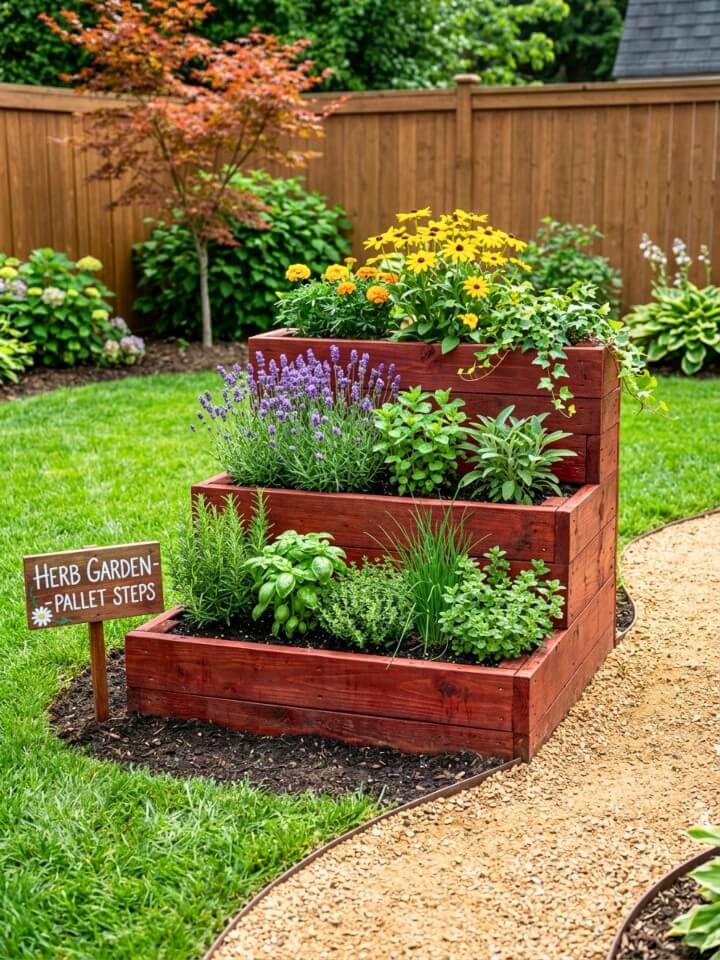
Sloped yards waste growing space. A stepped pallet bed terraces a slope into productive levels that finally make the hillside useful instead of just hard to mow.
Terracing the Slope without Erosion
Dig level shelves into the slope, each wide enough for one pallet plus 18 inches of walking room behind it. Set each pallet on its leveled shelf, then backfill behind with 6 inches of crushed stone before adding soil. The stone intercepts rainwater running downhill so it drains sideways instead of saturating the bed below. On slopes steeper than 15 degrees, anchor each pallet with two 3-foot rebar stakes driven through the front frame into the hillside — soil pressure alone slowly pushes unanchored pallets downhill.
29. Tiered Corner Pallet Garden
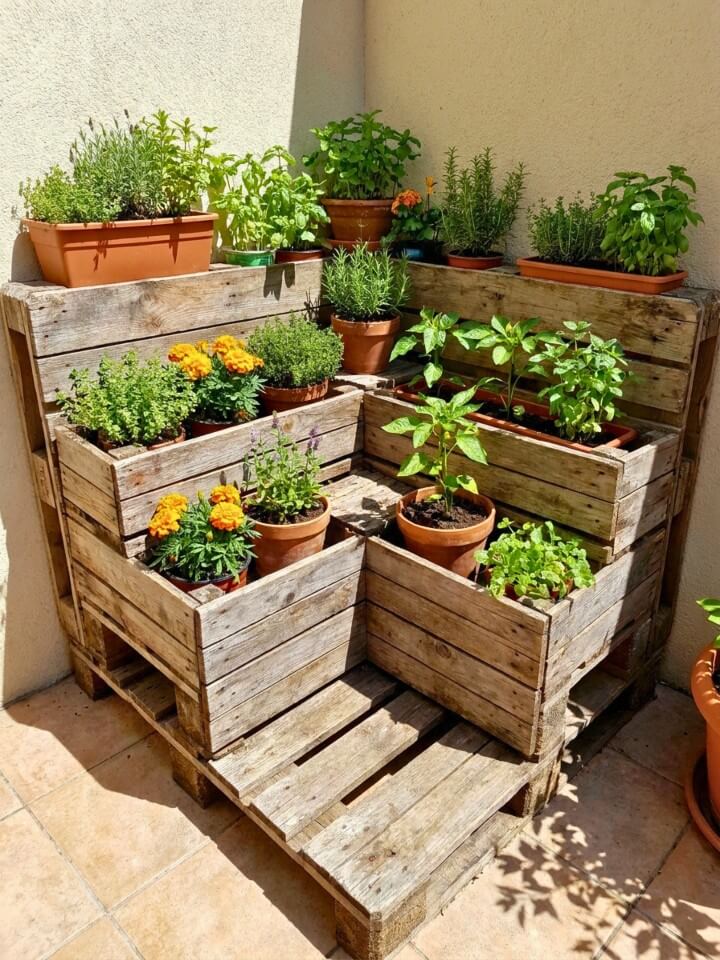
A 4-square-foot corner produces more food than people believe — but only when you build vertically and choose crops bred for tight spaces.
Maximum Yield from A 4 Sq Ft Footprint
Three stacked tiers in a corner planter give you roughly 12 vertical square feet of growing surface from just 4 ground-level square feet. A realistic annual harvest: 30 lbs of tomatoes from compact bush varieties, 40 heads of lettuce across three rotations, 6 lbs of strawberries from 8–10 crowns, plus continuous herb cuttings. Skip standard tomato or squash varieties entirely — they overwhelm tiered beds and shade out everything below them. Look for “patio,” “tumbling,” “compact,” or “bush” in variety names; these are bred specifically for vertical and container growing.
30. Vertical Wall-Mounted Pallet Bed
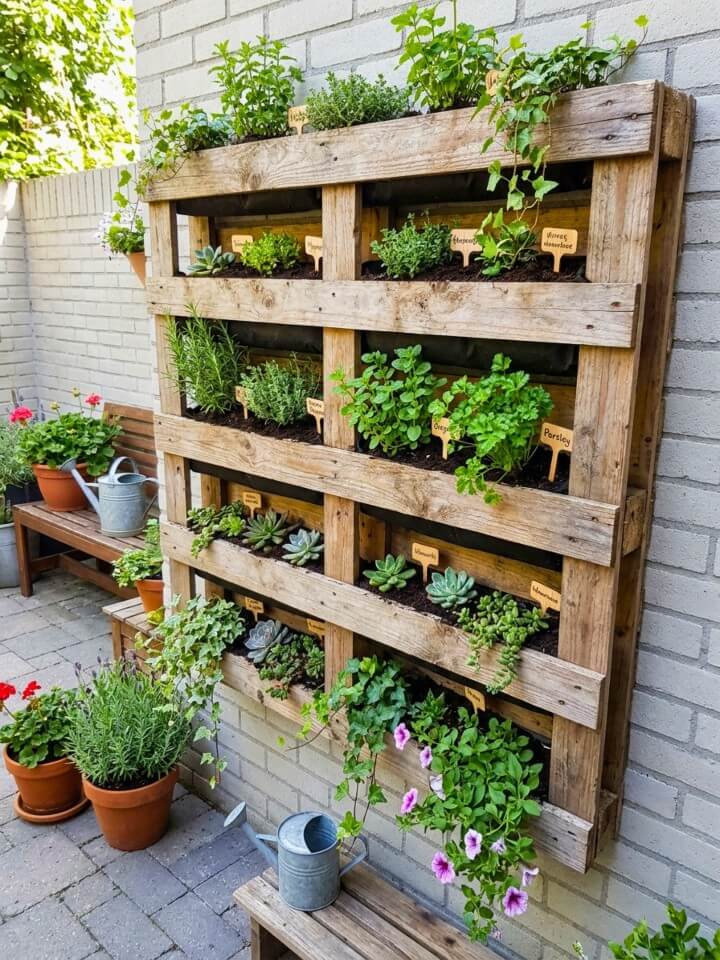
Mounting a pallet vertically sounds simple until you drill into the wall and discover it can’t hold what you’re hanging on it. Wall type determines everything.
Which Walls Can Actually Hold a Planted Pallet
- Solid wood fence with 4×4 posts: Yes, but mount into the posts, not the fence boards. Boards split under sustained load.
- Brick or block: The best surface. Use sleeve anchors rated for 75+ pounds each, two anchors minimum per pallet.
- Vinyl or aluminum siding: No. Anchors pull straight out. If you must use a sided wall, mount a treated 2×6 ledger board into the studs first, then hang the pallet from the ledger.
- Stucco over wire lath: Avoid — anchors crack the stucco over time and let water seep in.
31. Zigzag Pallet Raised Garden
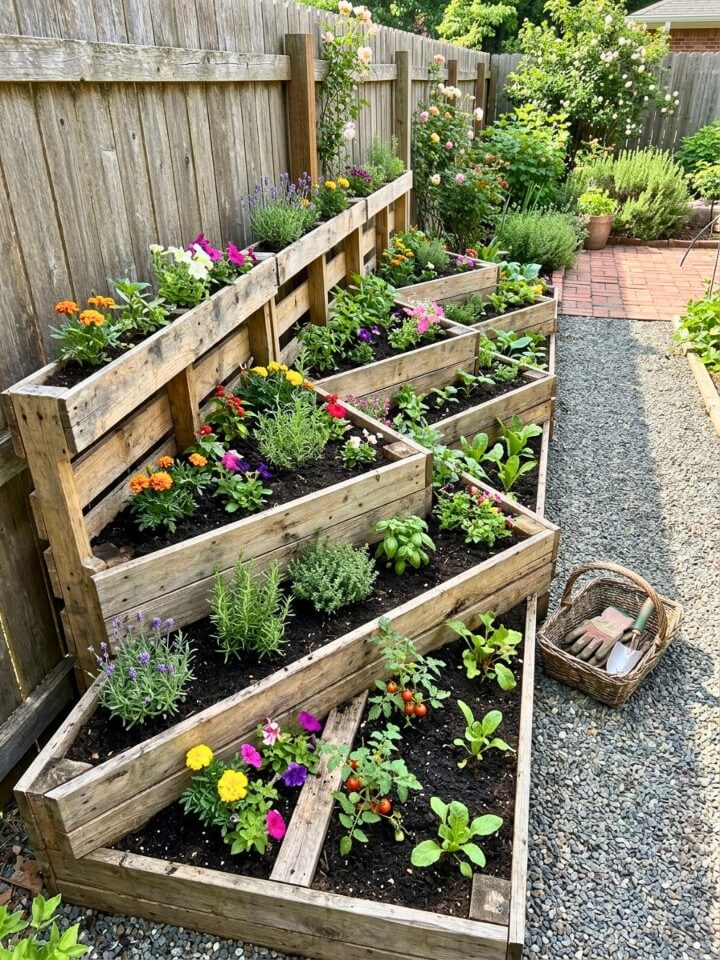
Zigzag layouts look like pure design but actually solve a real problem: rainwater running along straight bed edges erodes soil at one end and floods the other.
How the Zigzag Pattern Controls Runoff
Each angle in a zigzag bed forces water to slow down and pool briefly at the corner before continuing along. That pause gives soil time to absorb moisture instead of channeling straight down the row. Build angles between 30 and 45 degrees — sharper than that traps debris that needs cleaning out, gentler than that doesn’t slow water enough to matter. Orient the zigzag perpendicular to your slope’s downhill direction so each angle works against gravity, not with it.
FAQs About Pallet Raised Garden Bed Ideas
Every homeowner runs into the same questions on their first pallet build. These short answers save you a weekend of trial-and-error mistakes.
Are Pallets Actually Safe for Growing Vegetables?
Only pallets stamped “HT” (heat-treated) are food-safe. Avoid anything marked “MB” — that’s methyl bromide, a toxic fumigant banned in many countries. Unstamped pallets carry unknown risk and should be reserved for ornamental beds only.
What Soil Mix Works Best Inside a Pallet Bed?
A 60/30/10 blend of quality topsoil, finished compost, and perlite drains well and feeds plants for a full season. Skip bagged “garden soil” alone — it compacts hard and chokes roots within weeks.
How Do You Stop Rats and Rodents from Nesting Underneath?
Lay quarter-inch galvanized hardware cloth across the ground before placing the pallet. Rodents can’t chew through metal mesh. Avoid chicken wire — the holes are too big and offer no real protection against burrowing pests.
How Long Does a Pallet Garden Bed Actually Last Outdoors?
Untreated pallets in direct soil contact last 3–5 years. With a stone footing, drainage holes, and an annual coat of linseed oil, you can stretch the lifespan to 12–15 years before replacement becomes necessary.
Do You Need to Line a Pallet Bed with Plastic or Fabric?
Use landscape fabric, not plastic. Fabric holds soil in place while letting water drain through. Plastic traps moisture against the wood and accelerates rot, killing your bed in two seasons instead of five.
Conclusion:
The best pallet bed isn’t the one that wins a design award — it’s the one you’ll actually finish and still use three summers from now. Start with a single project that matches your space and skill level. Build it on a Saturday. Plant it the next morning. Watch how a free piece of wood quietly changes the way you see your yard.
A pallet bed teaches something most store-bought planters can’t: that the patch of ground behind your house is waiting on you, not the other way around. Pick one idea. Begin this weekend.