26 Indoor Pool Ideas, From Modest Plunges to Glass-Roof Retreats
An indoor pool changes how a house feels from the moment you walk through the front door — the slight warmth in the air, the faint sound of moving water, the way light bounces off the surface into nearby rooms. None of that shows up in floor plans. That’s what makes choosing between 26 must-see indoor pool ideas harder than it should be: the photos rarely capture the part you’ll actually live with.
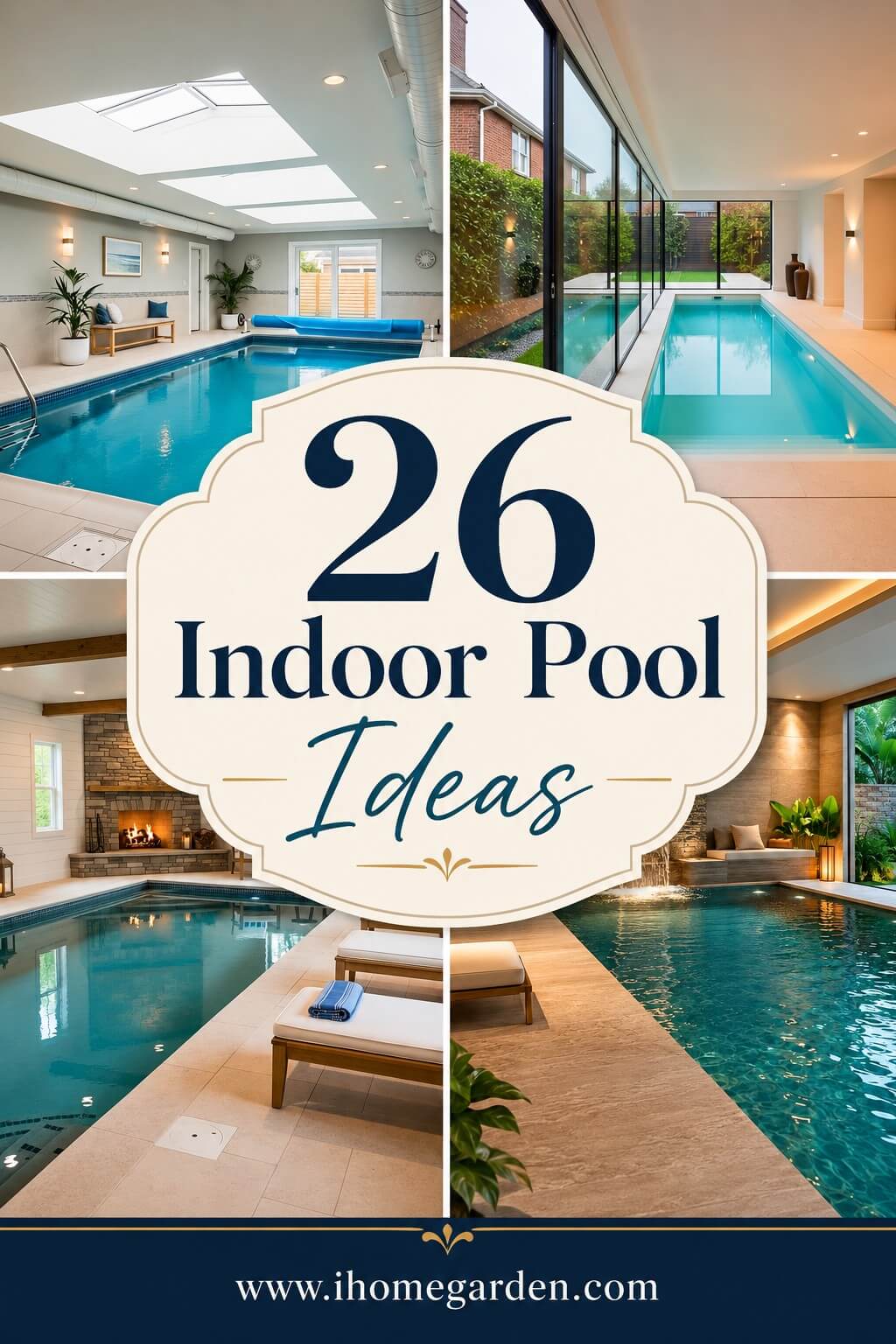
What you’ll read next is the side of indoor pools nobody Instagrams. Which tile holds up under chlorine for twenty years. Which ceiling materials survive constant humidity. How much glass you can put around a pool before condensation turns into a daily problem. Some ideas are bold — black tile, glass roofs, infinity edges. Others are quiet and useful, like a built-in lounge zone or a retractable safety cover. Find the ones that fit your home, then dig into the spec details under each.
1. Glass-Walled Pools That Blur the Indoor-Outdoor Line
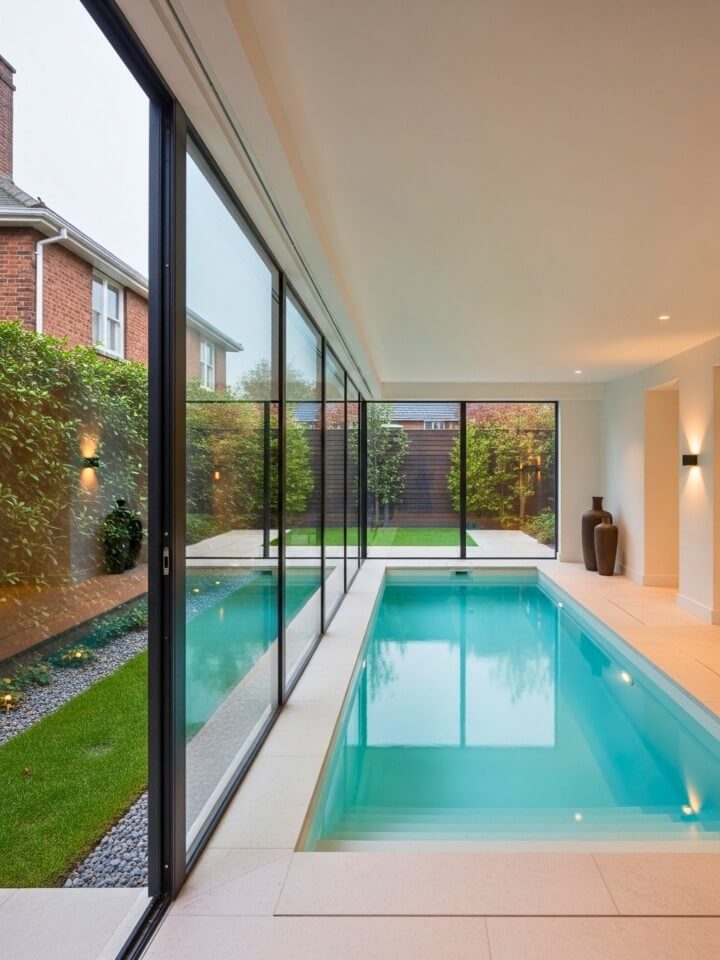
Floor-to-ceiling glass turns a swim room into something that reads almost outdoor, even in February. Position the wall toward a backyard, courtyard, or planted side yard — there has to be something worth looking at, or the windows just become awkward dark rectangles after sunset.
Glass Specs that Actually Matter
Skip standard windows. You need insulated low-E panels with thermally broken aluminum frames, otherwise condensation will pool on the sill every cold morning. Argon-filled and double-pane is the minimum; go triple-pane if your climate runs harsh. Pair the windows with pale travertine flooring, slim black mullions, and a privacy hedge outside so the neighbors don’t accidentally become part of the view.
2. Lap Pool with Minimalist Design
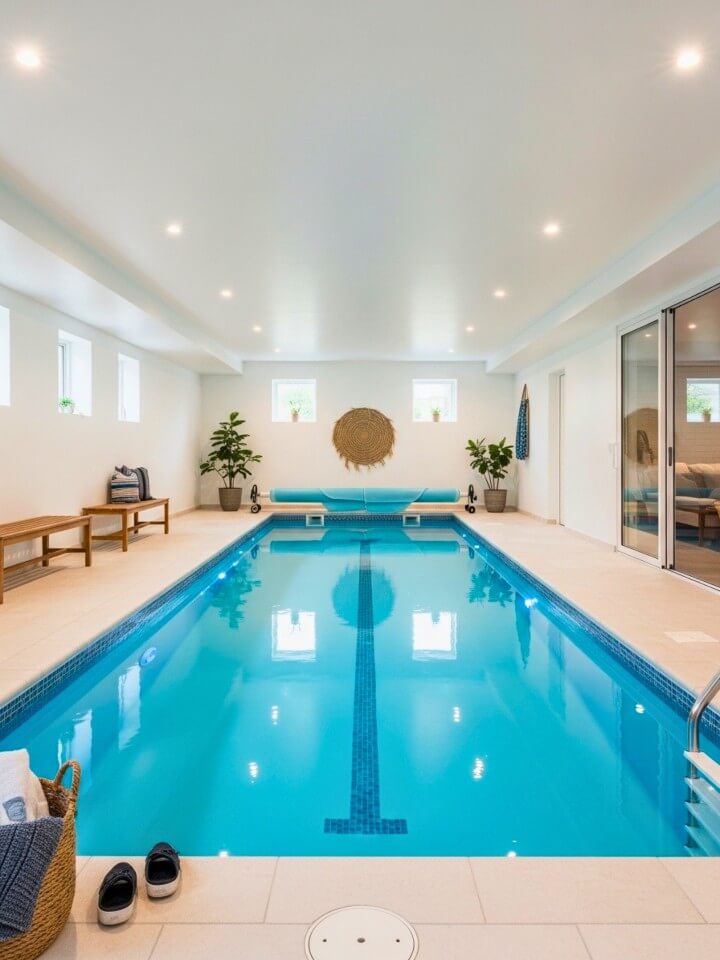
A lap pool earns its space by doing one job extremely well: letting you swim straight lines without turning every three strokes. Dimensions matter more than styling here.
- Length: 40–75 ft is the residential sweet spot
- Width: 8–10 ft for single lane, 12–14 ft for dual
- Depth: 3.5–4 ft uniform — no deep end needed for laps
Long narrow rooms, side wings, and basement extensions take this shape naturally. Finish the surround in large-format porcelain in gray or sand, hide drainage in slot channels, and tuck LED strips into the ceiling cove. A teak bench at the shallow end gives swimmers somewhere to recover between sets.
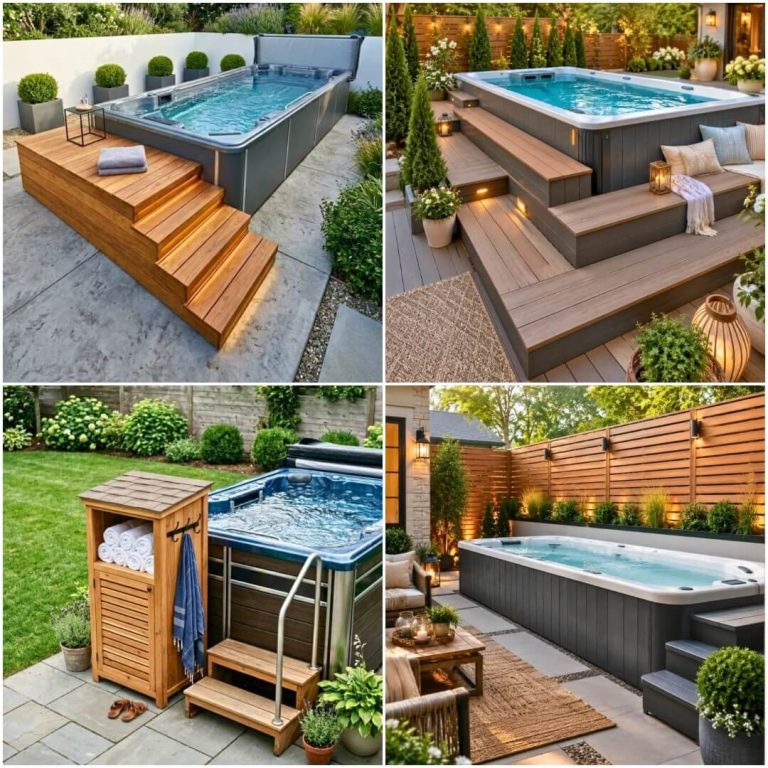
3. Stacked-Stone Pools with a Mountain-Lodge Feel
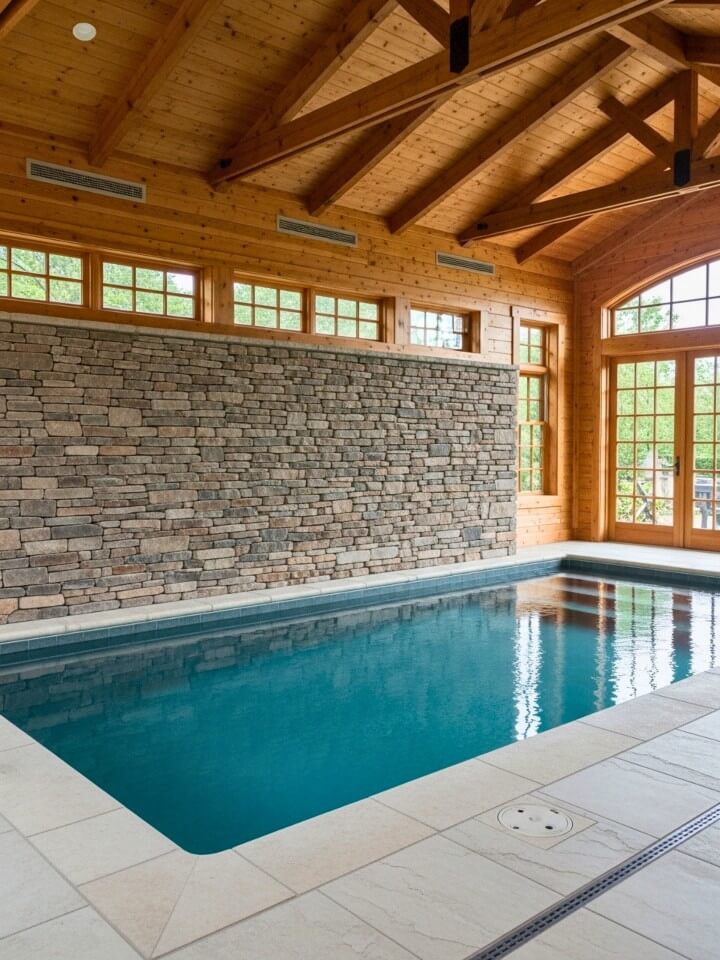
An inside pool turns a quiet corner of your home into a year-round escape — rain, snow, or sunshine. Stacked stone behind a pool changes the whole feel of the room — closer to a mountain lodge or converted barn than the clinical white-tile look most indoor pools default to. Ledger panels in slate, quartzite, or weathered limestone do the heavy lifting on one feature wall. Cover all four walls, and the room starts feeling like a cave; restraint is the difference between rustic and oppressive.
Pro tip: Honed (not polished) bluestone or limestone coping around the waterline ties the rough wall texture to the smooth pool edge without competing with it.
Finish with exposed timber rafters, woven loungers, and warm 2700K lighting overhead.
4. Pool Rooms Lit From Above with Skylights
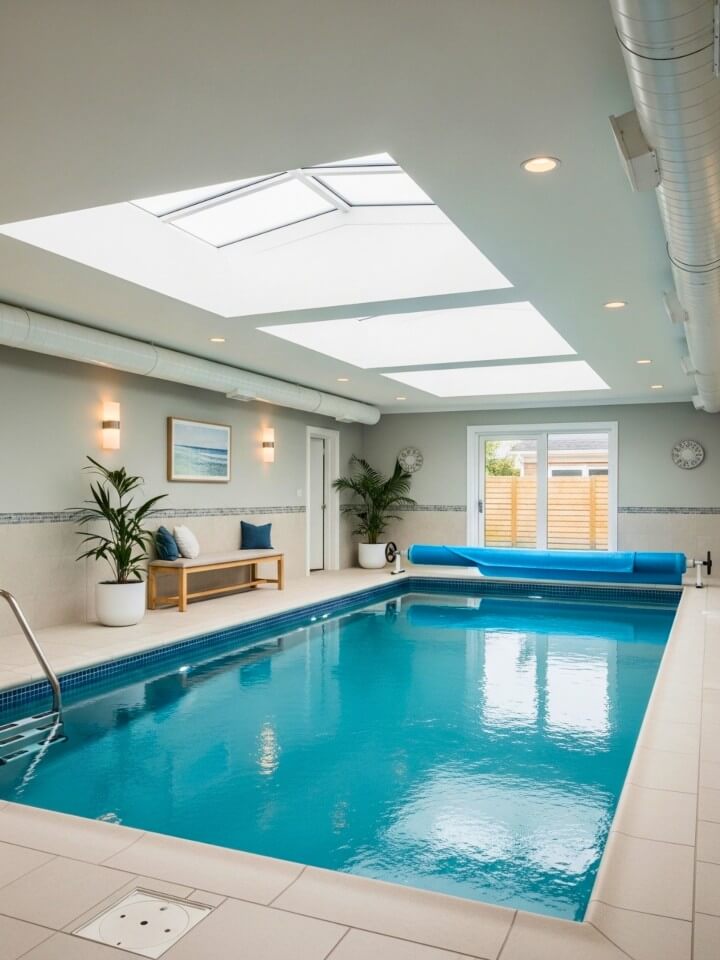
The biggest complaint about indoor pools is that they feel like basements. Skylights fix that faster than any other single decision you can make during the build.
Layout
Long rectangular skylights running parallel to the pool give you even daylight across the entire water surface. Scattered round ones leave bright spots and dark spots.
Spec Sheet
Dual-pane, low-E, argon-filled, rated for high-humidity environments. Anything less and you’ll have condensation dripping onto the deck by mid-November. Operable units with rain sensors vent humid air automatically on mild days. Pair the overhead light with pale tile, light oak benches, and a few floor plants.
5. Tropical Plant-Filled Pool Retreats
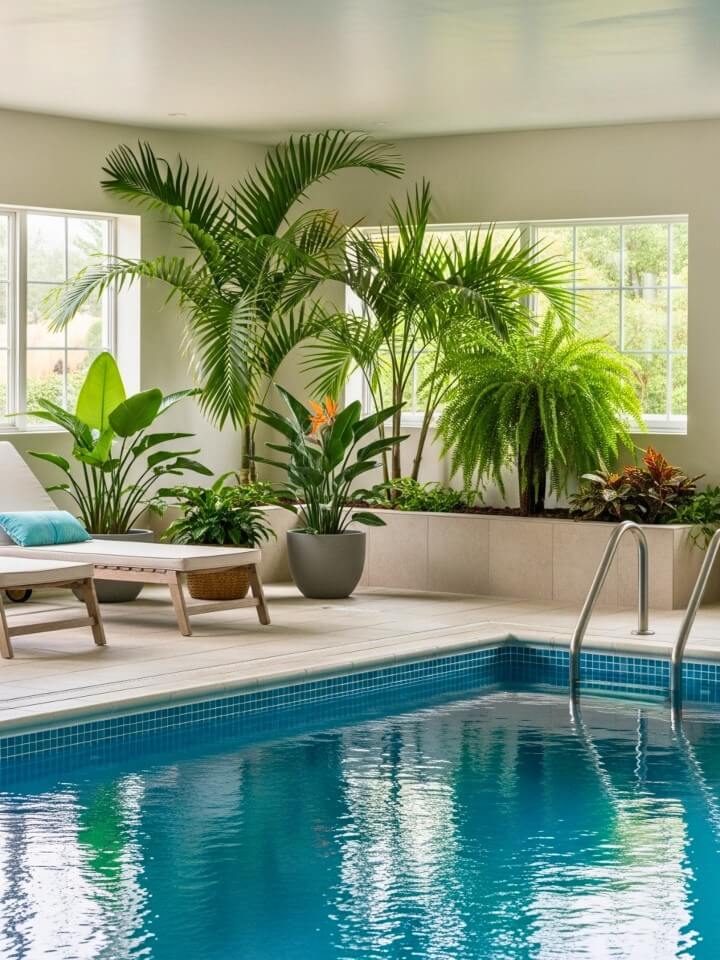
The humidity that ruins most houseplants is exactly what tropical species thrive in — which makes a pool room one of the few places in a house where they’ll actually flourish without daily misting.
Plants that Handle Pool Humidity Well: kentia palm, areca palm, bird of paradise, monstera deliciosa, Boston fern, pothos, philodendron, fiddle leaf fig.
Group taller specimens in corners where they won’t crowd walkways, and tuck trailing plants onto shelves or planter ledges. Use planters with sealed bottoms or deep saucers — chlorinated splash will stain unsealed terracotta and damage hardwood floors fast. Skip anything spiky near foot traffic. Warm uplights at each plant base cast great shadows on the ceiling at night.
6. Spa-Style Indoor Pool
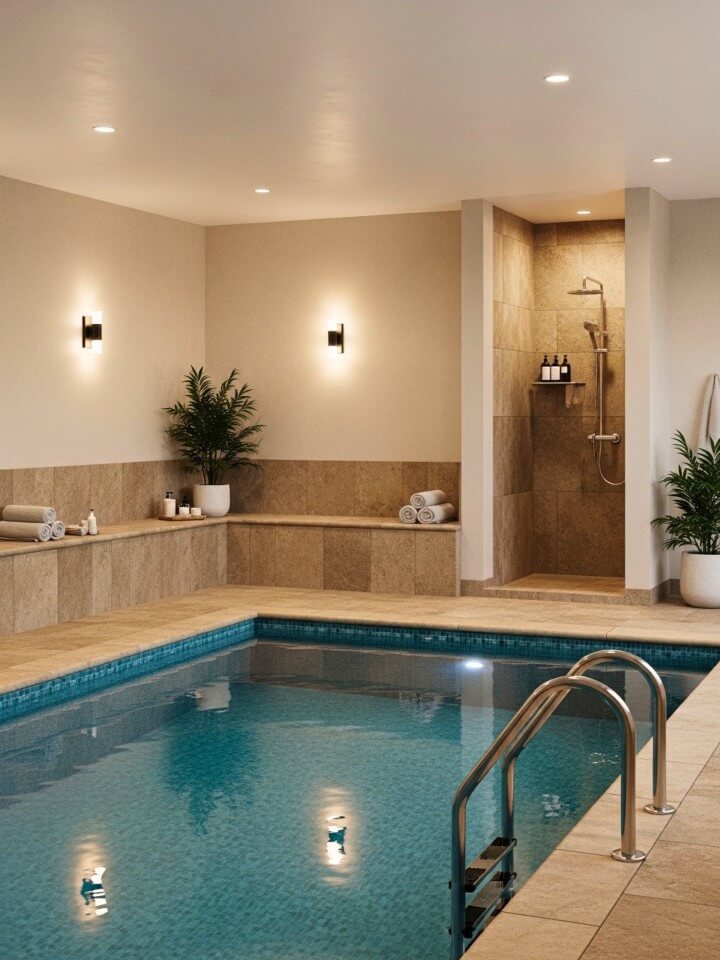
A spa-style pool isn’t really about the pool itself — it’s about what surrounds it. Strip out the gym-locker fluorescents, the noisy pump room next door, and the harsh tile, and you start getting closer to a hotel wellness suite.
What Turns a Pool Room Into a Spa
Dimmable warm lighting (2400–2700K), a textured stone like tumbled travertine underfoot, built-in teak benches, and a rain shower within ten steps of the water. A small dry-heat sauna or steam shower nearby finishes the loop. Keep the palette to two or three earth tones — sand, charcoal, warm white. Rolled towels on a low shelf, a single eucalyptus plant, and silence do more than any expensive feature.
7. Basement Pools Done Right
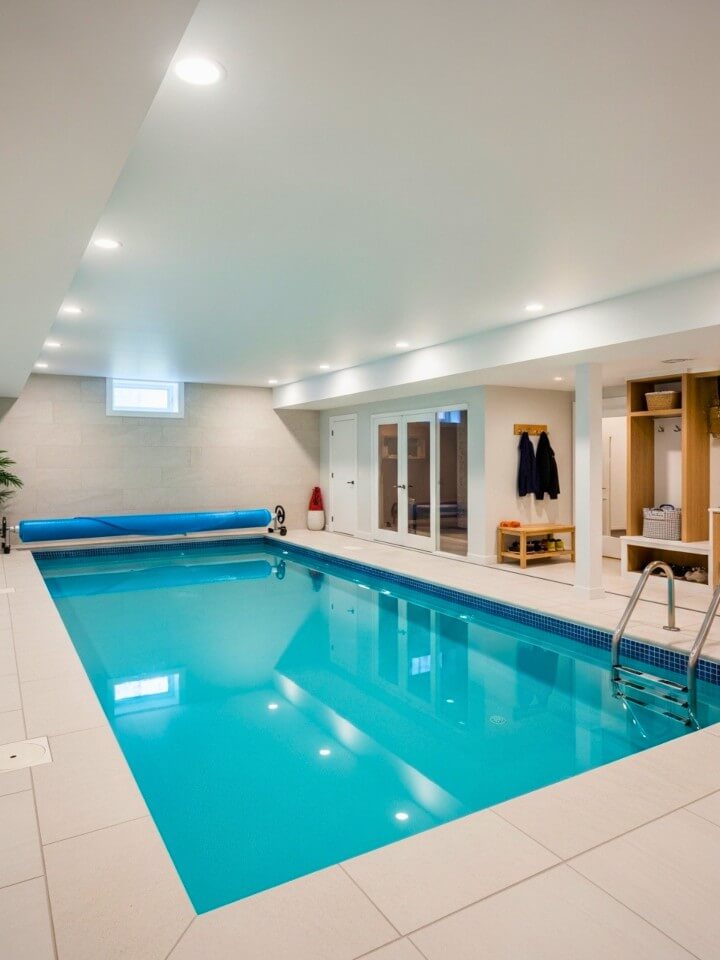
Basement pools make sense when the upstairs square footage is already spoken for, but they come with real engineering constraints worth knowing before you commit.
Non-Negotiables Before You Build
- Ceiling height: 9 ft minimum, 10–12 ft is much better
- Dehumidification: dedicated system, not a residential dehumidifier
- Vapor barrier: properly sealed under the slab and behind every wall
- Egress: at least one code-compliant exit from the pool room
Skip any of these and you’re inviting mold, warped flooring upstairs, and a resale problem. Light the room aggressively — recessed cans on a tight grid plus wall sconces — because basements always read darker than the lux meter says. Pale tile and glass doors help.
8. Warm Wood-Ceiling Pool Rooms
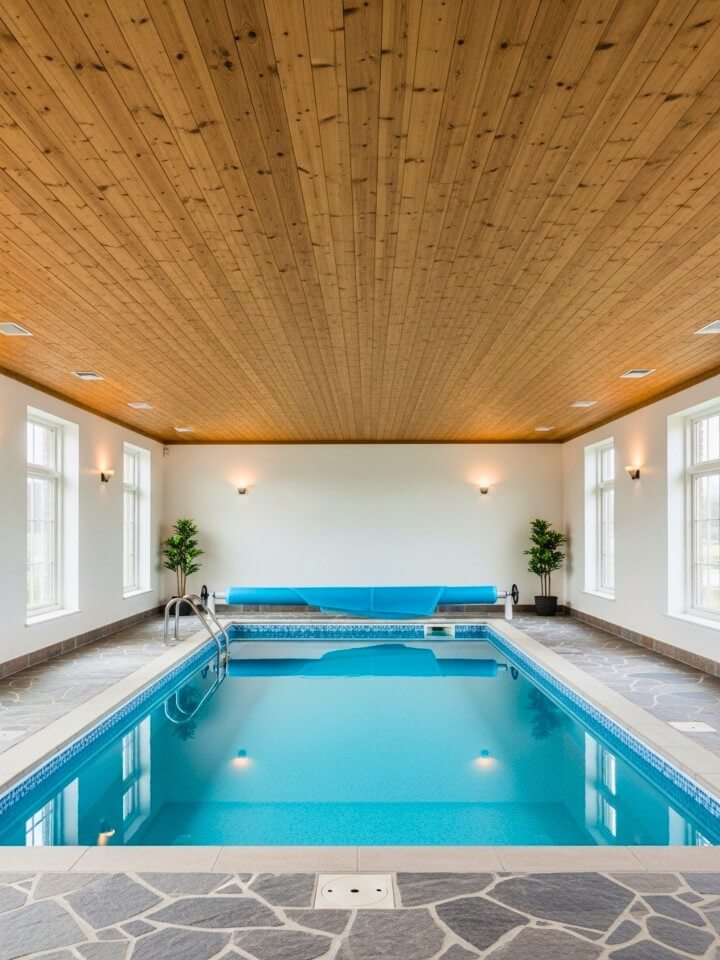
Smart indoor pool ideas balance bold design with the practical specs your home actually needs daily. A wood ceiling over water sounds risky, and it is — if you use the wrong material. Done right, it’s the warmest design move you can make in a pool room, far more inviting than painted drywall or exposed concrete beams.
Wood that Actually Survives Pool Humidity
Western red cedar and accoya are the two real options. Both stay dimensionally stable in high humidity and naturally resist rot. Reclaimed barnwood looks great but warps within two years unless it’s been kiln-dried and sealed properly. Skip pine, oak, and most engineered panels.
Run the planks along the long axis of the pool to stretch the room visually, and finish them with a marine-grade penetrating oil rather than polyurethane.
9. Small Plunge Pool
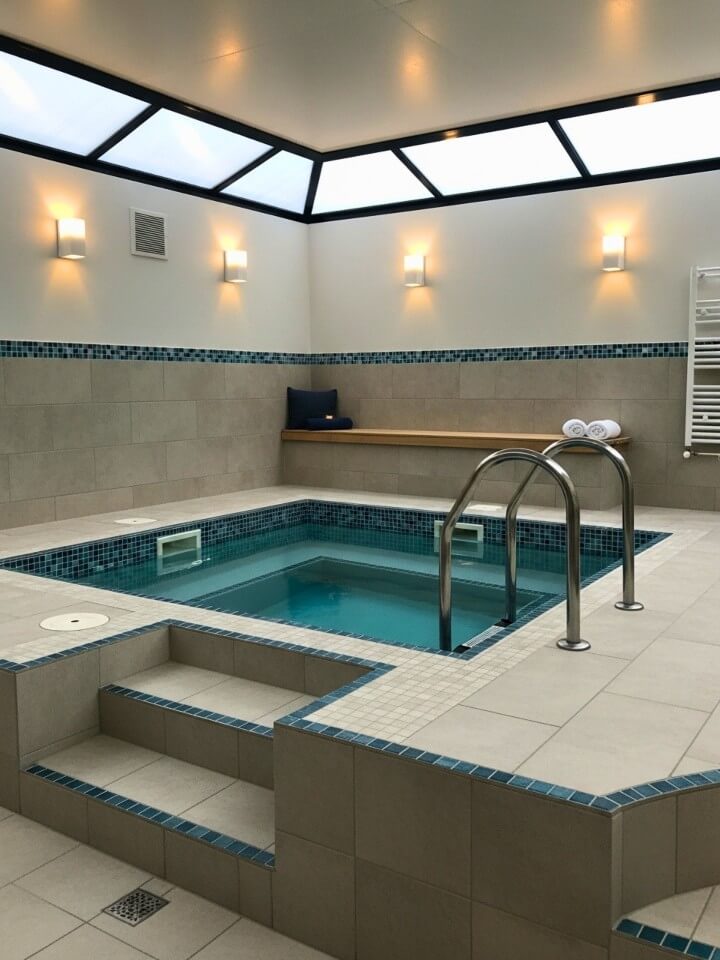
Plunge pools earn their keep when full-size swimming isn’t the goal — they’re built for cold soaks, post-sauna dips, and cooling off after a workout. The smaller footprint also opens up sites that wouldn’t work for a lap pool.
Typical Dimensions:
- Surface: 7×7 ft up to 10×15 ft
- Depth: 4–5.5 ft uniform
- Volume: 1,500–4,000 gallons (much faster to heat or chill than a full pool)
A compact sunroom, basement corner, enclosed patio, or wellness room beside a sauna all work. If the plunge pool connects to an outdoor threshold, the same space-saving thinking behind superb small patio landscaping ideas can help the transition feel intentional instead of squeezed in. Square or round shapes feel more deliberate than scaled-down rectangles. Add wide bench-style steps along one edge, slip-resistant pebble tile, and a chiller unit if you want true cold-plunge temperatures.
10. Pool Room with a Dedicated Lounge Zone
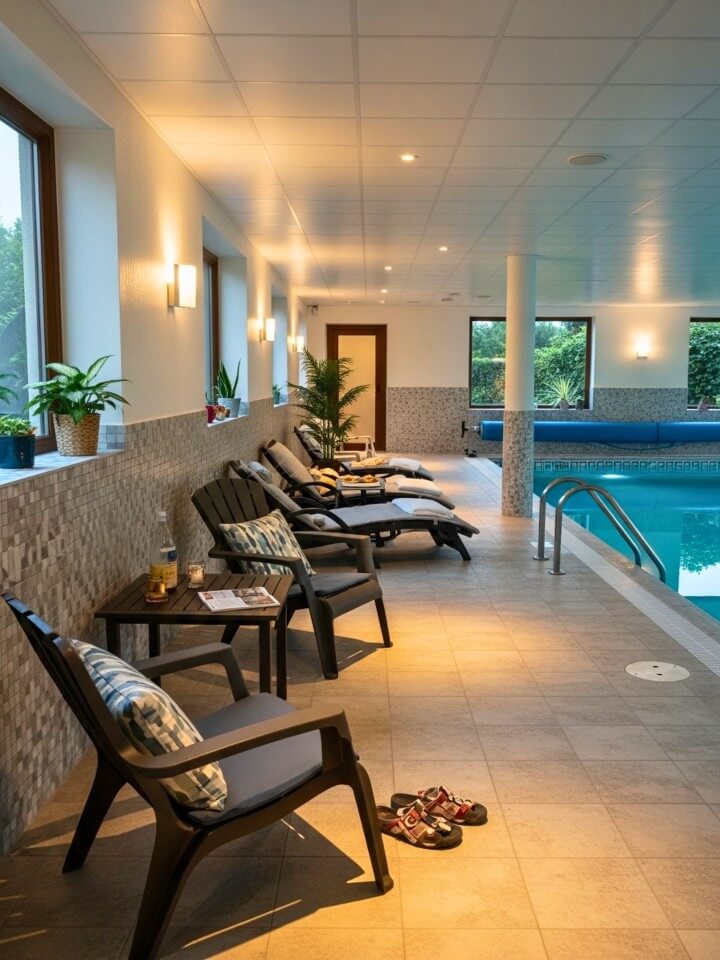
A pool room used only for swimming gets used twice a week. Add a lounge zone and it becomes somewhere people actually hang out — reading, talking, supervising kids without standing on wet tile.
Zoning the Room
Run the lounge along one long side of the pool, near the windows so the seating area gets daylight too. Keep at least 4 feet of clear walkway between cushions and waterline.
Furniture that Survives
Powder-coated aluminum frames, solution-dyed acrylic cushions (Sunbrella or similar), and teak or HDPE side tables. Skip anything in cotton or linen. A low-pile indoor-outdoor rug under the seating defines the zone without becoming a slip hazard.
11. Mosaic Tile Accents That Don’t Date
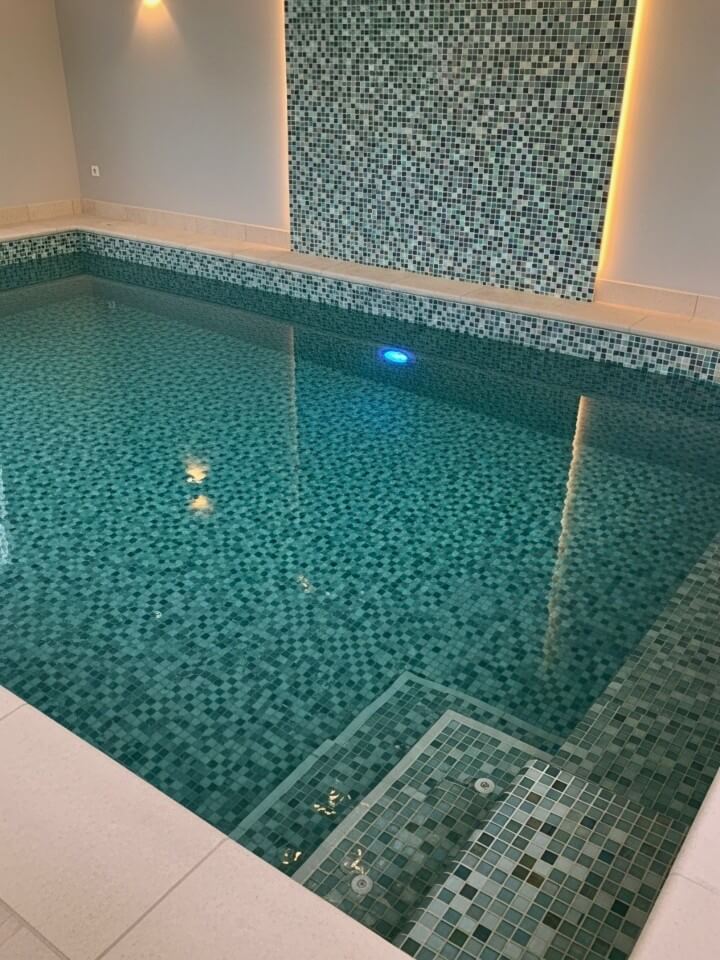
Mosaic tile is one of the few decorative moves that holds up under chlorine, sun, and decades of use without looking dated. The mistake most homeowners make is using too much of it.
Where Mosaic Actually Works
- Waterline band — a single tile row where the water meets the wall; classic and forgiving
- Pool floor inset — a medallion or geometric pattern visible only from above
- Step risers — adds depth perception and a safety cue
- One feature wall behind the pool — keep the rest of the room plain
Stick to glass mosaics in muted blues, sea greens, soft grays, or off-whites. Avoid bright primaries and busy multi-color blends — they read as dated within five years and dating yourself is the one thing tile is supposed to prevent.
12. Garden-View Pools Framed by Glass
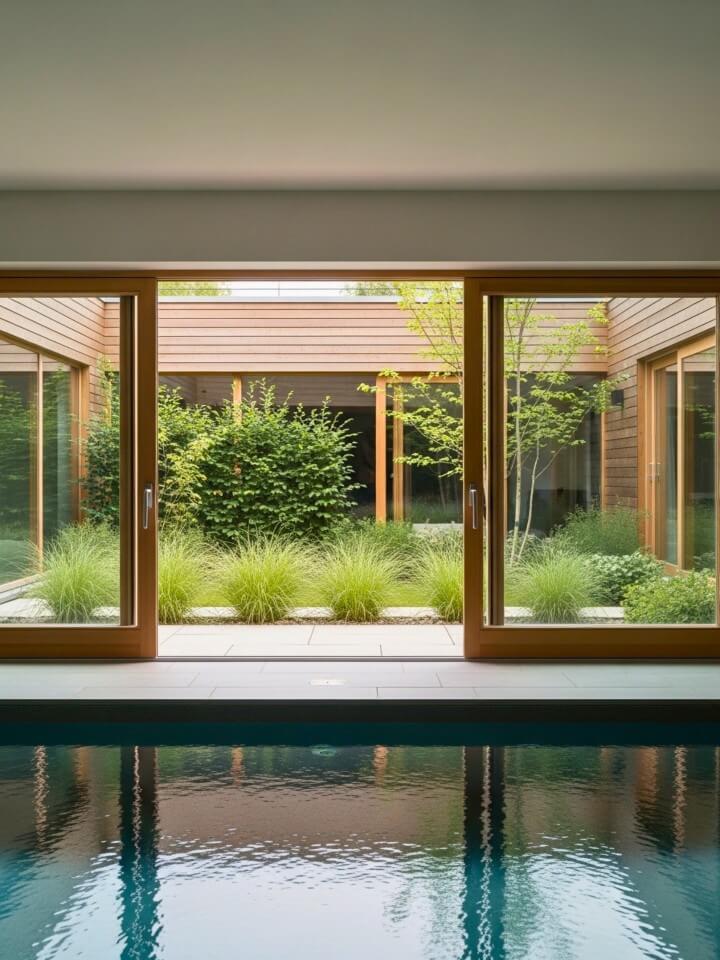
The point of a garden-view pool isn’t really the pool — it’s the frame. The water and surrounding tile should stay quiet enough that the eye travels straight through the glass to the planting beyond.
That means restraint indoors: neutral tile in stone or sand tones, minimal contrast at the waterline, no busy mosaic competing with the leaves outside. A sliding or pivoting glass wall opens the room in shoulder seasons; fixed panels are cheaper if you don’t need the access.
Pro tip: Design the outdoor planting first, then choose pool finishes to recede behind it. Most people do this backwards and end up with a beautiful pool fighting a beautiful garden.
Mature ornamental grasses, layered evergreens, and a single specimen tree carry more weight than dense flower beds.
13. Indoor Pool with Built-In Hot Tub
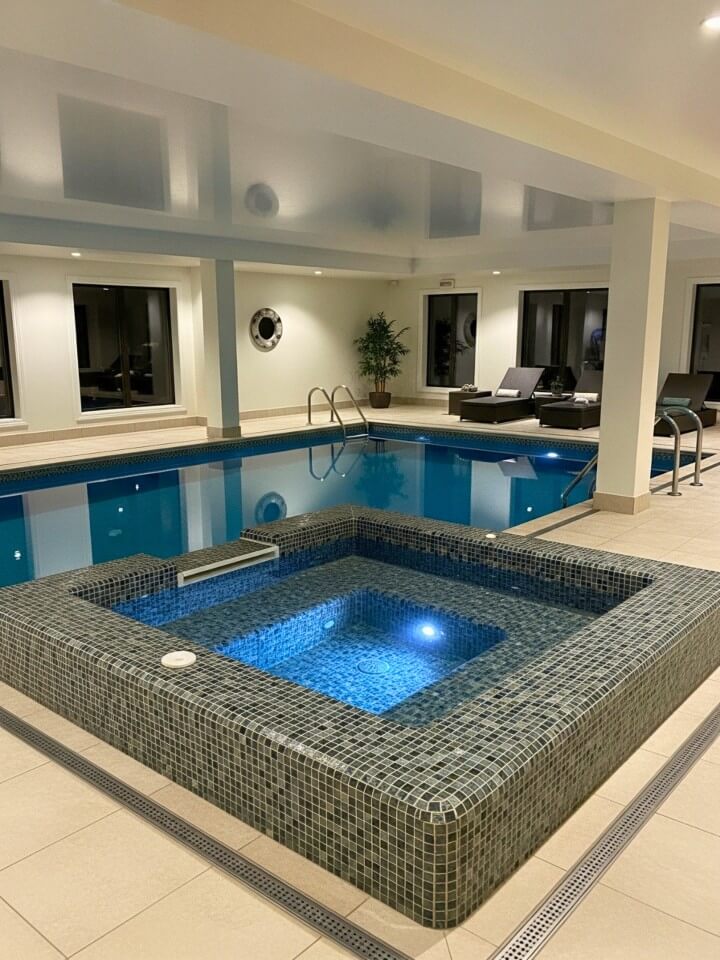
Good indoor swimming pool design starts with humidity, light, and how the space feels at midnight. A separate hot tub at the end of a pool wastes square footage and looks tacked on. Building one into the pool itself solves both problems — if temperature and circulation are handled correctly.
Two Ways to Integrate It
- Shared edge, separate systems. A 4–8 inch wall keeps the 102°F spa water from mixing with the 84°F pool. Each side has its own pump, heater, and filter — more expensive, but the tub actually stays hot.
- Spillover design. Spa water cascades into the pool at a slow trickle, creating a quiet water feature. Easier to engineer, but you’ll run the spa heater longer to maintain temperature.
Match tile across both bodies, add slip-resistant edging at the transition, and put the spa lights on their own dimmer.
14. Glass-Roof Pool Rooms Drenched in Daylight
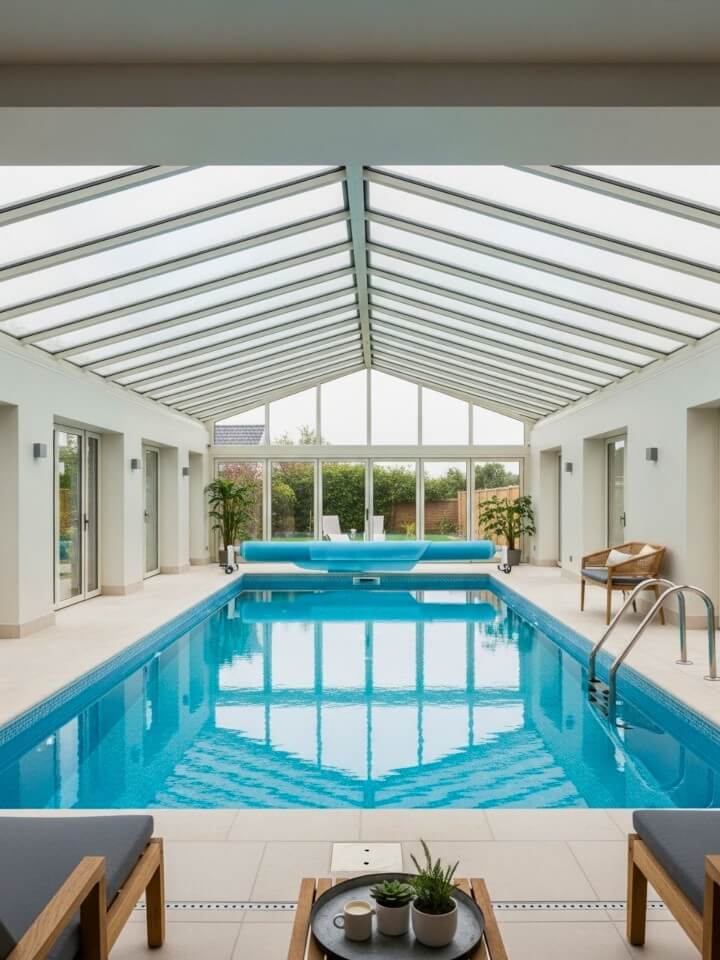
A glass roof is the most dramatic ceiling option for an indoor pool — and the most expensive mistake if specified wrong. Budget 3–5x what a standard insulated roof costs, before you factor in the structural engineering for snow loads.
Specs that Aren’t Optional
Triple-pane low-E with argon fill, structural silicone glazing, and a thermal break at every connection. Single-pane glass roofs are a guaranteed condensation disaster. A motorized interior shade system handles summer heat gain — without it, the room becomes unusable from June through September.
Pair the glass roof with minimal framing in matte black or warm bronze, pale tile to reflect daylight, and one or two low planters. Skip overhead pendants; the sky handles the lighting.
15. Indoor Pool with Color-Changing Lights
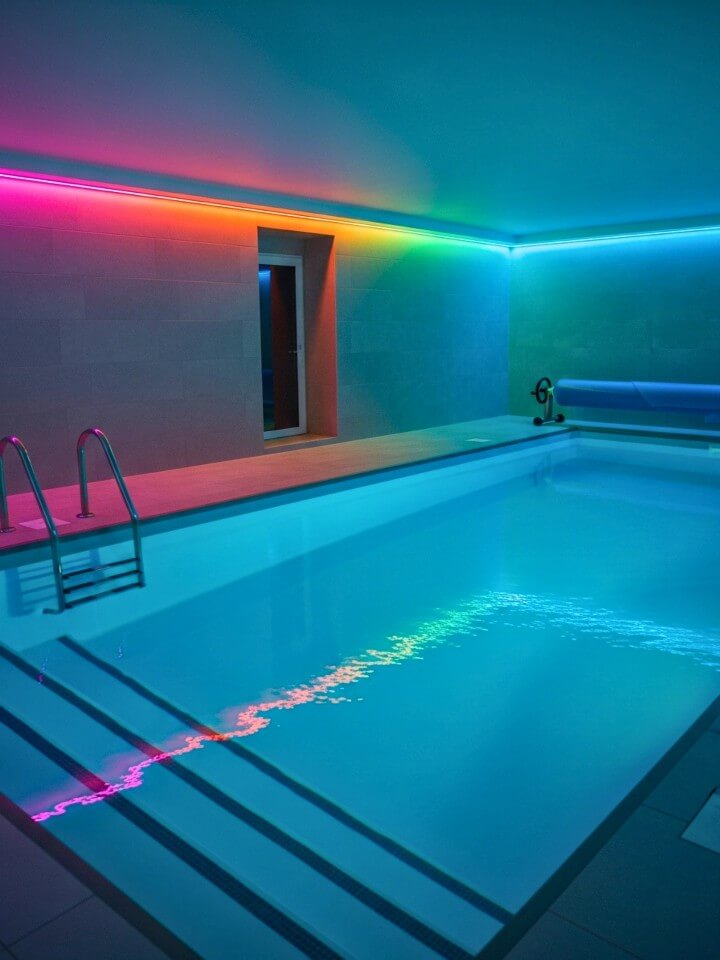
RGB pool lighting is fun for about a week, then most people leave it on the same warm white forever. The trick is treating color as a setting you use occasionally, not the default.
Useful Scene Presets
- Warm white (3000K): everyday swimming, photographs well
- Cool white (5000K): clearest underwater visibility for laps
- Deep blue: evening soak, low-stimulation mood
- Amber/sunset: entertaining or party scene
Underwater LED housings should be niche-mounted, low-voltage (12V), and rated for your pool size — roughly one fixture per 8 linear feet of wall. Add wall-wash strips behind a cove or under the deck overhang for indirect color. Control everything from a single app or wall keypad rather than juggling switches.
16. Infinity-Edge Pools Indoors
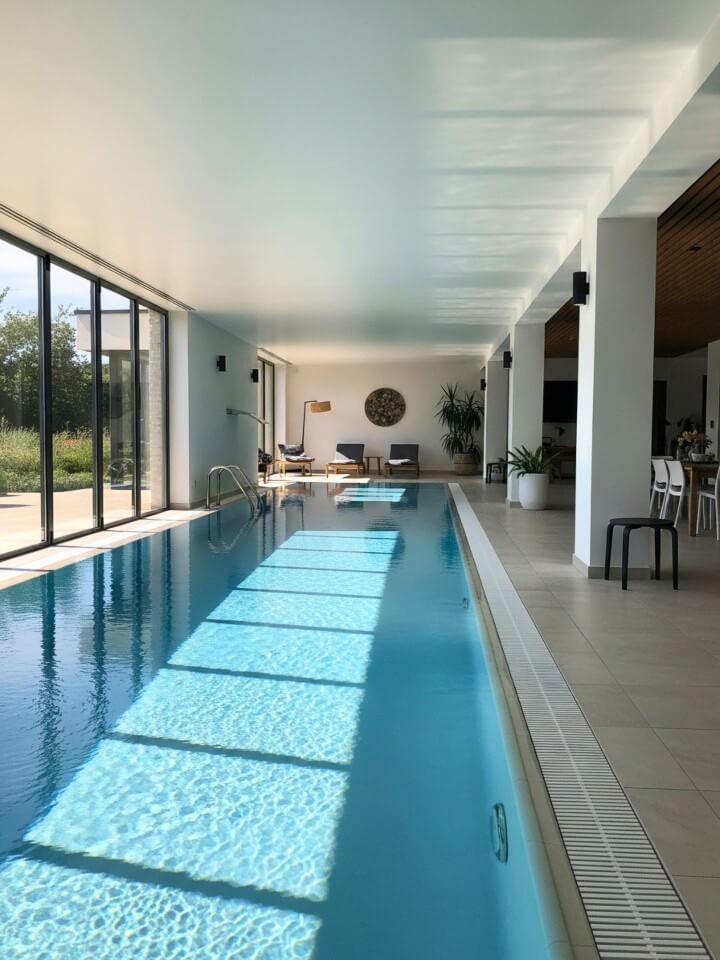
Infinity edges look like magic from the right angle and like an expensive drainage problem from the wrong one. Here’s what actually makes the effect work indoors.
The Mechanics
Water spills over a precisely level edge — tolerance is around 1/16 inch across the entire length — into a hidden catch basin below. A secondary pump returns it to the main pool. The illusion only holds if the room’s lighting and the wall behind the edge cooperate: a dark rear wall or floor-to-ceiling glass sells it, a bright wall kills it.
Indoor infinity edges are harder than outdoor ones because there’s no horizon to blend into. Pair the edge with dark catch basin tile, minimal furniture in the sightline, and one strong light source above the water.
17. Pool Room with a Working Fireplace
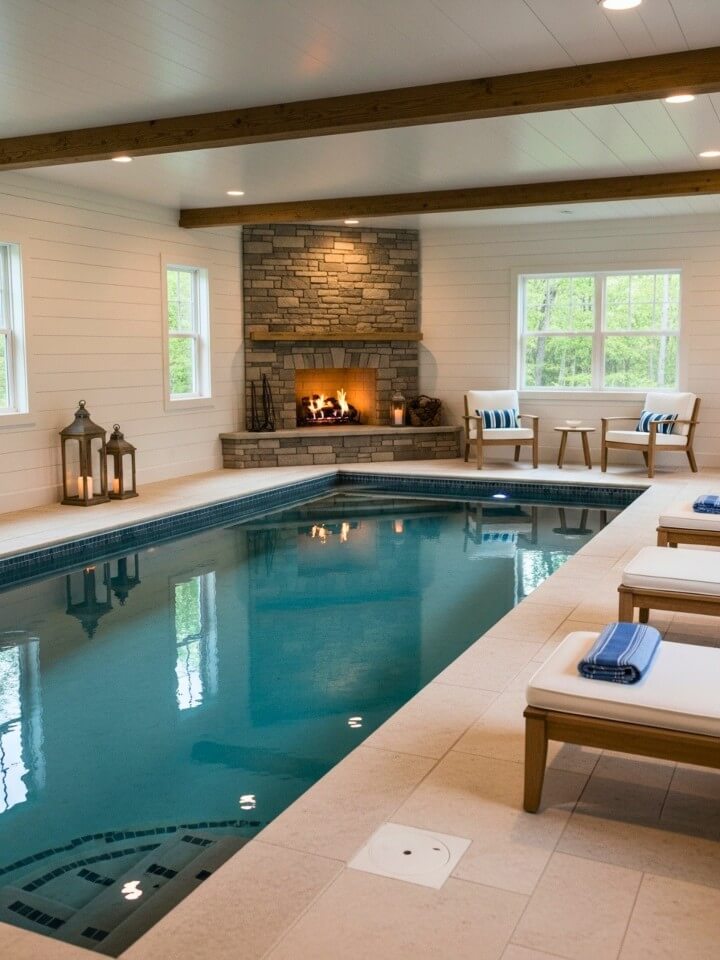
A fireplace in a pool room sounds like a contradiction — open flame beside splashing water — and it would be, with the wrong fuel choice.
- Skip: wood-burning (smoke plus humidity equals chimney corrosion) and vented gas with a draft hood (drafts pull pool chemistry into the flue).
- Choose: sealed-combustion direct-vent gas, or a UL-listed bioethanol burner. Both seal cleanly against moisture-heavy air.
Set the firebox at least 6 feet from the waterline and behind a non-combustible surround — porcelain slab, stacked stone, or steel-clad masonry. A linear horizontal opening reads more modern than a traditional rectangular box. Pair it with low-slung loungers facing the water and a rug rated for damp areas.
18. Waterfall Features That Set the Sound of the Room
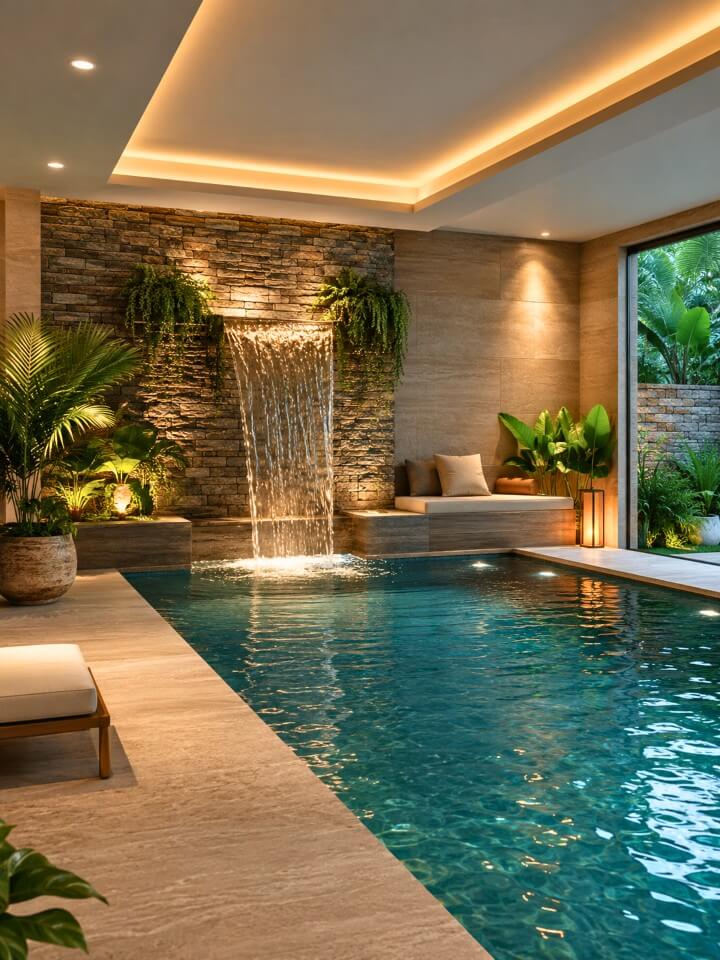
Indoor waterfalls split into two camps based on how loud you actually want the room to be.
- Sheer descent (quiet): A thin laminar sheet of water falls from a wall-mounted slot — almost silent, more visual than audible. Best for spa-style rooms where conversation matters.
- Rock cascade (active): Water tumbles over stacked stone with real splash and sound — around 50–55 dB, which is restaurant-conversation level. Better for resort-feel rooms with high ceilings that absorb echo.
Either way, mount the source on a short end wall, not above the swimming area where splashback becomes a slip hazard. A dedicated pump separate from the main filtration gives you on/off control without disturbing circulation.
19. Bold Black-Tile Pool with Mirror-Like Water
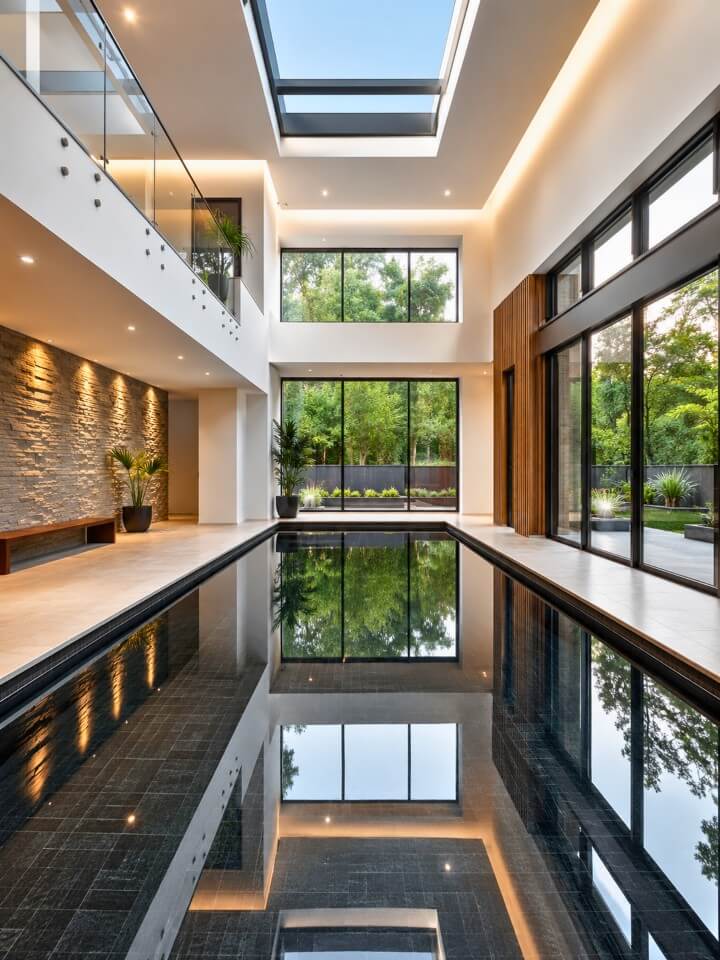
A pool in house design isn’t just luxury — it’s smart use of space, light, and year-round comfort. Black tile is the boldest finish an indoor pool can take — and the one that punishes shortcuts the hardest. The water looks deep, glassy, almost reflective, provided the room is bright enough to make the surface read as a mirror rather than a hole.
Light First, Then Tile
Plan on roughly double the lumens you’d use in a white-tile room. Skylights, large windows, or a glass roof do the heavy work; ceiling fixtures alone won’t carry it.
The Maintenance Reality
Black tile shows every speck of scale, calcium deposit, and algae streak that white tile hides. Plan on weekly brushing and tight water chemistry — pH and calcium hardness especially. Matte or honed finishes hide imperfections better than polished.
20. Floating Deck That Turn a Pool Into Architecture
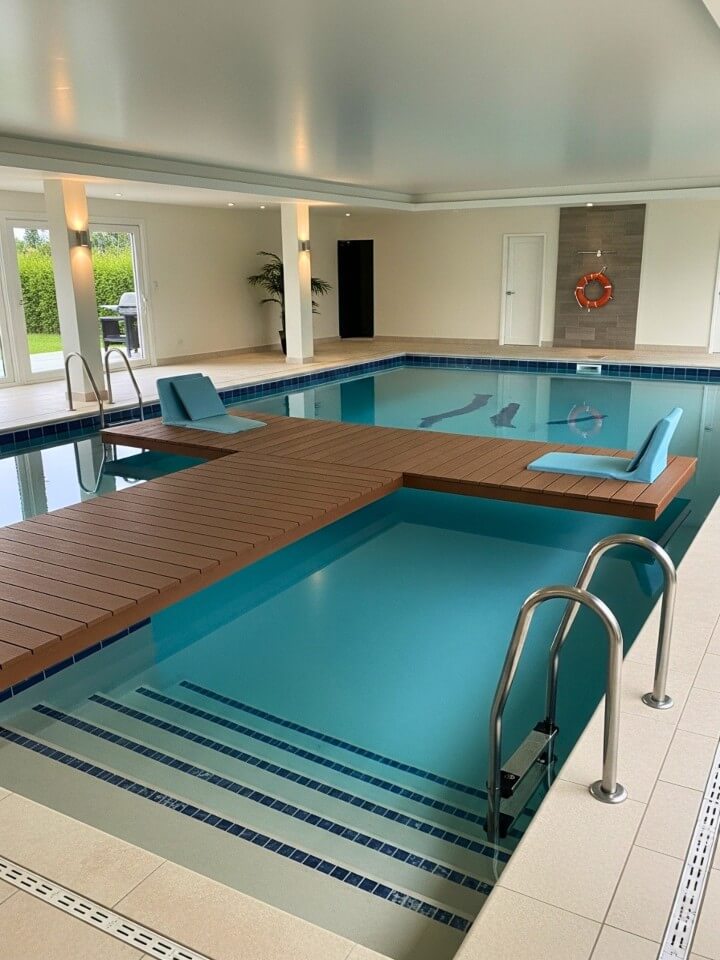
A floating deck — a platform sitting above or across part of the water — turns a single-purpose pool into something closer to architecture. The structural detail separates decks that age well from the ones that warp inside two years.
Material Options, Ranked
- Ipe or cumaru — dense tropical hardwood, 25+ year life, expensive but proven
- Thermally modified ash — similar look, mid-range cost, good rot resistance
- Capped composite — zero maintenance, slightly plastic appearance
- Textured concrete — most durable, heaviest, requires engineered support
Mount it on stainless or hot-dip galvanized steel brackets anchored to the pool wall — never to the pool shell itself. Leave a 3/8 inch gap between boards for drainage and inspection access.
21. Indoor Pool with Retractable Cover
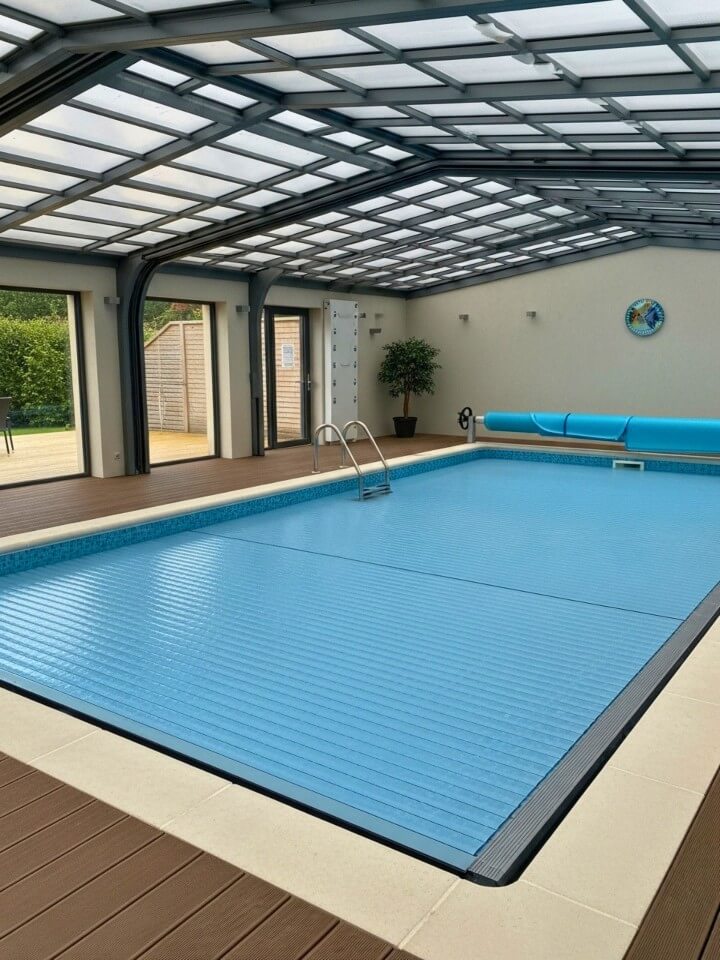
A retractable cover is the safety feature most indoor pool owners regret skipping. It also cuts heating costs by 50–70% by trapping evaporation, which is the single biggest energy drain in any pool room.
Three Cover Types Worth Knowing
- Automatic slatted (rigid): Polycarbonate slats roll out from a recessed end housing. Walk-on rated, best safety, highest cost ($15k–$30k installed).
- Automatic vinyl tracked: A vinyl membrane runs along tracks under the coping. Lower profile, mid-range cost, walk-on rated when fully closed.
- Manual reel: A thermal blanket on a wheeled reel. Cheap and effective for evaporation, but not a safety device.
Wire the motor to a key switch rather than a wall button — keeps kids from playing with it. For homes where pool access also connects to outdoor areas, splendid pool fence ideas can help you think through another layer of safety and visual separation.
22. Indoor Pool with Lounge Chairs
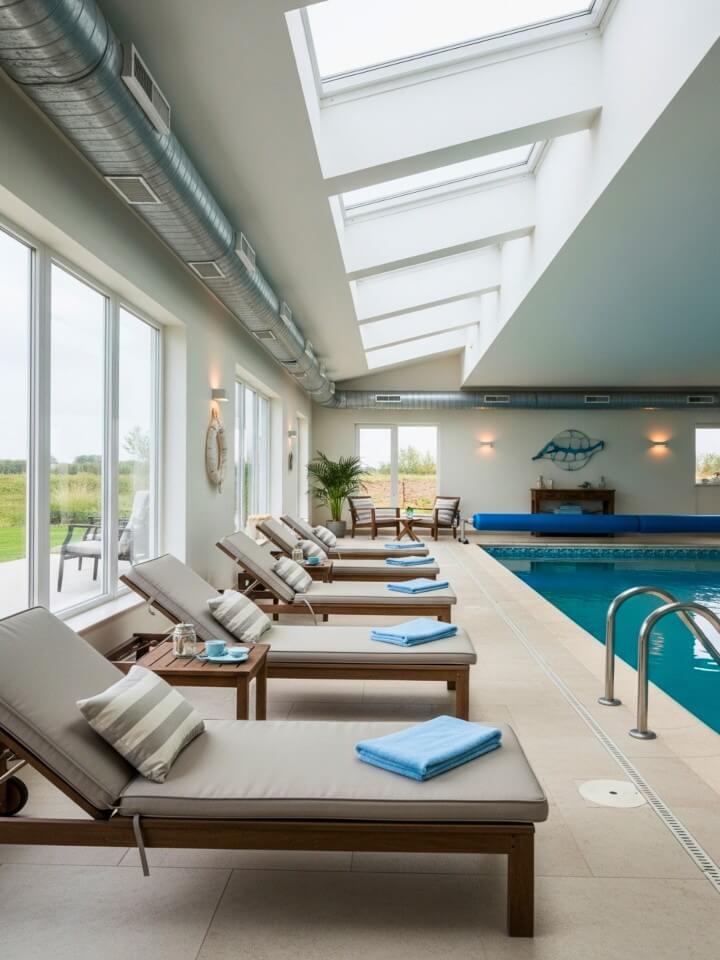
Pool-room loungers face a harder environment than outdoor furniture: constant humidity, chlorine off-gassing, and zero UV to kill mildew on damp cushions. Most patio furniture fails inside two years here.
What Actually Survives:
- Frames: powder-coated aluminum or 316 marine-grade stainless — skip standard steel, even painted
- Slings: solution-dyed acrylic mesh (Textilene, Phifertex)
- Cushions: solution-dyed acrylic covers (Sunbrella) with quick-dry foam — never cotton or polyester batting
- Feet: rubber or HDPE glides, never bare metal on wet tile
Two or three loungers along the long side of the pool is usually the right count. Add one teak side table for a glass of water — not four matching pieces fighting for space.
23. Exposed Beams Over the Water
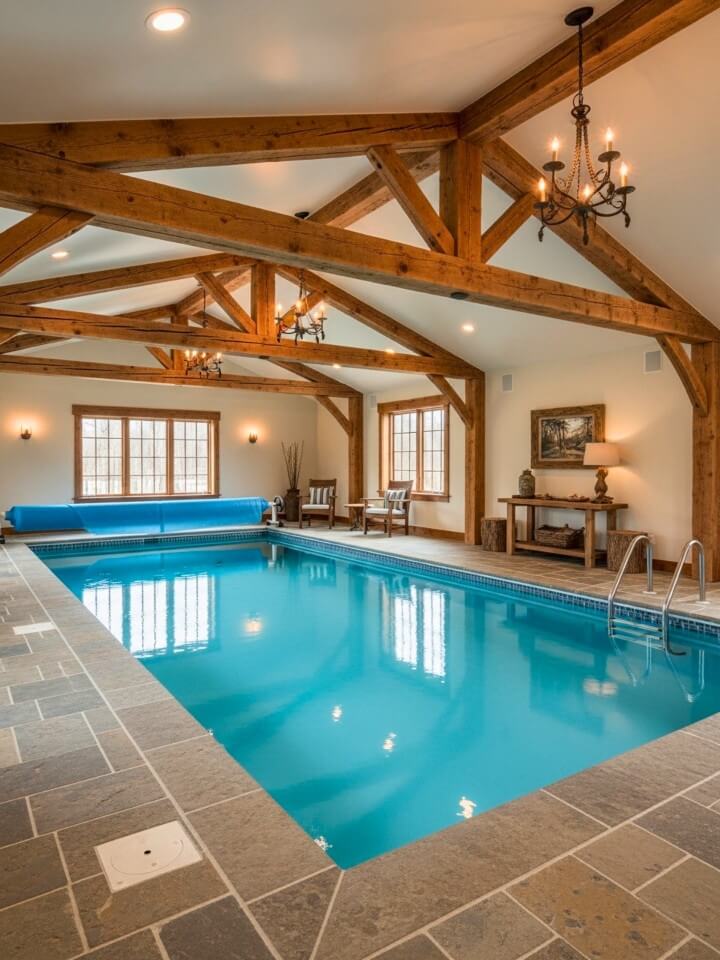
Exposed beams over an indoor pool add character that drywall can’t fake — but pool-room humidity destroys untreated wood faster than any other interior environment. The wrong species or finish is a multi-thousand-dollar mistake.
What Holds up Over Water
Western red cedar, accoya, white oak with a marine-grade sealer, and borate-treated Douglas fir are the proven choices. Reclaimed barnwood looks incredible and warps within two years unless it’s been kiln-dried and sealed on all six sides — including the hidden faces touching the framing.
Solid structural beams cost more than decorative box beams cladding a steel core, but they age better. Either way, finish with a penetrating marine oil reapplied every 2–3 years.
24. Stone Pathways With Real Slip Resistance
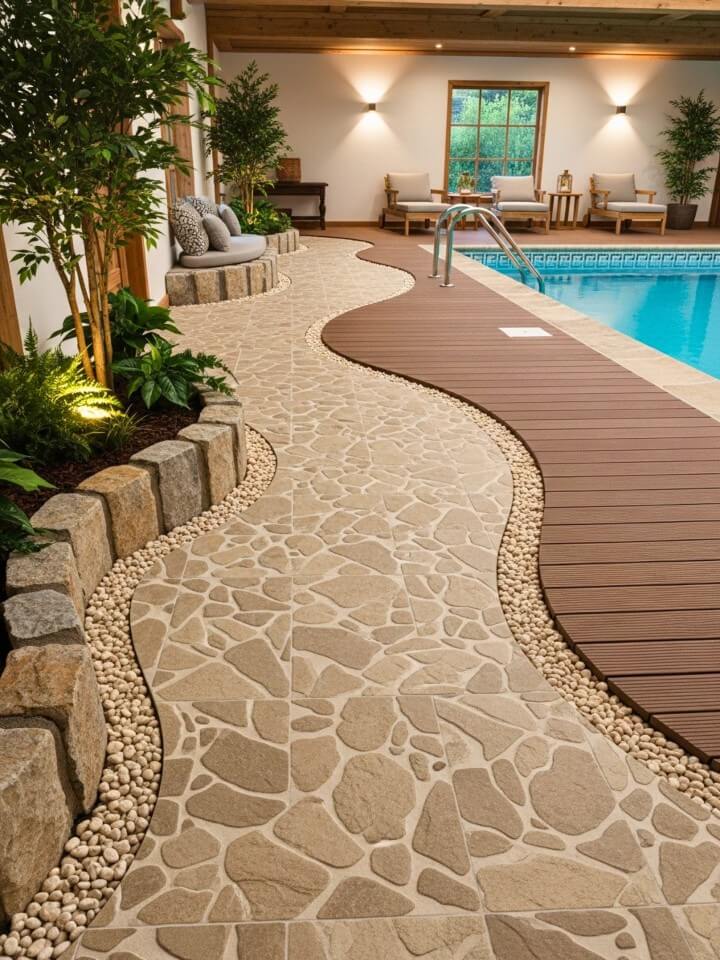
A stone pathway around a pool isn’t only a design choice — it’s a slip-hazard test wet feet run every day. The detail that matters most is barely visible.
The surface needs a Dynamic Coefficient of Friction (DCOF) of at least 0.42 when wet — the threshold for code-compliant wet-area flooring. Tumbled travertine, flamed granite, sandblasted bluestone, and split-face slate all clear this comfortably. Polished marble and most porcelain pavers don’t.
Set stones with tight grout joints (1/4 inch max) so toes don’t catch, slope the path 1/8 inch per foot away from the pool for drainage, and keep walkways at least 36 inches wide for two-way traffic.
25. Minimalist Tile Choices That Stay Timeless
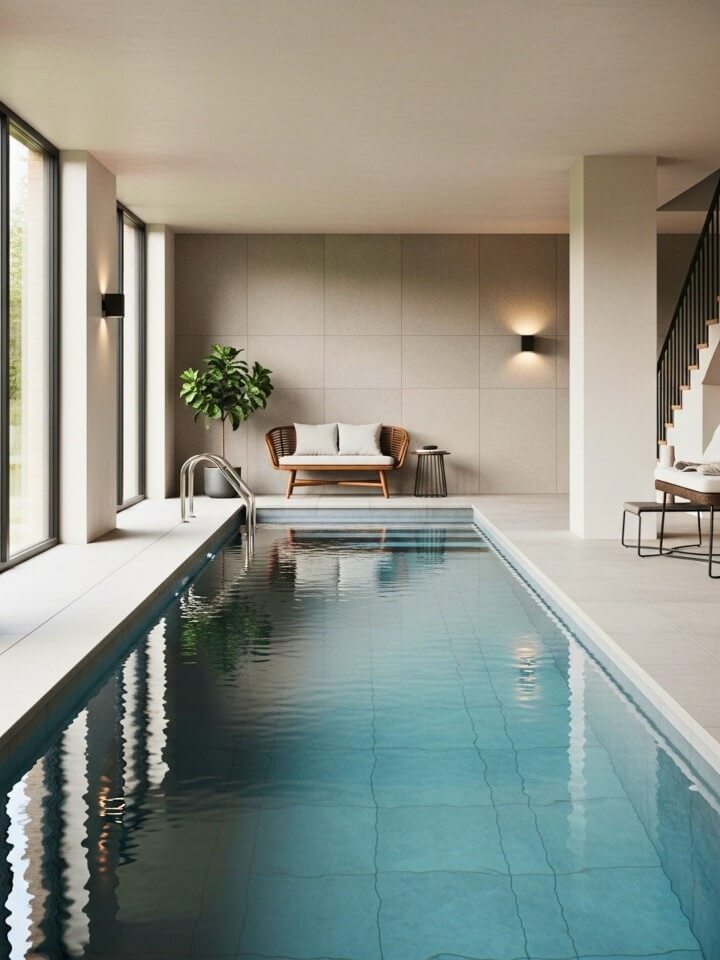
Fresh indoor pool ideas for house owners who want bold style without losing daily practicality. Minimalist pool tile is harder than it looks. With no pattern to hide behind, every grout line and color shift becomes visible — which is why format and tone matter more than the tile design itself.
Format that Reads as Minimalist
- 24×48 inch large format: fewest grout lines, cleanest look
- 12×24 inch porcelain: mid-range cost, still clean
- 2×2 inch glass mosaic: only if you want subtle texture
Color that Stays Timeless
Soft warm grays, sand, off-white, and the palest greige outlast every other pool color. Cool grays and bright whites date faster than people expect.
Match coping and deck tile within one or two shades — sharp contrast undoes the minimalism.
26. Indoor Pool with Indoor Garden
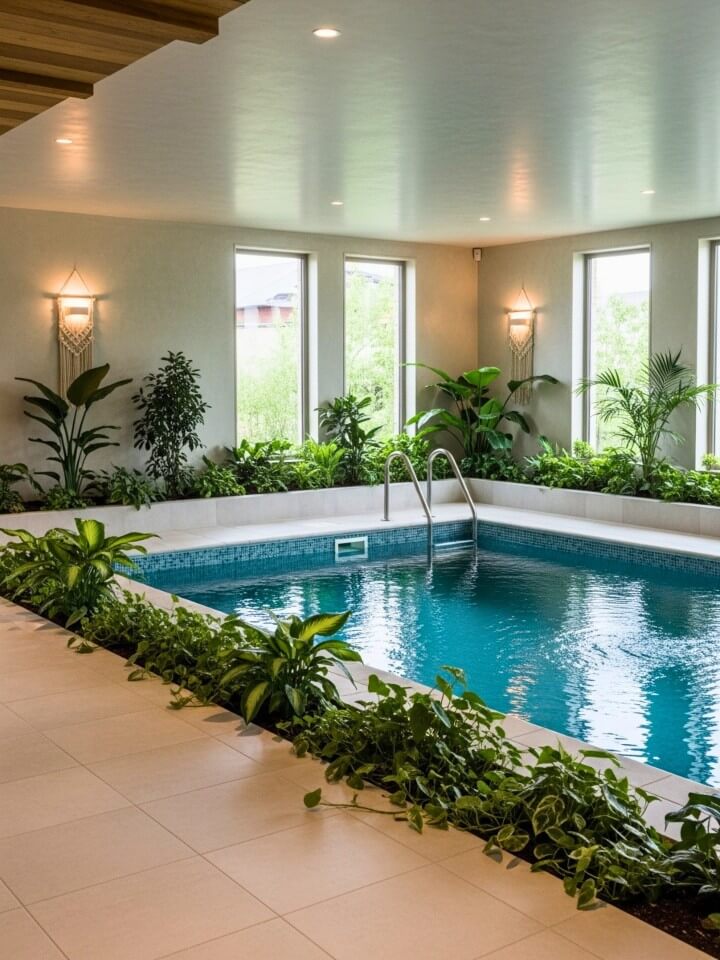
An indoor pool with a true garden — not just a few potted palms — is the highest-effort, highest-payoff version of the whole concept. Done casually, it turns into a maintenance disaster. Done deliberately, the room stops feeling like a pool and starts feeling like a conservatory.
Build It Into the Structure
Plan dedicated planting beds with waterproof liners and proper drainage to the building’s gray-water system — not pots placed on tile after the fact. Soil depth of 18–24 inches handles most tropical species. Run a low-voltage drip line on a timer.
Layer the planting: tall kentia palms or ficus as canopy, mid-height monstera and philodendron, and a ground layer of pothos. Supplement low-light spots with 6500K grow fixtures.
Indoor Pool FAQs: The Questions That Decide Whether You Actually Build One
Cost, upkeep, resale value, and what tends to go wrong — these are the practical worries that stall most indoor pool projects long before a contractor is hired. Here are honest answers to the five questions homeowners ask most before signing anything.
How Much Does It Cost to Build an Indoor Pool?
Indoor pools typically run $100,000 to $250,000 fully installed, with luxury builds pushing past $500,000. The pool itself is only part of it — dehumidification, ventilation, structural work, and the room enclosure usually cost more than the water.
What’s the Monthly Cost to Run an Indoor Pool?
Expect $200 to $700 a month for heating, dehumidification, chemicals, and electricity. Larger pools and colder climates push the high end. A well-insulated room paired with an automatic pool cover can cut that monthly bill nearly in half.
Does an Indoor Pool Add Value to A Home?
It depends entirely on the market. In luxury neighborhoods, a well-built indoor pool can boost value by 5–8%. In mid-range areas, it often shrinks the buyer pool more than it raises the price tag, so research comparable sales first.
How Long Does It Take to Build an Indoor Pool?
A full build typically runs 6 to 12 months from permit to first swim. Custom designs with glass roofs, structural changes, or basement excavation can stretch past 18 months. Weather delays, inspections, and material lead times add real unpredictability.
How Do You Prevent Mold and Humidity Damage in An Indoor Pool Room?
A dedicated dehumidification system — not a residential unit — keeps room humidity between 50–60%. Add a vapor barrier behind every wall, seal the slab properly, and run an automatic pool cover whenever the room isn’t being used.
Conclusion:
The best indoor pools aren’t the ones with the biggest budget or the most dramatic glass roof — they’re the ones where every decision was made with humidity, light, and how the room actually gets used in mind. A modest plunge pool with the right ventilation will outlast a luxury build that ignored the basics. Before falling in love with a finish or a feature, sit in the empty room at night and picture a damp swimsuit on the floor, fogged windows, and a Tuesday in February. The pool you’ll still love in ten years is the one that survives that picture.