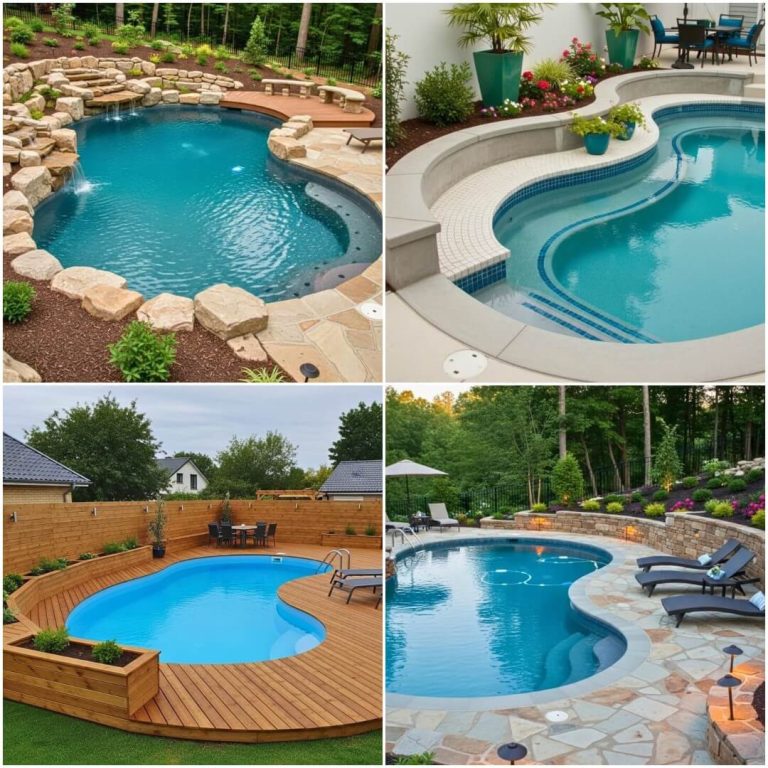
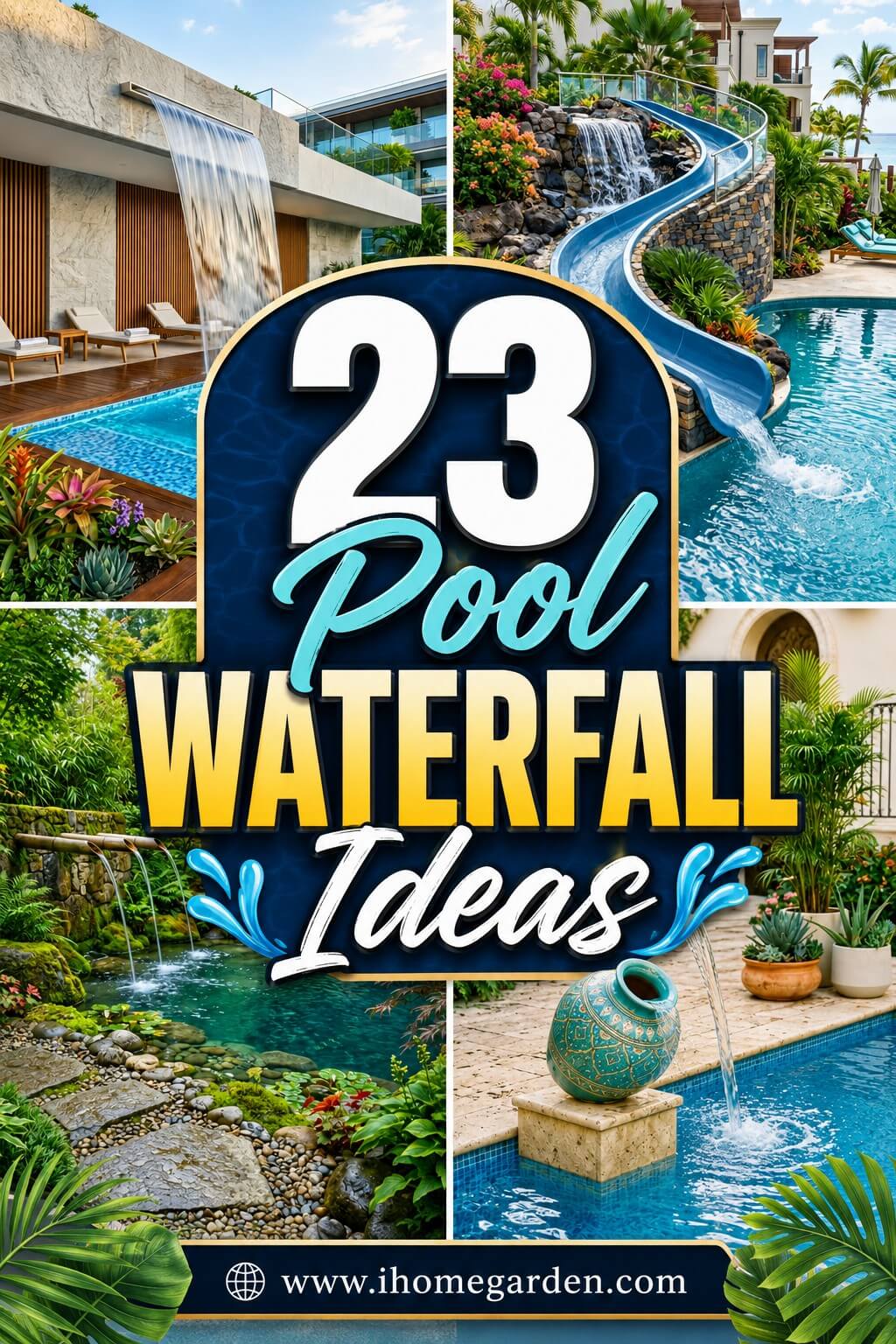
23 Pool Waterfall Ideas: From Simple Spouts to Show-Stoppers
There is something about the sound of falling water in a backyard that makes the whole space feel different. Kids stop asking for screens. Adults actually sit still for a minute. Even the dog picks a spot nearby and settles in. That is the quiet power behind these 23 excellent pool waterfall ideas, and why so many homeowners end up adding one after living with a plain pool for a few years.
The choices go way beyond piled-up rocks in the corner. Think glass panels that look almost invisible, small copper spouts that add a heartbeat of sound, or hidden edges where water seems to vanish into thin air. Some fit tight courtyards, others need a hillside to shine.
Pick one that matches how the backyard actually gets used, not just how it looks in photos. The right feature changes everything, from morning coffee to late-night swims.
1. Rock Grotto Waterfall
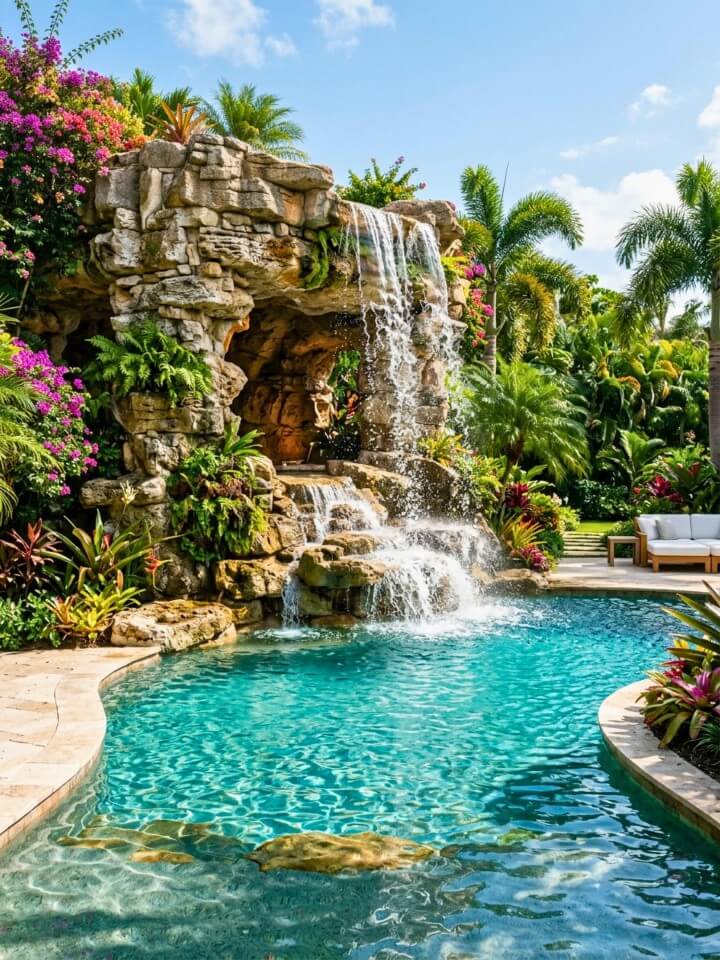
Consider a hidden cave tucked into the deep end of the pool, with water spilling through gaps in stacked boulders and creating a shaded pocket underneath. That is the appeal of a rock grotto. Swimmers can duck inside, sit on a submerged ledge, and listen to water rushing overhead.
This feature belongs in tropical or rustic backyards where dense planting hides the edges of the structure. Palms, ferns, and climbing vines complete the effect. Budget-wise, expect one of the higher price tags on this list because grottos require custom rockwork, structural engineering, and skilled masonry. Once built, though, they last decades with minimal upkeep beyond occasional pressure washing and checking pump performance.
2. Sheer Descent Water Feature
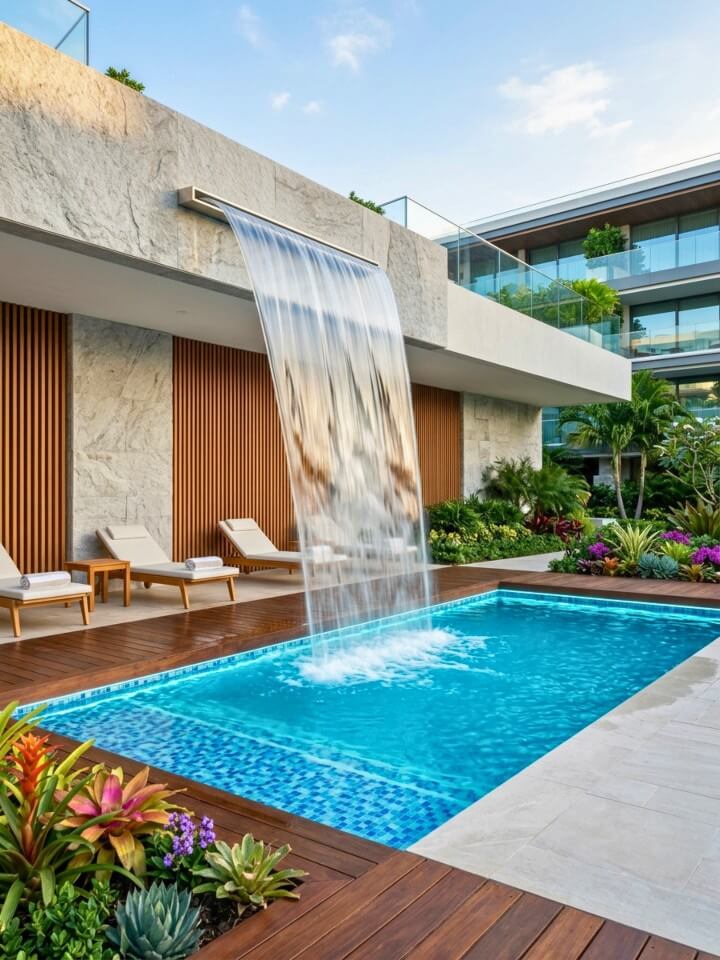
Straight lines. Smooth flow. A single sheet of water falling into the pool without a single ripple out of place. That is what a sheer descent delivers, and it is why architects reach for this design when working with modern homes.
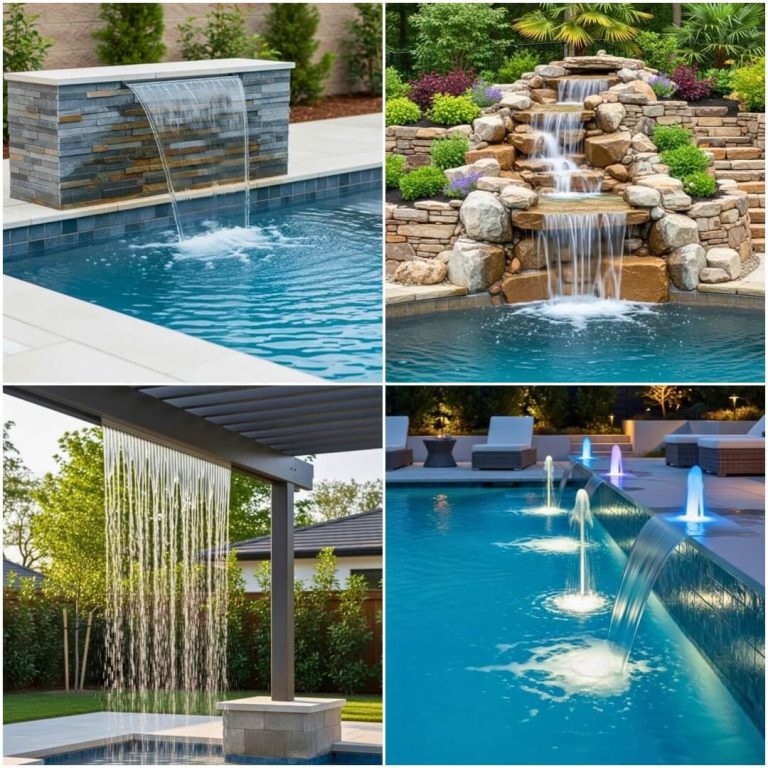
The mechanism is simple: a wide rectangular chute mounted just above the waterline pushes water out in a controlled arc. Widths typically range from one to four feet. Longer chutes need stronger pumps, so plumbing choices matter early in planning. Best pairings include porcelain tile, poured concrete, and stacked ledger stone walls. For nighttime drama, install a waterproof LED bar directly behind the spill so the falling sheet glows.
3. Wall Scupper Spout Ideas
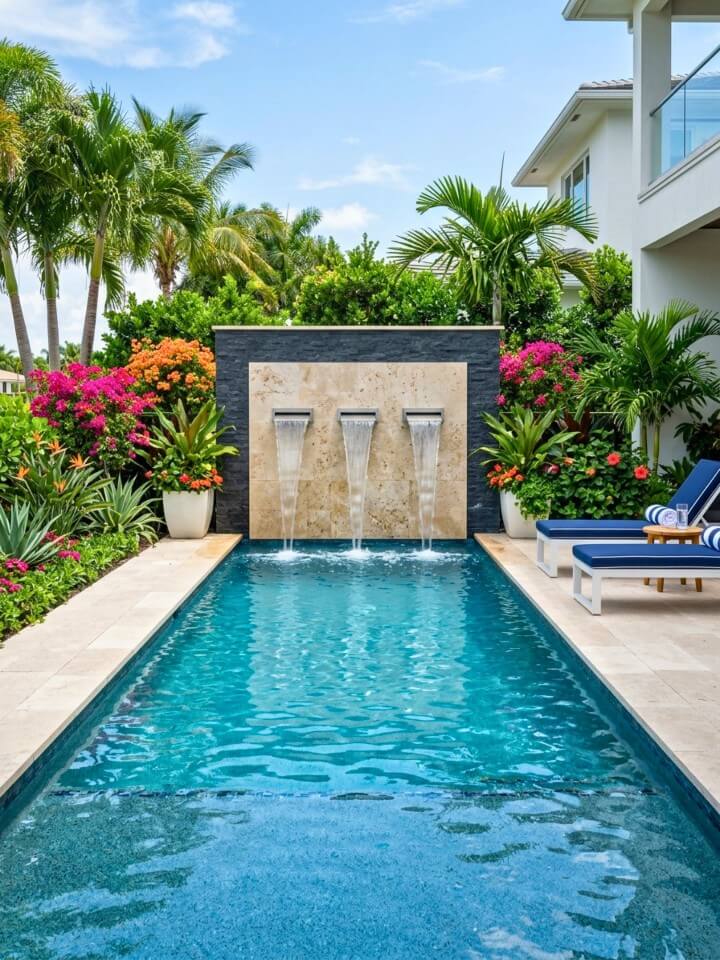
Transform your backyard oasis with a stunning pool waterfall that turns ordinary swims into escapes. Scuppers are small metal spouts, usually copper, bronze, or brushed stainless, that push water out in short, focused streams. Think of them as jewelry for a pool wall. They rarely stand alone as the main feature but instead add rhythm and detail to a larger design.
Common arrangements include three evenly spaced scuppers along a raised wall, or a symmetrical pair flanking a central sculpture. The choice of metal matters more than most homeowners realize. Copper develops a green patina over time, bronze deepens in color, and stainless stays sharp and industrial. Mediterranean villas, Spanish revival homes, and geometric modern builds all take well to this feature.
4. Raised Wall Spillover
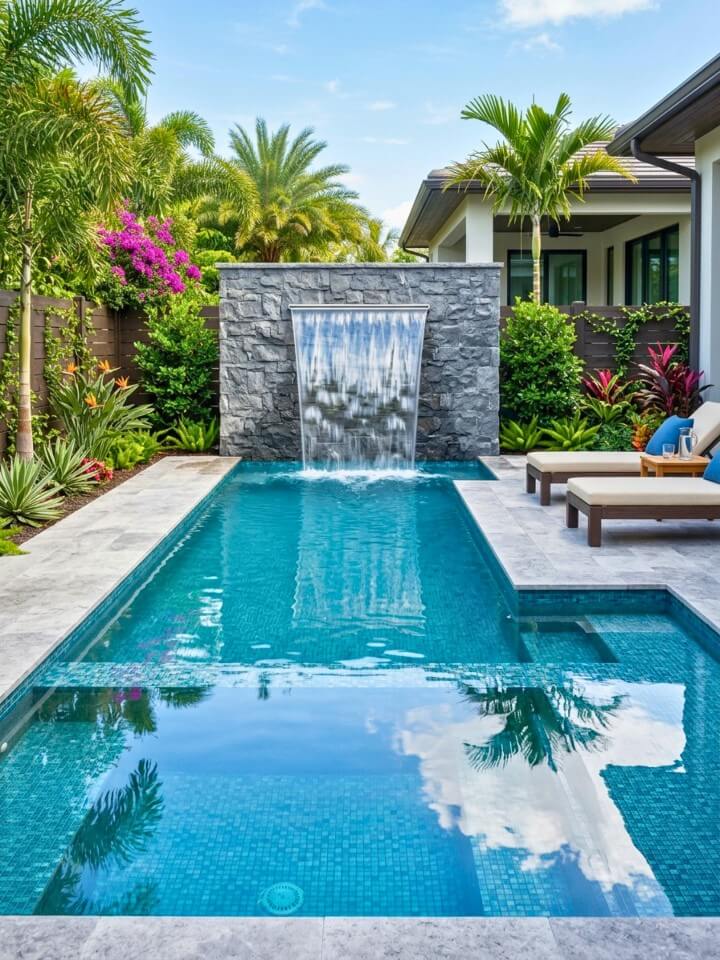
A raised wall spillover works as both a design element and a practical divider. The wall itself separates the pool from a patio, garden bed, or seating deck, and water flowing over its edge softens what would otherwise be a hard vertical line.
The spill can stretch across the entire wall length or just a section, depending on the visual effect wanted. Wider spills produce a curtain-like sheet, while narrower cuts feel more focused. Plaster gives a clean finish, travertine adds warmth, and glass tile brings shimmer. Homeowners in transitional or modern spaces get the most from this design. Adjusting flow rate through a variable-speed pump lets the sound shift between whisper and rush.
5. Spa to Pool Cascade
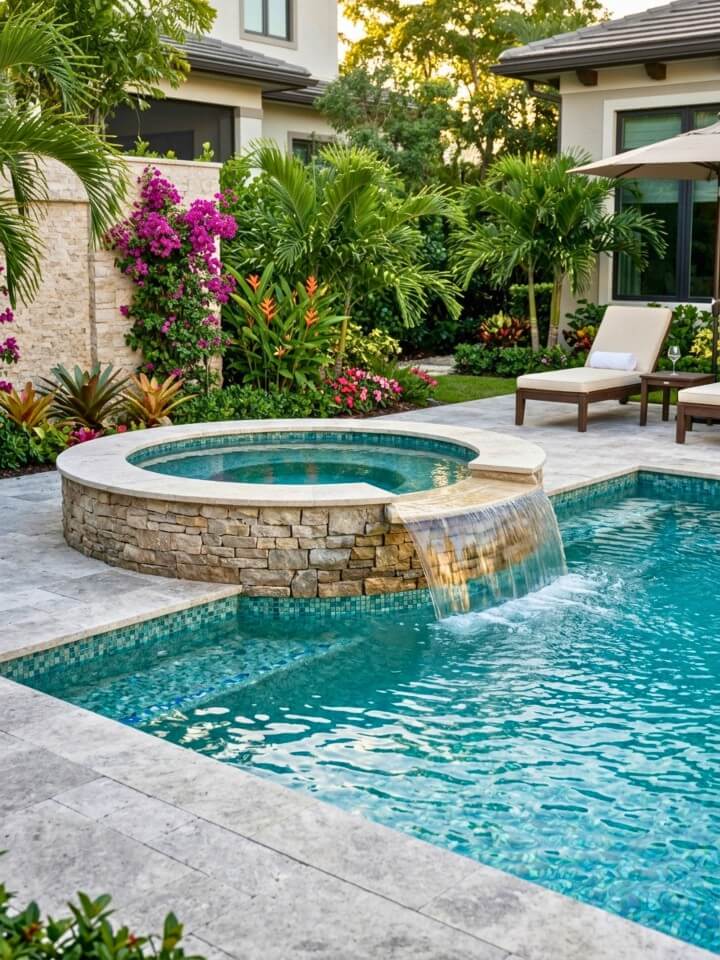
Combining a hot tub with a pool used to feel like sticking two separate features side by side. The spa spillover fixes that. Warm water tumbles from the raised spa down into the cooler pool, tying both together into one connected experience.
Why It Works so Well:
- Shared plumbing and heating cut long-term energy costs
- The sound of falling water masks conversation from neighbors
- Warm water rising from the pool surface creates gentle steam on cool evenings
- The elevated spa becomes a natural focal point in the yard
Stone coping, glass tile, or textured concrete all suit this design. Position outdoor loungers within earshot but out of splash range, and the space becomes a year-round retreat.
6. Pondless Slate Waterfall
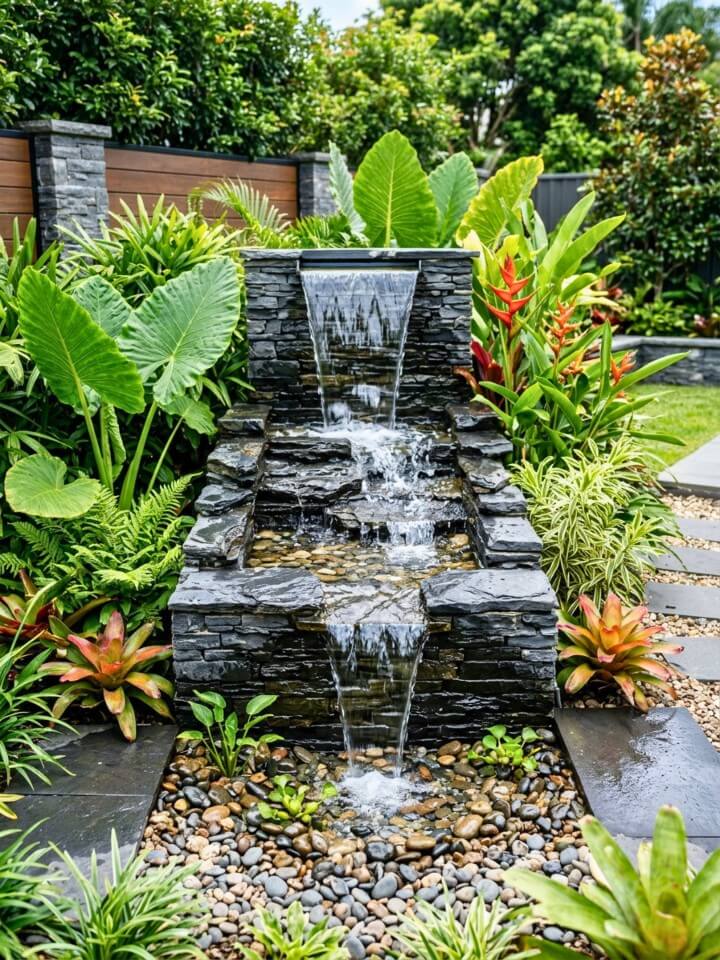
Not every backyard has room for a full catch basin, and not every homeowner wants the maintenance that comes with standing water. The pondless slate waterfall solves both problems. Water flows down layered slate, disappears into a bed of decorative gravel, and gets pumped back up through a hidden underground reservoir.
The result reads as a natural waterfall without any visible pool at the bottom. Side yards, narrow pool borders, and courtyard corners all suit this design. Slate works particularly well because flat, dark stones create smooth sheeting flow that catches light beautifully. Costs stay reasonable since the reservoir replaces expensive pond construction. Surround the base with mondo grass, creeping thyme, or dwarf mondo for a finished garden look.
7. Decorative Urn Water Feature
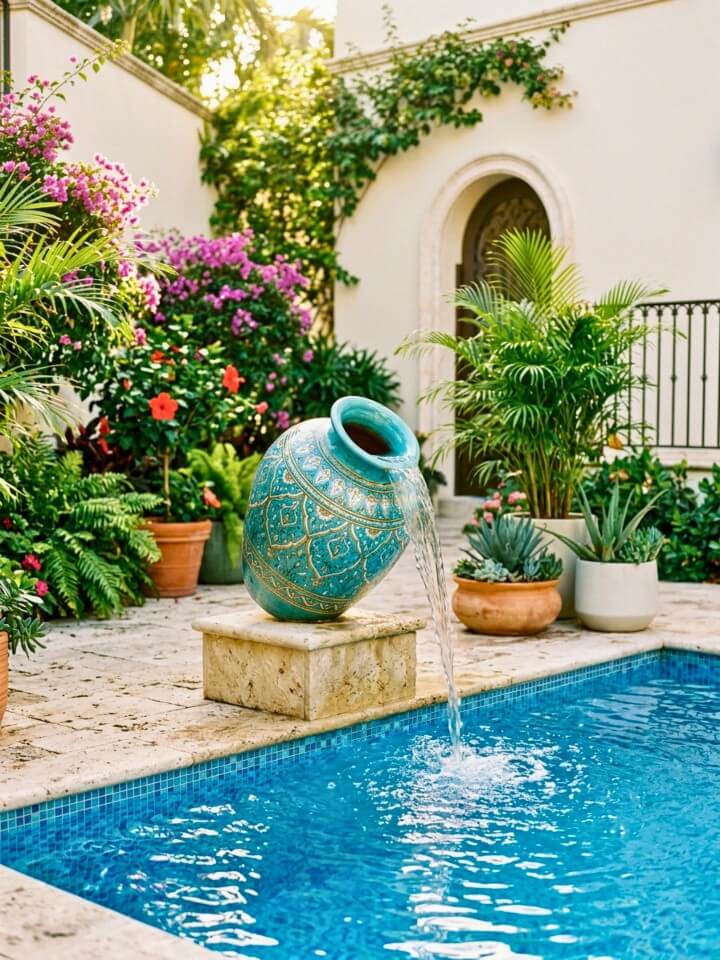
Sometimes the best feature is the simplest one. A single decorative vessel, tipped slightly or set upright with a hidden spout, pours water into the pool from a raised edge or nearby ledge.
Vessel Choice Drives the Entire Mood:
- Glazed ceramic in deep blue or forest green suits Mediterranean and Spanish styles
- Weathered terracotta brings farmhouse warmth
- Hammered copper develops character over years of exposure
- Cast concrete anchors modern minimalist spaces
- Carved stone fits classical or formal gardens
Installation stays affordable because no major construction is needed. A small submersible pump, some hidden tubing, and proper leveling handle the mechanics. Adjust flow strength to shift the mood from meditative trickle to energetic pour.
8. Pool Slide Cascade Combo
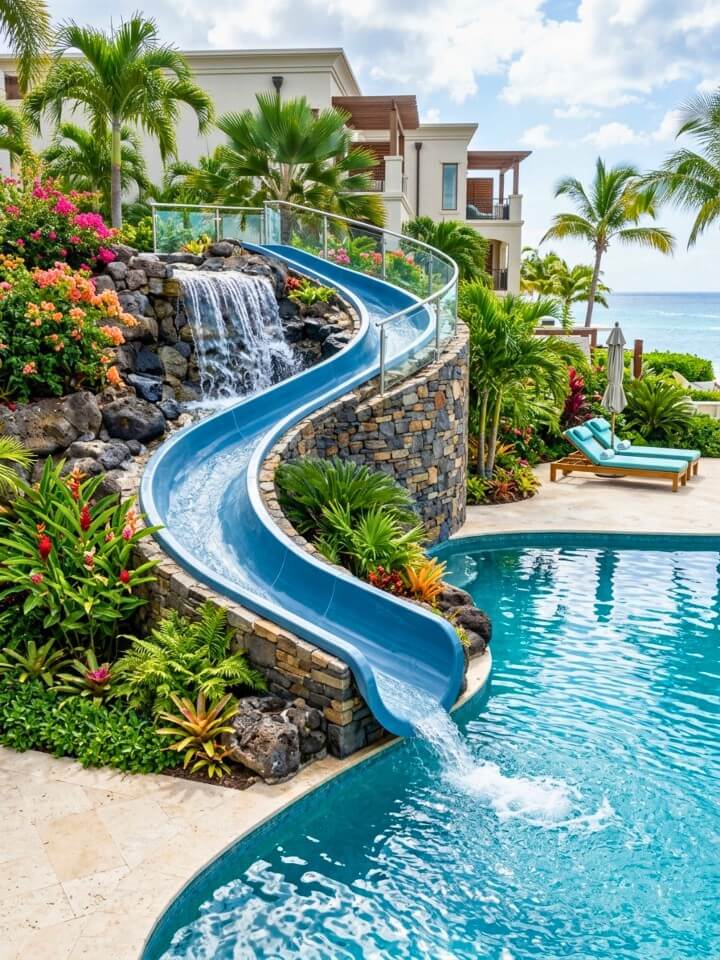
Discover jaw-dropping pool waterfall ideas that blend luxury, nature, and soothing sounds beautifully. Kids do not care about design magazines. They care about whether the slide is fast and fun. Adding a waterfall along a pool slide accomplishes both goals at once, keeping the surface slick for smoother rides while turning a functional element into a lively centerpiece.
Water channels run along the sides of the slide bed or feed from the top platform, cascading down alongside the rider. Deeper splash zones at the base handle the landing safely, so pool depth matters when planning placement. Clearance around the slide entry needs open decking without furniture or planters. Resort-style backyards and family-focused layouts benefit most. Budget varies widely depending on slide size, custom shaping, and how elaborate the water system becomes.
9. Garden Bridge Water Crossing
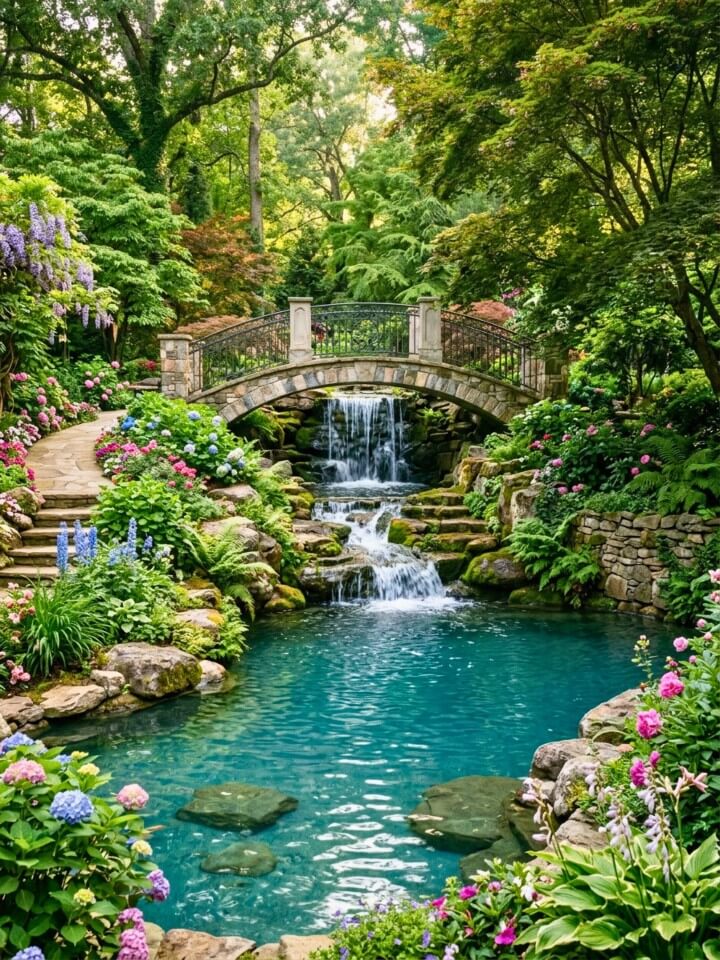
A bridge waterfall belongs in yards big enough to have distinct zones. The bridge itself connects one part of the landscape to another, say a lawn to a patio, or a garden path to the pool deck, and water flows underneath or alongside the crossing.
The style of the bridge sets the tone completely. Curved red wooden bridges pull toward Japanese garden inspiration. Flat stone slabs feel rustic and grounded. Wrought iron railings lean classical. Keep water flow gentle rather than dramatic, since the bridge is meant to invite people to pause and cross, not compete with a rushing torrent. Plant clumping bamboo, Japanese maples, or ornamental grasses along the banks to soften the transition between structure and landscape.
10. Rain Curtain Waterfall
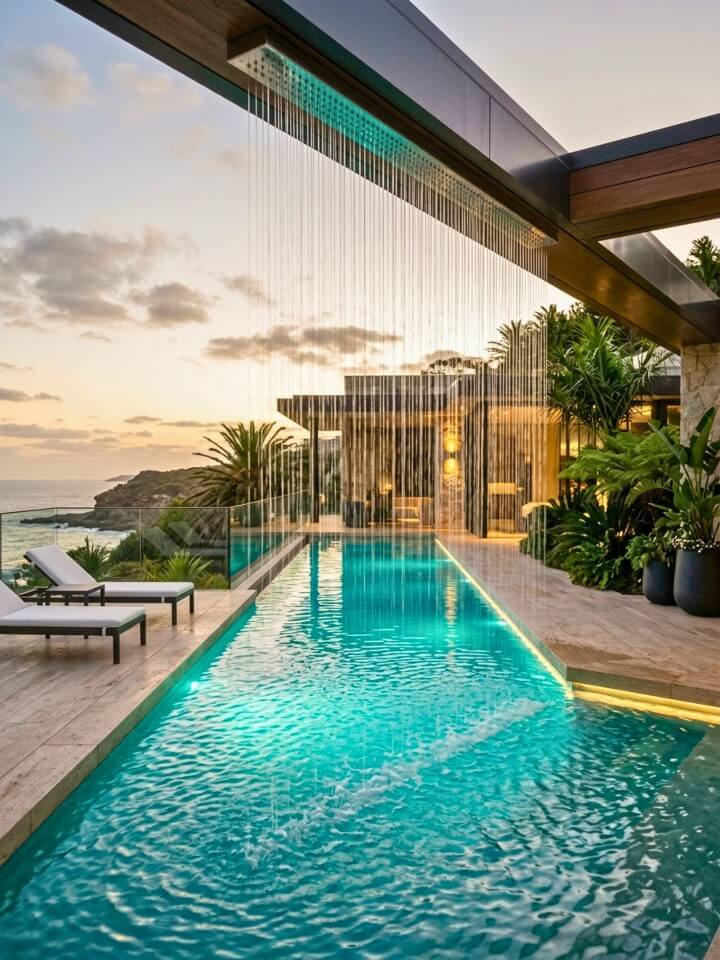
Imagine standing under a pergola while dozens of thin water streams fall in perfectly spaced lines, hitting the pool surface with a soft, steady patter that sounds exactly like light rain. That is the appeal of a rain curtain.
A horizontal beam mounted above the pool holds a row of small nozzles, each releasing a controlled stream. Spacing between nozzles determines the density: closer together for heavy rainfall, wider apart for gentle drizzle. Pergolas, spa surrounds, and raised beams all provide the structural support needed. This design suits spa-inspired and luxury backyards where relaxation drives the layout. Visibility across the pool stays open since the streams are thin, so seating on the far side still feels connected to the water.
11. Tiered Cascade Backyard Design
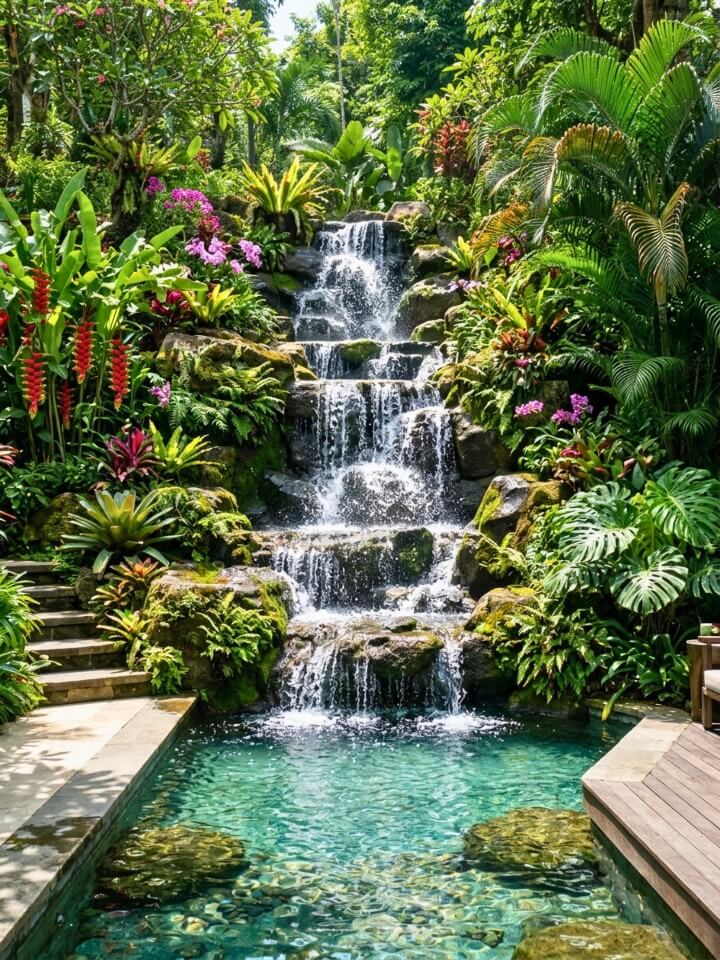
Step, pause, step, pause. That is the rhythm of a tiered cascade. Water drops from one level to the next across stacked surfaces, gathering briefly on each tier before spilling to the one below. The effect turns a single waterfall into a series of smaller performances.
Sloped yards and hillside properties are the obvious homes for this design, since natural elevation does half the work. On flat lots, retaining walls create the necessary height. Three to five tiers usually strike the right balance. Fewer feels abrupt, more feels busy. Vary tier depth deliberately: shallow ledges create fast sheeting flow, deeper pools slow the water and add reflection. Tuck creeping jenny or dwarf iris between levels to blur the edges between stone and plant.
12. Glass Waterfall
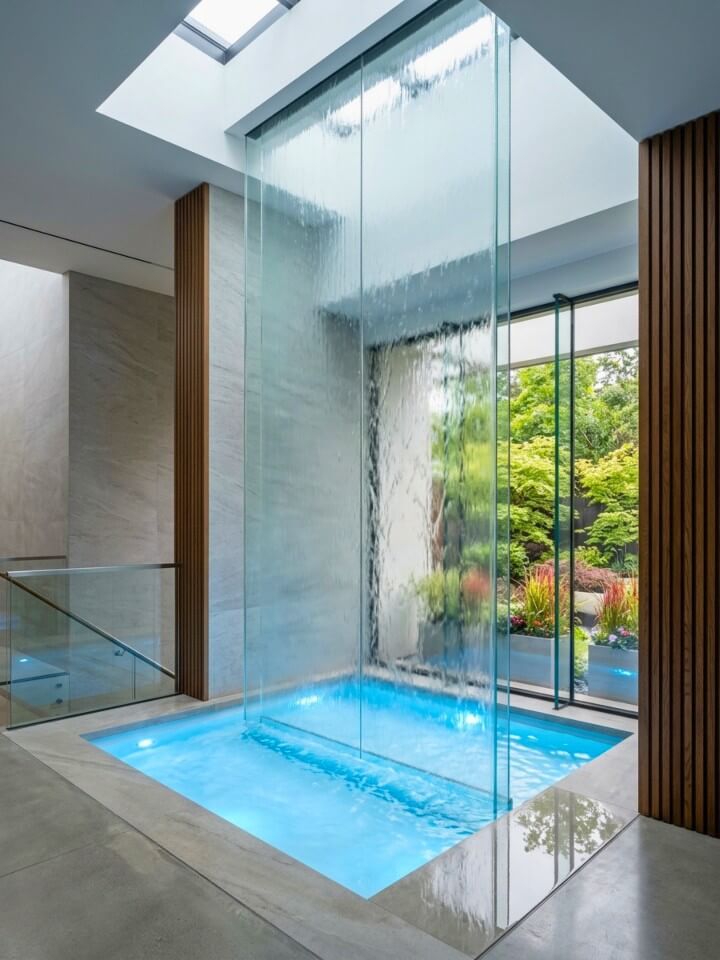
Glass changes everything about how water moves. Instead of splashing over rough stone, it glides down a smooth transparent panel with almost mechanical precision. The panel practically disappears, leaving only the flowing water visible.
Where this design earns its place:
- Rooftop patios where weight and cleanliness matter
- Small courtyards that need a feature without visual clutter
- Modern pool decks paired with steel, concrete, or polished stone
- Indoor-outdoor spaces where sightlines connect living areas to the pool
Tempered glass panels handle pool chemistry and weather exposure, but they show every water spot and fingerprint. Weekly wipe-downs keep the surface pristine. Backlit installation makes the water appear to fall through pure light after sunset.
13. Fire and Water Feature
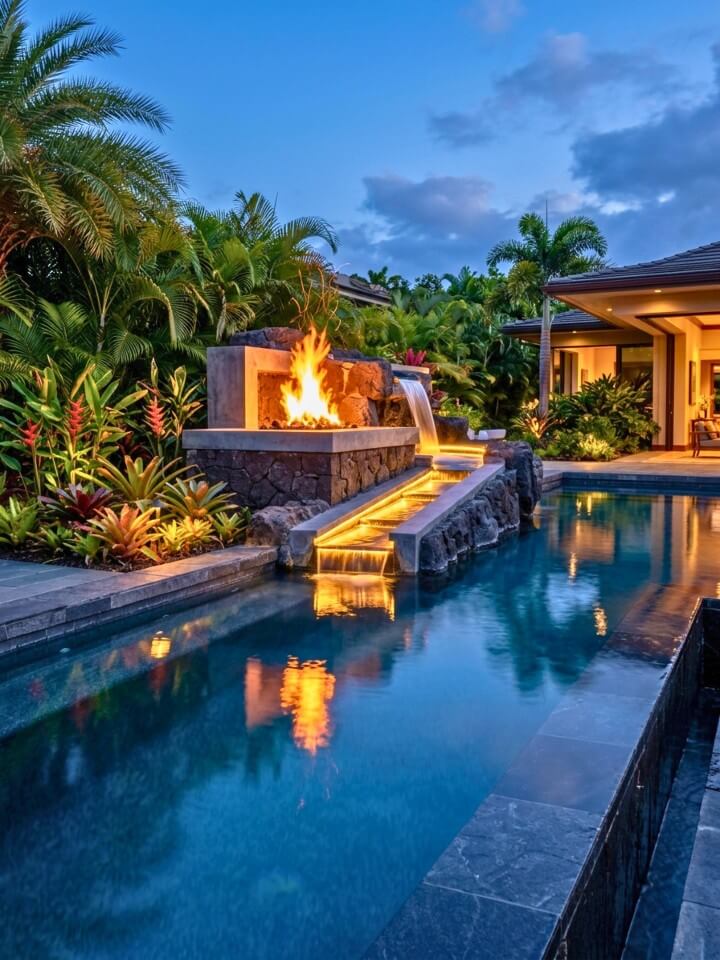
Two elements that should not belong together, sharing the same design. Flames flicker beside flowing water, and somehow the contrast makes both feel stronger. Warmth meets movement, glow meets reflection.
The most common arrangement places small fire bowls along the edges of a water channel or spillway, spaced evenly for balance. Gas lines require professional installation and proper permits, which drives up cost and complexity compared to water-only features. Propane offers flexibility for yards without natural gas hookups. Central patio zones and open pool decks work best because people gather around fire naturally, especially after sunset. Concrete, natural stone, and corten steel finishes all complement the pairing. Keep the surrounding layout uncluttered so both elements can breathe.
14. Negative Edge Waterfall
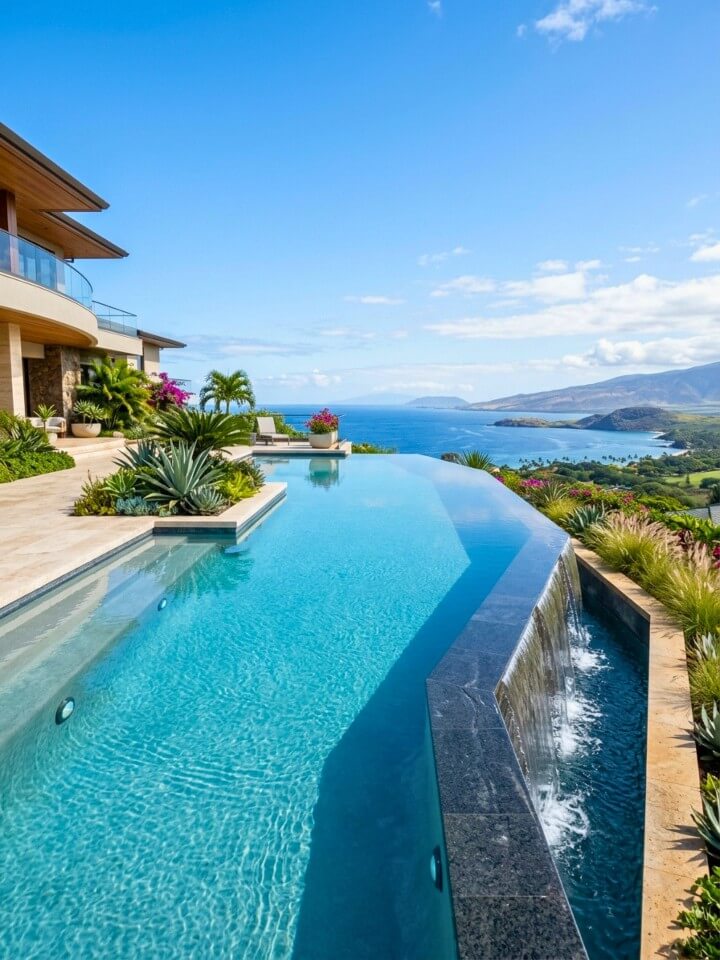
An infinity edge is less about the waterfall itself and more about what the eye cannot see. Water spills over one side of the pool into a hidden catch basin below, creating the illusion that the surface extends outward into whatever view lies beyond.
This feature exists for one reason: the view. Hillside lots overlooking valleys, oceanfront properties, and elevated yards facing open scenery are where negative edges belong. On a flat lot with a fence in the background, the effect falls flat.
Precision engineering matters enormously here. The overflow edge must be dead level along its entire length, sometimes forty feet or more. Even a quarter-inch variation ruins the illusion. Water level control systems keep the surface tension consistent, especially important on windy days when evaporation and wave action fight against the effect.
15. Bamboo Spout Waterfall
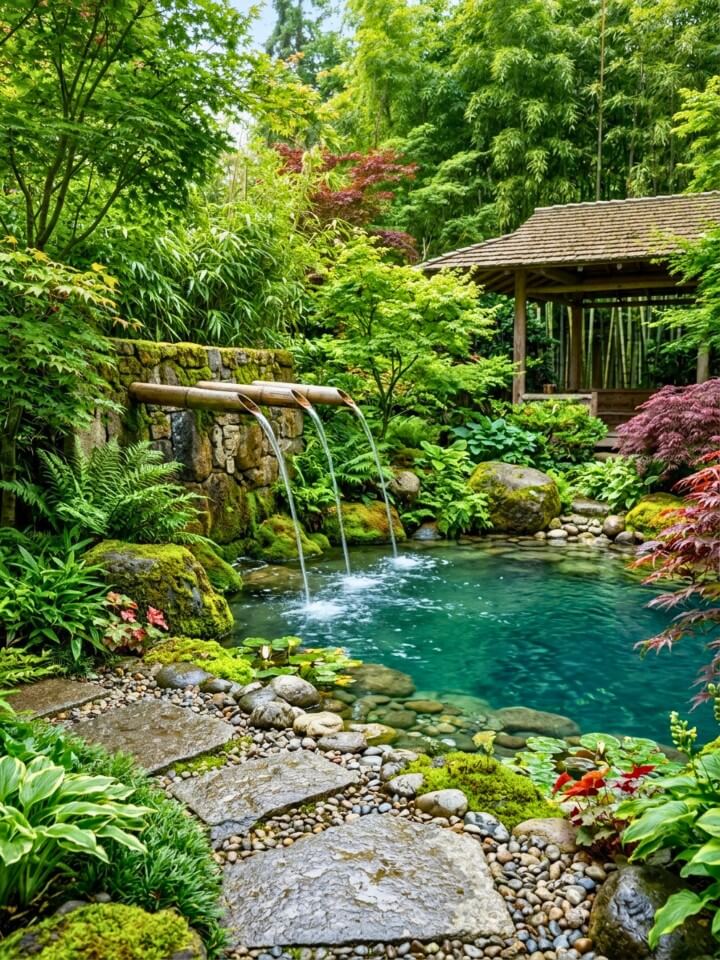
Explore charming small pool waterfall ideas designed to maximize style in compact backyard spaces today. The Japanese call it shishi-odoshi, though most modern versions skip the traditional tipping mechanism and simply let water flow continuously. A hollow bamboo tube, angled downward, releases a slim stream into the pool or a stone basin beside it.
Nothing about this design tries to impress with scale. That is exactly the point. Compact corners, shaded pool edges, and small courtyard gardens gain the most from bamboo spouts because the feature invites close attention. Pair it with a moss-covered stone lantern, a bed of smooth river pebbles, or a single Japanese maple, and the space transforms into a meditation garden.
Real bamboo eventually splits and needs replacement every few years. Copper or resin versions shaped like bamboo last much longer while keeping the visual character.
16. Classic Lion Head Spout
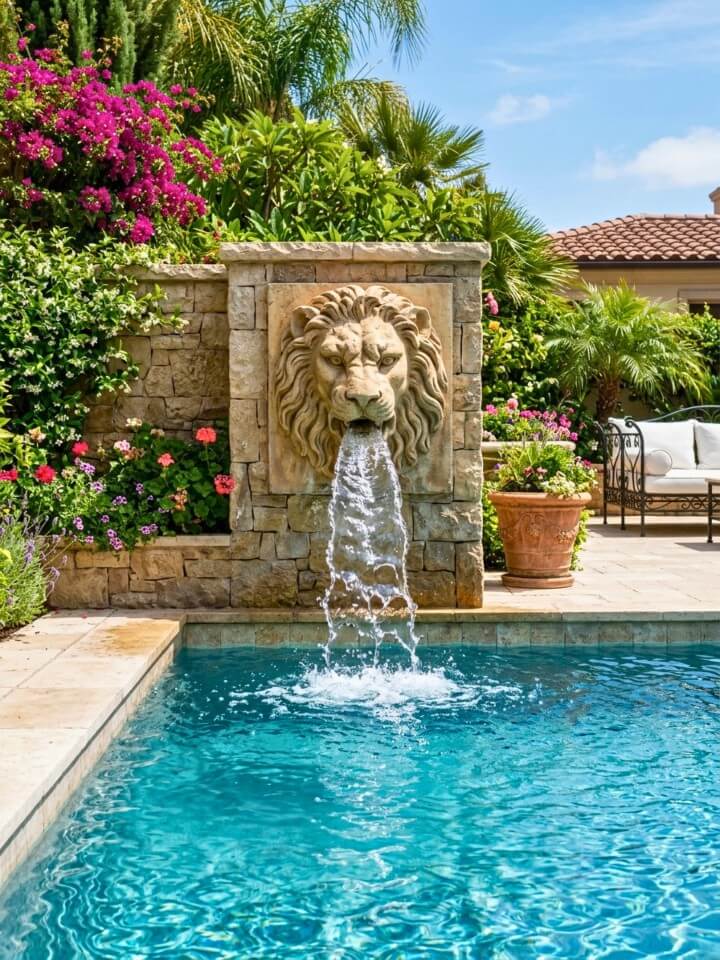
Classical estates, formal gardens, and Mediterranean villas have used sculpted animal heads as water spouts for centuries. The lion remains the most iconic choice, though rams, dolphins, and gargoyles all appear in traditional designs. A sculpted face mounted on a raised wall releases water from its open mouth into the pool below.
Symmetry drives everything about placement. A single lion head works as a bold centerpiece above a formal pool edge, but pairs and quartets bring balance to grand designs. Mount the sculpture slightly above eye level so the water stream stays visually prominent when approaching the pool.
Cast stone, bronze, and hand-carved limestone offer different price points and aging characteristics. Bronze develops a rich patina, limestone weathers softly, and cast stone holds its original appearance longest. Position matters for sound too, since the drop height controls how loud the water hits.
17. Swim-Up Bar Waterfall
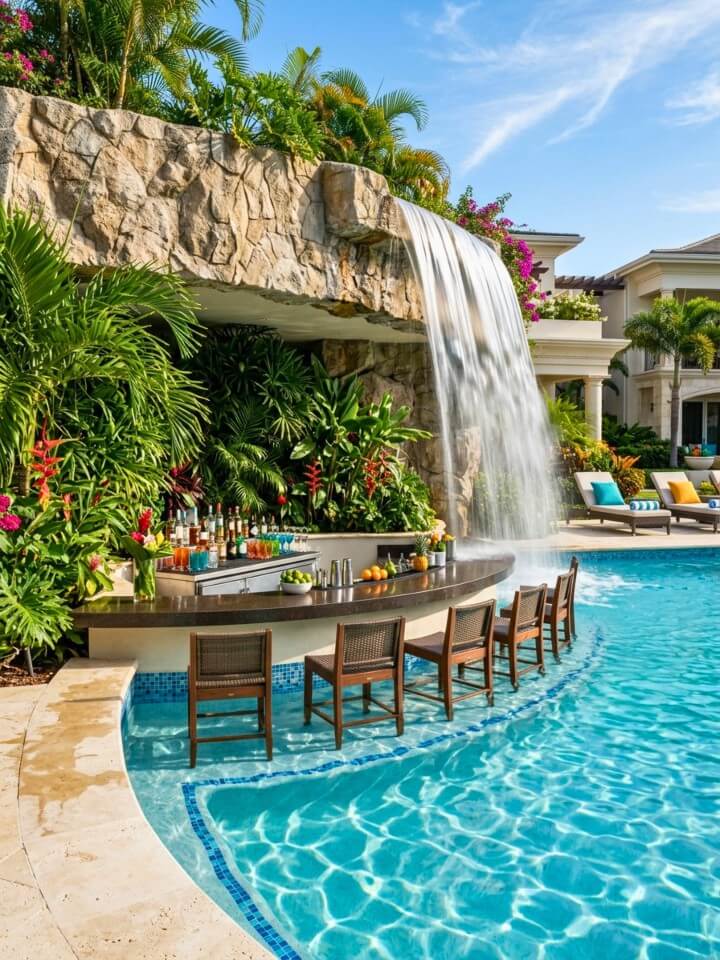
Resorts figured this combination out decades ago. Guests sit on submerged stools at a poolside counter, order drinks, and enjoy a gentle water feature flowing somewhere behind or beside them. The waterfall never dominates because conversation is the whole point.
Design considerations that actually matter:
- Water flow must stay quiet enough for easy talking across the counter
- Bar stool depth typically sits between 18 and 24 inches below waterline
- Counter surface needs weather-resistant material like sealed concrete, quartzite, or teak
- Overhead coverage protects both the bar and swimmers from harsh sun
- Nearby speakers should be waterproof-rated for pool environments
Thin sheeting waterfalls behind the bar create ambient background sound without splashing drinks. Larger pools handle this feature best since seating space needs to feel generous rather than cramped.
18. Disappearing Edge Sheet Flow
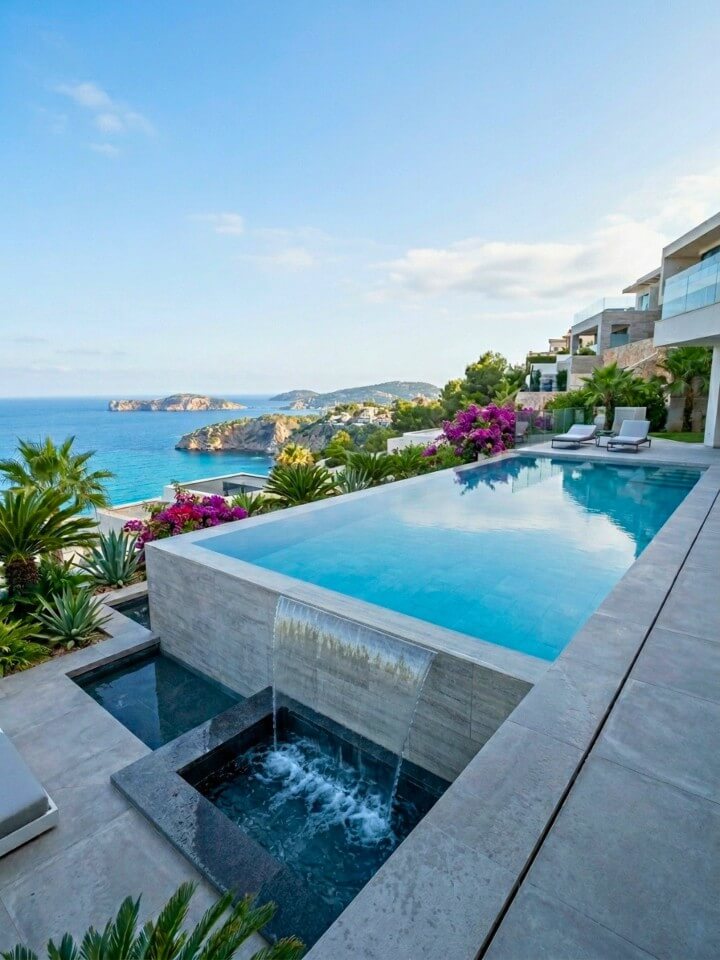
Where does the water go? That is the question this design refuses to answer visually. A smooth sheet of water flows over a pool edge and vanishes into a concealed trough below, hidden by decking, planters, or a deliberately shadowed recess.
The effect differs from a negative edge in one key way. An infinity edge extends the pool visually into a distant view. A disappearing edge sheet works even without a background view, creating pure minimalist geometry where water simply stops existing at the edge.
Straight rectangular pools showcase this design most effectively. Curves complicate the trough engineering and disrupt the clean linear effect. Neutral finishes like light travertine, gray porcelain, or white plaster keep the water movement as the star. The catch basin needs proper drainage sizing to handle full flow without backing up.
19. Natural Pebble Stream Design
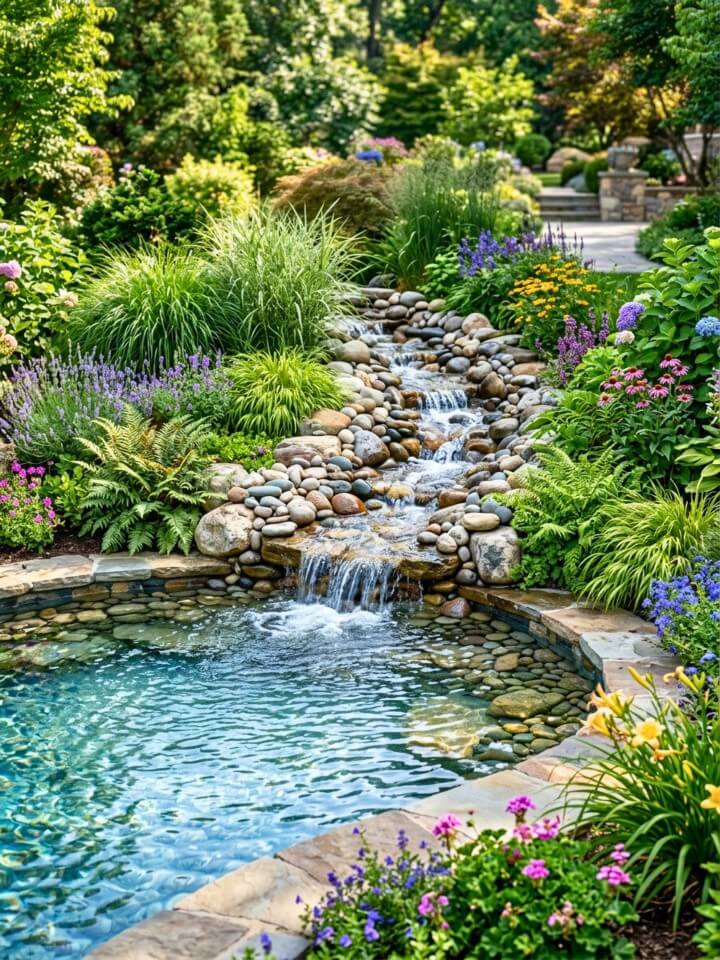
Streams in nature rarely fall in dramatic drops. They meander, tumble over small stones, catch briefly in shallow pools, and continue on. A pebble stream waterfall recreates that gentle character by guiding water across smooth river rocks before it reaches the pool.
The stream itself becomes the feature, not just the endpoint. Route it through a landscaped border, along a garden edge, or as a transition between lawn and pool deck. Length matters less than believability. A ten-foot stream that looks natural beats a thirty-foot one that reads as artificial.
Mix pebble sizes deliberately. Larger stones anchor the sides and create small pools, smaller pebbles line the flow path, and a few strategic boulders break up straight sections. Surround the banks with sedges, dwarf grasses, and low ground cover so the stream feels like it has always been there.
20. Cantilevered Waterfall
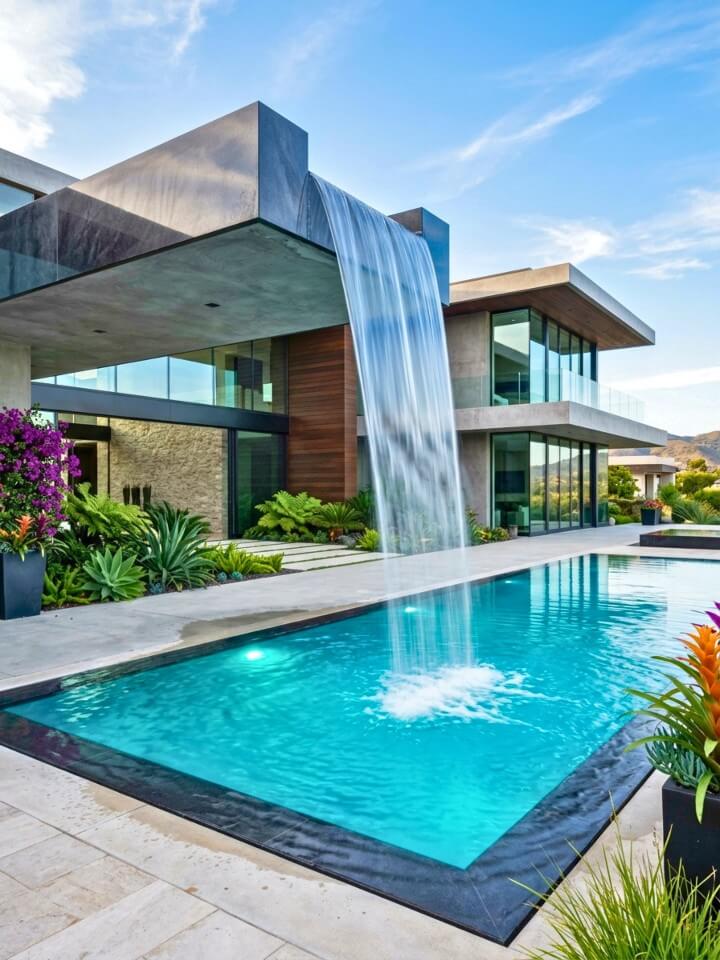
Physics says water needs a source. Cantilevered waterfalls hide that source completely, projecting a flowing sheet from what appears to be empty space. A concealed structural arm supports the water outlet, but from most angles the water seems to float in midair before dropping into the pool.
This is architectural theater. The projection can extend anywhere from one to four feet beyond the supporting wall, with longer projections creating more dramatic floating effects. Steel framing hidden inside concrete or stone housing carries the load, and the engineering requirements push installation into professional territory only.
Contemporary pools with strong architectural lines make the ideal setting. Cluttered backyards drown the effect entirely. Keep the surrounding zone deliberately empty, so nothing competes with the visual trick. Underlighting from the pool itself catches the falling water beautifully after sunset, making the cantilever glow against the darker background.
21. LED-Lit Color-Changing Waterfall
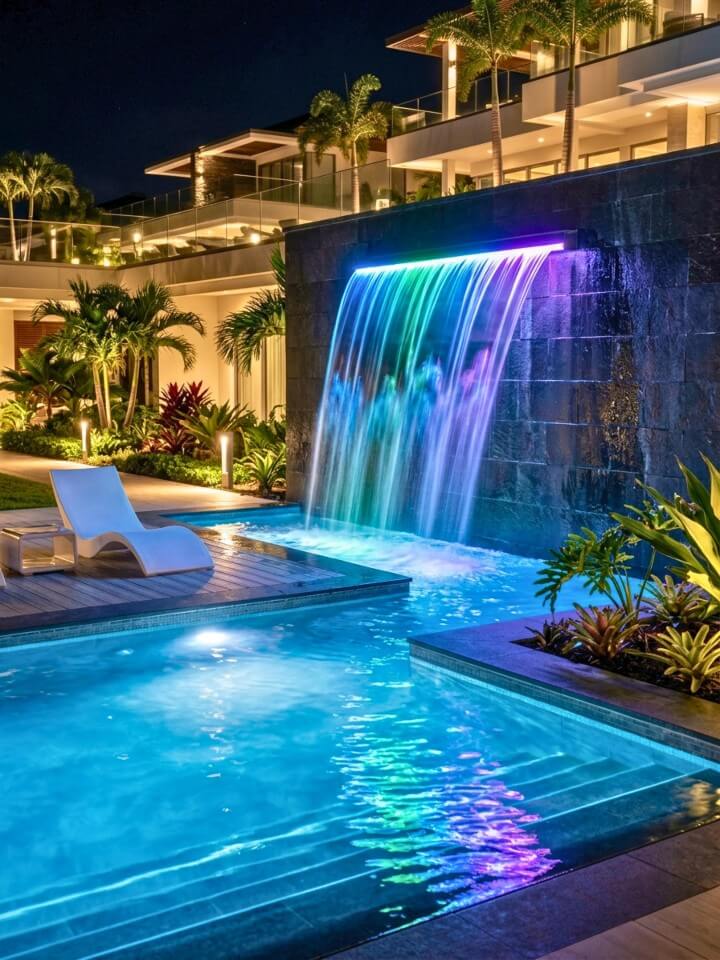
Elevate your outdoor retreat with cascading pool waterfalls that add elegance, motion, and pure magic. Daytime waterfalls rely on shape, sound, and stone for character. After sunset, none of those elements read the same way. Programmable LED lighting turns any existing waterfall into a nighttime showpiece without changing its physical structure.
Sheer descents, scupper streams, and wall spillways take particularly well to lighting because their smooth flow catches color evenly. The light source belongs behind or directly beneath the water, never in front, so the glow appears to come from within the flow itself. RGB systems shift through the full spectrum with app control, while single-color installations cost less. Warm whites suit relaxed evenings, bold cycling fits parties. Waterproof pool-rated fixtures are non-negotiable for safety.
22. Mosaic Tile Feature Wall
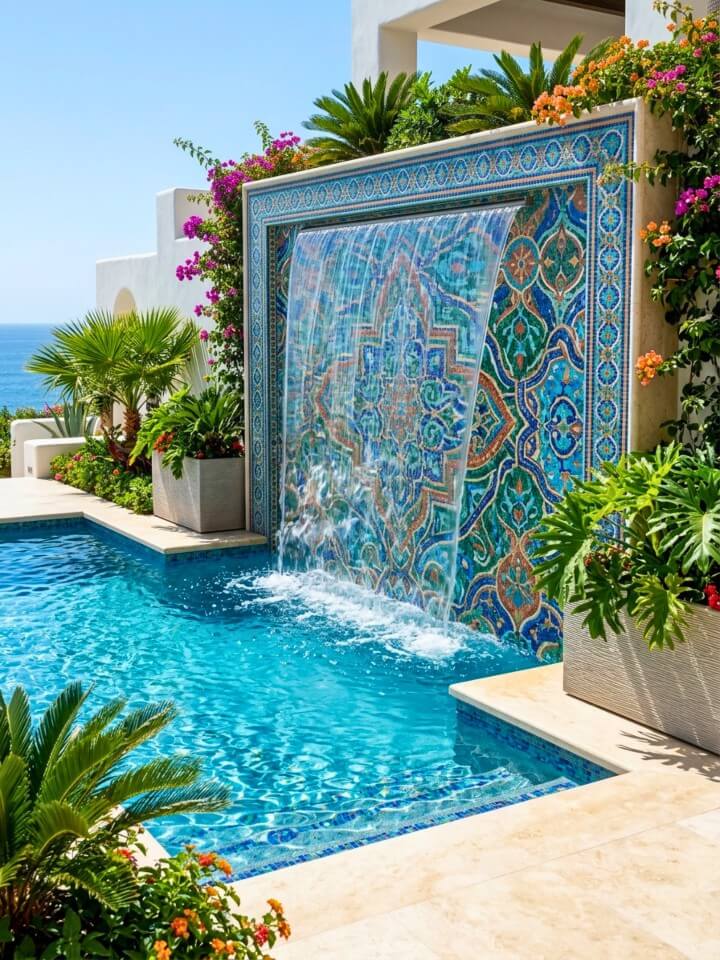
Not every water feature depends entirely on the water. A mosaic tile waterfall wall makes the surface behind the flow just as important, creating a permanent backdrop that adds color and detail even when the pump switches off.
Subtle patterns using two or three related tones bring texture without shouting. Elaborate mosaics with geometric designs or gradient color washes turn the wall into functional art. Blue and green palettes dominate for their water association, though terracotta, gold, and metallic accents open doors to Mediterranean, Moroccan, and coastal styles.
Grout choice matters more than most homeowners realize. Epoxy grout resists pool chemistry, staining, and mildew far better than standard cementitious grout, saving years of maintenance work.
23. Stream-Fed Natural Pool Design
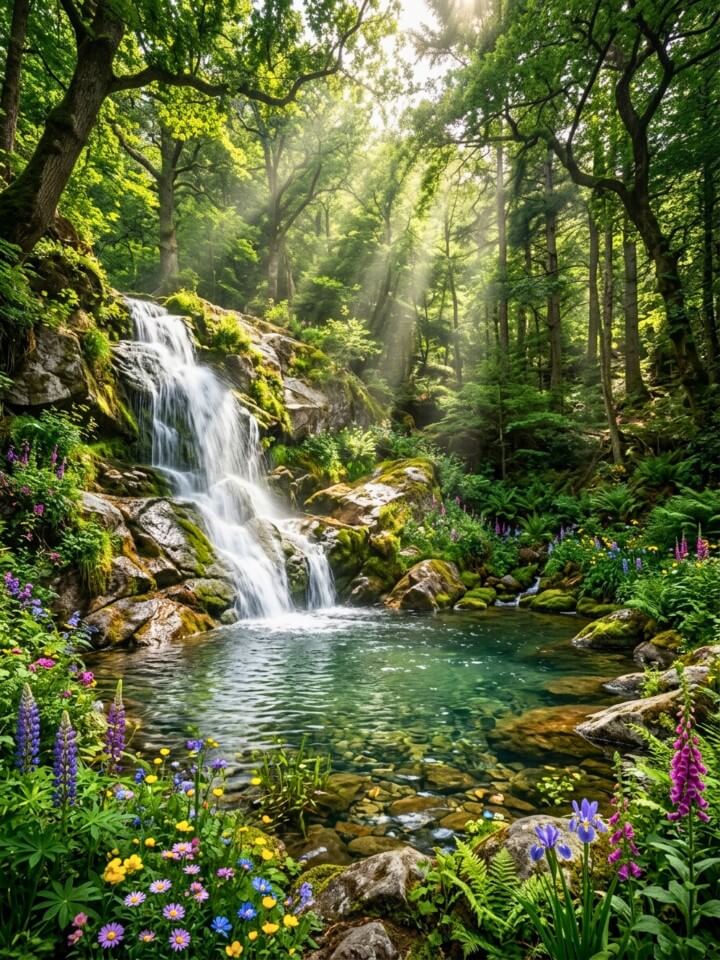
The most ambitious design on this list feels the least designed. A natural stream-fed waterfall carries water into the pool from a constructed stream winding through the property, blurring the line between swimming pool and natural landscape.
Large yards with real topography make this work. Sloped gardens, wooded lots, and rural properties provide the space and elevation the effect needs. Small backyards cannot sell the illusion no matter how well the stream is built.
Authenticity comes from restraint. Curve the stream around existing trees, vary the width irregularly, and let water speed up in narrow sections and pool in wider spots. Native ferns, sedges, and moss-covered logs complete the effect naturally.
FAQs About Pool Waterfalls
Planning a backyard water feature brings up plenty of practical questions. Here are honest answers to the ones most homeowners ask before making a final decision.
How Much Does a Pool Waterfall Cost to Install?
Costs range widely based on style and size. Simple scupper or urn features start around $500 to $1,500. Sheer descents run $1,500 to $4,000. Custom rock grottos and infinity edges can easily exceed $20,000.
Can I Add a Waterfall to an Existing Pool?
Yes, many features work as retrofits. Sheer descents, scuppers, pondless designs, and decorative urns install without draining the pool. Rock grottos and infinity edges usually require major reconstruction and rarely make sense as add-ons.
How Much Extra Electricity Does a Pool Waterfall Use?
Most residential pumps add roughly $10 to $30 monthly when running a few hours daily. Variable-speed pumps cut that cost significantly. Larger features like grottos or rain curtains draw more power due to higher flow demands.
Do Pool Waterfalls Require Special Maintenance?
Routine care includes clearing debris, checking pump performance, and treating for algae on wet stone surfaces. Tile and glass features need occasional wipe-downs for mineral spots. Natural stone may require sealing every two or three years.
Are Pool Waterfalls Safe for Kids and Pets?
Most designs are safe when built to code with proper edges and non-slip surfaces. Avoid sharp rockwork near play zones. Keep pump intakes covered, and supervise young children around grottos or slides where visibility drops.
Conclusion
The right waterfall shapes how a backyard feels every day, not just during summer parties. Some designs ask for major construction and serious budgets. Others slip into existing pools with minimal disruption and modest cost.
Start with honest questions before falling for a specific style. How much space actually exists? What sound level fits the household? Which architectural style already defines the home? Is the goal quiet retreat, family fun, or dramatic entertaining? Answers narrow twenty-three options down to two or three that make real sense.
Professional consultation pays for itself on larger projects like infinity edges and grottos. Smaller additions like bamboo spouts and decorative urns suit weekend projects for hands-on homeowners.