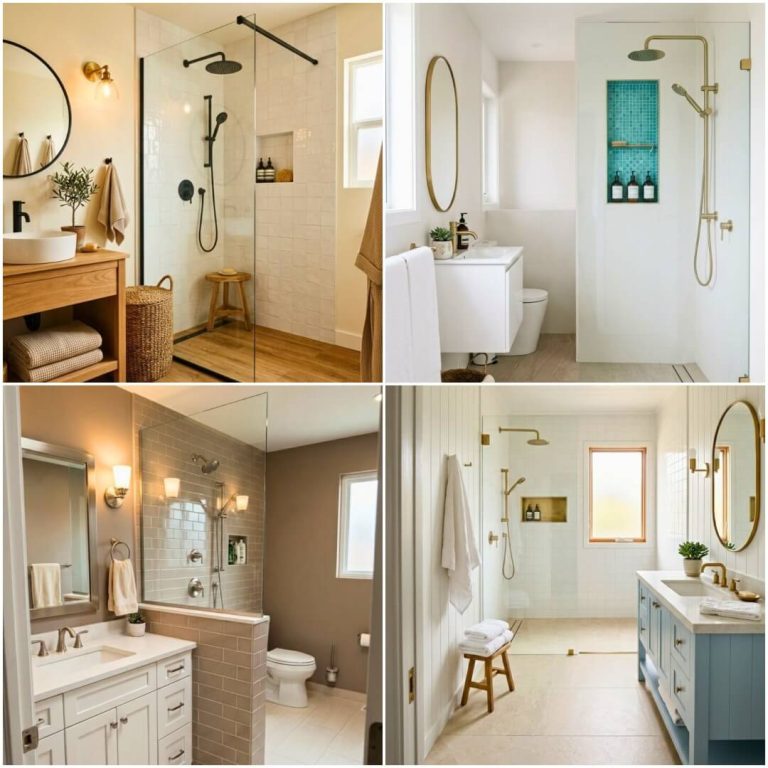
20 Bathroom Mosaic Tile Ideas To Steal Before Your Next Renovation
There’s a reason hotel bathrooms stick in your memory long after the trip ends — and nine times out of ten, it’s the tile. A wall of tiny iridescent squares behind a soaking tub, a penny-round shower floor that crunches softly underfoot, a strip of brass-flecked marble running above the vanity. That’s the quiet power of small tile, and it’s exactly why these 20 unique bathroom mosaic tile ideas are worth a slow scroll before your next renovation.
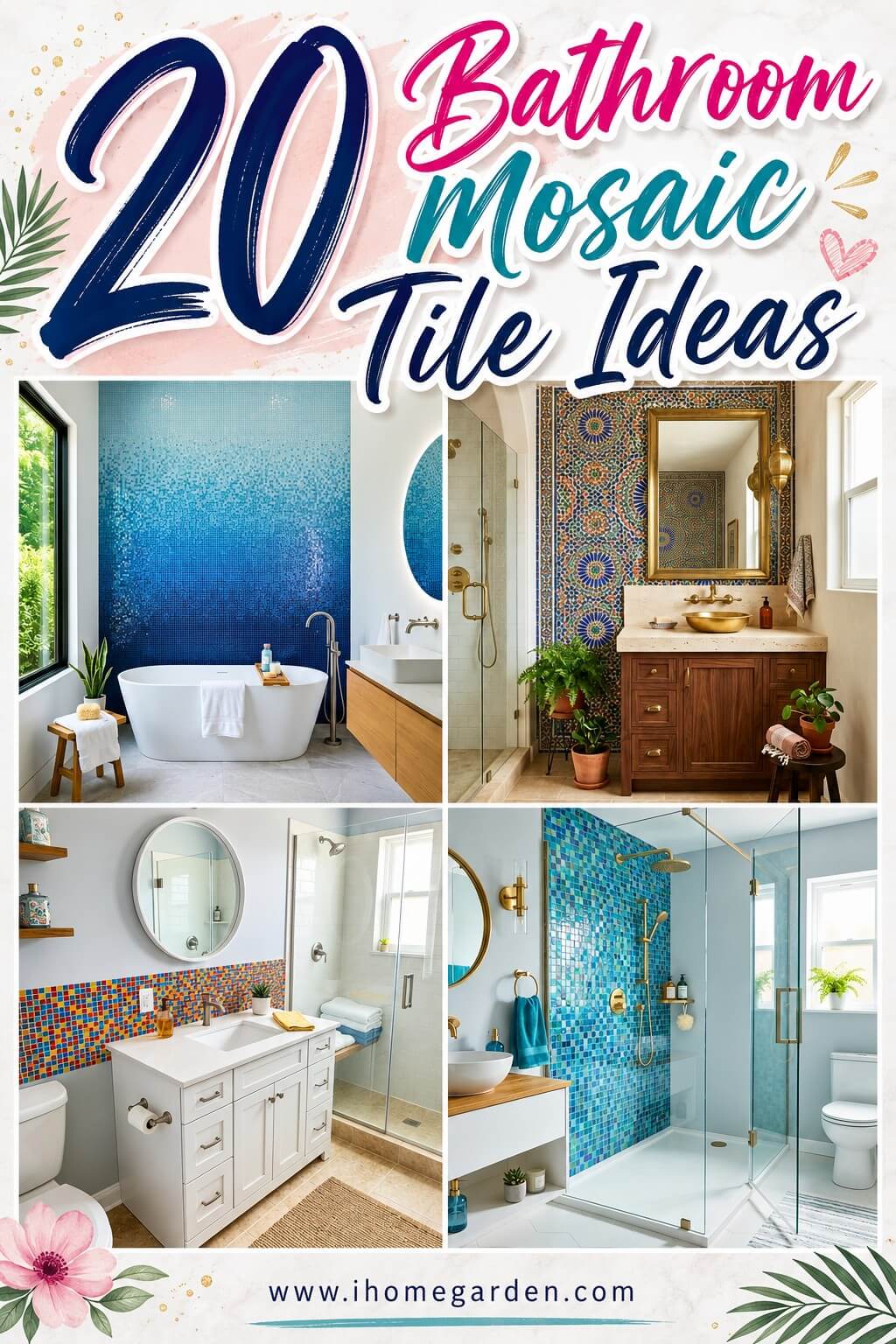
Mosaic isn’t just decoration anymore. The right pattern can make a cramped half-bath feel twice its size, turn a builder-grade shower into something worth photographing, or add grip exactly where you need it most. Some of the ideas ahead cost under $40 to test with a single sheet; others belong in a once-a-decade remodel. Either way, you’ll finish this post knowing which one actually fits your space, your budget, and your Saturday-morning patience.
1. Chevron and Diamond Geometric Mosaics
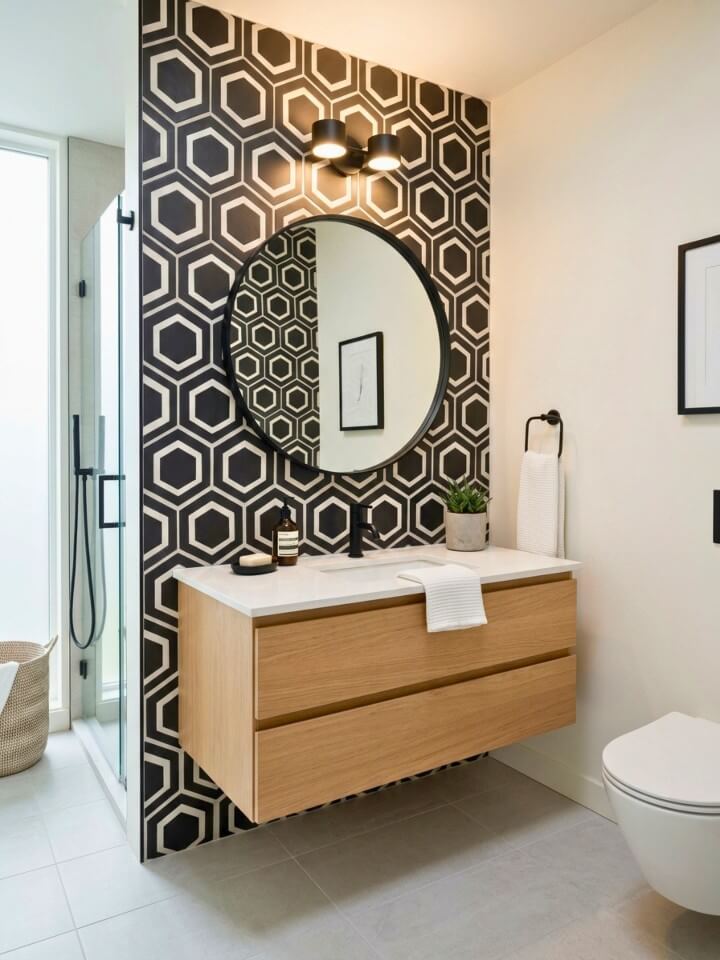
Directional patterns do something subtle but powerful: they pull the eye across a wall, which makes a cramped bathroom feel wider or taller depending on how you orient them. Run a chevron vertically behind a floating vanity and an 8-foot ceiling suddenly reads as nine. Stick to two-tone combinations — warm white with charcoal, bone with muted sage — so the geometry feels architectural instead of busy.
Where It Earns Its Place
A single accent wall, a tub alcove, or the strip above a wainscot. Avoid pairing chevron walls with a patterned floor; one of them needs to stay quiet. Porcelain runs $8–$15 per sheet, handmade ceramic significantly more.
2. Natural Stone Mosaic for a Quiet, Spa-Like Bath
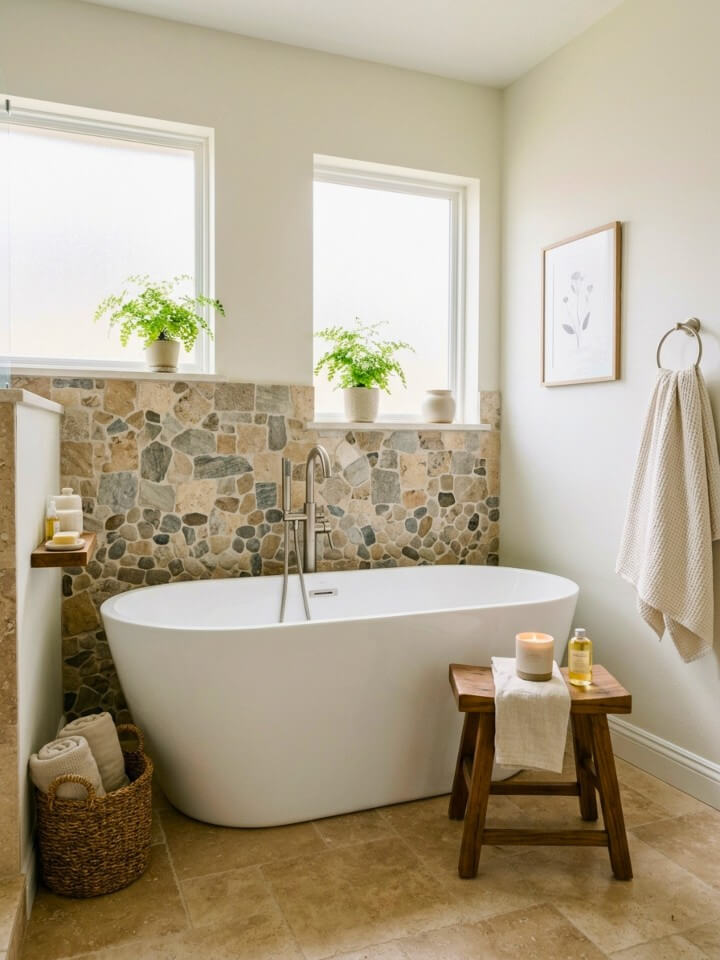
Tumbled travertine, split-face slate, and honed limestone bring the calm of a hillside hotel into a daily routine. The irregular surfaces catch low light in a way ceramic never quite manages, which is why these mosaics shine in showers lit by a single overhead fixture or a high window. Pair stone walls with a warm wood vanity and matte black hardware — without those warmer counterweights, all-stone bathrooms can drift toward cold and museum-like.
A Word on Maintenance
Natural stone is porous. It needs resealing every 12–18 months, more often in heavy-use showers. Skip it on shower floors if texture underfoot bothers anyone in the household.
3. Vibrant Glass Mosaic Tiles for a Pop of Color
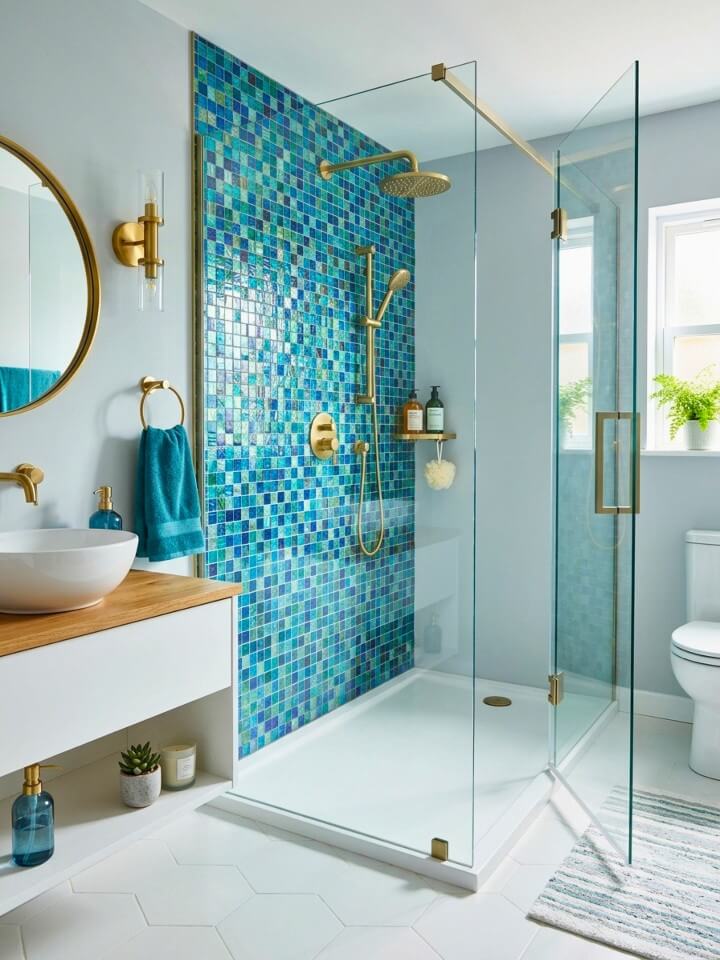
Steal these mosaic tile bathroom ideas that turn cramped corners into your favorite room daily. Here’s the case for glass in a tight bathroom: it bounces light instead of absorbing it, and a 40-square-foot powder room can feel meaningfully bigger after one reflective wall goes up. Deep teal, emerald, and cobalt are the shades that hold up over a decade.
Trendy corals and dusty pinks tend to date a renovation within five years, so think twice before committing thousands of dollars to a color you’ve only liked for six months. Use glass on one feature wall — usually the wet wall of a shower. Wrap the whole room and the effect tips from elegant into swimming pool, fast. Non-porous, mold-resistant, but tricky to cut around outlets.
4. Black and White Mosaic with a Modern Edge
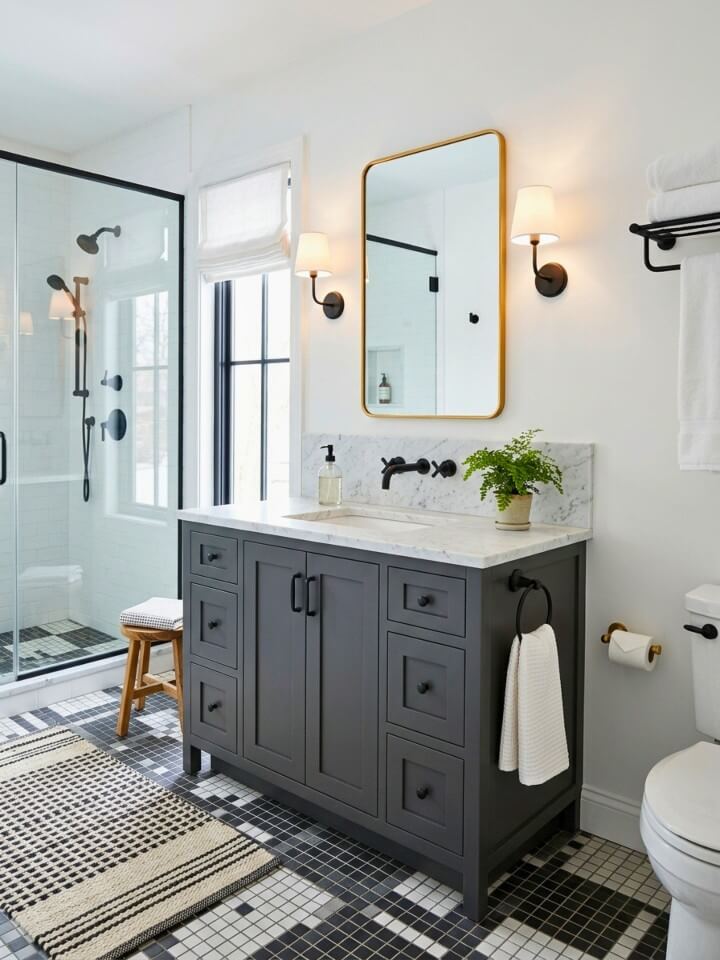
The black and white penny round floor has been around for over a century and still looks current in Craftsman bungalows, mid-century ranches, and brand-new builds. That kind of staying power is rare. Anchor the look with a black hex border framing a white field for a hotel-bathroom feel, or flip the ratio with a dark floor under bright walls for more drama.
The Detail Most People Get Wrong
Fixture choice. Unlacquered brass or matte black faucets keep this combination feeling current; polished chrome can drag it backward into diner territory. And use medium gray grout, not stark white — white yellows within a year and never looks crisp again.
5. Metallic Mosaic for a Jewel-Box Powder Room
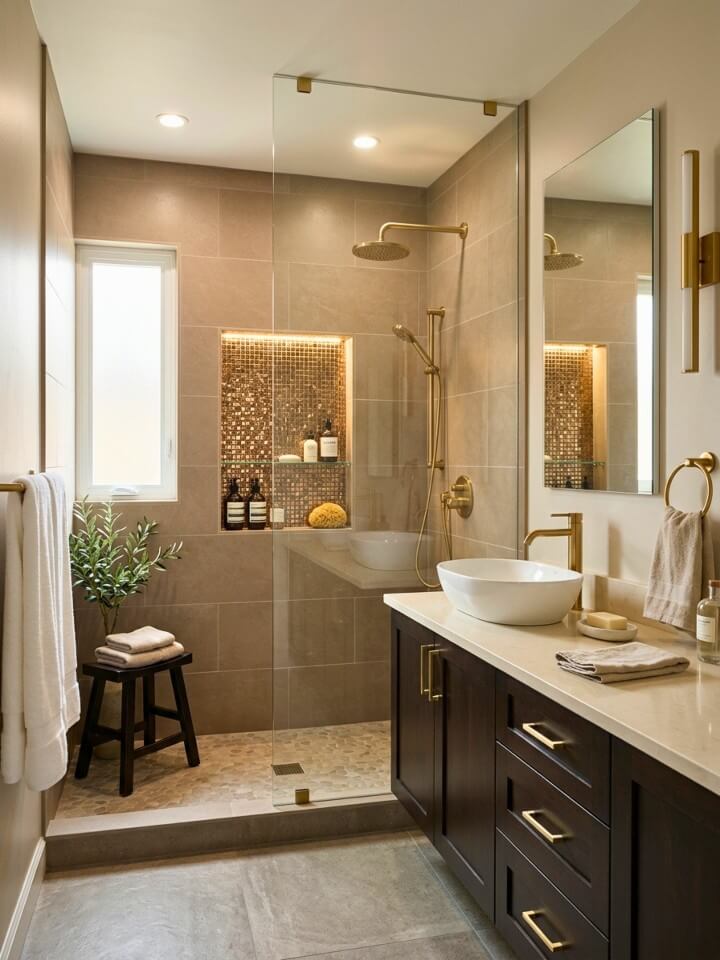
Metallic mosaics are too much for a primary bath but exactly right for a small powder room where guests spend three minutes and leave impressed. Brushed brass, antique copper, gunmetal — all of them want a dark, moody wall color nearby (inky navy, forest green, oxblood) so the metal reads as warm rather than cold and clinical. Use them behind a pedestal sink, wrapping a single niche, or framing a mirror. Full-room coverage tips into nightclub territory remarkably fast.
Cheaper than You Think
Real metal tiles run $25–$60 per square foot, but porcelain and glass alternatives with metallic glazes deliver roughly 80% of the effect at a quarter of the price.
6. Marble Mosaic for Quiet Luxury
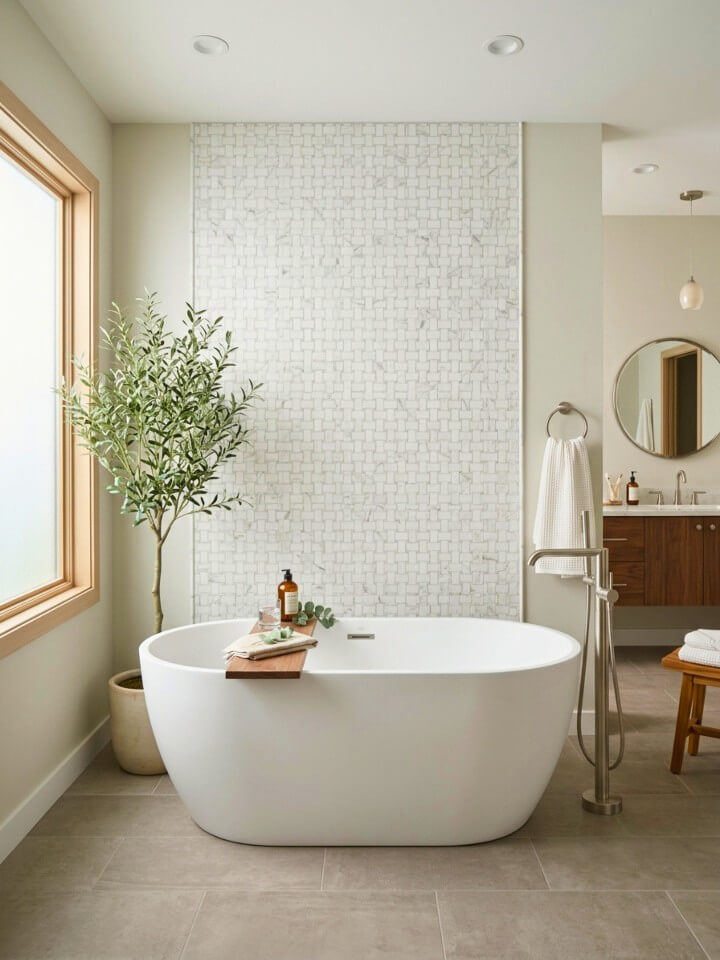
A 12-inch sheet of Carrara mosaic runs $10–$30 and gives you the same hushed elegance as slab marble that would cost hundreds per square foot. Hexagon and basketweave cuts are the most forgiving in residential baths because smaller pieces hide the slight unevenness — lippage — that makes large-format marble look badly installed.
Honed Beats Polished, Almost Always
Polished marble etches the first time someone leaves toothpaste on it overnight. Honed (matte) surfaces hide that wear far better, and they have a softer, more contemporary look. Marble does stain — a drop of nail polish remover can mark it permanently — so keep the sealer current and wipe cosmetics up promptly.
7. Patterned Moroccan Mosaic Tiles for a Global Flair
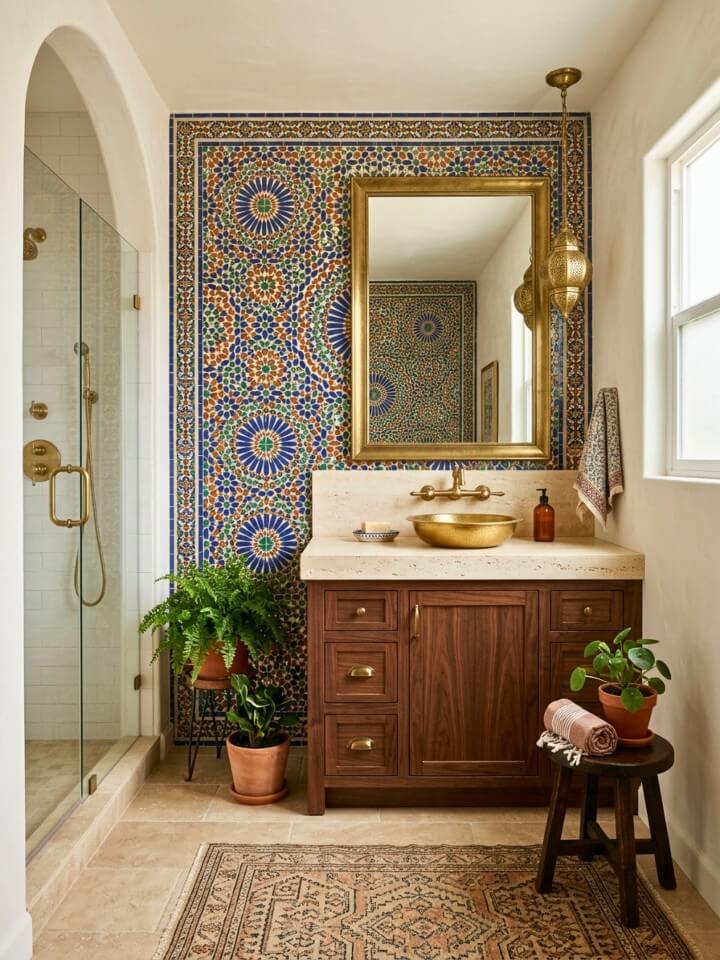
Hand-glazed zellige has a quality machine-made tile simply can’t fake: slight color variation from kiln to kiln, soft uneven edges, a depth of glaze that catches light at unexpected angles. The imperfection is the point. Deep ocean blue, mustard, and clay terracotta are the historic palette, but soft sage and ivory versions are now widely available for homeowners who want the texture without the saturation. Best used on one shower wall, behind a vanity, or framing a soaking tub.
Installation Reality Check
Zellige needs wider grout lines (around 3/16 inch) and an installer who’s worked with it before. The uneven edges break tilers who expect uniformity. Authentic versions start around $15 per square foot, plus higher labor.
8. Mini Subway Mosaic in Herringbone
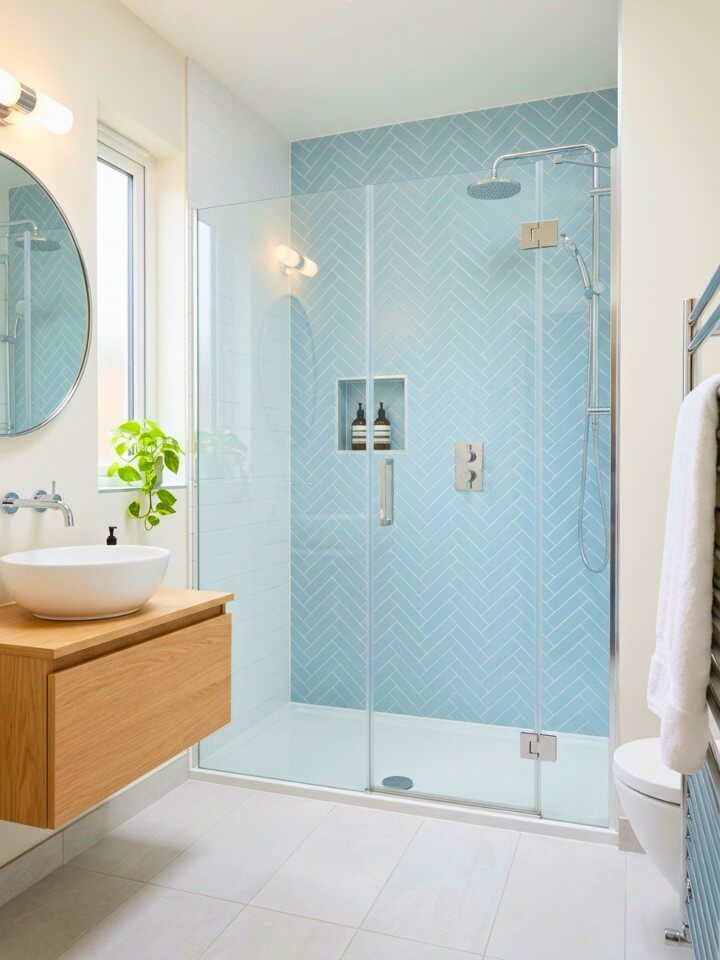
A 1-by-2-inch subway laid in herringbone is the workhorse of modern bathroom design. It looks custom, photographs beautifully, and resells well — three things that rarely line up in tile choices. The smaller scale wraps curves, niches, and shampoo shelves more cleanly than full 3-by-6 subway, which is why it has quietly taken over high-end shower walls over the last few years. White with light gray grout is the safe path. For more personality, sage green with cream grout or terracotta with charcoal both age gracefully. Herringbone takes more cutting than a stacked layout, so budget roughly 15–20% more in labor than for a straight-set install.
9. Pebble Mosaic for a Barefoot-Friendly Shower Floor
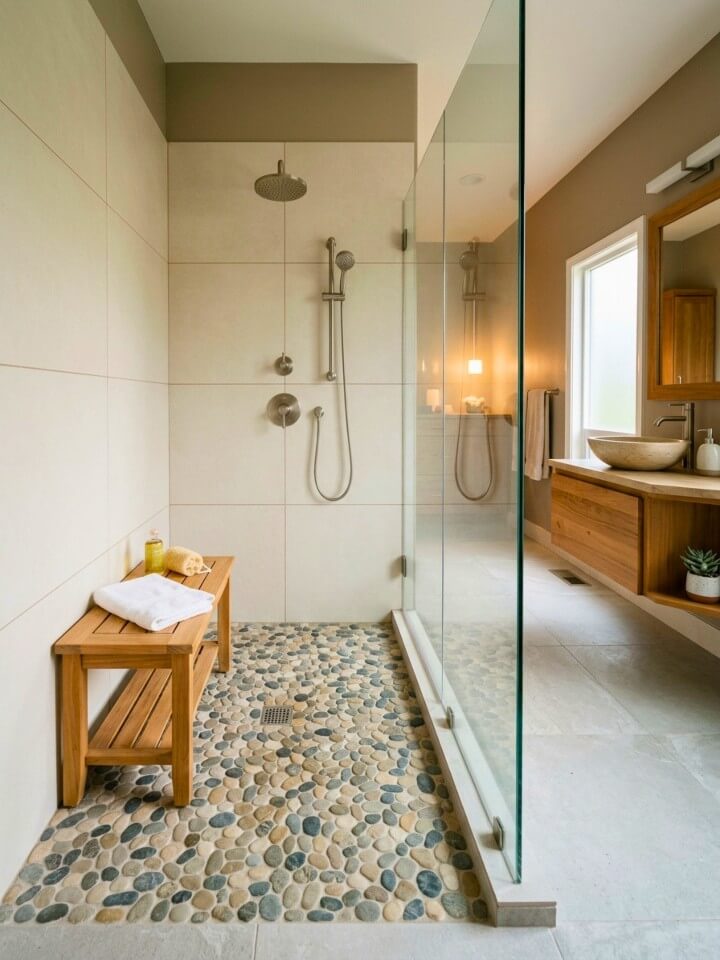
Pebble tile is the rare mosaic that’s as functional as it is good-looking. The rounded surfaces grip wet feet — genuinely useful for older homeowners and households with young kids — and feel like a low-grade reflexology session every morning. Choose sliced pebbles over full-round ones whenever possible. Sliced versions sit flatter, drain better, and use less grout, which means less of the maintenance headache pebble floors are known for.
The Cleaning Routine Matters
All those crevices trap soap scum. Plan on a weekly wipe-down with a pH-neutral cleaner and an annual grout reseal. Earth tones (sand, slate, charcoal) hide residue far better than white pebbles, which look grimy within months.
10. Ombre Mosaic Tiles for a Stunning Gradient Effect
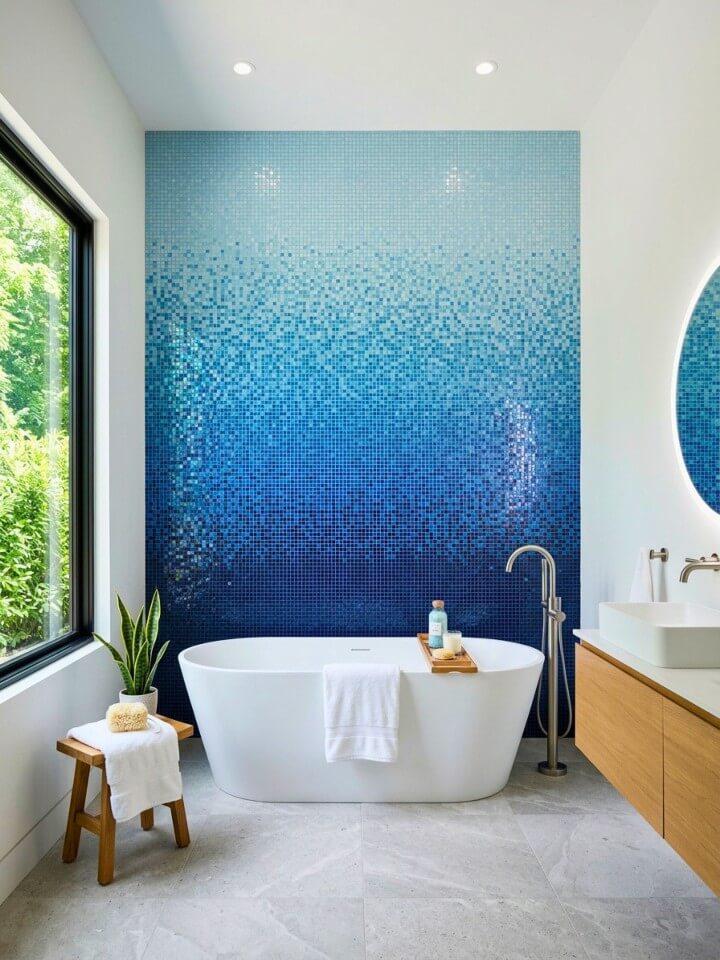
A wall of small tiles graduating from dark at the bottom to pale at the top — or the reverse — looks like a designer commission and costs a fraction of one. Glass and porcelain mosaics work best because the color consistency lets the gradient read cleanly; natural stone varies too much to ombre without looking accidental. Stay within one color family. Deep ocean fading to seafoam, charcoal softening to dove gray, plum dissolving into blush. Cross color families and the effect becomes chaotic.
The Execution Secret
Lay the entire wall out flat on the floor first and hand-blend the transition rows before any thinset touches the wall. Reserve ombre for one feature wall only.
You Might Also Like: 25 Small Bathroom Curbless Shower Ideas To Steal Right Now
11. Hexagonal Mosaic for Modern Geometry
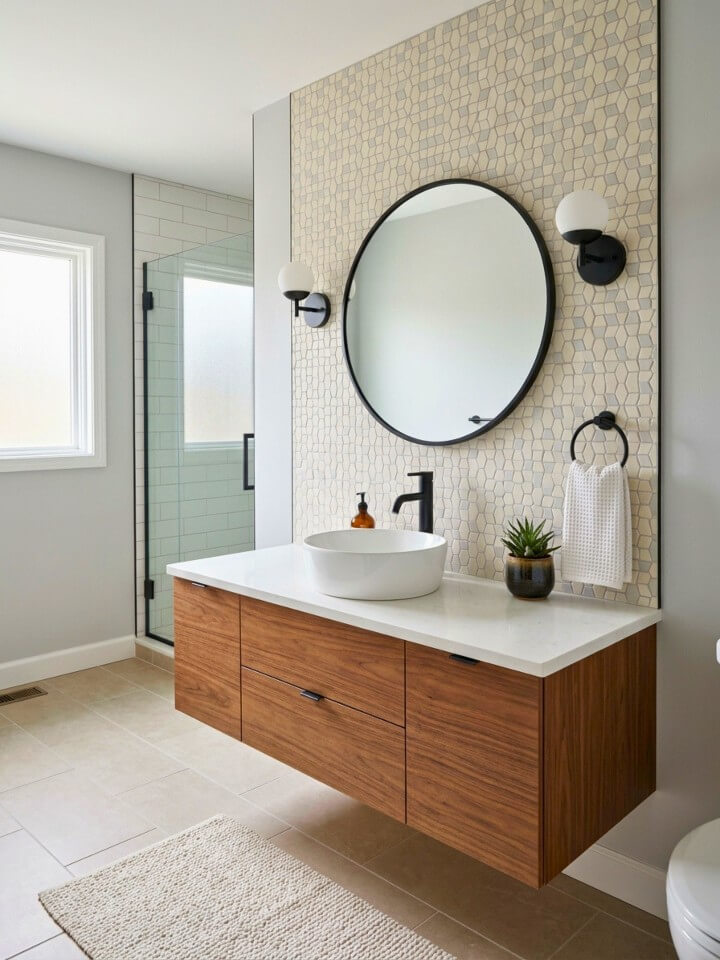
Hexagons read as contemporary without trying too hard, which is why they’ve held up across a decade of design trends while sharper geometric patterns have come and gone. The honeycomb shape works on floors, shower walls, and accent strips, and pairs well with both vintage clawfoot tubs and ultra-modern wall-hung vanities.
Scale Matters More than Color
A 1-inch hex on a shower floor reads as classic; a 4-inch hex on the same surface reads as Scandinavian-modern; an 8-inch hex feels almost industrial. Pick the scale before you pick the color. Mix two sizes in the same room only if you’re confident — most bathrooms look calmer with one hex size and one accent tile elsewhere.
12. Textured and 3D Mosaic Tiles
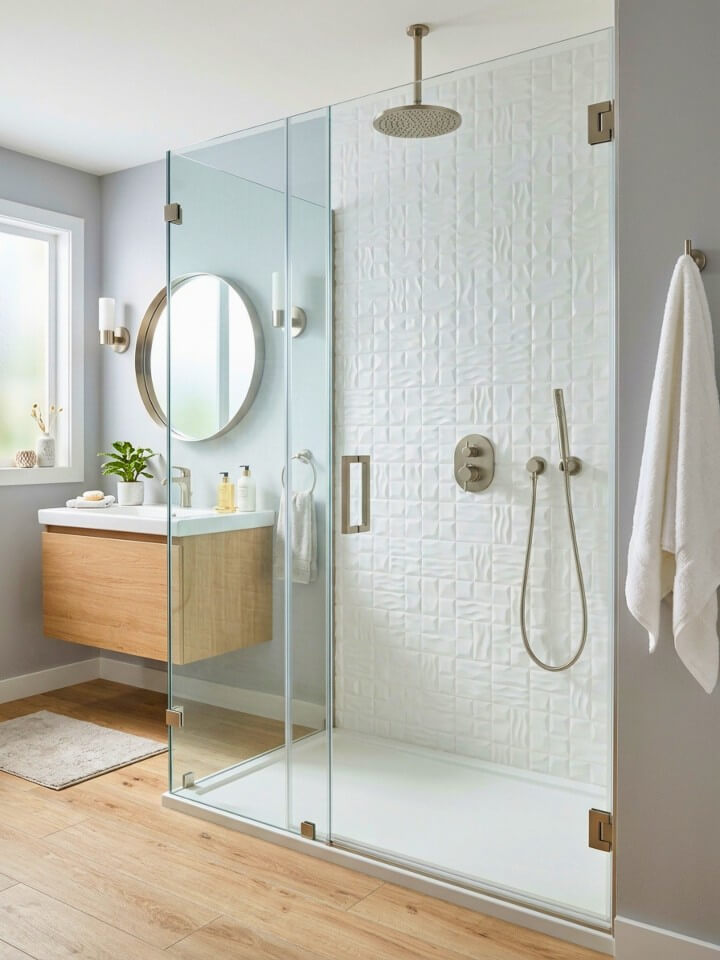
Discover fresh bathroom mosaic tile ideas with real budgets, pro tips, and patterns that age beautifully. Flat tile is fine. Textured tile is interesting. Raised ripples, fluted ridges, scalloped fans, and dimensional waves catch light differently throughout the day, so the same wall looks soft at sunrise, sharp at noon, and almost sculptural under evening sconces.
Neutral colors — bone, oat, dove gray, terracotta — let the shadows do the work without competing for attention. Textured mosaics are best placed where you can light them well: behind a vanity with sconces on either side of the mirror, or on a shower wall hit by a window. Skip them on shower floors (water sits in the grooves) and busy bathrooms with toddlers (toothpaste lives in those grooves too).
13. Mosaic Tiles with Subtle Metallic Inlays
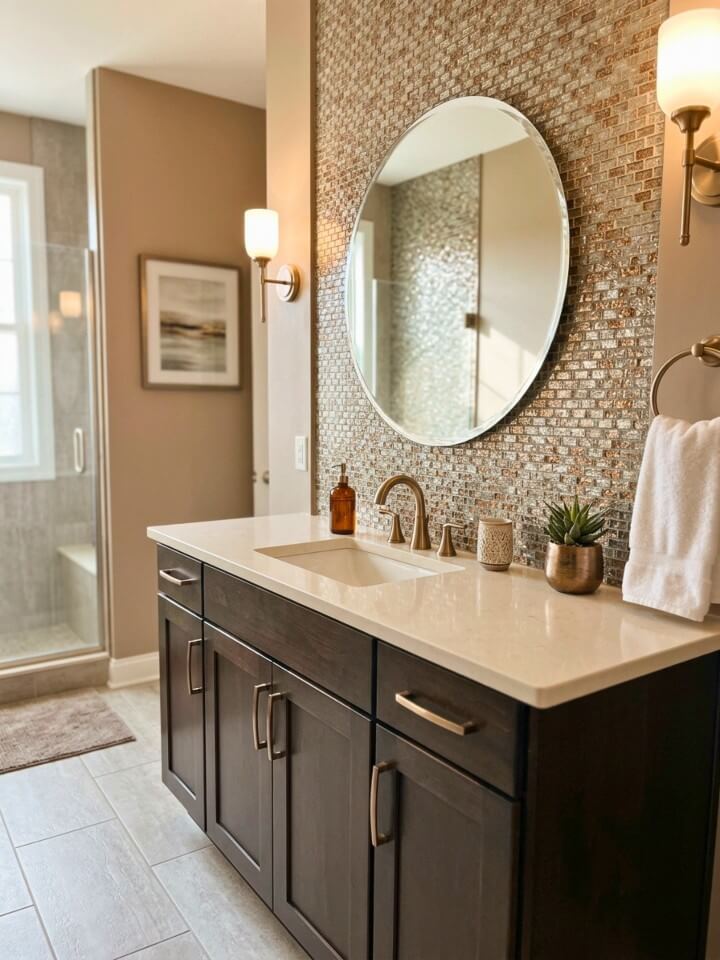
This is the restrained cousin of the full metallic wall. A mostly-neutral mosaic — white marble, gray slate, soft ivory — threaded with thin strips or scattered chips of brushed brass or matte gold reads as quietly upscale rather than flashy. It’s the version that works in a primary bath where you actually live, not just a powder room where guests pass through.
Where to Spend, Where to Save
A small accent band — say, a 4-inch strip running horizontally behind the vanity at eye level — gives you most of the visual payoff for a fraction of a full wall. Reserve the more expensive metal-inlay sheets for that focal zone and use plain matching tile everywhere else.
14. Nature-Inspired Mosaic Patterns
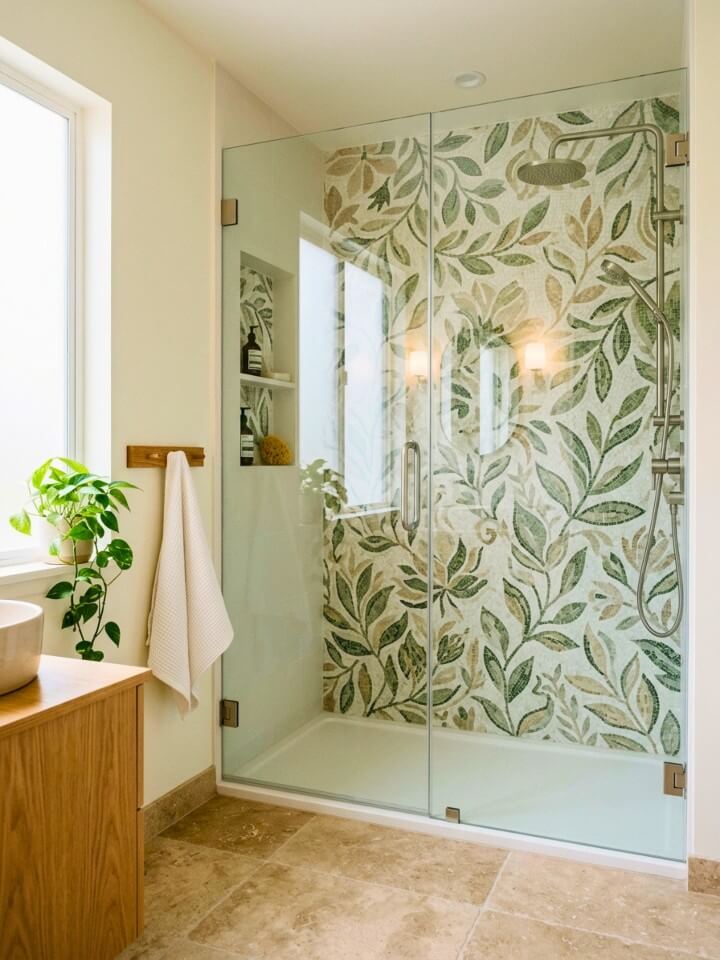
Some mosaics suggest leaves, waves, fish scales, or flower petals through their cut and arrangement — fish scale (also called fan or scallop) tile is the most popular example and the easiest to source. The shape is calming in a way grid layouts aren’t, which makes it well-suited to bathrooms designed as a retreat from screens and noise.
Will It Look Dated in Five Years?
Fish scale has been around long enough — and continues to appear in new builds — that it’s safely past the trend cycle. Leaf and floral motifs are riskier; they can swing toward themed or dated. If you love the look, confine it to one wall or a single niche that’s easy to replace later.
15. White Mosaic Tiles with Colored Grout
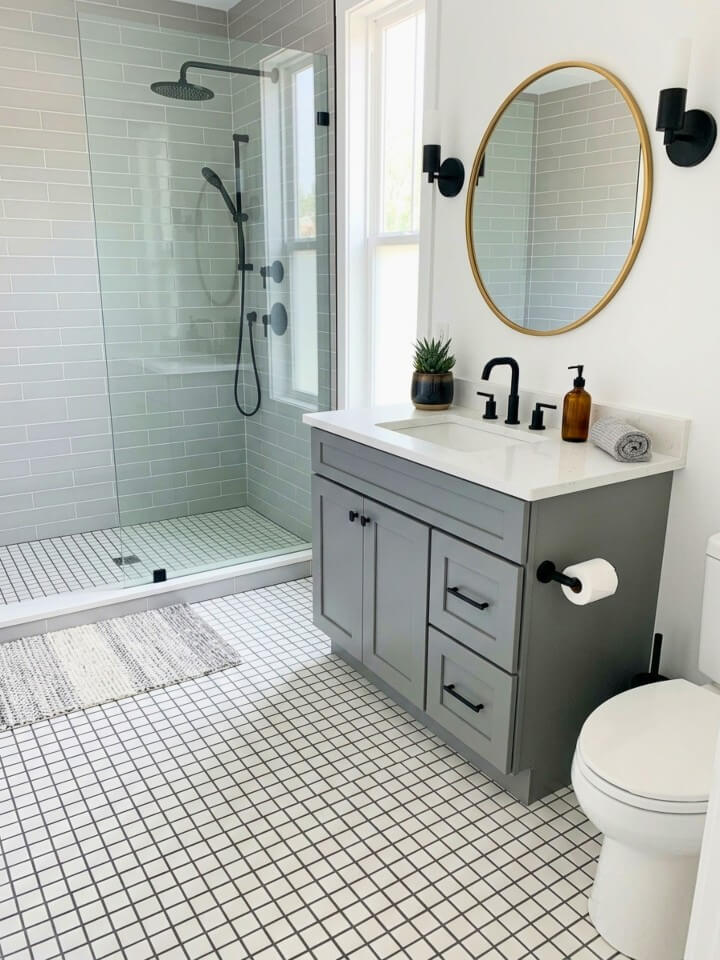
Here’s a designer trick that costs almost nothing: take ordinary white penny round or subway mosaic and grout it with charcoal, navy, terracotta, or even soft blush instead of standard white or gray. The tile suddenly looks intentional and graphic, the layout pattern becomes the star, and you’ve spent maybe $40 extra on grout instead of thousands on specialty tile. Charcoal grout is the safest bet — it hides everyday grime, looks modern, and works with almost any fixture finish. Pastel grouts (sage, blush, dusty blue) are charming but show soap residue and need more cleaning. Whichever color you choose, seal it within a week of installation to lock the pigment in.
16. Iridescent Mosaic for a Dreamy Glow
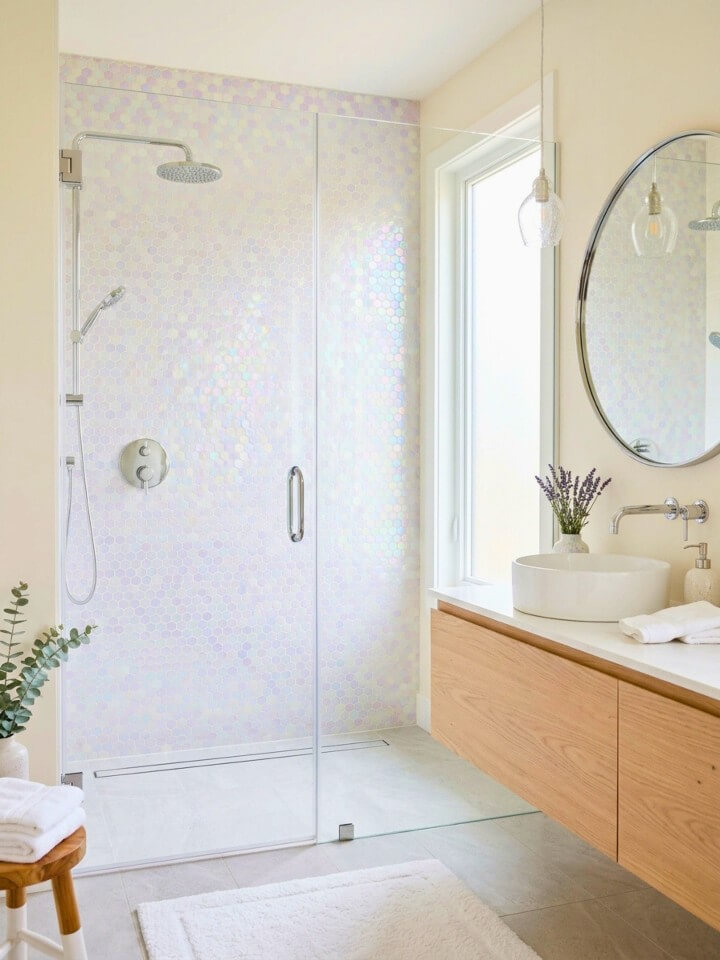
Find mosaic bathroom tile ideas that punch above their price and photograph like a hotel suite. Iridescent glass shifts color as you move past it — pearl pink under morning light, lavender at midday, pale gold at dusk. The effect is genuinely beautiful in person and almost impossible to capture in listing photos, which is why it’s underused.
A small installation does more than a large one; an entire iridescent wall starts to feel like a teenager’s bedroom from 2003. Use it inside a single shower niche, as a thin border at chair-rail height, or wrapping the back of an open shelving unit where the changing color reads as a quiet surprise. Pair with deeply neutral surroundings — warm white walls, oak vanity, brushed nickel fixtures — so the shimmer has room to breathe.
17. Bold Primary-Colored Mosaic Tiles
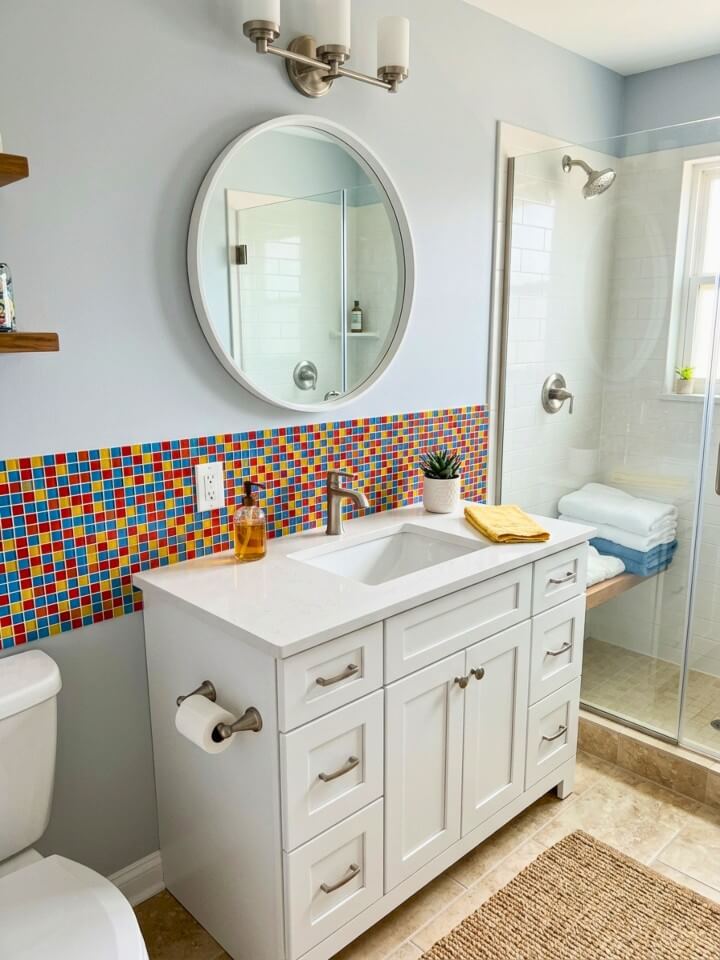
Red, cobalt, and sunflower yellow tiles are usually rejected outright by anyone thinking about resale, but they’re the right call for a kids’ bathroom that needs to stay cheerful for the next decade, or for a confident homeowner with no plans to sell.
Keeping It from Looking Like a Play Area
Use one bold color, not three. Anchor it with substantial white space — a primary-colored shower wall against white walls, white vanity, white floor — so the color reads as graphic and intentional rather than chaotic. Matte finishes age better than glossy for saturated colors; gloss can look plastic-toy under bright bathroom lighting. Pair with simple chrome or matte black fixtures and skip patterned accessories.
18. Tonal Mosaic for Quiet Depth
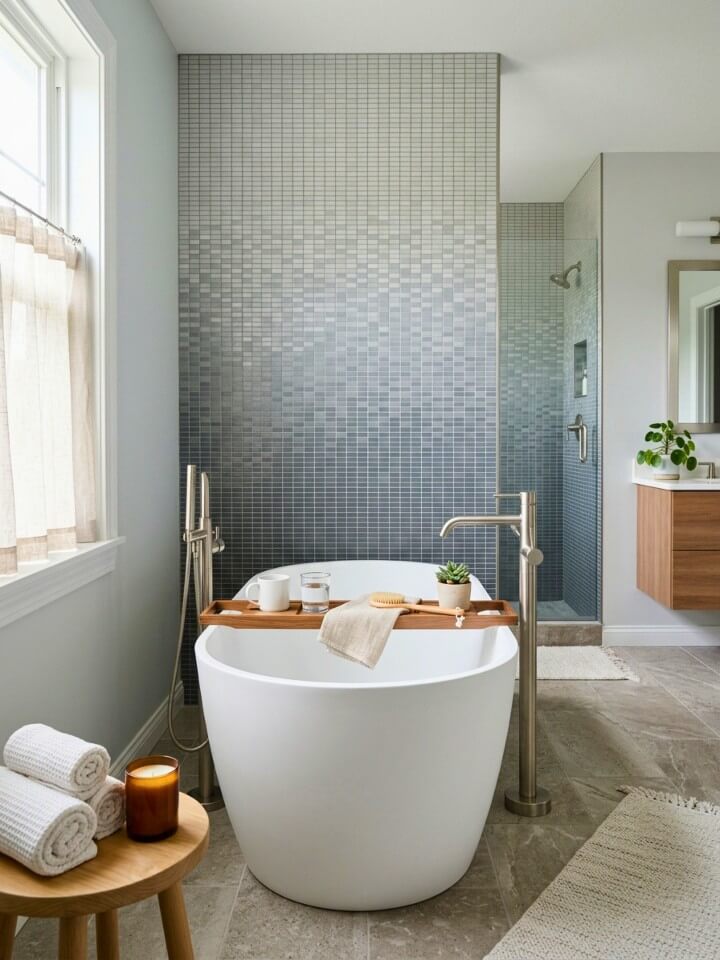
Unlike ombre, which transitions visibly from one shade to another, a tonal mosaic stays within a narrow band of one color — five or six closely related shades of stone gray, sand, or soft sage scattered randomly across a wall. The effect is movement without drama. From across the room it reads as a single color; up close, the subtle variation gives the wall a handmade, sun-faded quality that perfectly uniform tile lacks. This approach is forgiving with natural stone, where color inconsistency is inherent anyway, and works beautifully on full walls where a bolder pattern would feel oppressive. It’s the choice for homeowners who want texture without committing to a focal point.
19. Penny Round and Dot Mosaic Tiles
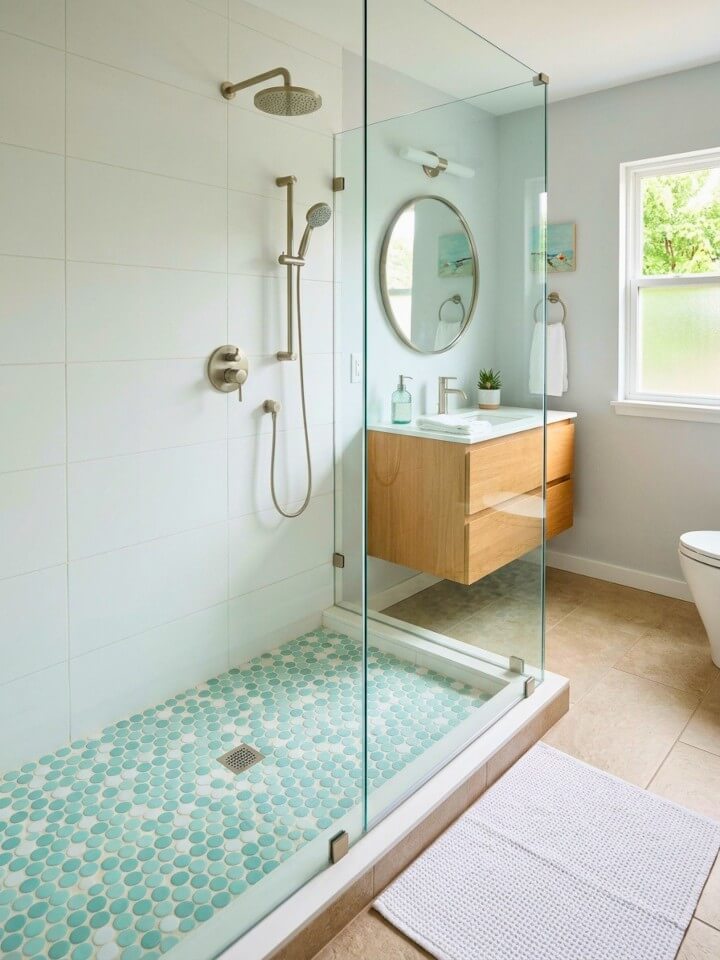
Penny rounds are the smallest of the round tiles — usually three-quarters of an inch — and they’ve quietly become a renovator favorite for shower floors. The small size means many grout lines, which means grip, which means safety. They also conform to sloped shower pans more easily than any squared tile.
Penny vs Hex
Both work. Penny rounds feel slightly more vintage and softer; hex feels more contemporary and graphic. Penny rounds in matte black with light gray grout look like a 1920s hotel; the same pattern in glossy white with dark grout looks like a current spec house. Same shape, very different rooms — your fixtures and wall color make the final call.
20. Mixed-Material Mosaic Tiles
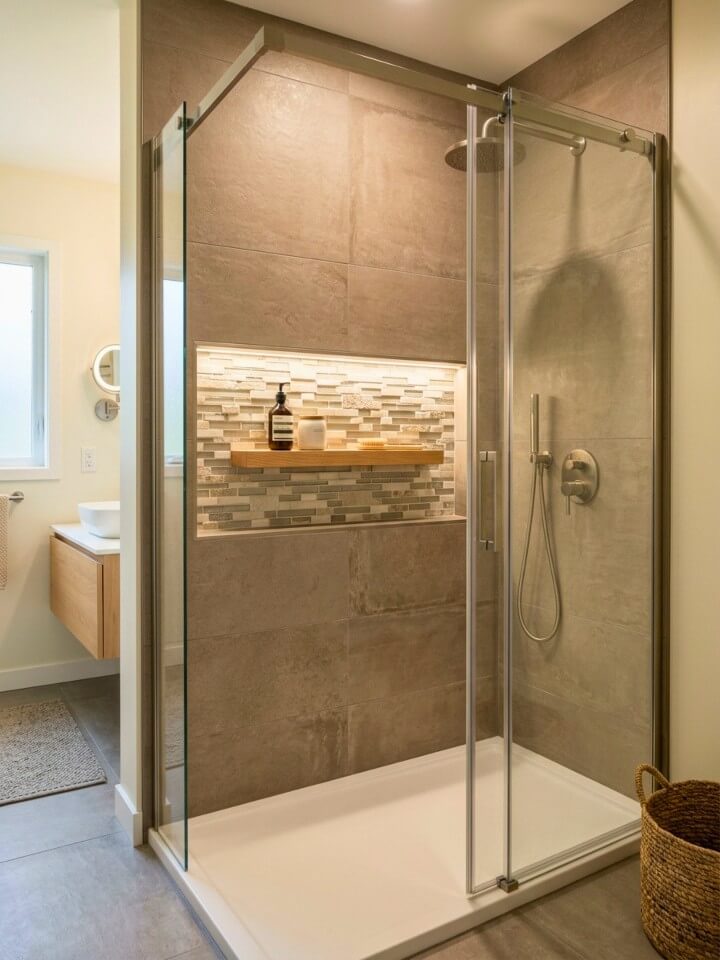
Design a bathroom with mosaic tiles using small-budget swaps that look custom and feel high-end. Combining glass, stone, and metal in a single mosaic sheet gives you texture, reflection, and weight in one installation — and it’s why mixed-material accent strips have become a backsplash staple. The variety adds depth that any single material struggles to match on its own. The risk is incoherence: pull together too many colors or finishes and the wall starts to look like a sample board.
Source from One Collection, Not Three
Buy a pre-designed mixed-material sheet from a single manufacturer rather than assembling your own. The designers have already balanced the proportions of glass, stone, and metal so nothing fights for attention. Use these only as accent bands or single niches — never wall-to-wall.
FAQs About Bathroom Mosaic Tile
Picking mosaic tile raises more questions than picking paint — and most of them only come up after the box arrives. Below are the five things homeowners ask most before they commit, with straight answers on installation, ordering, grout, and the choices that actually pay off when it’s time to sell.
Can I Install Bathroom Mosaic Tile Myself, or Do I Need a Pro?
Sheet-mounted mosaics on a flat wall are doable for a patient DIYer with a wet saw and a weekend. Shower floors, curved niches, and natural stone almost always need a pro — the waterproofing and cuts are unforgiving.
How Much Mosaic Tile Should I Order for My Bathroom?
Measure the square footage, then add 15% for cuts, breakage, and future repairs. Bump that to 20% for herringbone, chevron, or anything set on a diagonal. Order every box from the same dye lot to avoid color mismatches.
What’s the Best Grout for Bathroom Mosaic Tile?
Epoxy grout wins in showers and wet zones — it’s waterproof, stain-resistant, and skips the yearly resealing chore. Standard cement grout is fine for vanity backsplashes and dry areas, costs noticeably less, and is far easier to apply cleanly.
Can I Install Mosaic Tile Over Existing Bathroom Tile?
Yes, if the old tile is flat, fully bonded, and not in a wet zone. Rough up the glaze, prime it, and use a thinset rated for tile-over-tile. Inside showers, it’s safer to strip down to the substrate first.
Which Mosaic Tile Holds up Best for Resale Value?
Classic neutrals win at resale: white marble hex, black-and-white penny round, and mini white subway in herringbone. Bold primary colors, heavy metallic walls, and trendy iridescent finishes can noticeably shrink your buyer pool when listing day rolls around.
Conclusion:
The best bathroom you’ve ever stood in probably wasn’t expensive — it was considered. Someone picked a tile small enough to wrap a curve, a grout color that flattered it, and stopped before the room got loud. That’s the whole game with mosaic. You don’t need all twenty ideas above; you need the one that fits your light, your habits, and how you actually use the room at 6 a.m. Order a single sheet of your top pick, tape it to the wall for a week, and live with it. The right one will quietly stop asking for your attention.