18 Pool Fountain Ideas for Every Budget, Style, and Backyard Size
A pool looks finished. A pool with a fountain feels alive. That soft splash changes the whole mood of a backyard. It covers traffic noise. It hides the hum of the pump. And it gives you a reason to actually sit outside instead of just walking past the water.
You’ll find 18 stylish pool fountain ideas below, each chosen for a different style, budget, and yard size. Some are budget bubblers under $200. Others are sculptural pieces that anchor a full landscape design. A few sit somewhere in between.
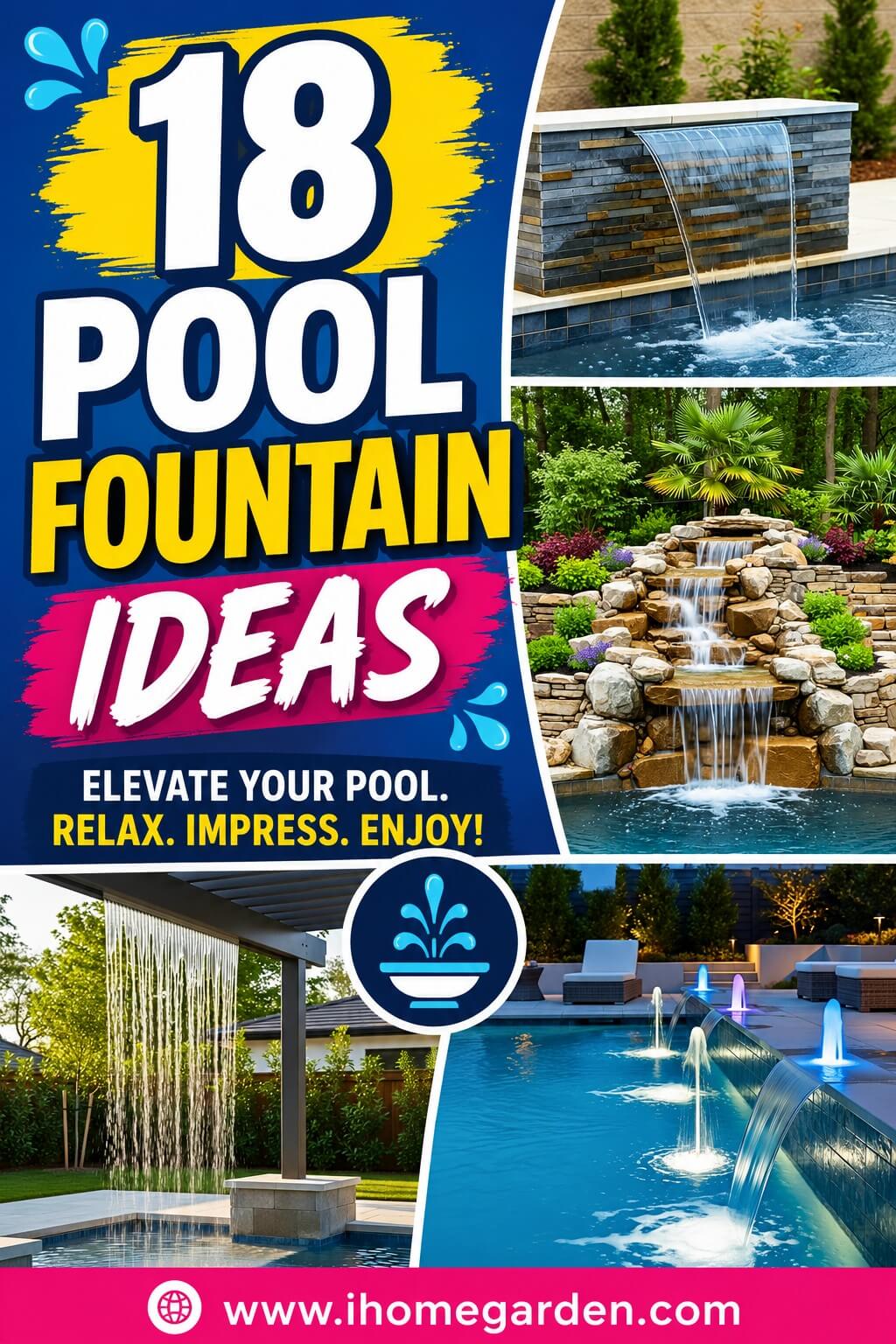
Each pool fountain idea covers the same practical ground. Where to place it. What materials hold up outdoors. Rough cost. And the maintenance nobody mentions in the showroom.
Pick one that fits your pool’s shape, your style, and how much upkeep you’ll actually do — not the version a catalog photo sells you. Let’s start with the classics and work toward the bold picks.
1. Classic Tiered Fountain
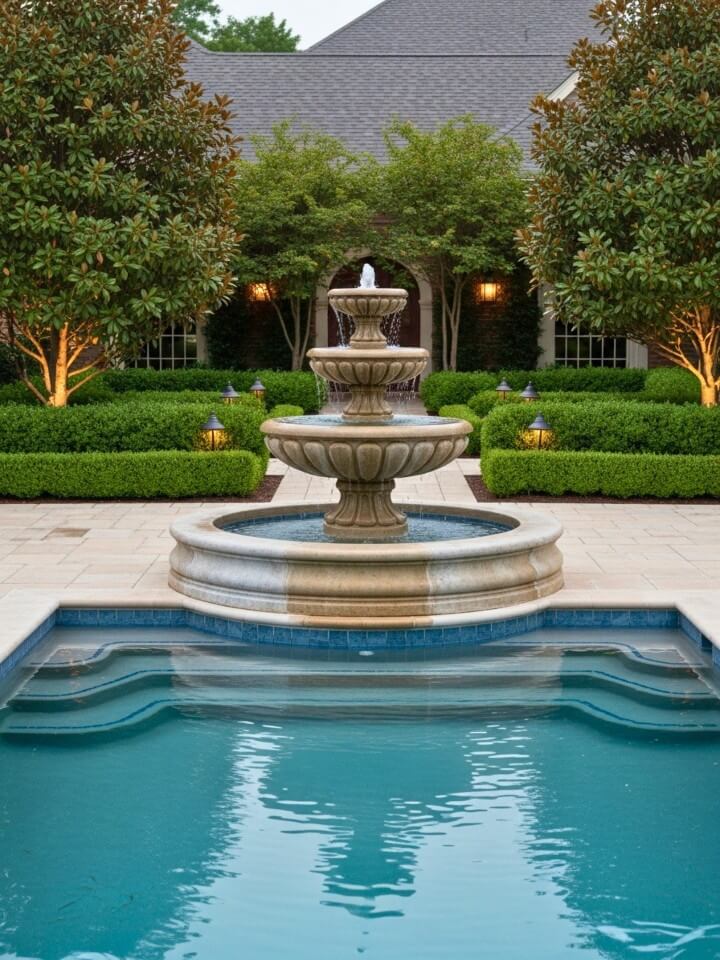
Tiered fountains earned their staying power honestly. The layered cascade produces a softer, more dimensional sound than any single-source water feature, and the vertical symmetry anchors a rectangular pool the way a chandelier anchors a dining room
The geometry mirrors the pool’s straight edges. Place it at a courtyard’s center or beside the shallow end, and sightlines from the house carry straight through to it.
What It Actually Costs to Own
Expect $400–$3,500 upfront, depending on tier count and material. Cast stone and fiberglass-resin outlast real limestone outdoors. The hidden cost is patience — algae colonizes the lower basin within two weeks during summer heat. A diluted vinegar scrub handles it.
2. Wall-Mounted Waterfall Fountain
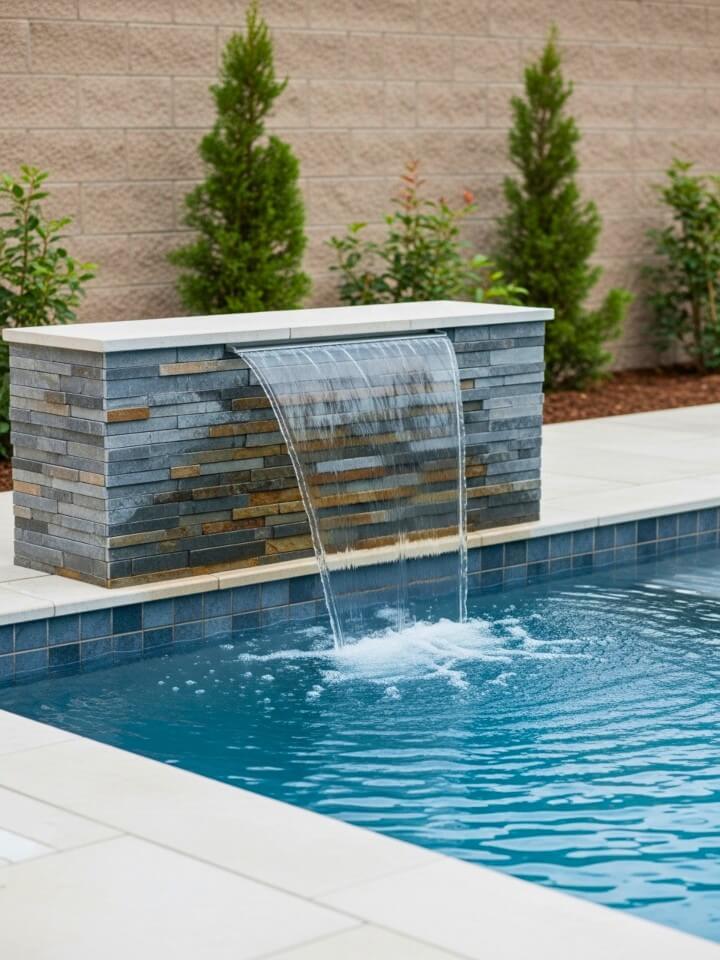
Small backyard, big ambition? Wall-mounted waterfalls were essentially designed for this problem.
Can You Mount One Anywhere?
Short answer: no. The wall needs real structural backing — a freestanding partition won’t survive years of constant water weight. An existing privacy wall, retaining wall, or the raised back edge of the pool itself works best.
The water sheets down directly into the swimming area, so you get the acoustic payoff without surrendering deck space to a basin. Glass mosaic finishes throw light around in interesting ways. Stacked ledger stone reads more grounded. Smooth stucco disappears, letting the water do all the talking. Budget $600 on the low end, closer to $2,800 for wider installations with premium tile.
3. Bubbling Jet Fountain
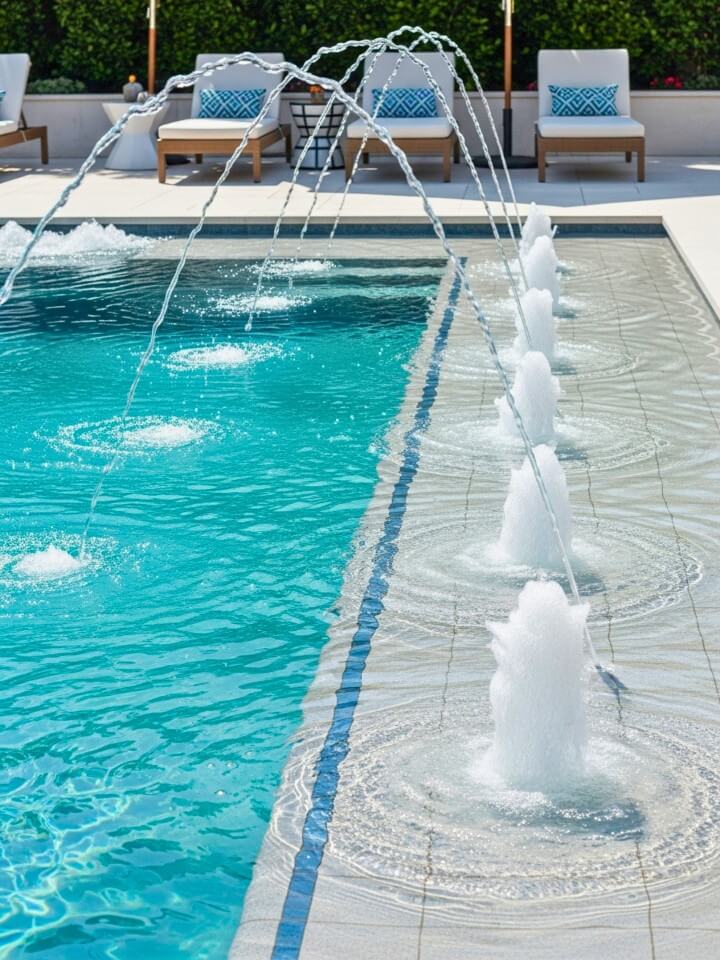
Transform your backyard oasis with stunning pool fountain ideas that blend elegance and relaxation. Picture this: a Sunday afternoon, kids splashing on the tanning ledge, two bubbler jets gurgling beside them, and you actually finishing a chapter of your book. That’s the bubbler promise — and it mostly delivers.
The Case for Adding Them
- Low installation cost relative to other water features ($150–$400 per jet)
- Safe enough for toddlers since water rises only a few inches
- Practically zero ongoing maintenance beyond a weekly nozzle check
The Case Against
- Retrofitting is expensive; tile removal often costs more than the jets themselves
- Two jets look unbalanced; three is the sweet spot; four crowds most ledges
- The effect is subtle — if you want drama, pick something else
Pair with pale plaster so the bubbling catches sunlight. And if toddlers or pets use the area often, treat the fountain as one piece of a bigger safety plan that may also include smart pool fence ideas.
4. Modern Minimalist Spout
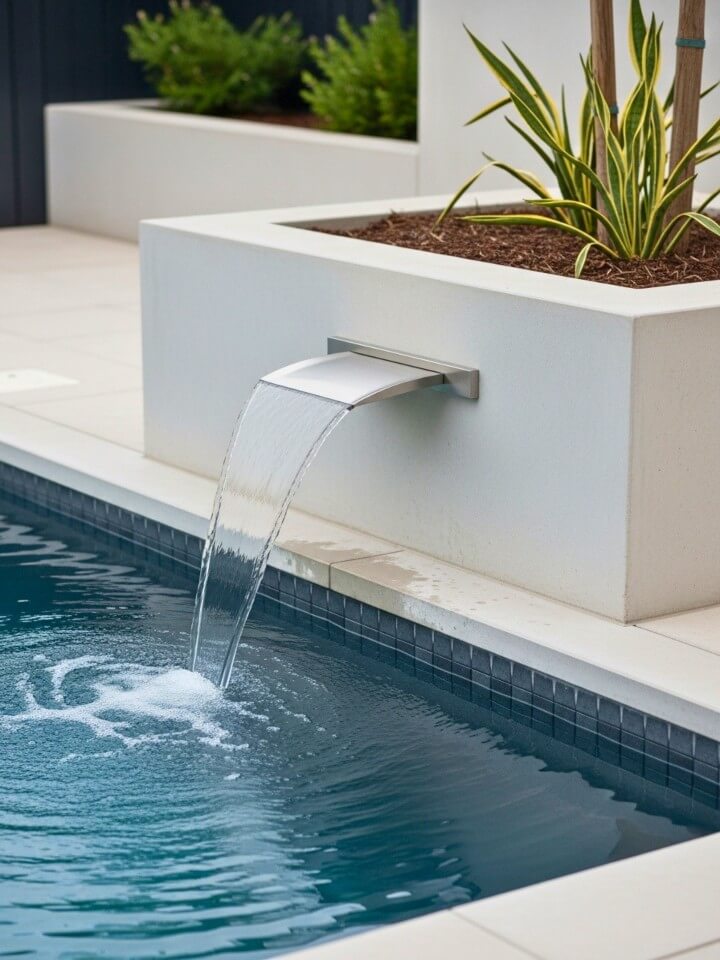
A single stream of water arcing into the pool from a wall, planter, or hidden niche — that’s the entire concept, and the restraint is exactly what makes it work.
Material Matters More than Design
Cheap spouts ruin the effect within a season. Here’s what survives outdoor chlorine exposure:
| Material | Chlorine-safe? | Visual feel |
|---|---|---|
| 316 stainless steel | Yes | Crisp, industrial |
| Matte black brass | Yes (powder-coated) | Bold against pale stone |
| Brushed brass | Yes | Warms cool patios |
| Painted steel | No | Avoid entirely |
Expect $180 for a no-frills scupper, $700+ for sculptural pieces from design studios. Hard water leaves white streaks on the spout face within months — keep CLR handy, or learn to love the patina.
5. Natural Rock Cascade
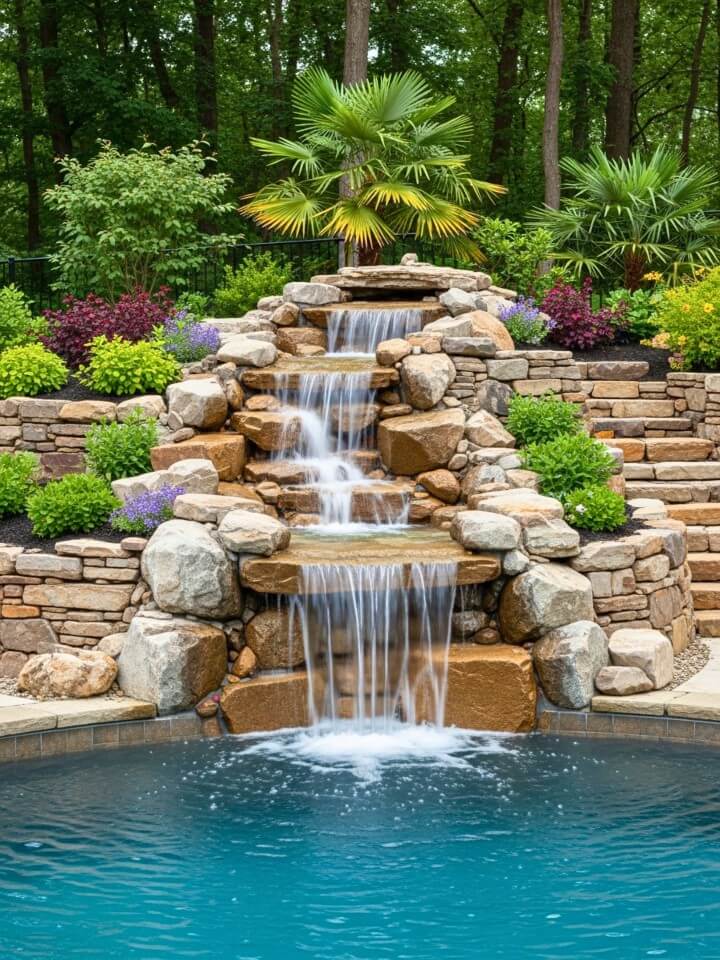
The natural rock cascade is the most ambitious idea on this list, and also the easiest to ruin. I’ve watched homeowners spend twelve thousand dollars on boulders and end up with something that looks like a miniature golf hazard.
The Mistake Almost Everyone Makes
Stacking the rocks in a visible pyramid. Real geological outcrops don’t work that way. Nature uses one or two dominant stones, with smaller ones wedged at deliberately awkward angles, and plants softening every transition where stone meets soil.
Use stone native to your region — imported rock never blends with native ground. Budget $3,000 for modest builds, closer to $15,000 if excavation gets involved. Size the pump to the cascade’s height; underspecced pumps produce trickles, not waterfalls.
6. LED Lighted Fountain
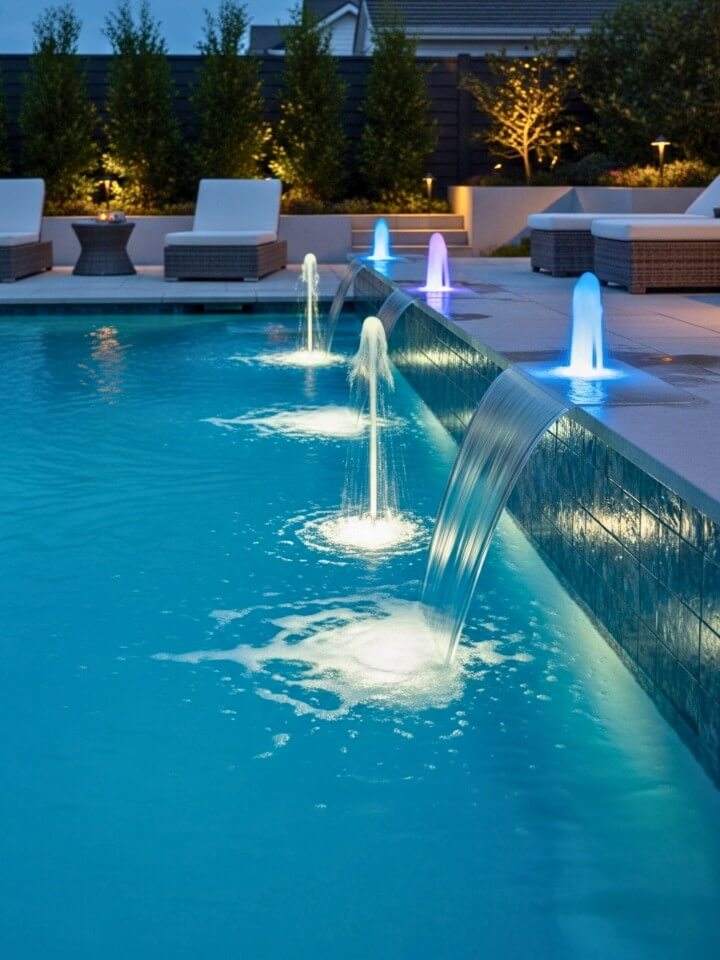
A swimming pool fountain adds soothing water sounds and a luxurious visual centerpiece to any yard. By day, this fountain just circulates water. After sundown, it earns its price tag — which is the whole reason to install one.
Backyards used regularly for evening swims, dinner parties, or weekend entertaining. The lighting genuinely transforms the space after dark.
When You’re Wasting Money
If the pool sits unused after 7 p.m., skip it. You’re paying a premium for a feature that performs in a window you don’t use.
A practical tip: avoid rapid color-cycling settings. They look like a roadside motel. A slow fade between two warm tones reads expensive. Stick with 12V low-voltage LED systems rated IP68 — anything less corrodes within a season. Budget $250 for plug-and-play units, $1,200+ for integrated builds. Electricity costs run about $15 yearly.
7. Floating Sphere Fountain
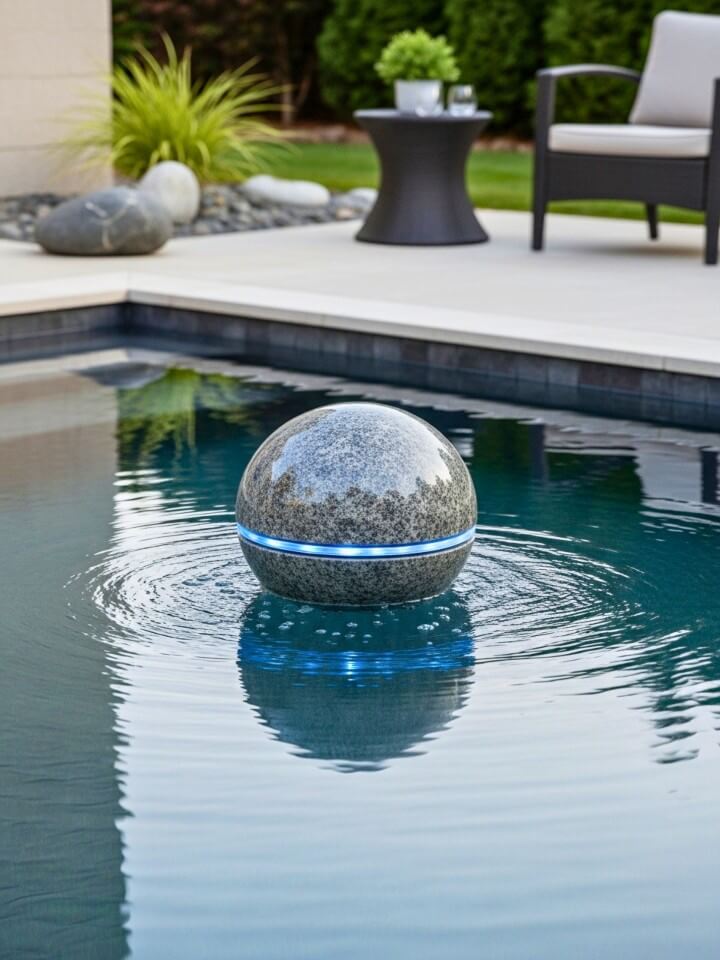
The easiest fountain to add to a finished pool — no plumbing, no construction, just drop it in and plug into a GFCI outlet. Three things worth knowing before you order one:
- Stone spheres look premium but punish small pools. They drift into walls constantly and chip the tile. Reserve them for pools wider than 16 feet.
- Resin and fiberglass versions cost less and behave better. Expect $120–$400. They won’t crack coping when they bump it, and the visual difference at a few feet is minimal.
- They’re not splash-proof. If kids are diving and cannonballing, the sphere ends up upside down weekly. These work in calm, adult-focused pools where the sphere functions as slow-moving sculpture.
8. Arc Water Jet Fountain
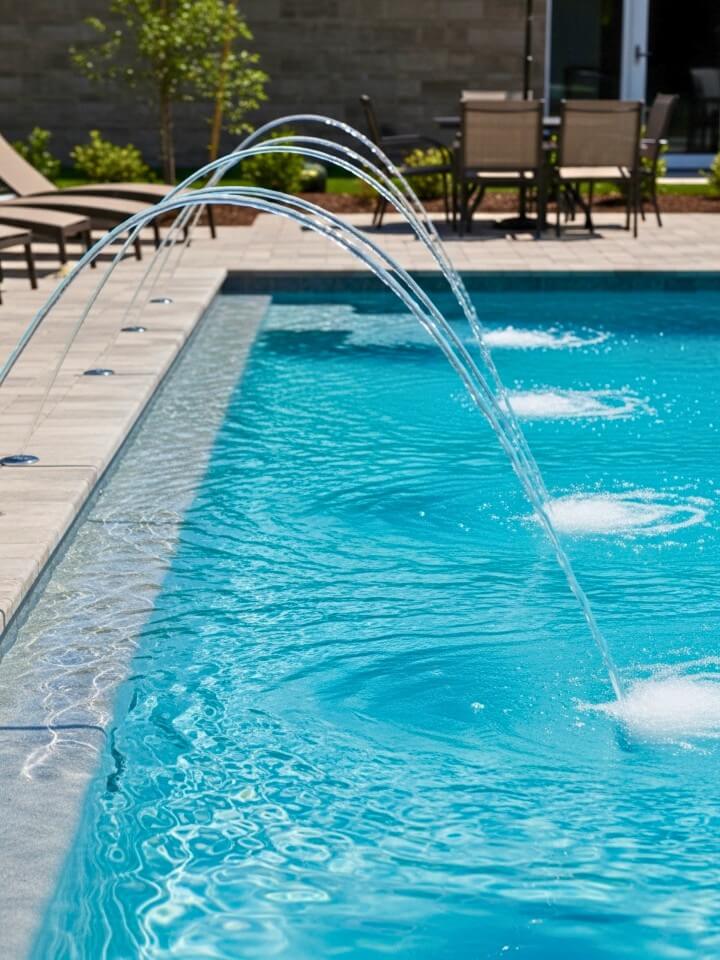
Arc jets — sometimes called deck jets or laminar jets — shoot clean ropes of water across the pool surface. There’s a lot of folklore around them, so let me clear some up.
Myth: All Deck Jets Look the Same
Wrong. Cheap jets produce wobbly streams that look like garden hoses. True laminar jets produce ropes so clean they appear solid — like glass tubing arcing through the air. The difference is the internal flow-conditioning chamber, and it’s worth the upcharge every time.
Myth: They’re Cheap to Run
Also wrong. Four laminar jets running six hours daily add $20–$30 to monthly utility bills. Budget $250–$900 per jet, plus a dedicated pump line during the plumbing rough-in.
9. Bamboo Spout Fountain
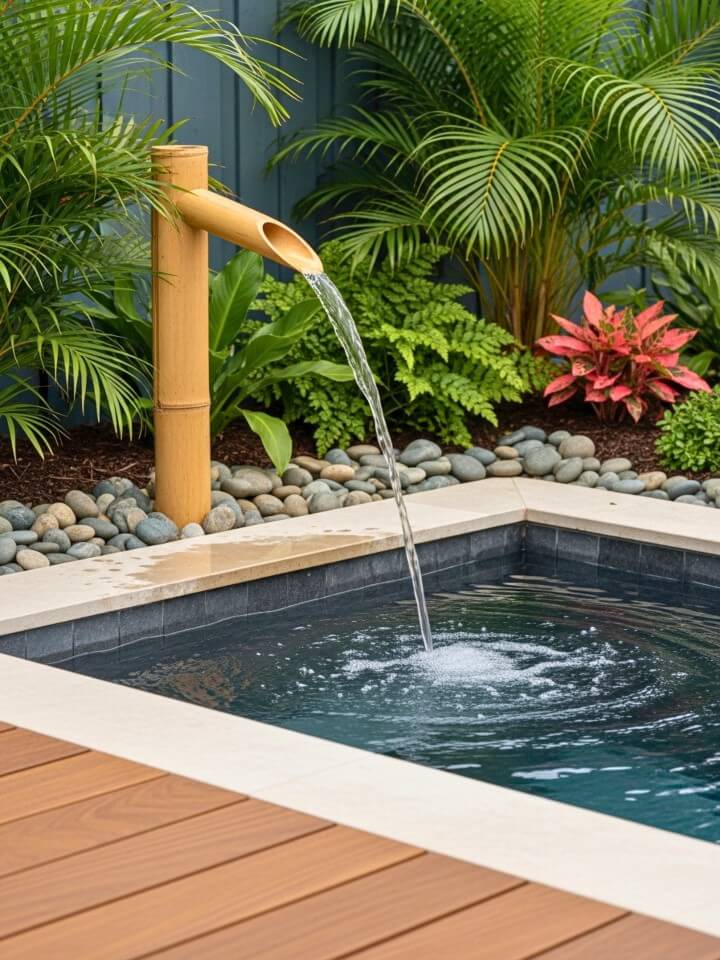
Borrowed from Japanese garden tradition, the bamboo spout has a rhythm to it — water collects in the upper chute, tips, releases, resets. There’s something almost meditative about watching it from a deck chair, and the sound carries softly across a small yard without ever feeling intrusive.
Real Bamboo or Fake?
Real bamboo splits and rots inside two years outdoors. Resin and copper versions cast to look like bamboo last a decade and read nearly identical from a few feet away. Go faux — no purist will judge you, and you’ll save the cost of replacing the spout twice.
Surround it with black river pebbles and mondo grass. Budget $90–$350. A $10 mesh pre-filter on the pump intake prevents leaf clogs.
10. Sculpture-Integrated Fountain
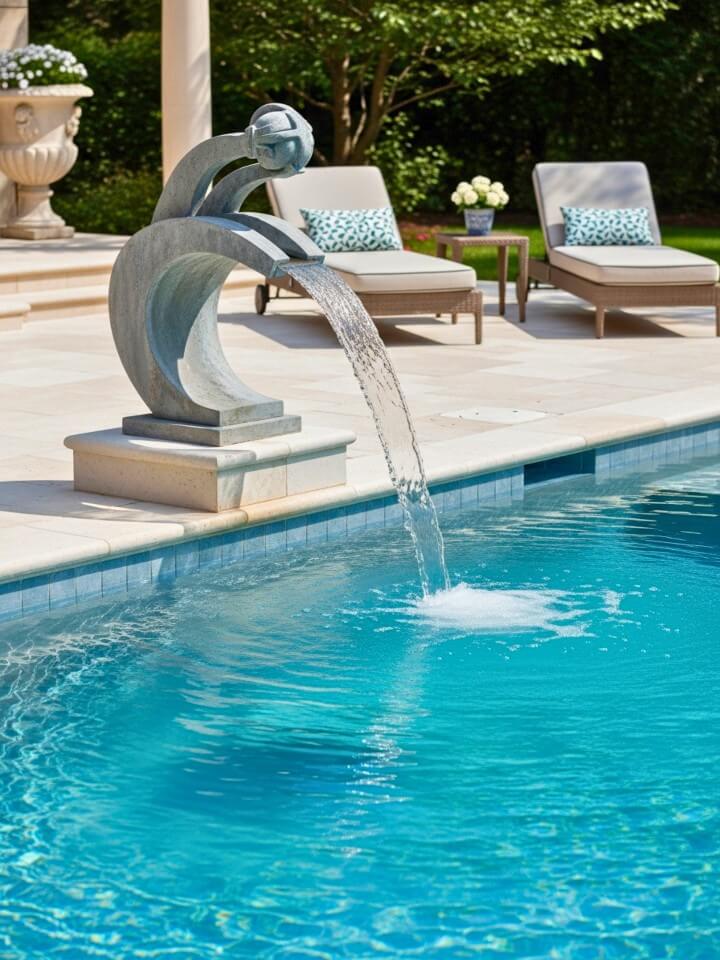
Here’s the honest take: sculptural fountains are the riskiest entry on this list. Done well, they become the thing guests remember about your home. Done badly, they look like a clearance pick from a garden center, and there is shockingly little middle ground.
Where Homeowners Get It Wrong
Two failures account for almost every disappointing install — wrong scale and wrong material. The sculpture should sit at roughly one-third the height of the nearest wall or structure. Anything smaller looks underfunded; anything larger feels aggressive.
For material, only bronze, marine-grade stainless, or fiber-reinforced concrete survive long-term outdoor exposure. Resin and painted finishes fade and peel within three summers. Expect $1,500 for production pieces, $8,000–$40,000 for commissioned work. If the budget isn’t there, skip the category — half-measures fail visibly.
11. Wall-Niche Fountain
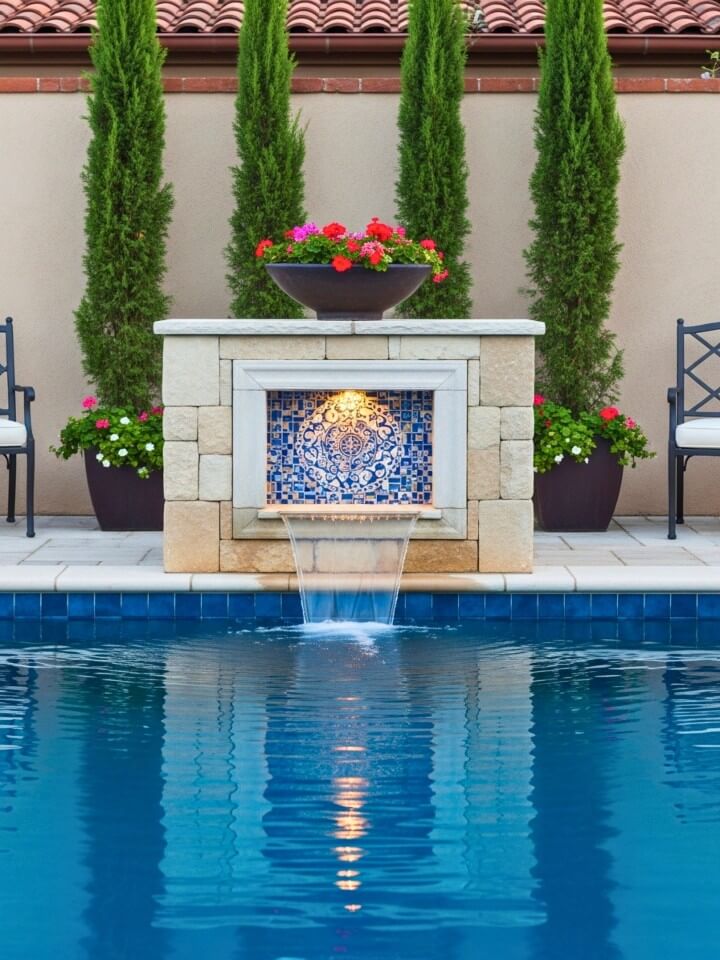
A wall-niche fountain hides inside an architectural cutout rather than projecting out into the space — the water emerges from a recessed alcove and falls into a basin below or directly into the pool. The result feels built-in, intentional, almost European.
What Makes a Niche Feel Custom (not Contractor-Grade)
The interior finish does most of the work. A handmade Zellige tile in deep teal or cobalt catches light unpredictably and gives the niche depth. Generic ceramic looks cheap immediately. Frame the opening with stone trim — limestone or travertine — and tuck a warm-white LED strip behind the upper lip so the water glows from above at night.
Budget $1,500–$6,000 if built during pool construction, considerably more as a retrofit since you’re cutting into existing walls.
12. Spinning Wheel Fountain
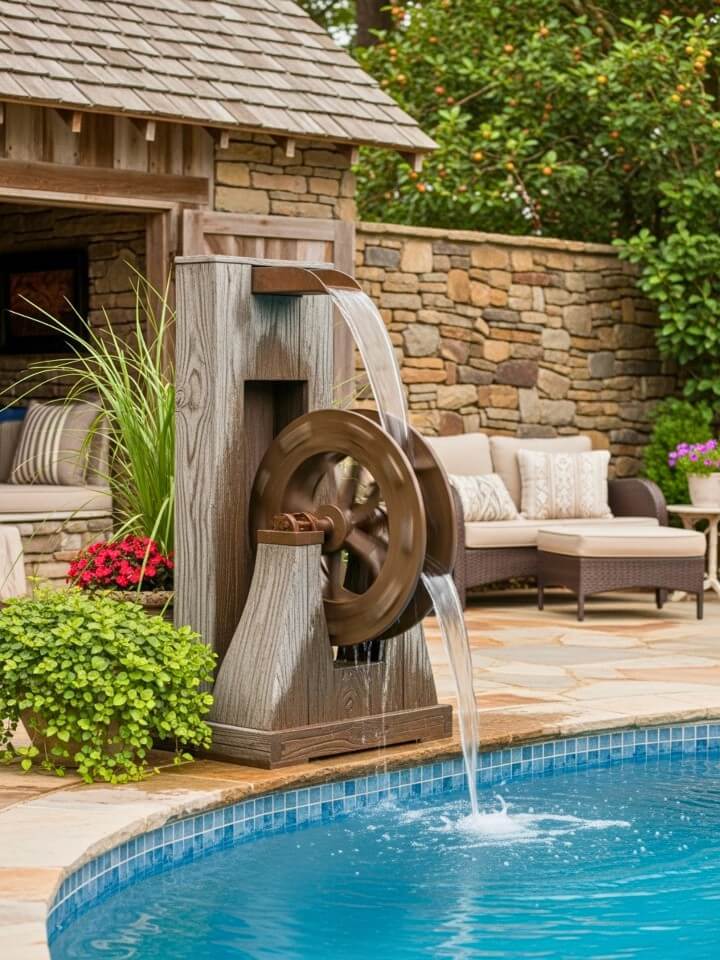
The spinning wheel fountain is the most polarizing pick on this list. Either it perfectly suits your yard or it looks completely out of place — there’s no neutral reaction.
Who It’s For
Homeowners with farmhouse, cottage, or rustic backyards already leaning into a handmade aesthetic. Aged wood siding on the pool house, climbing roses on an arbor, a gravel path instead of paver edging. In that context, a slowly turning water wheel becomes a charming focal point that fits the story the rest of the yard is telling.
Who Should Skip It
Anyone with a modern, minimalist, or contemporary pool. The wheel will read as costume jewelry on the wrong outfit. Budget $400–$1,800. Wood-look composite outlasts real wood three to one outdoors.
13. Stainless Steel Ribbon Fountain
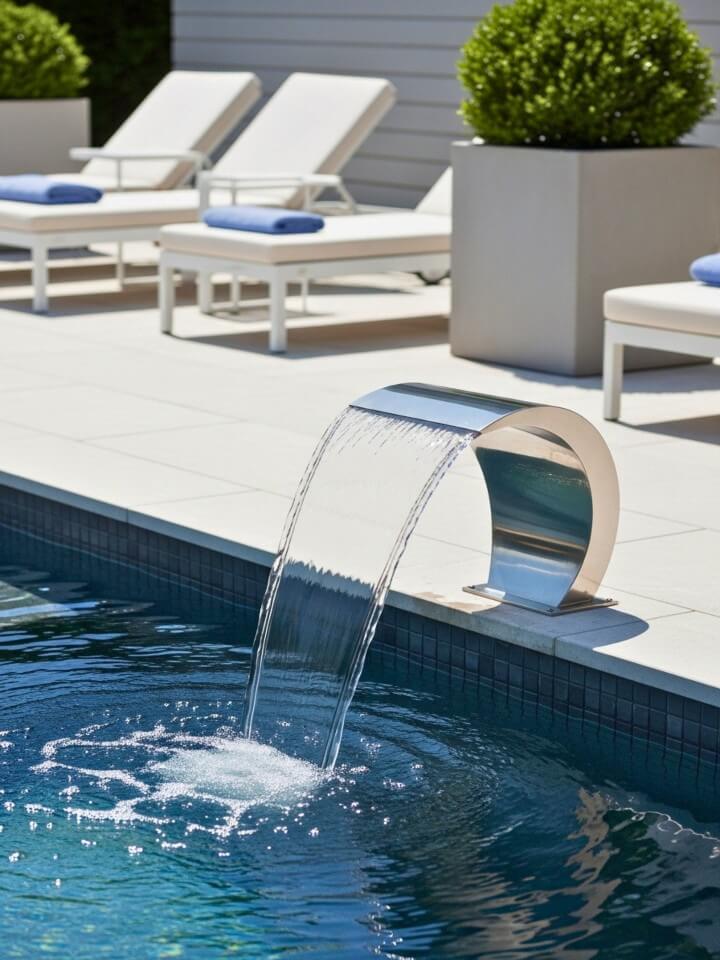
The ribbon fountain releases water through a thin horizontal slot, producing a flat, glass-smooth sheet that falls into the pool. The effect depends entirely on installation precision — a quarter-inch off level and the sheet breaks into uneven strands halfway down.
What Your Contractor Needs to Get Right
Three things make or break this feature:
The slot itself must be machined, not stamped — machined slots produce that signature unbroken sheet. The mounting surface has to be laser-leveled across its full width before the unit goes in. And the supply line needs adequate pressure; underspecced pumps produce gaps in the water sheet that no amount of adjustment fixes.
Budget $800–$3,500 for the fountain itself, plus skilled installation labor. Pair with dark waterline tile so the sheet stands out by contrast against the pool surface.
14. Tiered Rock Waterfall
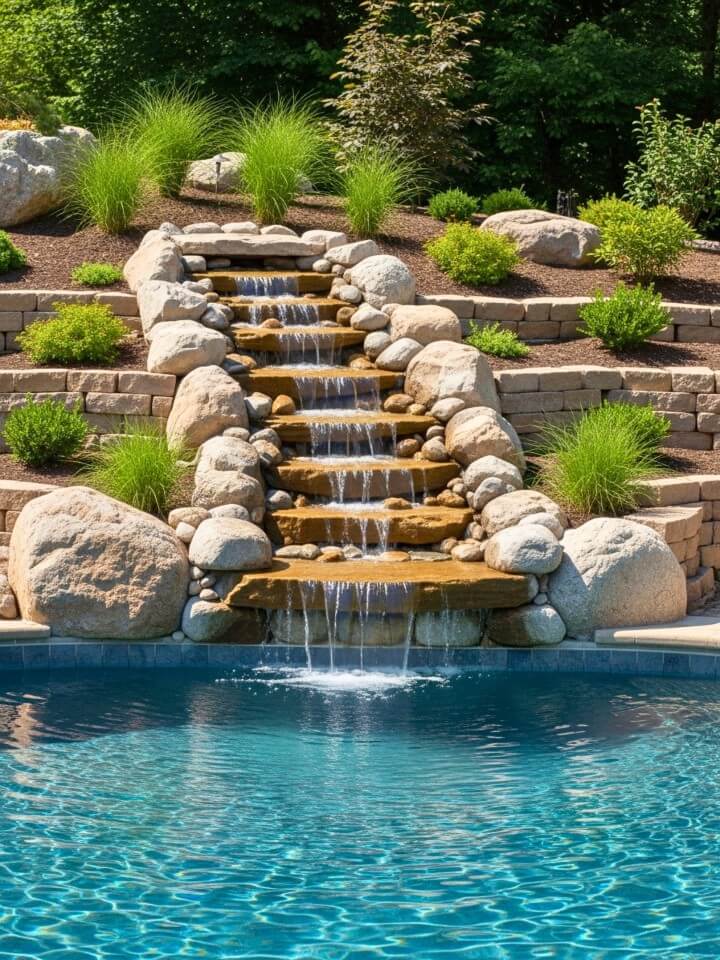
Explore creative pool water fountain ideas that turn ordinary pools into breathtaking resort vibes. Unlike a single rock cascade, a tiered waterfall steps water down in distinct ledges — each pool catching, holding briefly, then releasing to the next. The sound is layered, the visual is dramatic, and the build sequence matters more than most homeowners realize.
How a Good Tiered Waterfall Actually Comes Together
Phase one is the structural shell — typically rebar and shotcrete, formed into the rough stair-step shape. Phase two is the waterproof liner, which non-negotiably must run continuously beneath every tier. Phase three is the stone facing, applied so each ledge slightly overhangs the one below, hiding the seams. Phase four is the planting — grasses and creepers softening the edges so it reads natural.
Budget $5,000–$25,000. Skip any contractor who proposes shortcuts on the liner phase.
15. Glass Tube Fountain
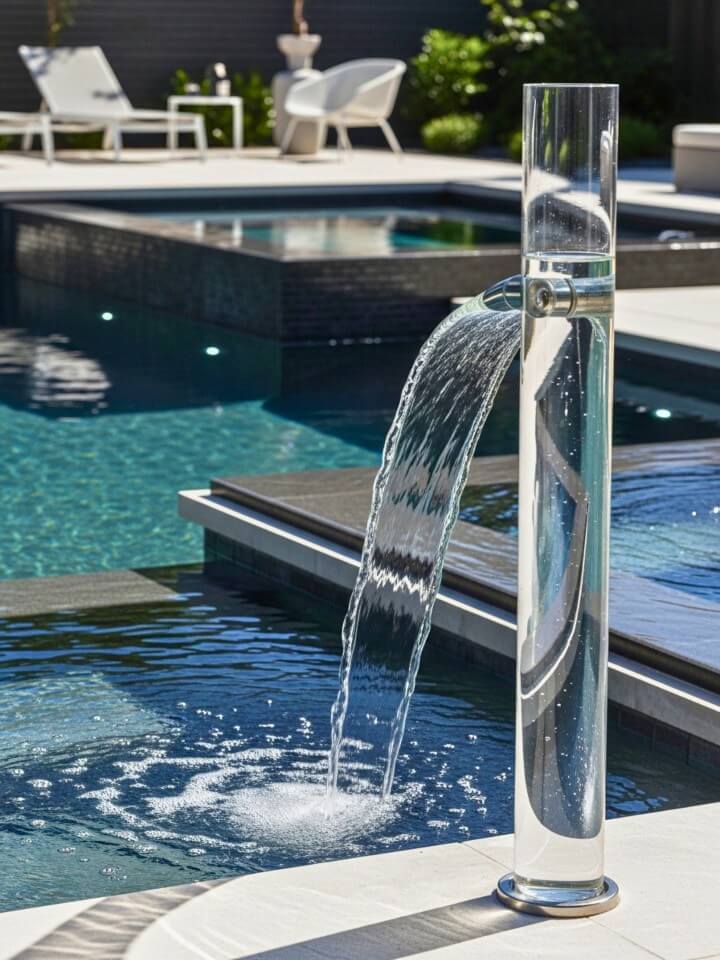
A glass tube fountain pulls water up through a clear vertical cylinder, then releases it back into the pool — the column appears to float in midair when sunlight hits it right. It’s one of the few water features that looks better in person than in photos.
Glass Tube vs. Other Modern Options
Compared to a ribbon fountain, the tube takes up less linear space and works better in tight corners. Compared to a sheer descent, it adds vertical interest where a sheet only adds horizontal. Compared to deck jets, it’s quieter — the sound is more of a soft burble than a splash.
The catch: tempered borosilicate glass is the only kind that survives outdoor temperature swings. Cheaper tubes crack in their first winter. Budget $600–$2,400.
16. Rain Curtain Fountain
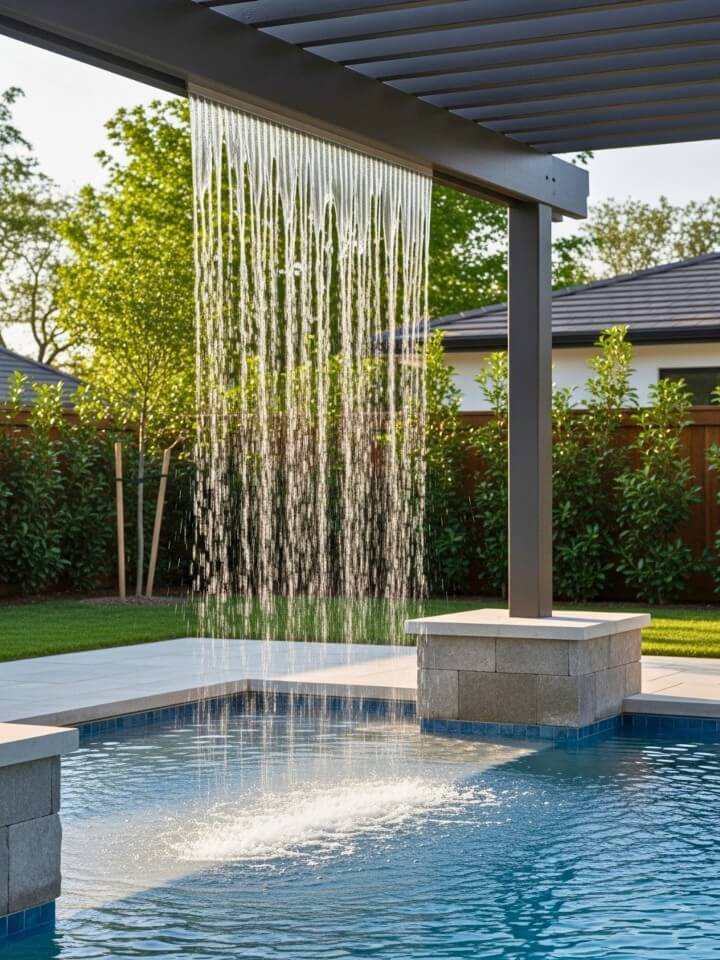
A rain curtain releases water through a long perforated bar mounted overhead, producing dozens of parallel streams that drop straight into the pool below. The sound sits somewhere between actual rainfall and a quiet shower — softer than any other water feature on this list.
The Wind Problem Nobody Mentions in Catalogs
Rain curtains hate breeze. Even a gentle five-mile-per-hour gust pushes the streams sideways onto your deck, your lounger cushions, your appetizer tray. Before you commit, spend a few evenings on the proposed install spot and pay attention to how the air actually moves through it.
If wind is a recurring issue, mount the curtain under a pergola roof or solid overhang rather than a freestanding beam. Budget $700–$3,500 depending on bar length.
17. Fire and Water Bowl Fountain
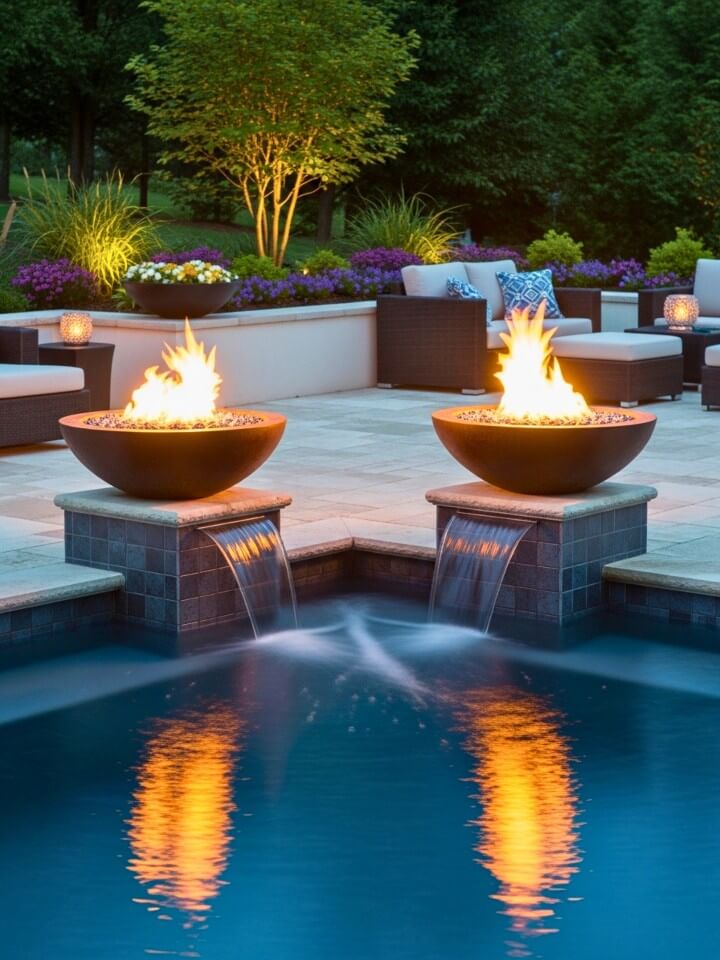
Fire-and-water bowls solve a problem that quietly nags at a lot of pool owners: the yard looks beautiful at sunset but feels emotionally flat after dark. Adding light alone doesn’t quite fix it. Movement helps. Warmth helps more. Combining both in one feature does something neither achieves alone.
Why the Combination Works
Flame draws the eye and registers as gathering, comfort, primal warmth. Falling water registers as calm, motion, life. Side by side in the same vessel, the contrast makes both elements feel more present than they would standing apart.
Practically: install bowls in matched pairs flanking the pool’s entry, on raised columns or back-wall pedestals. Use natural gas if available — propane runs out at the wrong moment. Budget $900–$4,500 per bowl.
18. Sheer Descent Pool Fountain
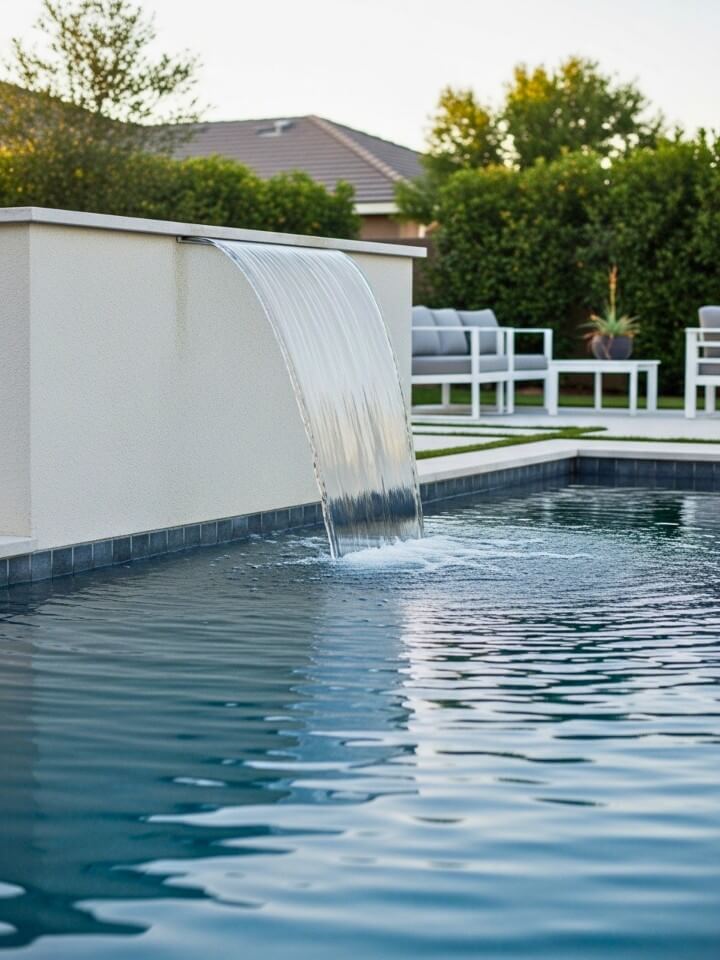
A sheer descent releases a thin, uniform sheet of water from a narrow slot, dropping it flat-faced into the pool. Cleaner than a waterfall, simpler than a ribbon fountain, and one of the most-installed pool features for a reason — it’s nearly impossible to make it look bad.
Is This the Right Pick for Your Pool?
Run through these questions honestly. The pool has a raised wall, spa spillover edge, or back ledge at least 12 inches tall? Yes is required. The surrounding architecture is modern, contemporary, or resort-leaning? Yes makes it shine. You want low maintenance and no moving parts beyond the pump? Yes again.
Three yeses and you’re looking at the safest water-feature decision available. Budget $400–$2,000 per unit. Width determines presence — narrower than 18 inches reads timid.
Frequently Asked Questions About Pool Fountains
Quick answers to the practical questions most homeowners ask after picking a style but before calling a contractor or installer.
How Much Does It Cost to Run a Pool Fountain Each Month?
Most pool fountains add $5 to $30 to monthly electric bills, depending on pump size and daily run time. Larger waterfalls and multiple deck jets sit at the higher end of that range.
Can I Add a Fountain to An Existing Pool without Major Construction?
Yes, for some styles. Floating spheres, bubblers on existing ledges, and certain wall-mounted spouts retrofit easily. Sheer descents, rock cascades, and built-in niches usually require cutting into existing tile or coping.
Do Pool Fountains Help Keep the Water Cleaner?
Indirectly, yes. The movement and aeration discourage algae growth and improve chemical distribution. They don’t replace your filter or skimmer, but they reduce the workload on both during heavy summer use.
How Do I Winterize a Pool Fountain in Cold Climates?
Drain the fountain’s plumbing lines completely, disconnect the pump, and store any removable parts indoors. Trapped water freezes, expands, and cracks pumps or basins. A breathable cover protects the fixture from snow weight.
What Size Pump Do I Actually Need for My Fountain?
Match pump flow rate to the fountain’s specification, not your pool’s overall pump. A 600 GPH pump suits small bubblers; tall cascades and ribbon fountains often need 2,000+ GPH. Undersized pumps produce weak, disappointing flow.
Conclusion:
A pool fountain isn’t really about water. It’s about what the water does to the space around it. The right one slows the yard down. It softens hard edges. It turns a swimming pool into somewhere you actually want to linger after the swim is over.
Don’t pick the fanciest option. Pick the one that matches how you actually live — quiet mornings, kids splashing, evening guests, or all three.
Years from now, you won’t remember what the fountain cost. You’ll remember the sound it made on a slow Sunday afternoon, with nowhere else to be.